MBA Age Limit: Is There Any Maximum Age to Pursue an MBA in India?
By Sriram
Updated on Jun 16, 2026 | 5 min read | 4.84K+ views
Share:

All courses
Certifications
More
By Sriram
Updated on Jun 16, 2026 | 5 min read | 4.84K+ views
Share:
Most MBA programs in India and abroad do not have an upper age restriction. Business schools evaluate candidates based on academic qualifications, entrance exam scores, work experience, and overall profile. Whether you are a fresher or an experienced professional, your eligibility depends more on merit and career goals than age.
This blog explains the age requirements for MBA programs in India, eligibility rules at top institutes, IIM criteria, career implications, and common misconceptions. By the end, you'll know whether age can affect your MBA journey and how to choose the right program.
Explore upGrad's MBA programs to build skills in product management, business strategy, customer-centric design, leadership, and data-driven decision-making for today's business environment.
Popular MBA Programs
Many candidates assume that MBA admissions have strict age restrictions similar to some government examinations. In reality, MBA programs operate differently. Most institutions focus on academic qualifications, entrance exam scores, and professional experience rather than age.
The good news is that there is generally no fixed MBA age limit in India for most universities and business schools. Whether you are 21 or 45, you can apply if you meet the eligibility criteria.
The table below summarizes common MBA eligibility factors in India.
| Criteria | Typical Requirement |
| Educational Qualification | Bachelor's degree from a recognized university |
| Minimum Marks | Usually 50% (45% for reserved categories in some institutes) |
| Entrance Exam | CAT, XAT, MAT, CMAT, GMAT, etc. |
| Work Experience | Optional for most MBA programs |
| Age Requirement | Usually no upper age limit |
Most of the Indian universities including the private ones allow candidates of different age groups. A new graduate might go for an MBA straight out of college, whereas seasoned professionals tend to go back to school to speed up career progression.
Age limit for MBA in India comes into play only in certain cases. For example:
A 35-year-old software engineer transitioning into management and a 22-year-old graduate joining business school might sit in the same classroom. Diverse experiences and perspectives are often an advantage in MBA programs.
Age rarely predicts admission outcomes. The things that matter much more are scores on entrances, academic performance, communication skills and leadership potential.
Must read : How Can I Do MBA? A Complete Guide
Free Courses
Thousands of applicants apply for Indian Institutes of Management every year. Hence, many of the candidates look for IIM age limit for MBA admission before taking CAT.
The answer is simple: There is generally no upper IIM age limit for MBA. Candidates of any age can apply if they meet the academic and entrance exam requirements.
The table below explains the typical admission criteria at IIMs.
| Admission Factor | Requirement |
| Entrance Exam | CAT score |
| Bachelor's Degree | Minimum qualifying marks |
| Work Experience | Optional but valued |
| Age Restriction | No upper age limit |
| Interview Process | Personal Interview and WAT |
Older applicants often possess:
However, younger applicants may benefit from:
The IIMs adopt a holistic approach to assess the candidates. A candidate with 10 years of experience is not automatically better than a fresher. By the same token, younger candidates do not have inherent advantages.
For example, a 32-year-old marketing professional applying to an IIM can demonstrate leadership accomplishments and impact on business. A fresher may have academic excellence and extracurricular achievements.
So, while discussing about IIM age limit for MBA, it is better to say that there is no formal age bar, but the applicant should have a compelling profile suited to their career aspirations.
Also read : Top 8 Reasons You Should Do Online MBA In 2026
MBA Courses to upskill
Explore MBA Courses for Career Progression
O.P.Jindal Global University
MBA (with Career Acceleration Program by upGrad)Become interview ready with Career Services
PSB MBA + IIML Certification
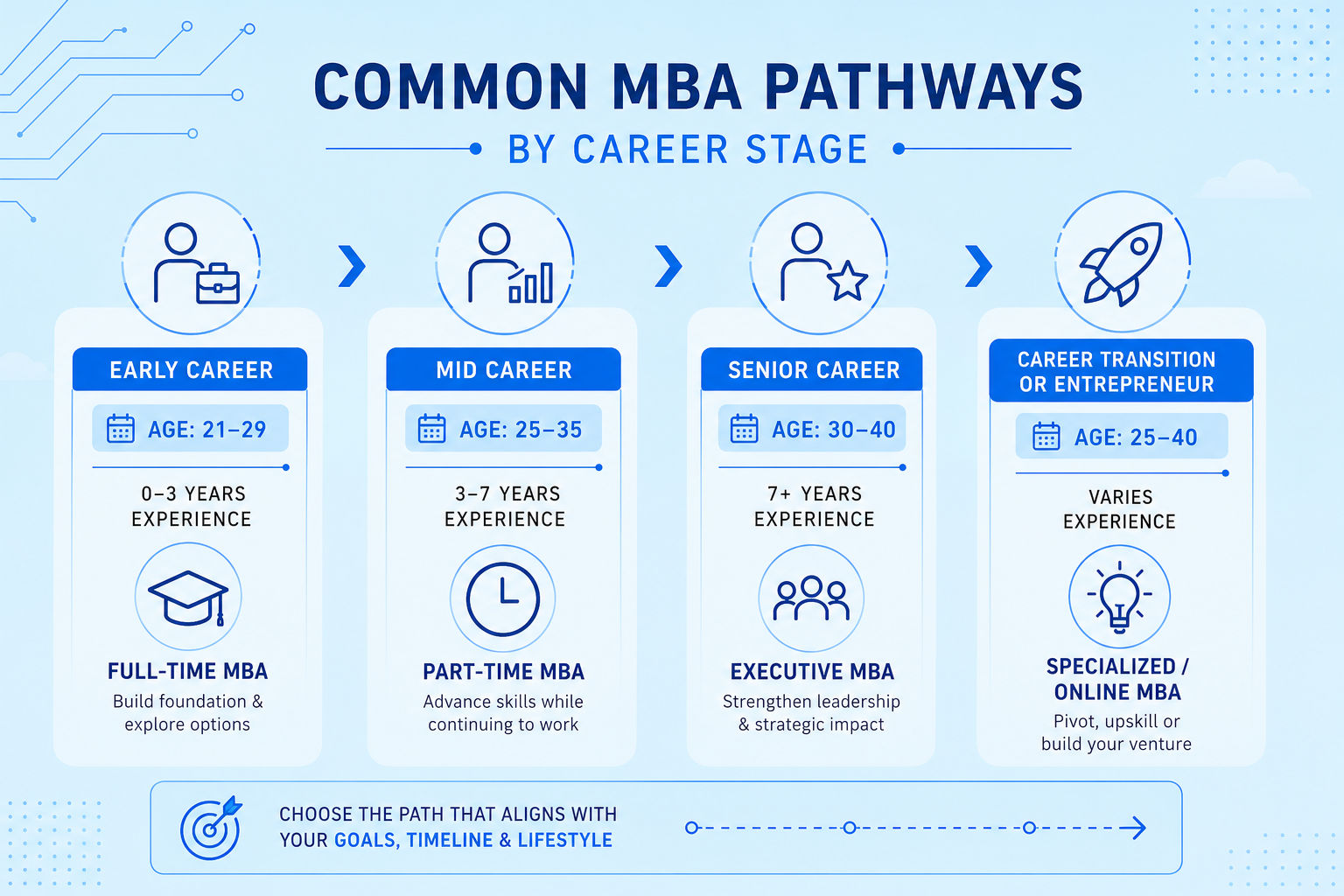
MBA from Paris School of Business with Certification from IIM LucknowAlthough there may not be an official MBA age limit, many candidates still ask when the ideal time is to pursue the degree. The answer depends heavily on career stage, industry, and long-term objectives.
Different MBA formats serve different age groups. The right choice often depends on experience and professional goals rather than age alone.
The picture below highlights common MBA pathways by career stage.
Pursuing an MBA early offers several benefits:
However, fresh graduates may have limited real-world business experience.
Professionals often opt for an MBA after some experience because they can more easily relate concepts taught in the classroom to the problems they face in the workplace.
For example, a product manager taking operations or finance classes can immediately apply those concepts to their organization. This practical understanding often enhances learning outcomes.
Business education appreciates experience as much as academic performance, so the age limit for the MBA in India is flexible. In thousands of classrooms, experienced practitioners enrich conversations with real-world examples that textbooks cannot provide.
Ultimately, the best age for an MBA is whatever age fits your career goals.
Also read : MBA Eligibility Criteria in 2026: Qualifications, and Admission Requirements
Many professionals hesitate to apply because they believe they are “too old” for management education. In fact, this perception is often incorrect.
There is no specific age limit for MBAs that would limit people in their 30s or 40s from getting admitted to business schools. Actually, experienced professionals are increasingly obtaining MBAs to stay competitive in evolving industries.
Below are some of the common drivers for older candidates to get an MBA:
Speed of change is a consequence of technology and AI. Professionals often reskill to remain relevant. An MBA can help you pivot to product management, consulting, strategy, or entrepreneurship.
But there are some practical issues candidates should be aware of:
An Executive MBA can be a big career booster for a 38-year-old engineer moving into management. An entrepreneurship-oriented professional could tap into the MBA network for mentors and investors.
The MBA age limit myth stops good candidates from applying. Business schools are increasingly seeking age and experience diversity, as it leads to richer classroom discussions and stronger peer learning.
If your career goals warrant the investment, age should rarely be the deciding factor.
Also Read: Why Do An MBA – 6 Top Reasons For Doing
Applicants often fixate on age and ignore the things that really matter in admissions. Most business schools assess candidates on multiple dimensions.
Usually the following things weigh more than age:
Admissions committees often look for candidates who can contribute meaningfully to the classroom and stand to benefit from management education.
Consider two applicants:
In many cases, Candidate B may present a stronger profile despite being older.
The table below shows the relative importance of admission factors.
| Admission Factor | Importance |
| Entrance Exam Score | High |
| Academic Record | High |
| Work Experience | Moderate to High |
| Leadership Potential | High |
| Age | Low |
Hence the age limit for MBA in India is quite flexible as the admissions are based on merit, ability and future potential and not on the basis of age.
Whether you’re starting your career or looking for a change, business schools are primarily looking to determine if an MBA fits your goals.
There is generally no fixed MBA age limit in India. Most business schools, including IIMs, focus on academic qualifications, entrance scores, and professional experience rather than age.
Understanding the age limit for MBA in India and the IIM age limit for MBA can help candidates make informed decisions. Ultimately, the best time to pursue an MBA is when it aligns with your career goals and long-term aspirations.
Ready to start your journey? Book a free consultation with upGrad today to find the best path for your career.
Yes, many business schools accept candidates with career gaps if they can explain them clearly. A break taken for family responsibilities, entrepreneurship, or skill development does not automatically reduce your chances. Admissions teams often look at how you used that time and whether your MBA goals align with your future plans.
No, most regular MBA programs in India do not require work experience. Fresh graduates can apply directly after completing their bachelor's degree. However, having professional experience may strengthen your application and classroom participation, especially in competitive institutions and executive programs.
Placements depend more on your skills, industry background, and role expectations than age. Experienced professionals often target leadership positions, while fresh graduates may begin with entry-level management roles. Employers usually focus on value creation rather than age alone.
Professionals with significant work experience often benefit more from Executive MBA or part-time MBA programs. These formats allow you to continue working while upgrading management skills. The right program depends on your career goals, industry, and flexibility requirements.
Yes, many government employees pursue online, distance, or executive MBA programs without leaving their jobs. Before enrolling, check your department's policies regarding higher education, study leave, and degree recognition to avoid future complications.
An educational gap usually does not impact eligibility if you meet the academic requirements. What matters is how you explain the gap during interviews. Candidates who demonstrate learning, work experience, or personal growth during that period often strengthen their profile.
Online MBA programs offer flexibility for professionals who cannot attend full-time classes. They help learners balance work and education. However, before applying, verify accreditation, curriculum quality, faculty expertise, and placement support offered by the institution
There is no universal ideal age because career goals differ for everyone. Some candidates pursue an MBA immediately after graduation, while others enroll after gaining experience. The best time is when the degree supports your professional growth and long-term plans.
Most online and distance MBA programs also do not impose a strict MBA age limit. Institutions generally focus on educational qualifications and eligibility criteria. If you are concerned about the MBA age limit, check the specific admission guidelines of your chosen university.
Yes, international students can apply to many Indian MBA programs without age restrictions. However, eligibility rules may vary across institutions. Applicants should review visa requirements, entrance exams, and academic criteria before starting the admission process.
In most cases, there is no maximum MBA age limit for candidates switching careers. Business schools increasingly welcome professionals from diverse industries. The MBA age limit rarely becomes a barrier if you can clearly explain your career transition goals and future plans.
715 articles published
Sriram K is a Senior SEO Executive with a B.Tech in Information Technology from Dr. M.G.R. Educational and Research Institute, Chennai. With over a decade of experience in digital marketing, he specia...
Speak with MBA expert
By submitting, I accept the T&C and
Privacy Policy
From MBA to Dream Job - Explore Our Alumni Success Stories
Top Resources
Master's Degree
13 Months
Master's Degree
12 Months
Master's Degree
15 Months