How Can I Do MBA? A Complete Guide
By Sriram
Updated on Jun 11, 2026 | 6 min read | 7.25K+ views
Share:

All courses
Certifications
More
By Sriram
Updated on Jun 11, 2026 | 6 min read | 7.25K+ views
Share:
Table of Contents
The MBA admission process usually involves completing a bachelor’s degree, preparing for entrance exams such as GMAT, GRE, or CAT, and collecting work experience if required. Applicants also need to submit documents like essays and recommendations. Overall, the process can take around 1 to 2.5 years based on the program chosen.
This blog explains everything you need to know about pursuing an MBA. You'll learn about eligibility criteria, admission processes, entrance exams, MBA specializations, costs, career opportunities, and how to choose the right program based on your goals.
Explore upGrad's MBA programs to build skills in product management, business strategy, customer-centric design, leadership, and data-driven decision-making for today's digital business environment.
Popular MBA Programs
Most students think that only commerce or business graduates can go for an MBA. In reality, MBA programs are open to candidates from virtually all academic backgrounds.
An MBA can be pursued by those who have completed a BA, BCom, BSc, BTech or any other recognized undergraduate degree, provided they meet the admission requirements of the institution.
Eligibility criteria may vary from one university to another, but most universities have certain common requirements.
The following table explains the typical eligibility requirements for MBA admissions.
| Requirement | Details |
| Educational Qualification | Bachelor's degree from a recognized university |
| Minimum Marks | Usually 50% aggregate marks |
| Reserved Category Relaxation | Often 45% in many institutions |
| Entrance Exam | CAT, XAT, MAT, CMAT, GMAT, or university-specific tests |
| Work Experience | Optional for many MBA programs but preferred in executive MBAs |
If you're wondering how can I do MBA after BA, the process is largely the same as for students from other disciplines.
A BA graduate can:
Many successful MBAs are humanities graduates. Skills like communication, critical thinking, research, and problem-solving often transfer well into management roles.
For example, a BA graduate in Economics can opt for an MBA in Finance, while a student from English Literature can choose Marketing, Human Resources or Business Analytics.
Before applying, concentrate on knowing your career goals instead of choosing an MBA just because it is a popular degree. Your choice of specialization can mean different opportunities, and it can have a dramatic effect on your future career.
Also Read : MBA Course Fees in India: How Much Your MBA Will Cost?
Free Courses
Understanding the admission process makes it easier to plan your MBA journey. While specific requirements vary across institutions, most MBA admissions follow a similar structure.
The MBA admission journey typically involves several stages.
The first step is identifying MBA programs that align with your career goals. Some candidates prioritize rankings, while others focus on affordability, location, faculty expertise, placement support, or industry exposure.
Creating a shortlist early helps you understand admission requirements and prepare more strategically.
Before applying, review the eligibility requirements of each institution. Most MBA programs require:
Checking eligibility beforehand helps avoid applying to programs that may not match your profile.
Most business schools use entrance exams as an important part of the selection process. The exam you choose depends on the institutions you plan to apply to.
Some commonly accepted MBA entrance exams include:
These exams typically assess:
Competitive MBA programs often have high cutoff scores, making preparation an essential part of the admission process.
Many candidates spend several months strengthening their:
Consistent preparation and mock tests can significantly improve performance.
After receiving entrance exam results, candidates can begin applying to their preferred institutions.
The application process generally requires:
Submitting accurate and complete information is important to avoid delays in evaluation.
Many business schools conduct additional assessments beyond entrance exam scores.
These may include:
These rounds help institutions assess communication skills, leadership potential, business awareness, and decision-making capabilities.
After the evaluation process, shortlisted candidates receive admission offers from the institutions where they have been selected.
At this stage, candidates should compare:
Making a thoughtful comparison helps ensure the program aligns with long-term career goals.
The final step involves accepting the admission offer and completing enrollment requirements.
This typically includes:
Once these steps are completed, students can begin their MBA journey and start building the skills needed for future career growth.
A practical approach is to create a shortlist of target institutions early and understand their admission criteria. This helps you prepare strategically rather than applying randomly to multiple programs.
Also Read : Online MBA Program – Is It Worth the Cost?
MBA Courses to upskill
Explore MBA Courses for Career Progression
O.P.Jindal Global University
MBA (with Career Acceleration Program by upGrad)Become interview ready with Career Services
PSB MBA + IIML Certification
MBA from Paris School of Business with Certification from IIM LucknowNot every MBA follows the traditional two-year classroom format. Today, universities offer several learning options designed for different career stages and lifestyles.
Choosing the right format is often just as important as choosing the right specialization.
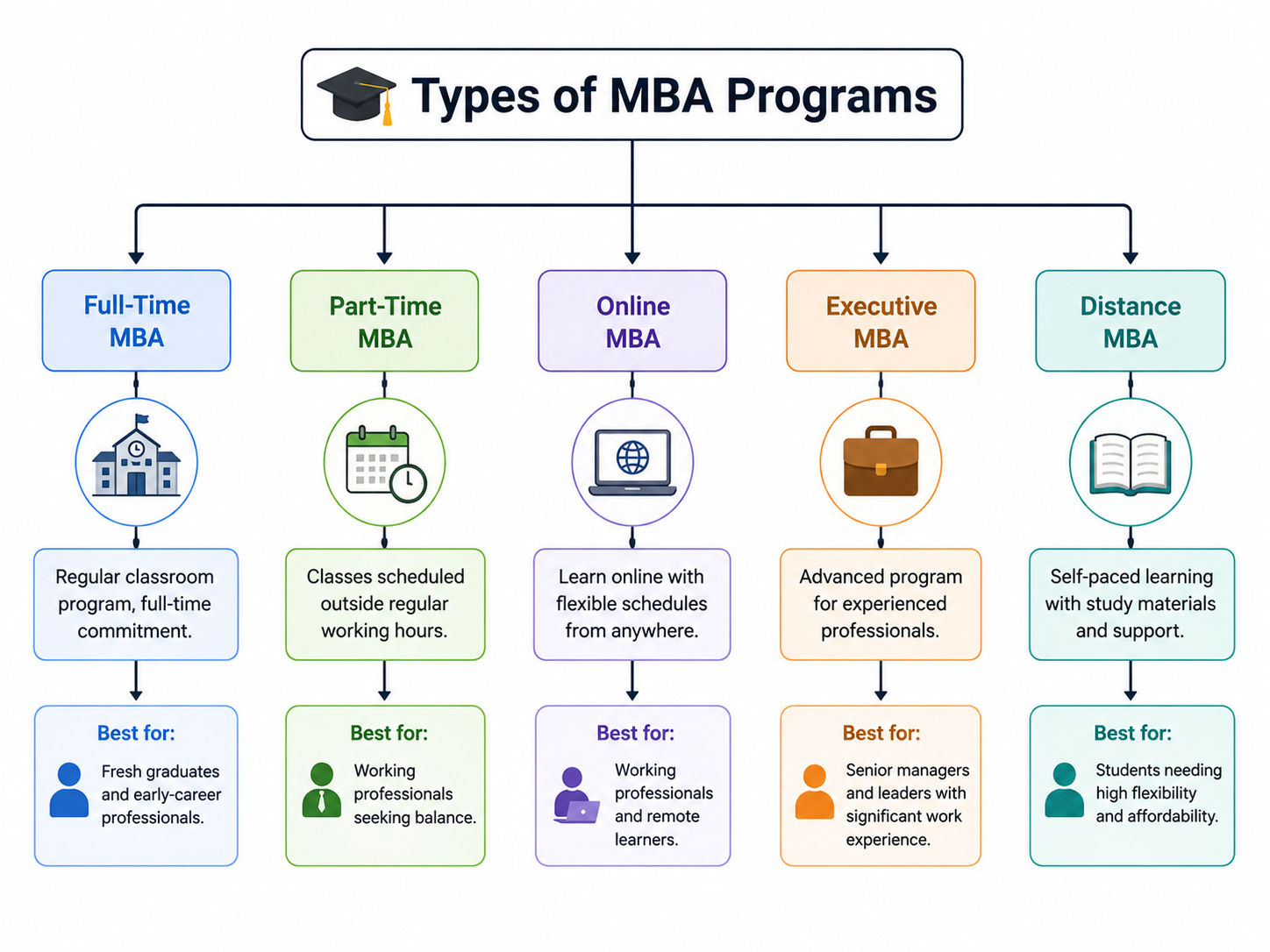
The table below compares common MBA formats.
| MBA Type | Ideal For | Duration |
| Full-Time MBA | Fresh graduates and early-career professionals | 1–2 years |
| Part-Time MBA | Working professionals | 2–4 years |
| Online MBA | Remote learners and working professionals | Flexible |
| Executive MBA | Experienced professionals | 1–2 years |
| Distance MBA | Learners seeking flexibility | Variable |
When evaluating MBA formats, consider factors such as:
The best choice depends on your individual circumstances rather than industry trends.
Also Read : What is an MBA in HR? A Comprehensive Guide
One of the most important decisions during your MBA journey involves selecting a specialization.
Your specialization influences the skills you develop, the industries you target, and the roles you may pursue after graduation.
The table below highlights popular MBA specializations and related career paths.
| Specialization | Typical Career Paths |
| Marketing | Brand Manager, Digital Marketing Manager |
| Finance | Financial Analyst, Investment Banker |
| Human Resources | HR Manager, Talent Acquisition Specialist |
| Operations | Supply Chain Manager, Operations Manager |
| Business Analytics | Data Analyst, Analytics Consultant |
| Information Technology | IT Manager, Product Manager |
| Healthcare Management | Hospital Administrator, Healthcare Consultant |
| International Business | Global Business Manager, Export Manager |
Students frequently choose specializations based on current market demand. While demand matters, long-term interest and aptitude are equally important.
An MBA is more than an academic qualification. It helps professionals develop business knowledge, leadership capabilities, and strategic thinking skills that can support long-term career growth. Whether you are a recent graduate or an experienced professional, an MBA can open doors to new opportunities across industries.
The degree also provides exposure to real-world business challenges, helping students understand how organizations operate, make decisions, and compete in dynamic markets.
A few of the most significant benefits of pursuing an MBA include:
The table highlights some common industries and career paths available to MBA graduates.
Industry |
Popular Career Roles |
| Technology | Product Manager, Business Analyst, Operations Manager |
| Banking and Finance | Financial Analyst, Investment Banker, Risk Manager |
| Consulting | Management Consultant, Strategy Consultant |
| Healthcare | Healthcare Manager, Hospital Administrator |
| Manufacturing | Supply Chain Manager, Plant Operations Manager |
| Retail | Category Manager, Retail Operations Manager |
| E-commerce | Growth Manager, Business Development Manager |
| Media and Entertainment | Marketing Manager, Brand Manager |
As businesses become more data-driven and globally connected, employers increasingly look for professionals who understand both business strategy and operational execution. This combination of management knowledge and practical skills makes MBA graduates valuable across a wide range of industries and career stages.
Must Read : MBA Eligibility Criteria in 2026: Qualifications, and Admission Requirements
If you're wondering how can I do MBA, the journey starts with completing a bachelor's degree, meeting eligibility requirements, preparing for entrance exams, and choosing a program that matches your career goals. Students from all academic backgrounds, including those exploring how to do MBA after BA, can pursue an MBA by selecting the right specialization and learning format.
With the right planning, an MBA can help you develop leadership skills, expand career opportunities, and achieve long-term professional growth.
Ready to start your journey? Book a free consultation with upGrad today to find the best path for your career.
Yes, you can apply for an MBA right after completing your bachelor’s degree. Many colleges accept fresh graduates based on entrance exam scores like CAT, GMAT, or GRE. However, some top programs prefer candidates with 1–3 years of work experience because it helps in understanding case studies and classroom discussions better.
If you are from a BA background, you can still pursue an MBA without restrictions. You need a recognized bachelor’s degree and qualifying marks in entrance exams. Your BA skills like communication, writing, and analysis can actually help in marketing, HR, and consulting roles during and after the MBA.
Most MBA programs in India accept CAT, XAT, CMAT, MAT, and GMAT. Each exam checks reasoning, quantitative ability, and English skills. If you plan to study abroad, GMAT or GRE becomes more important. You should choose the exam based on the colleges you want to target early in your preparation.
The MBA admission process usually takes 6 months to 2 years depending on your readiness. If you are starting from scratch, you will spend time preparing for exams, shortlisting colleges, and completing interviews. Planning early helps you avoid delays and increases your chances of getting into better institutes.
Before starting an MBA, focus on basic analytical thinking, communication, and business awareness. You should also understand current market trends like digital transformation and AI in business. Reading business news and solving case-based problems helps you adapt faster once classes begin and improves your participation in discussions.
Yes, an MBA is often used for career switching. Many professionals move from technical roles to management, marketing, consulting, or finance. However, your switch depends on how you use internships, projects, and networking during the program. Without practical exposure, switching industries becomes more difficult after graduation.
You can move into finance even after a BA by choosing an MBA specialization in Finance or Business Analytics. You should prepare for entrance exams and build basic financial knowledge before joining. Many students from non-commerce backgrounds successfully enter banking roles after learning core concepts during MBA coursework.
A full-time MBA focuses on campus learning, internships, and peer networking. An online MBA gives flexibility to study while working. If you want placement support and structured exposure, full-time works better. If you already have a job and want skill growth, online MBA becomes a practical option.
An MBA does not guarantee a high salary. Your outcome depends on your institute, skills, internships, and performance. Students who actively participate in projects and build strong networks often get better opportunities. Your ability to apply classroom learning in real business situations matters more than the degree alone.
MBA specializations like Business Analytics, Finance, Marketing, and Operations remain in demand. Business Analytics is growing due to data-driven decision-making in companies. Marketing stays strong because of digital platforms. Your choice should depend on your interest, not only job trends, because long-term consistency matters more than short-term demand.
Yes, you can pursue an MBA while working through part-time or online programs. These formats are designed for professionals who want to upgrade skills without leaving jobs. You need discipline because balancing work, study, and assignments becomes challenging. Many professionals use this path for promotions and role changes within their company.
695 articles published
Sriram K is a Senior SEO Executive with a B.Tech in Information Technology from Dr. M.G.R. Educational and Research Institute, Chennai. With over a decade of experience in digital marketing, he specia...
Speak with MBA expert
By submitting, I accept the T&C and
Privacy Policy
From MBA to Dream Job - Explore Our Alumni Success Stories
Top Resources
Master's Degree
13 Months
Master's Degree
12 Months
O.P.Jindal Global University
MBA (with Career Acceleration Program by upGrad)Become interview ready with Career Services
Master's Degree
12 Months