Can I Do MBA After 12th? Complete Guide for Students After Class 12
By upGrad
Updated on Jun 17, 2026 | 8 min read | 2.57K+ views
Share:

All courses
Certifications
More
By upGrad
Updated on Jun 17, 2026 | 8 min read | 2.57K+ views
Share:
Table of Contents
“Can I Do MBA After 12th?” is the question most students ask after school. The short answer is yes, but not through the traditional MBA route. While a regular MBA requires a bachelor's degree, there are integrated management programs that allow students to begin their management education right after Class 12.
This blog is about management studies after school. You'll find out how integrated MBA programs work, Eligibility requirements, Admission processes, Career opportunities, and fees. You can be, from science, commerce, or arts background; this blog will help you decide.
If you want to pursue an MBA after 12th? Explore upGrad's Online MBA Courses and start planning your journey today.
Popular MBA Programs
This is the most common question for students interested in MBA after their 12th.
Technically, a traditional MBA cannot be pursued immediately after Class 12 because MBA programs need you to have a bachelor's degree as the minimum qualification.
The Integrated MBA programs put together the postgraduate management courses into one, and they usually take 5 years to complete. You get both your undergraduate and postgraduate degrees in management at the same time.
This is an option for students who want to pursue an MBA after 12th.
Also Read: What are the Different Types of MBA Courses? Master’s of Business Administration
An Integrated MBA is a program. It combines two degrees, design for students who are sure about their career path in management.
Instead of doing a 3-year bachelor's degree and then 2-year MBA students can join a single 5-year management program.
Feature |
Traditional MBA |
Integrated MBA |
| Entry Level | After Graduation | After Class 12 |
| Duration | 5 Years Total (3+2) | 5 Years |
| Admission Exam | CAT, XAT, MAT, etc. | University Entrance Exams |
| Degree Structure | Separate Degrees | Combined Program |
| Career Focus | After Graduation | Early Management Exposure |
The answer to can I do an MBA after pursuing different Strems in 12th, is yes, provided that you meet the university's requirements to get in.
Students from all streams can apply:
Also Read: Integrated MBA: Best Programs & Career Opportunities You Can’t Miss!
Free Courses
However, this path is best for students who like management, business, and entrepreneurship. It is also good for those in marketing, finance, or consulting careers. Students who are already into business and management will find this path helpful.
Many students prefer integrated programs because they
Also Read: Why Do An MBA – 6 Top Reasons For Doing
MBA Courses to upskill
Explore MBA Courses for Career Progression
O.P.Jindal Global University
MBA (with Career Acceleration Program by upGrad)Become interview ready with Career Services
PSB MBA + IIML Certification
MBA from Paris School of Business with Certification from IIM LucknowStudents often ask how they can do an MBA after 12th and what steps they need to follow.
The admission process, for an MBA is generally straightforward although it varies slightly across institutions when it comes to doing an MBA.
Management programs welcome diverse backgrounds.
Most universities require:
Requirement |
Details |
| Education | Class 12 from a recognized board |
| Minimum Marks | Usually 50%–60% |
| Stream | Science, Commerce, or Arts |
| Age Limit | Usually none |
Universities may admit students through:
Some colleges offer admission based on:
Many reputed institutions conduct entrance tests covering:
Students generally need:
Once students understand that the answer to can, I do MBA after 12th is yes through integrated programs. The next question is where to study.
India offers several integrated management programs through universities and institutes.
Program Type |
Duration |
| Integrated BBA + MBA | 5 Years |
| Integrated Management Program (IPM) | 5 Years |
| B.Com + MBA | 5 Years |
| BA + MBA | 5 Years |
Some institutions offer specialized management programs in:
The All-India Council for Technical Education and some of the management schools say that when students learn things that are connected to the industry and do internships, they have a much better chance of getting a job.
This is because industry-integrated learning and internships really help students become more employable and are thus very important for students.
Look for programs that offer:
What really matters is the curriculum quality, the placements, the faculty's expertise, and the career support they provide. You should avoid choosing a program based only on:
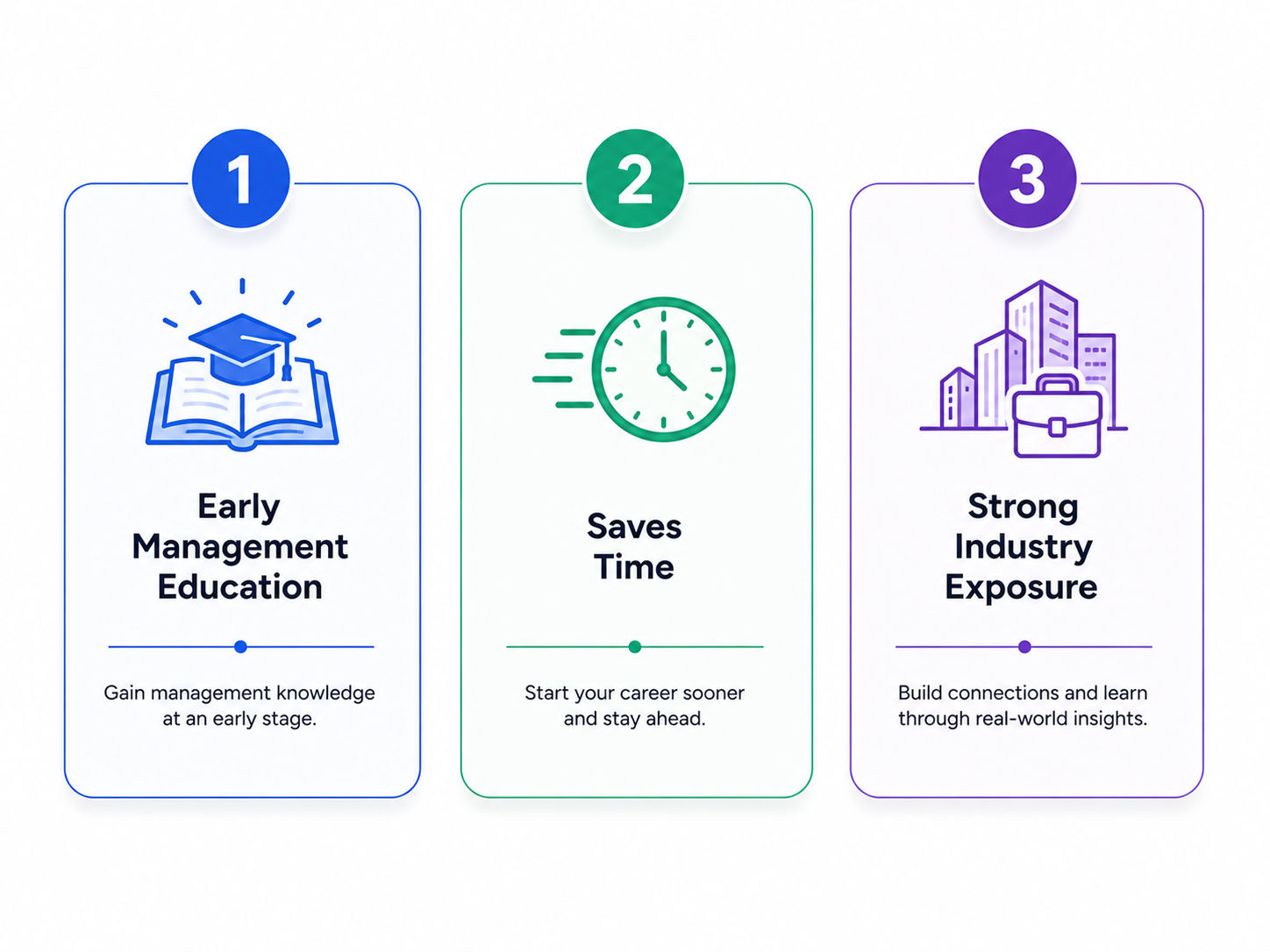
Many students wonder how they can pursue an MBA right after completing their grades. This is because they want to get a head start in their careers.
Here are some benefits of MBA programs if chosen wisely: Integrated MBA programs can be an option
Students start learning:
at a much earlier stage.
Students do not have to prepare for MBA admissions by themselves after they finish college. They have to follow a learning path for MBA admissions. This way, the students are always preparing for the MBA.
Many programs include:
Graduates can explore roles in:
Career Area |
Common Roles |
| Marketing | Marketing Executive, Brand Associate |
| Finance | Financial Analyst |
| Human Resources | HR Executive |
| Operations | Operations Analyst |
| Consulting | Business Analyst |
| Entrepreneurship | Startup Founder |
Also Read: What is an MBA in HR? A Comprehensive Guide
Subscribe to upGrad's Newsletter
Join thousands of learners who receive useful tips
Candidates with practical exposure to the workforce often do a lot better than candidates who only have academic qualifications.
This is because candidates with practical exposure have a better understanding of what the job is really like.
Entry-level salaries depend on:
Also Read: MBA Salary in India For Freshers & Experienced [2026]
Not necessarily. Students who are not sure of what they want to do for a career may want to get a bachelor's degree first. This way, they can figure out what they want to do.
Then they can decide later if they need an MBA degree. They can think about if an MBA degree is really necessary, for them.
An integrated MBA is ideal for students who:
Students who are entering management education today will probably work in industries that are increasingly driven by technology, data, and innovation.
Management education is important for these students because technology, data, and innovation are changing the way industries work.
Management education is evolving rapidly.
Growing demand exists in:
So, can I do an MBA after 12th? Yes, but through integrated MBA or integrated management programs rather than a traditional MBA.
Whether you're asking can I do MBA after 12th science, can I do MBA after 12th commerce, or can I do MBA after 12th arts, there are opportunities available across streams. The key is choosing the right institution, understanding the long-term commitment, and aligning the program with your career goals.
If you're still exploring options, taking time to complete a bachelor's degree before pursuing an MBA may provide greater flexibility in your career.
Want to explore more about “can I do an MBA after 12th?” Book your free 1:1 personal consultation with our expert today.
You cannot pursue a traditional MBA immediately after Class 12 because MBA programs require a bachelor's degree. However, you can enroll in an integrated MBA program that combines undergraduate and postgraduate management education. These programs are specifically designed for students who want to begin management studies after school.
Students from science and arts backgrounds can also apply for integrated MBA programs. Universities generally accept candidates from all streams. Entrance exams and interviews focus on aptitude, reasoning, communication skills, and academic performance rather than prior commerce knowledge.
Yes, many science students successfully transition into management education through integrated MBA programs. Their analytical and quantitative skills often help them excel in subjects such as finance, operations, analytics, and business strategy. Stream background rarely limits future management opportunities.
Commerce students often have familiarity with business concepts such as accounting and economics. This can make certain management subjects easier initially. However, long-term career success depends more on skills, internships, projects, and performance rather than school streaming alone.
Yes. Most integrated MBA programs do not require mathematics as a compulsory subject in Class 12. While quantitative aptitude may be tested during admission, institutions usually provide foundational business and analytical training during the course.
The answer depends on your career clarity. Integrated MBA programs offer continuity and save admission preparation time. BBA followed by MBA provides more flexibility and allows students to reconsider career choices after graduation. Both routes can lead to successful management careers.
Different institutions conduct different admission processes. Some accept Class 12 scores, while others conduct aptitude tests, interviews, or university-specific entrance examinations. Students should always verify current admission requirements directly from the institution they wish to join.
Integrated MBA programs generally last five years. They combine undergraduate and postgraduate management studies into a single curriculum. Students graduate with both foundational business knowledge and advanced management expertise in one continuous academic journey.
Placement outcomes depend on the institution, industry exposure, internship experience, and student performance. Programs with strong corporate partnerships, practical projects, and career services typically provide better employment opportunities for graduates entering the job market.
Yes. Integrated MBA graduates remain eligible for many government examinations, provided they meet specific recruitment requirements. The degree is recognized as a postgraduate qualification and can be useful for administrative, banking, public sector, and management-related roles.
Modern management graduates are increasingly entering fields such as business analytics, product management, digital marketing, fintech, supply chain management, and consulting. As businesses adopt technology-driven strategies, demand for professionals with management and analytical skills continues to grow.
972 articles published
We are an online education platform providing industry-relevant programs for professionals, designed and delivered in collaboration with world-class faculty and businesses. Merging the latest technolo...
Speak with MBA expert
By submitting, I accept the T&C and
Privacy Policy
From MBA to Dream Job - Explore Our Alumni Success Stories
Top Resources
Master's Degree
13 Months
Master's Degree
12 Months
Master's Degree
15 Months