Corporate Social Responsibility in India: CSR Rules and Company Examples
By upGrad
Updated on Nov 07, 2026 | 4 min read | 1.42K+ views
Share:

All courses
Certifications
More
By upGrad
Updated on Nov 07, 2026 | 4 min read | 1.42K+ views
Share:
Table of Contents
Key highlights
Explore upGrad’s MBA programmes to develop your business management, strategic decision-making, and leadership skills while learning how organisations drive responsible business practices and sustainable growth.
Popular MBA Programs
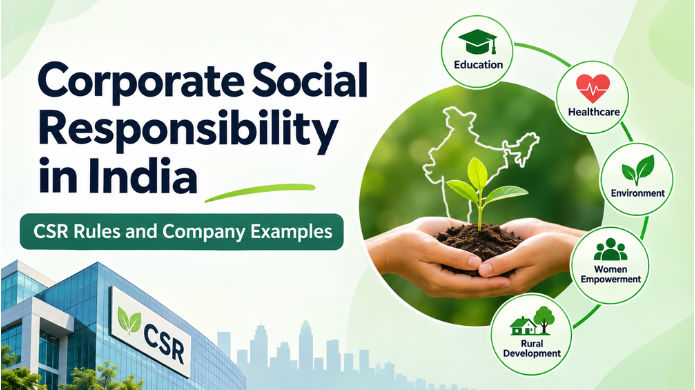
The corporate social responsibility definition in India is simple. It’s a company’s duty to spend a fixed share of its profit, at least 2% on social causes named in the law, with Board oversight and public reporting. It compels mandatory CSR provisions through the Companies Act, 2013. India is one of the first countries that established a a statutory corporate spending requirement for social development.
The four components of the rules that shaped it.
A qualifying company must form a CSR Committee of the Board, adopt a CSR policy, spend the required amount and report it in the Board’s report. If the yearly obligation is ₹50 lakh or less, the Board can do the committee’s job itself.
The rules keep moving. The 2021 amendment brought in Form CSR-1 registration, impact assessments and the Unspent CSR Account. The “Companies (Corporate Social Responsibility Policy) Amendment Rules, 2026” that came into force on 27 May 2026 have incorporated Rule 4A. This rule provides that a company may allocate up to 10% of its annual CSR liability to Zero Coupon Zero Principal bonds issued by NGOs listed on a Social Stock Exchange.
Another proposed amendment that is yet to take place includes the raising of the net profit ceiling from ₹5 crore to ₹10 crore, which has been suggested in the “Corporate Laws (Amendment) Bill, 2026”. A Joint Parliamentary Committee Report dated 3 August 2026 has been submitted with regards to this proposal.
The following three tests are essential. If your company fulfills any one of the tests in the previous financial year you fall under Section 135. Meeting all three tests isn’t required.
Test |
Threshold |
| Net worth | ₹500 crore or more |
| Turnover | ₹1,000 crore or more |
| Net profit | ₹5 crore or more |
The rules cover private companies, public companies, holding and subsidiary companies and Indian branches of foreign companies that cross a threshold. Net profit here means profit before tax as shown in the financial statements, minus items such as overseas branch profits and dividends from other Indian companies.
A company that stays below all three thresholds for three financial years in a row does not fall in this criteria. But as soon as it crosses it, you become eligible for CSR.
Companies must spend at least 2% of the average net profit of the three preceding financial years. Take profit before tax for each year, average the three figures, then multiply by 0.02.
Financial year |
Net profit |
| 2023-24 | ₹8 crore |
| 2024-25 | ₹12 crore |
| 2025-26 | ₹10 crore |
| Average | ₹10 crore |
| CSR obligation for 2026-27 (2%) | ₹20 lakh |
A few rules decide how the money counts.
Is 2% a ceiling? No. It’s the floor, and companies are free to spend more.
Build your business and leadership skills with upGrad’s MBA from Golden Gate University. Learn to make strategic business decisions, manage organisations, and drive sustainable growth in a competitive business environment.
Free Courses
Schedule VII lists the causes that qualify. A project outside this list won’t count toward the 2%, however useful it is to the community.
Schedule VII deals with education, which includes special education, as well as the development of vocational skills for employment. Examples include school construction, science labs, scholarships, computer laboratories, training of teachers and tradesmen such as welders, electricians and retailers.
The manufacturer of parts for cars in Pune providing an electrician training course at a nearby ITI would be one example.
This is the first item in the Schedule and the one which is chosen most often by organizations. This deals with preventive and therapeutic health services, food, sanitation and drinking water.
Examples are mobile hospitals, cancer detection camps, kitchen in schools, community toilet facilities and reverse osmosis plant for water in villages.
The Schedule covers gender equality, women’s hostels, homes for orphans, old age homes and day care centres. It also covers steps to reduce inequalities faced by socially and economically backward groups.
Self-help group training, women’s hostels near industrial areas and livelihood programmes for rural women all qualify.
This list consists of ecological balance, flora and fauna, animal rights, agroforestry, natural resource conservation, and quality of soil, air, and water. Any contributions towards Clean Ganga Fund would also be considered for inclusion. Tree plantation is an extremely popular endeavor.
Rural development projects cover village infrastructure, watershed work, farm support and local livelihoods. Slum area development covers housing upgrades, drainage and sanitation in notified slum areas.
These projects are long and often depend on local government approvals.
Here are the other eligible activities:.
As mentioned above about the qualified activities. There are some activities which do not qualify. Even if there is good intention.The law rules out several activities, even when they help people.
Activity |
Why it doesn’t count |
| Work done in the normal course of business | It serves the company, not the community |
| Projects outside India | Only training of Indian sports personnel is allowed abroad |
| Contributions to political parties | Barred under Section 182 |
| Schemes benefiting employees and their families | The benefit isn’t public |
| Sponsorships meant to market products or services | The purpose is promotion |
| Activities required by another law | They’re already a statutory duty |
MBA Courses to upskill
Explore MBA Courses for Career Progression
O.P.Jindal Global University
MBA (with Career Acceleration Program by upGrad)Become interview ready with Career Services
PSB MBA + IIML Certification
MBA from Paris School of Business with Certification from IIM LucknowNow that we know how important Corporate Social Responsibility is. Let’s learn how a company can implement these Corporate Social Responsibility activities.
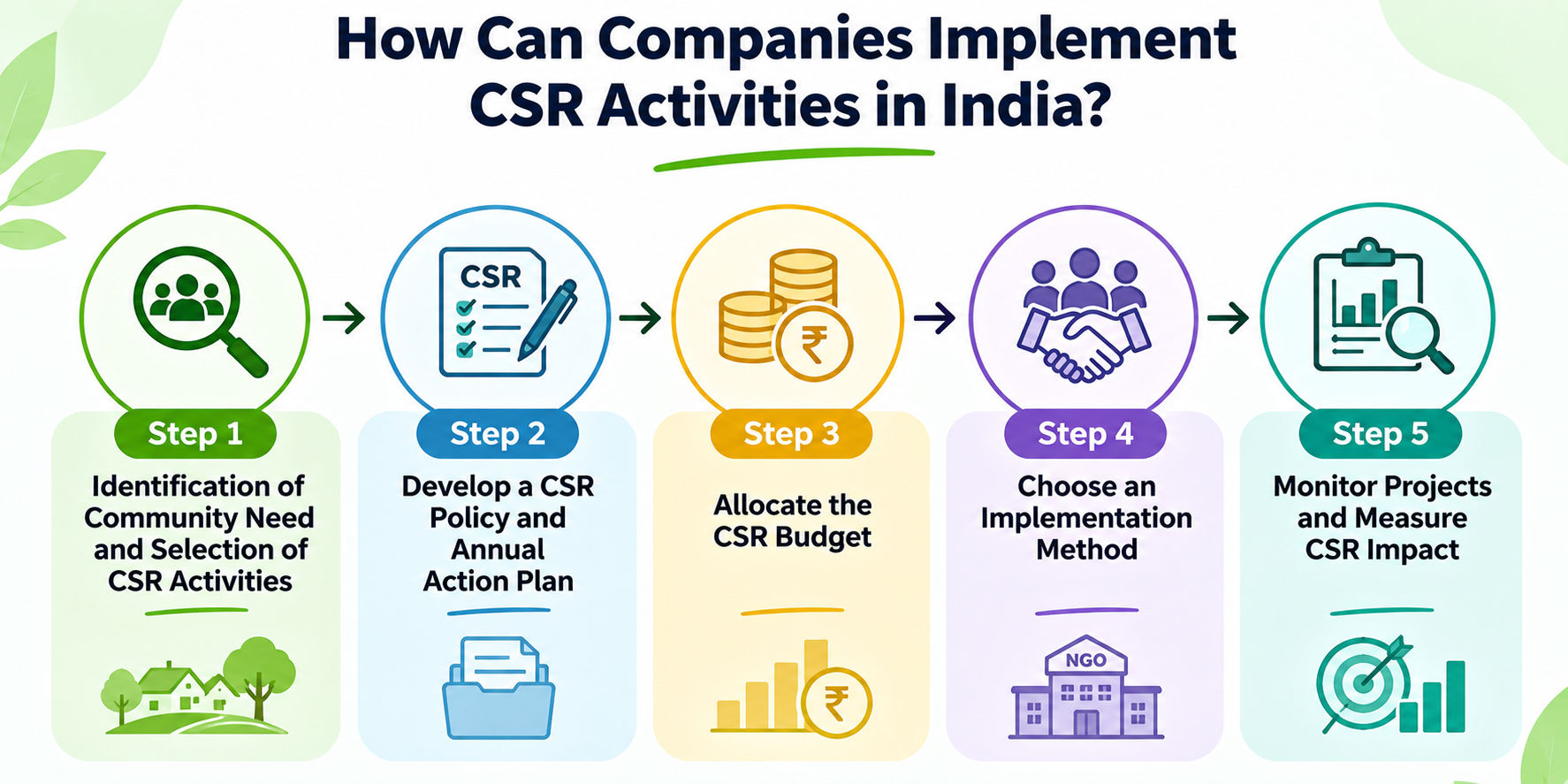
Five-step CSR implementation process in India
Begin from where the organization works. Meet panchayats, school authorities, health workers and local administration. Refer to the statistics provided by the district regarding literacy, anaemia, water availability and dropout ratio, and select the area which needs the most attention. The most important thing for an industry in a district facing water shortage is the issue of water itself.
The CSR committee writes the policy, which is approved by the board and published on the company’s website. This policy outlines the areas of interest and the methodology to be used for monitoring the projects.
Annual Action Plan is an independent document that includes projects and budgets, organizations executing the projects, schedule and whether the project is ongoing or not. Board approves the action plan annually.
Calculate the 2% figure first. Then split it across projects, keeping administrative costs under 5% and setting aside money for monitoring. Impact assessment costs can be counted too, up to 5% of the year’s CSR spending or ₹50 lakh, whichever is higher.
Multi-year projects need a budget for every year, not just the first.
Companies have four routes.
Route |
What it means |
| Direct | The company’s own team runs the project |
| Own foundation | A Section 8 company, trust or society set up by the company |
| External agency | A registered NGO or trust with a CSR-1 registration number and a three-year track record |
| Collaboration | Two or more companies pool funds on one project |
Small companies rarely have a CSR team. They usually go through an NGO, which makes agency selection the most important decision they’ll make.
Collect utilisation certificates, visit project sites and track results against targets set at the start. A health camp that treated 5,000 people sounds good. A fall in untreated hypertension in the same villages tells you more.
Larger companies must also commission independent impact assessments, covered in the compliance section below.
Also Read: Marketing Management Explained with Examples
CSR compliance has two forms, CSR-1 and CSR-2 are here are they:
Form CSR-1 is filed on the MCA portal by the implementing agency, not by the company. The agency gets a unique CSR registration number after a practising professional certifies the form.
Before releasing any money, check that the agency’s number is valid.
Companies file Form CSR-2 as an addendum to Form AOC-4 along with their annual financial statements. It reports the CSR obligation, the projects, the agencies, the amount spent and the amount left unspent.
This is separate from the Board’s report. The two documents should match, and mismatches are the commonest filing error.
Also Read: What is Corporate Finance: Definition, Functions & Real-World Examples
The Board’s report carries an annexure with the CSR policy summary, the committee’s composition, the average net profit, the prescribed obligation, the amount spent and details of any unspent amount with reasons.
The company website must show the committee’s composition, the CSR policy and the projects approved by the Board.
The Chief Financial Officer, or the person handling finances, certifies that funds were used as the Board approved. Companies with an average CSR obligation of ₹10 crore or more over the three preceding years must also run independent impact assessments for projects with an outlay of ₹1 crore or more that finished at least a year ago.
Keep invoices, utilisation certificates, MoUs, site photographs and meeting minutes. Auditors ask for them.
Do read: Highest Paid CEO in the World 2026: Top 10 List of CEOs
Not spending isn’t automatically a violation. Not explaining it, or not moving the money correctly, is.
The law splits unspent money into two buckets. One is for ongoing projects, which are multi-year projects lasting no more than three years excluding the year they begin. The other is for everything else.
The Board report must explain why the money wasn’t spent. A vague line about “project delays” won’t satisfy a reviewer.
It’s a separate bank account in a scheduled bank, named the Unspent Corporate Social Responsibility Account of the company for that financial year. Money for ongoing projects moves there and can be used only for those projects.
Here are the rules for transferring the unspend CSR funds:
Situation |
Where the money goes |
Deadline |
| Ongoing project, amount unspent | Unspent CSR Account | Within 30 days of the financial year end |
| Money in that account still unspent | A fund listed in Schedule VII | Within 30 days of the third financial year end |
| Other unspent amount | A fund listed in Schedule VII | Within 6 months of the financial year end |
The Corporate Laws (Amendment) Bill, 2026 proposes to extend the 30-day windows to 90 days. That change isn’t in force yet.
Projects slip for ordinary reasons such as land approvals and monsoon delays. Build realistic timelines before labelling a project as ongoing.
Section 135(7) sets monetary penalties for failing to spend or transfer the money. They’re civil penalties, not jail terms.
Who |
Penalty |
| The company | Twice the unspent amount or ₹1 crore, whichever is less |
| Each officer in default | One-tenth of the unspent amount or ₹2 lakh, whichever is less |
False statements in the Board report can attract separate liability under Section 448 of the Act. The cost of a wrong report can be much higher than the cost of the missed spending.
Read more: Corporate Governance: Meaning, Principles & Models
Scale differs, but the pattern is the same for these companies. Large groups run CSR through foundations and long programmes instead of one-off gifts. Check each company’s latest annual report for current figures, since spending changes every year.
The Tata Trusts hold a majority stake in Tata Sons, so philanthropy sits close to the group’s ownership. Support for cancer care at the Tata Memorial Centre is a long-running example. Tata Steel’s work with tribal communities in Jharkhand and Odisha covers health, education and livelihoods.
Reliance Foundation runs programmes in healthcare, education, rural transformation and disaster response. The Sir H. N. Reliance Foundation Hospital in Mumbai and the foundation’s school network are two visible projects.
Infosys Foundation, set up in 1996 by Sudha Murty, works in healthcare, rural development, education, libraries and support for destitute people. It also funds the preservation of arts and culture.
Nanhi Kali supports the education of underprivileged girls and is one of the group’s best-known programmes. The Mahindra Pride Classrooms train young people for jobs in sectors such as retail and hospitality.
Also Read: Top 10 Management Skills Required to Become a Successful Manager
ITC’s rural programmes cover watershed development, agriculture support, women’s livelihoods and social forestry. The company has described itself as carbon positive and water positive for many years.
HDFC Bank runs its CSR under the Parivartan umbrella. The Holistic Rural Development Programme works in villages on education, skills, livelihoods and financial literacy.
Wipro Cares supports education reform, healthcare, disaster relief and ecology. The Azim Premji Foundation is a separate philanthropic organisation, so it shouldn’t be counted as Wipro’s CSR spending.
Also Read: 7 Best Online MBA Programs in India
CSR is a spending duty under company law. ESG measures how a business performs on environmental, social and governance factors, and investors and lenders use that information to judge risk.
Point |
CSR |
ESG |
| Basis | Section 135, Companies Act, 2013 | Investor and regulatory expectations |
| Focus | Spending on community causes | Company-wide performance |
| Main reader | Government, regulators and communities | Investors and lenders |
| Reporting | Board report and Form CSR-2 | Business Responsibility and Sustainability Report for top listed companies, plus voluntary disclosures |
| Scope | Eligible companies only | Any company that wants capital |
They overlap in the “social” part. A CSR project on women’s livelihoods can feed an ESG report. But a company can spend its full 2% and still score badly on ESG if its factories pollute or its board is weak.
Conclusion
Corporate social responsibility in India now works like a financial compliance function with a social payoff. Missing the calculation or the paperwork will cost you money.
The hard part in all these is choosing projects that still matter in three years. Start with the threshold test, calculate the 2% from the correct profit figure, pick registered agencies and plan multi-year projects realistically. Watch the Corporate Laws (Amendment) Bill, 2026 as well, because it could change who falls under the rules.
Ready to start your journey? Book a free consultation with upGrad today to find the best path for your career.
Companies Act, 2013 and the CSR Rules became applicable from 1st April 2014. Companies that were above the threshold needed to begin their expenditures starting fiscal year 2014-15. The amendment in 2021 came with further requirements such as registering, impact assessment and non-expenditure accounts.
It’s calculated on profit before tax. Companies take that figure from their financial statements, remove items such as overseas branch profits and dividends from other Indian companies, then average three years. Tax paid doesn’t reduce the CSR obligation.
Yes. The law sets a minimum and no maximum. Excess spending in a year can be set off against the requirement of the next three financial years if the Board passes a resolution. Surplus earned from CSR projects can’t be used for this.
No. Activities that benefit employees and their families are excluded. Schemes open to the wider community stand on firmer ground, even if some employees use them. A staff creche or an employee-only scholarship doesn’t count toward the 2% obligation.
Yes. A company can run projects directly through its own team, or through its own Section 8 company, trust or society. Only external implementing agencies need a CSR-1 registration number. The project must still fall under Schedule VII and have Board approval.
CSR-1 is the form for one-time registration of the implementation agency for the purpose of securing a CSR registration number. CSR-2 on the other hand, is an annual form for filing by the spending company as an annexure to form AOC-4. One is for registration while the other is for expenditure.
Begin by verifying the CSR-1 number and tax registration of the agency. Look into the financial statements over the past three years and the results of the previous projects. Inspect a live project and talk to the beneficiaries of the project. Also, ask for sample utilization certificates and compare overheads of at least two agencies.
It is compulsory only for large firms. It is necessary if the average CSR obligation over the previous three years is ₹10 crore or above. This is applicable to those projects where the outlay is ₹1 crore or above and completed at least one year ago.
CSR is a legal duty to spend on community causes, and it applies only to companies above the thresholds. ESG measures overall performance on environmental, social and governance factors for investors. A company can meet its CSR obligation and still score poorly on ESG.
The Companies (Corporate Social Responsibility Policy) Amendment Rules, 2026, notified on 27 May 2026, let companies route up to 10% of their yearly obligation through Zero Coupon Zero Principal instruments. The Corporate Laws (Amendment) Bill, 2026 proposes a ₹10 crore net profit threshold and awaits passage.
Not freely. Unspent money for an ongoing project moves to the Unspent CSR Account and must be spent within three years, or it goes to a Schedule VII fund. Other unspent money goes to a Schedule VII fund within six months of the financial year end.
1348 articles published
We are an online education platform providing industry-relevant programs for professionals, designed and delivered in collaboration with world-class faculty and businesses. Merging the latest technolo...
Speak with MBA expert
By submitting, I accept the T&C and
Privacy Policy
From MBA to Dream Job - Explore Our Alumni Success Stories
Top Resources
Master's Degree
13 Months
Master's Degree
12 Months
O.P.Jindal Global University
MBA (with Career Acceleration Program by upGrad)Become interview ready with Career Services
Master's Degree
12 Months