Corporate Governance: Meaning, Principles & Models (2026)
By Faheem Ahmad
Updated on May 05, 2026 | 9 min read | 2.38K+ views
Share:

All courses
Certifications
More
By Faheem Ahmad
Updated on May 05, 2026 | 9 min read | 2.38K+ views
Share:
Table of Contents
Corporate governance is a framework of rules, practices, and processes that guide how a company is managed, controlled, and held responsible for its actions.
It helps balance the interests of different stakeholders, like shareholders, management, customers, and the wider community, while promoting transparency, ethical conduct, and long-term growth. Strong governance supports better performance, whereas weak governance can lead to scandals and financial losses.
In this guide, you’ll learn the corporate governance definition, meaning, principles, models, and theories, explained in a simple and practical way.
Looking to apply workplace efficiency concepts like Corporate Governance in real business settings? Explore upGrad’s management programs to build practical leadership, operations, and process improvement skills.
Popular Management Programs
Corporate governance refers to the system of rules, practices, and processes by which a company is directed and controlled. It defines how decisions are made and how responsibilities are shared between management, the board, shareholders, and other stakeholders.
In simple terms, if you’re wondering what is corporate governance, it’s about how a company is managed and held accountable.
According to Organisation for Economic Co-operation and Development, corporate governance involves relationships between management, board members, shareholders, and stakeholders, ensuring accountability and transparency.
The corporate governance definition can be understood as a framework that ensures companies operate ethically, follow regulations, and protect stakeholder interests.
It answers key questions like:
Good corporate governance plays a major role in building trust and long-term growth.
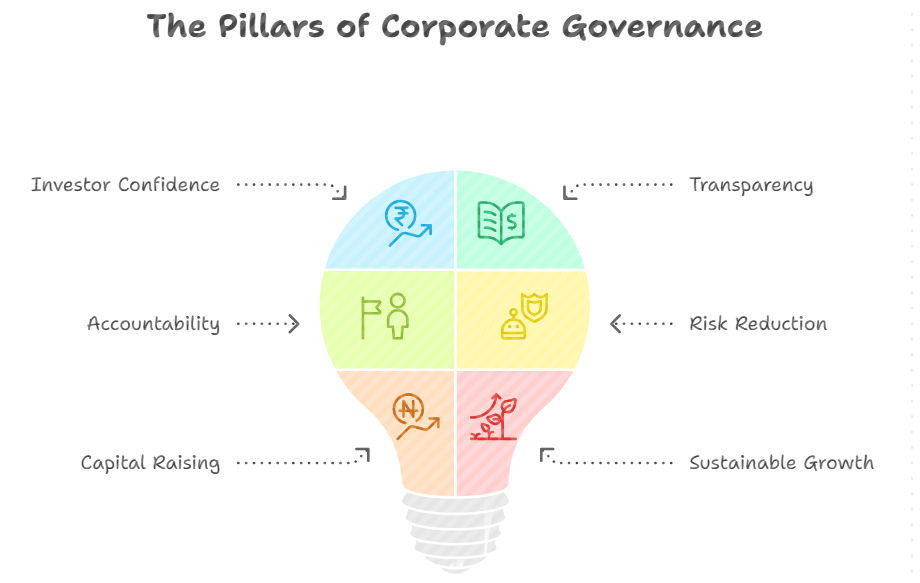
Strong governance systems create trust, transparency, and accountability, which support economic growth and financial stability.
Also Read: Top 10 Management Skills Required to Become a Successful Manager
Free Courses
For any framework to be effective, it must be rooted in ethical and functional standards. The principles of corporate governance revolve around four key pillars:
Also Read: How to Become A Corporate Lawyer: A Complete Roadmap to Success (2026)
Management Courses to upskill
Explore Management Courses for Career Progression
IIIT-B & IIM, Udaipur
Chief Technology Officer & AI Leadership ProgrammeDifferent countries and companies follow different models of corporate governance depending on their structure and legal system.
Also Read: What is Corporate Finance: Definition, Functions & Real-World Examples
To truly understand the "why" behind these structures, we must examine the theories of corporate governance. These academic lenses explain how and why certain governance decisions are made:
Also Read: Marketing Management Explained with Examples
Corporate governance may sound like a theory, but in real life, it works through clear roles and everyday processes inside a company. The goal is simple, make sure no single person has too much control and everything stays transparent and fair.
Looking at examples makes it easier to understand how corporate governance actually impacts a company.
In a well-governed company, things are open and well-managed. The company shares regular financial updates, follows rules, and has an independent board that questions decisions when needed.
For example, if a company clearly reports its profits, risks, and future plans, investors feel more confident. Ethical practices and proper checks help build trust over time. This usually leads to better reputation, steady growth, and easier access to funding.
In contrast, poor governance often leads to serious problems. A company might hide financial information, ignore rules, or allow conflicts of interest within management.
For instance, if leaders make decisions for personal benefit instead of the company, it can damage trust. Lack of transparency may lead to scandals, legal trouble, or financial losses. In many cases, this also causes investors to pull out, which harms the business even more.
Do Read: Best Business Management Courses in India [2026]
Implementing a robust governance framework isn't just about following rules; it's a competitive advantage that stabilizes a company's future.
Also Read: What is Management?
While the benefits are significant, maintaining high standards of corporate governance comes with practical hurdles that organizations must manage.
Also Read: Techniques of Decision-Making: 15+ Tools & Methods for Success in 2026
Corporate governance is no longer optional, it’s a necessity for modern businesses. It ensures companies are run responsibly, decisions are transparent, and stakeholders are protected.
By understanding the corporate governance meaning, principles, models, and theories, businesses can build trust, reduce risks, and achieve long-term success.
Ready to start your journey? Book a free consultation with upGrad today to find the best path for your career.
While management is about the day-to-day operations and "running" the business, corporate governance is about the "oversight" and ensuring the business is being run in the right direction. Management handles the execution, whereas governance sets the ethical and strategic boundaries.
Absolutely. While many believe it’s only for giants like Apple or Google, the corporate governance meaning for small businesses lies in creating a foundation for future scaling. It helps small firms professionalize their operations and makes them more "bankable" for future loans or acquisitions.
The agency problem occurs when the goals of the managers (the agents) and the owners (the shareholders) don’t align. Most theories of corporate governance, such as Agency Theory, were developed specifically to find ways to bridge this gap through incentives and monitoring.
ESG (Environmental, Social, and Governance) is a broader framework for sustainable investing. Within this, corporate governance acts as the "G", the steering mechanism that ensures the environmental and social goals are actually met and legally compliant.
The internal auditor acts as the eyes and ears of the board. Since corporate governance is a form of internal control, the auditor ensures that the policies set by the directors are actually being followed by the staff on the ground.
No single structure works for everyone. Different models of corporate governance, such as the Anglo-American or the Japanese Keiretsu, reflect the cultural and legal values of their specific regions. What works in New York might not work in Tokyo.
Investors often pay a "governance premium." When a company adheres to the principles of corporate governance, it lowers the perceived risk of fraud or sudden collapse, which often leads to a more stable and higher valuation on the stock market.
It is a formal process that allows employees to report unethical behavior without fear of retaliation. This is a critical component of a modern corporate governance definition, as it helps catch internal issues before they turn into public scandals.
Modern theories of corporate governance suggest that diverse boards (in terms of gender, ethnicity, and experience) are less prone to "groupthink." This leads to better problem-solving and a more accurate understanding of a global customer base.
Industry best practices suggest a comprehensive review every 12 to 24 months. Because the market moves fast, the corporate governance meaning must evolve to include new challenges like cybersecurity risks and AI ethics.
Failures usually lead to a loss of investor confidence, heavy regulatory fines, and in extreme cases (like Enron or Lehman Brothers), the total collapse of the organization. This is why understanding what is corporate governance is vital for any long-term business strategy.
79 articles published
Faheem Ahmad is an Associate Content Writer with a specialized background in MBA (Marketing & Operations). With a professional journey spanning around a year, Faheem has quickly carved a niche in the ...
Get Free Consultation
By submitting, I accept the T&C and
Privacy Policy
Top Resources
Certification
3 Months
Certification
6 Months
O.P. Jindal Global University
Masters in International Accounting and Finance (Accredited by ACCA, UK)Master's Degree
12 Months