How to Develop Business Acumen and Think Like a Business Leader
By upGrad
Updated on Nov 06, 2026 | 7 min read | 5.91K+ views
Share:

All courses
Certifications
More
By upGrad
Updated on Nov 06, 2026 | 7 min read | 5.91K+ views
Share:
Quick Insights
Want to build a strong business acumen? Explore MBA online courses upGrad’s guided learning lets you practise through projects and case studies at your own pace.

Popular MBA Programs
Business acumen is useful across different roles and industries. From planning a marketing campaign to managing a team or reviewing company performance, it helps professionals understand what is good for the business and make decisions with that in mind.
Business Acumen Meaning:
Business acumen is the ability to understand how a business earns money, manages costs and works towards its goals. It helps people see how their decisions affect the business. It is not limited to managers or business owners. Anyone can develop this skill and use it in their work.
Business acumen helps professionals:
Want a global MBA without leaving your job? Study online with Golden Gate University and upGrad, with an optional campus immersion in San Francisco. Explore the MBA from Golden Gate University.
Free Courses
Business acumen includes several skills that help people understand business needs and make better decisions. The following skills are important for professionals who want to grow into leadership roles.
| Skill | How it helps decision-making |
| Financial understanding | Allows professionals to compare costs, profits and cash flow before approving a business idea or spending money. |
| Strategic thinking | Encourages people to consider future risks and opportunities instead of focusing only on immediate results. |
| Market and customer awareness | Helps businesses choose products, prices and marketing strategies based on customer needs and competitor activity. |
| Analytical and problem-solving skills | Allows professionals to use data to find the cause of a problem and choose a solution based on facts rather than guesswork. |
| Leadership skills and communication skills | Helps managers explain decisions, gain team support and turn business plans into action. |
MBA Courses to upskill
Explore MBA Courses for Career Progression
O.P.Jindal Global University
MBA (with Career Acceleration Program by upGrad)Become interview ready with Career Services
PSB MBA + IIML Certification
MBA from Paris School of Business with Certification from IIM LucknowBusiness acumen is useful across different business functions. Professionals use it to understand problems, assess their impact and make practical decisions.
| Business function | Situation | Business acumen example |
| Finance | Rising costs | Reviewing expenses to find where the company can save money without affecting work quality. |
| Marketing | Falling sales | Checking campaign results and customer responses to identify why sales have dropped. |
| Operations | Delivery delays | Finding supply chain issues and changing processes to improve delivery times. |
| Leadership | New market opportunity | Studying market demand, costs and risks before deciding to expand. |
In each case, business acumen means looking beyond the immediate problem and considering its impact on the business before taking action.
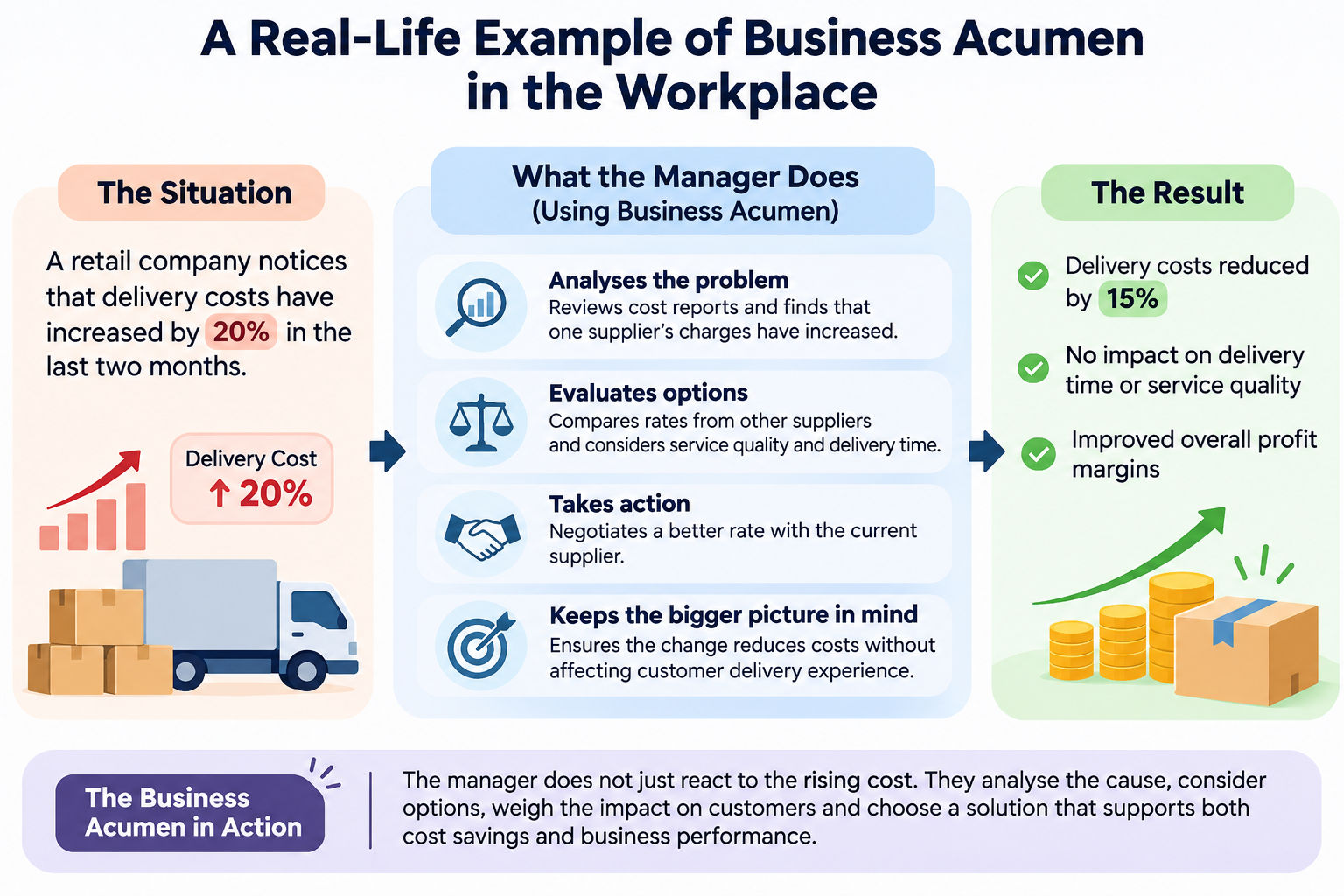
Real Life Business Acumen Example:
You can develop business acumen by learning how businesses work and applying that knowledge at work. Here are six practical ways to build this skill.
Start by learning:
This helps you understand how your role contributes to the company's success.
Focus on understanding basic financial terms:
You can also read company reports or speak with your finance team to learn more.
Read: Essential Skills for Accounting and Finance
Make it a habit to:
This gives you a better understanding of market changes and business opportunities.
Understand the roles of different teams:
This shows how different teams work together to achieve business goals.
Before making a decision:
Using data helps you understand what is working and where changes are needed.
You can learn by:
Pay attention to how they assess risks, compare options and make decisions.
Business leaders look beyond daily tasks. They consider how their decisions affect the company, its customers and its future. You can develop this way of thinking by following four simple practices.
Understand how your work connects to the company's goals. Before making a decision, consider:
Every business decision can affect costs, customers, employees and deadlines. Before taking action:
Learn About: Risk Management Strategies
Do not just point out problems. Take steps to find possible solutions:
A decision that gives quick results may not always support future growth. For example, offering heavy discounts may increase sales but reduce profit margins. Before making such decisions:
Learn the difference between Goal vs Objective
Conclusion:
Business acumen is a skill you can develop with practice.
Over time, this will help you think and make decisions like a business leader.
Ready to start your business journey? Book a free consultation with upGrad today to find the best path for your career.
More Helpful Reads:
Business acumen is the ability to understand how a business works and make decisions that support its goals. It includes knowing how a company earns money, manages costs, serves customers and competes in the market. It also means understanding how your decisions affect the overall business.
There is no single official list, but four commonly recognised areas are:
The seven pillars can vary across business frameworks. A common list includes strategy, finance, marketing, sales, operations, people management and technology. These areas cover how a business sets goals, manages resources, attracts customers and runs its daily activities.
Show it with a real example instead of simply claiming it. Explain a situation where you considered costs, customer needs or market trends before making a decision. Mention the action you took and how it benefited the business.
Business acumen is mainly a skill that develops with knowledge, practice and work experience. It involves understanding business finances, markets, customers and operations. Qualities such as curiosity, critical thinking and good judgement can also help you build it.
Yes, you can develop business acumen over time. Learn how your company earns money, follow industry trends, understand basic financial terms and observe how experienced leaders make decisions. Applying this knowledge at work will help you improve.
A manager notices that delivery costs are increasing and reviews supplier charges to find the reason. They negotiate a better rate with a supplier without affecting service quality. This shows business acumen because the manager considers both costs and customer needs before making a decision.
Show that you understand the company, its customers and the industry it operates in. Share an example of a decision where you considered costs, risks or business goals before taking action. Explain the result to show how you applied your understanding.
Financial knowledge helps you understand how decisions affect revenue, expenses, profit and cash flow. For example, before approving a project, you can compare its expected costs with the returns it may generate. This helps you judge whether the project is financially practical.
Business acumen helps you consider costs, risks, customer impact and expected results before making a decision. For example, a marketing team may review campaign costs and sales data before increasing its advertising budget. This makes decisions more informed and aligned with business goals.
Yes, business acumen is useful for employees at every level. It helps them understand how their work supports company goals and affects customers, costs and other teams. For example, a marketing executive who understands sales targets can plan campaigns that support revenue growth.
Commercial awareness means understanding the market, industry, competitors and customer needs that affect a business. Business acumen is broader because it also includes financial knowledge, strategic thinking and an understanding of business operations. It involves using this knowledge to make sound business decisions.
1347 articles published
We are an online education platform providing industry-relevant programs for professionals, designed and delivered in collaboration with world-class faculty and businesses. Merging the latest technolo...
Speak with MBA expert
By submitting, I accept the T&C and
Privacy Policy
From MBA to Dream Job - Explore Our Alumni Success Stories
Top Resources
Master's Degree
12 Months
Master's Degree
13 Months
O.P.Jindal Global University
MBA (with Career Acceleration Program by upGrad)Become interview ready with Career Services
Master's Degree
12 Months