Organisational Culture: How It Shapes Employee Behaviour and Performance
By upGrad
Updated on Nov 06, 2026 | 6 min read | 5.66K+ views
Share:

All courses
Certifications
More
By upGrad
Updated on Nov 06, 2026 | 6 min read | 5.66K+ views
Share:
Table of Contents
Quick Insights:
Want to understand organisation culture and other business management factors? Explore MBA online courses upGrad’s guided learning lets you practise through projects and case studies at your own pace.
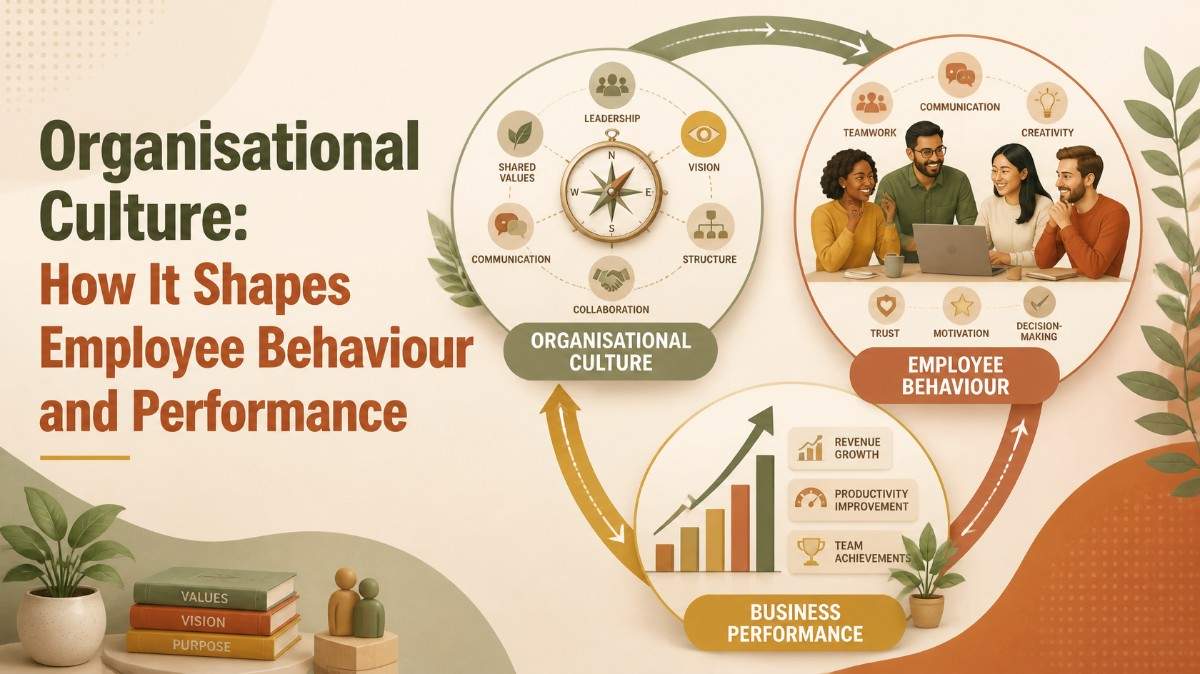
In this image you can see how organisational culture brings people together through shared values, teamwork and common goals. And how it helps shape employee behaviour and overall business performance.
Popular MBA Programs
Every workplace has its own way of doing things. It can be seen in how employees communicate, work in teams, follow rules and respond to challenges. These shared practices form the organisation's culture and influence the everyday work experience.
Organisational Culture Meaning
Organisational culture refers to the shared values, beliefs, attitudes and behaviours that shape how people work and treat one another in a company. In simple words, it is "the way things are done here." Employees understand this culture by observing what the company rewards, what it accepts and how its leaders behave.
Also Understand: What is Organizational Development
Want a global MBA without leaving your job? Study online with Golden Gate University and upGrad, with an optional campus immersion in San Francisco. Explore the MBA from Golden Gate University.
Free Courses
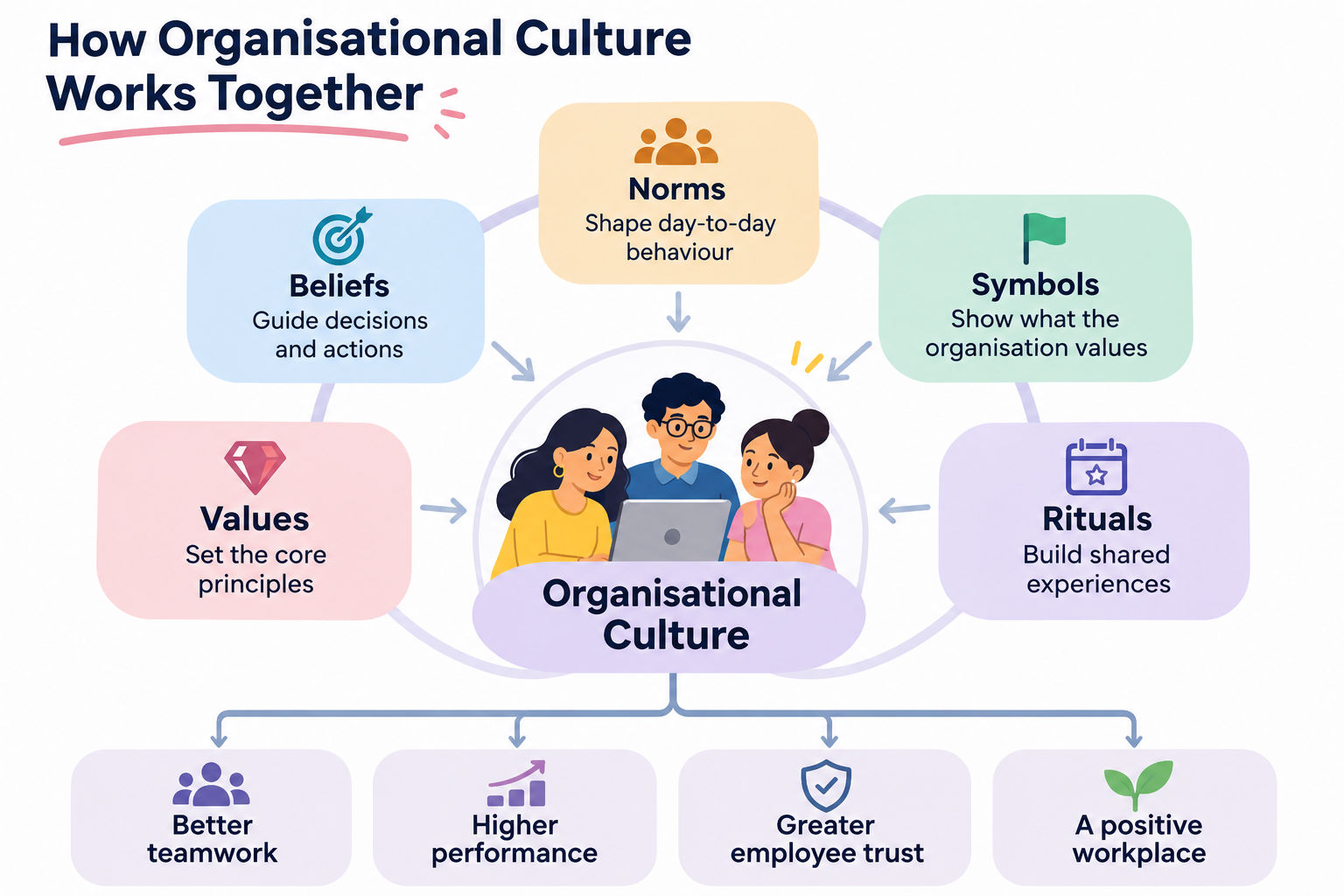
Organisational culture is shaped by many elements. Some are easy to notice and some influence how employees think and behave at work.
| Element | Description | Workplace Example |
| Values | The things a company believes are important. | A company that values honesty refuses to make a deal that is not fair. |
| Beliefs | What employees think is important for good work. | Employees believe that working as a team gives better results. |
| Norms | The usual ways employees are expected to behave. | Employees are expected to reply to work messages on the same day. |
| Symbols | Things that show what a company stands for. | An open office shows that the company supports teamwork and sharing ideas. |
| Rituals | Activities that employees do regularly. | Weekly team meetings and yearly award ceremonies. |
| Stories | Stories about the company's past and growth. | New employees hear how the founder started the company. |
| Language | The words and terms employees use at work. | A company calls its employees "partners" instead of "staff". |
MBA Courses to upskill
Explore MBA Courses for Career Progression
O.P.Jindal Global University
MBA (with Career Acceleration Program by upGrad)Become interview ready with Career Services
PSB MBA + IIML Certification
MBA from Paris School of Business with Certification from IIM LucknowThe Competing Values Framework, developed by Kim Cameron and Robert Quinn, identifies four common types of organisational culture. Each type has a different approach to teamwork, innovation, competition and workplace management.
Clan culture creates a family-like work environment. It focuses on teamwork, trust, employee development and loyalty. Leaders act as mentors and encourage employees to work together and support one another.
Adhocracy culture encourages creativity, new ideas and risk-taking. Employees get the freedom to experiment, try new approaches and learn from failures. This type of culture is common in start-ups and technology companies.
Market culture focuses on targets, competition and business results. Employees work towards clear goals, and their performance is measured regularly. Companies often reward employees for meeting targets and achieving results.
Hierarchy culture follows a structured work environment with clear rules, roles and reporting levels. It focuses on stability, consistency and efficiency. This type of culture is often found in banking, government and manufacturing.
Understand: Levels of Management
Let’s look at the organisational culture type its key characteristics and example at a glance for better understanding:
| Type of Culture | Key Characteristics | Workplace Example |
| Clan | Teamwork, trust and employee development | Mentoring programmes and team-building activities |
| Adhocracy | Creativity, flexibility and risk-taking | Hackathons and pilot projects for new ideas |
| Market | Competition, targets and results | Sales targets and performance-based rewards |
| Hierarchy | Rules, structure and clear responsibilities | Standard procedures and formal approval processes |
Many organisations follow a mix of these four culture types, depending on their values, goals and workplace practices
Organisational culture affects how employees feel, work and interact with one another. A positive workplace culture can improve employee motivation, teamwork and overall business performance.
Employees feel more involved when they connect with the company's values and goals. A supportive culture encourages them to:
Explore: Inspiring Ways to Improve Employee Development
A workplace built on trust and shared goals makes it easier for employees to work together. It encourages:
Employees are more likely to stay when they feel respected, valued and comfortable at work. A positive culture can:
Organisational culture gives employees a common understanding of how to act at work. It helps them:
When employees are motivated, work well together and stay with the organisation, the business benefits from:
Helpful Read: Organizational Behavior Model
Organisational culture affects how employees behave and perform in their daily work. It influences how they communicate, make decisions, handle responsibilities and interact with others.
Employees often follow the behaviour they see around them. For example, when a company values punctuality and responsibility, employees are more likely to:
On the other hand, when poor work habits are ignored, other employees may start following them too.
Workplace culture shapes how comfortable employees feel when sharing their thoughts. In an open and supportive environment, employees are more likely to:
In a workplace where employees fear criticism, they may avoid speaking up. This can delay problem-solving and affect teamwork.
Organisational culture gives employees an idea of what is expected from them. It influences how they respond to different situations. For example, in a customer-focused company, employees may:
Also Read: Why Listening is Important for Effective Communication
A supportive workplace gives employees a better environment to focus on their work. It can:
When employees do not feel supported or valued, they may lose interest in their work, feel stressed and struggle to perform well.
Subscribe to upGrad's Newsletter
Join thousands of learners who receive useful tips
Different companies follow different workplace practices based on their values and business goals. Here are some examples of how organisational culture can shape employee behaviour.
| Company | Type of Culture or Cultural Practice | How It Shapes Employee Behaviour |
| Innovation-focused culture | Gives employees room to share new ideas and test different solutions. | |
| Netflix | Freedom and responsibility | Promotes ownership of decisions and open, honest feedback. |
| Zappos | Customer-focused culture | Gives employees the freedom to take extra steps to improve customer experience. |
| Patagonia | Purpose-driven and environmentally focused culture | Connects employees' work with environmental responsibility. |
| Amazon | Customer-focused and performance-driven culture | Drives employees to consider customer needs and use measurable results when making decisions. |
These examples are based on how the companies publicly describe their workplace cultures. Employee experiences may differ across teams and locations.
Conclusion
Organisational culture is more than the values a company talks about. It is reflected in how employees work, communicate and treat one another every day.
Ready to start your business journey? Book a free consultation with upGrad today to find the best path for your career.
More Similar Reads:
Organisational culture is the shared way employees think, behave and work in a company. It is reflected in everyday activities, like how people communicate, follow rules, make decisions and treat their colleagues.
Organisational culture influences how employees behave and interact at work. It affects how they handle responsibilities, respond to managers, work in teams and deal with workplace challenges.
The Competing Values Framework identifies four main types:
Five commonly recognised elements are values, beliefs, norms, symbols and rituals. For example, company values may promote honesty, norms may set expectations for punctuality, and regular team meetings may bring employees together.
Employees generally follow the behaviour they see around them. For example, when a company values teamwork, employees are more likely to share ideas, help colleagues and work together to solve problems.
A supportive workplace gives employees the confidence and resources to do their jobs well. Clear expectations, regular feedback and helpful managers can improve work quality. A poor communication and workplace stress can reduce productivity.
Some common examples include:
Organisational culture refers to the shared values and practices that shape how a company works over time. Organisational climate describes how employees feel about their workplace at a particular time. For example, workplace conflicts can create a negative climate even when a company promotes teamwork.
An organisation can improve its culture by:
A strong organisational culture has shared values, clear expectations and consistent workplace practices. Employees understand their responsibilities, communicate openly and trust their colleagues and leaders.
There is no single standard list of the 5 C's of organisational culture. One commonly used version includes communication, collaboration, commitment, creativity and consistency. These focus on how employees share ideas, work together and follow common goals.
The seven key elements are values, beliefs, norms, symbols, rituals, stories and language. Together, they shape workplace practices, employee interactions and the way people understand their organisation.
1346 articles published
We are an online education platform providing industry-relevant programs for professionals, designed and delivered in collaboration with world-class faculty and businesses. Merging the latest technolo...
Speak with MBA expert
By submitting, I accept the T&C and
Privacy Policy
From MBA to Dream Job - Explore Our Alumni Success Stories
Top Resources
Master's Degree
12 Months
Master's Degree
13 Months
O.P.Jindal Global University
MBA (with Career Acceleration Program by upGrad)Become interview ready with Career Services
Master's Degree
12 Months