Employee Development Plan
By upGrad
Updated on May 08, 2026 | 7 min read | 1.71K+ views
Share:

All courses
Certifications
More
By upGrad
Updated on May 08, 2026 | 7 min read | 1.71K+ views
Share:
Table of Contents
An employee development plan is a well-defined, collaborative framework created by both managers and employees to support continuous growth. It specifies clear goals, practical actions, and the resources required to enhance skills and advance careers. By aligning individual ambitions with organizational objectives, these plans help improve employee engagement, retention, and overall performance. Key elements typically include SMART goals, defined timelines, and structured development approaches.
This blog provides a detailed idea into building structured growth programs that actually work for modern teams. You'll learn how to identify skill gaps and set measurable milestones to drive high performance across different departments.
Want to move beyond basic growth strategies and build an employee development plan that drives real performance? Explore upGrad’s MBA and Management programs to learn practical people management, workforce planning, and leadership skills for modern workplaces.
Popular Management Programs
A 2018 LinkedIn Workplace Learning Report found that 94% of employees would stay longer at a company that invests in their career development. (Source: LinkedIn). Organizations that skip development planning often face higher attrition, lower engagement, and skill gaps that slow down growth.
An employee development plan acts as a retention tool that pays for itself by keeping your most knowledgeable people engaged and motivated.
When you integrate a career development plan for employees into your weekly or monthly check-ins, you build a culture of ongoing learning. This consistent approach helps your business stay competitive. You'll have a pipeline of internal candidates ready for leadership roles when they open up.
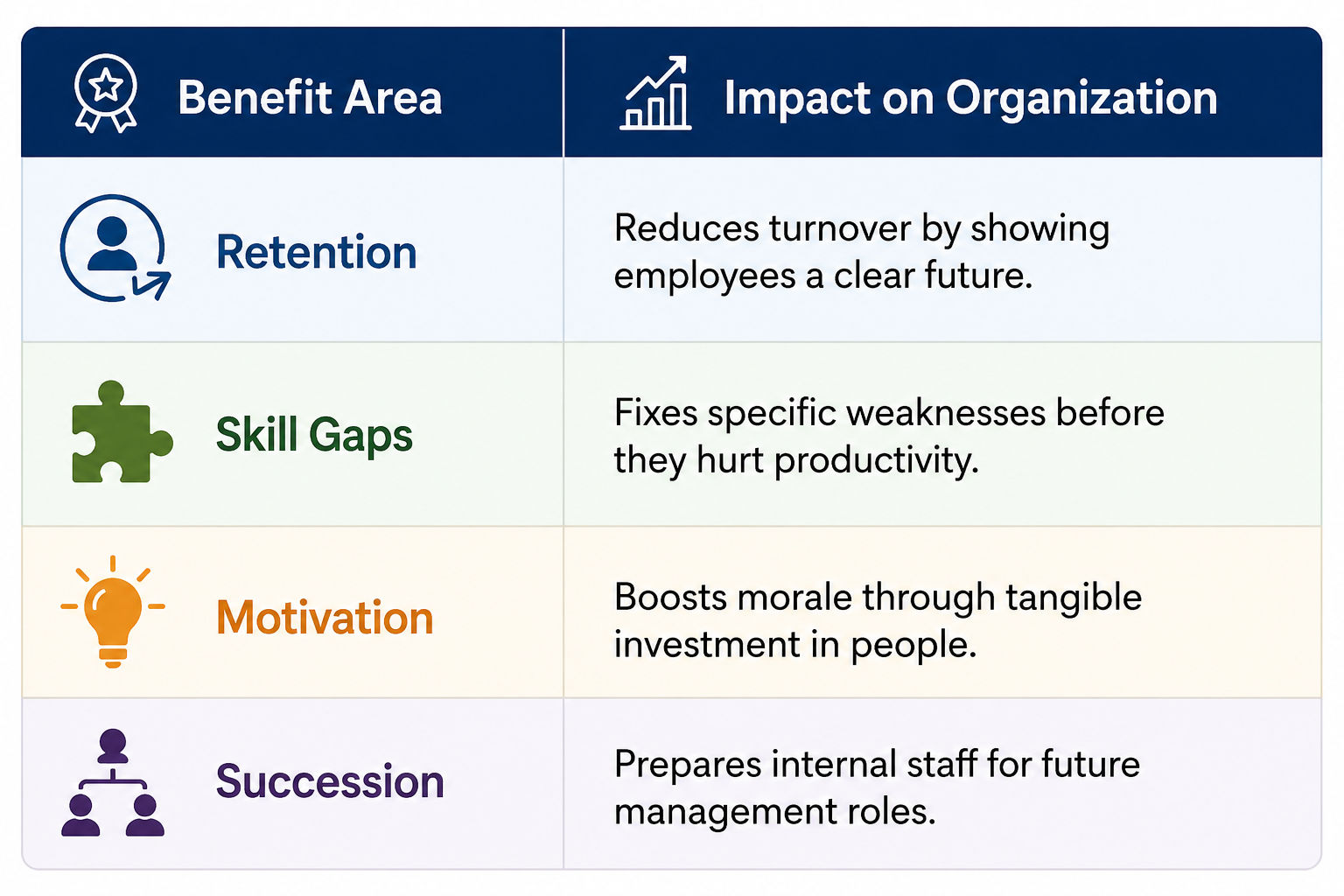
You'll see better results when you align with what the company actually requires to hit its quarterly targets. That's how you turn a simple training list into a professional development improvement plan.
Companies Without Development Plans |
Companies With Development Plans |
| Higher turnover | Better retention |
| Skill shortages | Internal talent growth |
| Slow adaptation | Faster upskilling |
| Weak leadership bench | Strong succession planning |
Must Read: 4 Inspiring Ways You Can Improve Your Employee Development Methods
Here are the most common types of development plans:
These plans focus on improving current job performance. They're useful when employees struggle with deadlines, communication, or technical skills.
A career development plan for employees focuses on future promotions or role transitions. Employees prepare for leadership, specialization, or cross-functional movement.
Companies use these plans for high-potential employees. The focus stays on decision-making, communication, delegation, and strategic thinking.
These plans target specific capability such as coding, sales negotiation, SEO, financial analysis, or public speaking.
These are tailored for a single employee’s personal and professional growth and focus on identifying strengths, addressing skill gaps, and aligning development efforts with individual career goals.
These are plans designed to enhance performance before issues arise. Unlike performance-driven plans, they are used when an employee is already performing adequately but wants to improve further or prepare for more complex responsibilities. The emphasis is on building new capabilities and staying ahead of future role demands.
Also read: Mastering Training and Development in HRM: Types and Purpose
Free Courses
A development plan works best when employees actively participate in building it. People commit more when they help shape the process instead of receiving generic goals from HR.
Step 1: Start with a skills assessment
Before setting goals, understand where the employee stands today. What are they good at? What do they struggle with? What feedback have they received recently?
Use self-assessments, manager input, and performance data together. Don't rely on just one source.
Step 2: Identify development goals
Goals should be specific and tied to real outcomes. "Improve communication skills" isn't a goal. "Lead the next two team presentations and collect feedback from peers afterward" is a goal.
Ask the employee what they actually want. Don't assume.
Step 3: Choose the right development activities
Development happens through experience, feedback, and observation too. Effective activities include:
Step 4: Set timelines and checkpoints
Every goal needs a deadline. Every deadline needs a check-in. Without structure, even the best plan sits in a folder and does nothing.
Monthly or quarterly reviews keep the plan alive.
Step 5: Document and share it
Both the employee and manager should have a copy. It should be easy to find, easy to update, and easy to reference during performance conversations.
Must Read: How to Increase the Productivity of your Employees?
Management Courses to upskill
Explore Management Courses for Career Progression
IIIT-B & IIM, Udaipur
Chief Technology Officer & AI Leadership ProgrammeAn employee development plan benefits both employees and organizations. The employee gains direction and confidence. The company gains stronger performance, higher retention, and better internal talent pipelines.
Benefit |
How It Helps Employees |
Impact on Organizations |
| Better Retention | Creates long-term career growth | Reduces turnover and hiring costs |
| Higher Productivity | Improves skills and confidence | Boosts efficiency and performance |
| Leadership Pipeline | Prepares employees for leadership | Builds future managers internally |
| Employee Engagement | Increases motivation and purpose | Improves morale and commitment |
| Better Adaptability | Encourages regular skill-building | Helps teams adapt faster |
| Internal Talent Growth | Supports career advancement | Reduces skill gaps |
| Faster Upskilling | Builds updated job skills | Speeds up business adaptation |
| Stronger Employer Brand | Shows investment in employees | Attracts better talent |
Do Read: Difference between Training and Development
Many development plans fail because companies treat them like administrative tasks instead of ongoing conversations. A professional development improvement plan should evolve as employees grow.
Avoid these mistakes:
Development planning should stay flexible enough to support real career shifts instead of forcing outdated goals.
Also Read: 12 Best Time Management Tips for Employees 2026 [Experts’ Guide]
Creating an employee development plan is the easy part. Sustaining it over months or years takes real commitment from managers, employees, and leadership teams.
An employee development plan gives employees direction, structure, and real opportunities to grow inside an organization. It also helps companies build stronger teams, improve retention, and prepare future leaders before skill gaps become business problems.
The strongest plans stay practical. They focus on clear goals, measurable progress, regular feedback, and real workplace learning instead of generic training checklists. When employees see growth happening consistently, motivation changes, and performance follows.
Ready to start your journey? Book a free consultation with upGrad today to find the best path for your career.
An employee development plan helps employees improve their skills and prepare for future responsibilities inside a company. It creates a clear growth path linked to career goals and business needs.
The plan also improves accountability because employees and managers can track progress together through measurable milestones, projects, and learning activities over time.
An individual development plan focuses on long-term growth and career progression. It helps employees build new capabilities and prepare for future roles. A performance improvement plan usually addresses current performance issues, missed targets, or workplace concerns that require immediate correction within a defined timeline.
A career development plan for employees should include career goals, skill gaps, learning activities, timelines, and progress metrics. Managers should also include feedback checkpoints and project-based learning opportunities.
The plan works best when employees actively participate in setting goals instead of receiving generic objectives from leadership teams.
Most companies review employee development plans quarterly or every six months. Frequent reviews help employees stay focused and adjust goals when business priorities or career interests shift.
Regular conversations also help managers identify obstacles early before progress slows down completely.
Managers and employees should create the plan together. Employees bring career interests and learning preferences, while managers provide guidance, feedback, and business context.
HR teams often support the process with templates, training resources, and tracking systems across departments.
Employees are more likely to stay when they see growth opportunities inside the company. A structured employee development plan shows that the organization invests in learning and long-term career progression.
That sense of progress improves engagement and reduces the feeling of career stagnation that often leads to resignations.
Many companies create development plans once a year and never revisit them again. Others use vague goals without measurable outcomes or timelines.
Some organizations also focus only on technical training while ignoring leadership, communication, and problem-solving skills that employees need for long-term success.
Yes. Small businesses often benefit even more because employees usually handle multiple responsibilities and grow quickly into broader roles.
Development plans in smaller companies may rely more on mentorship, project exposure, and cross-functional learning instead of expensive training programs.
Companies use HR software, learning management systems, performance management platforms, and simple tracking spreadsheets to manage development plans.
The tool matters less than consistency. Even a basic shared document works when managers regularly review progress and support employee learning.
Managers can measure success through skill improvement, certification completion, promotion readiness, productivity growth, and employee feedback.
Performance indicators should connect directly to the employee’s goals so progress feels meaningful instead of administrative.
Employees usually disengage when plans feel unrealistic, generic, or disconnected from actual career opportunities. Lack of manager support also reduces motivation quickly.
Development plans work better when employees receive feedback, project exposure, and enough time to apply new skills during regular work.
1001 articles published
We are an online education platform providing industry-relevant programs for professionals, designed and delivered in collaboration with world-class faculty and businesses. Merging the latest technolo...
Get Free Consultation
By submitting, I accept the T&C and
Privacy Policy
Top Resources
Certification
3 Months
Certification
6 Months
O.P. Jindal Global University
Masters in International Accounting and Finance (Accredited by ACCA, UK)Master's Degree
12 Months