Stages of Team Development: Understanding the 5 Stages of Team Development for High-Performing Teams
By Sriram
Updated on Jul 01, 2026 | 10 min read | 4.5K+ views
Share:

All courses
Certifications
More
By Sriram
Updated on Jul 01, 2026 | 10 min read | 4.5K+ views
Share:
Table of Contents
Stages of team development are the sequential phases teams progress through as they grow into cohesive and high-performing units. Developed by psychologist Bruce Tuckman, this widely recognized model outlines five key stages: Forming, Storming, Norming, Performing, and Adjourning. Understanding these stages helps leaders and team members navigate challenges, improve collaboration, build trust, and achieve shared goals more effectively.
In this blog, you'll learn what the stages of team development are, explore the 5 stages of team development in detail, understand why they matter, and discover practical ways to build stronger, more effective teams.
Want to lead high-performing teams with confidence? Explore upGrad's Management programs to develop practical skills in team building, communication, conflict resolution, and strategic decision-making.
Popular Management Programs
Team development stages are the sequential phases teams progress through as they evolve into cohesive and high-performing units. These stages explain how members build trust, define roles, improve communication, overcome challenges, and collaborate effectively to achieve shared goals. The process recognises that strong teamwork develops gradually rather than happening immediately.
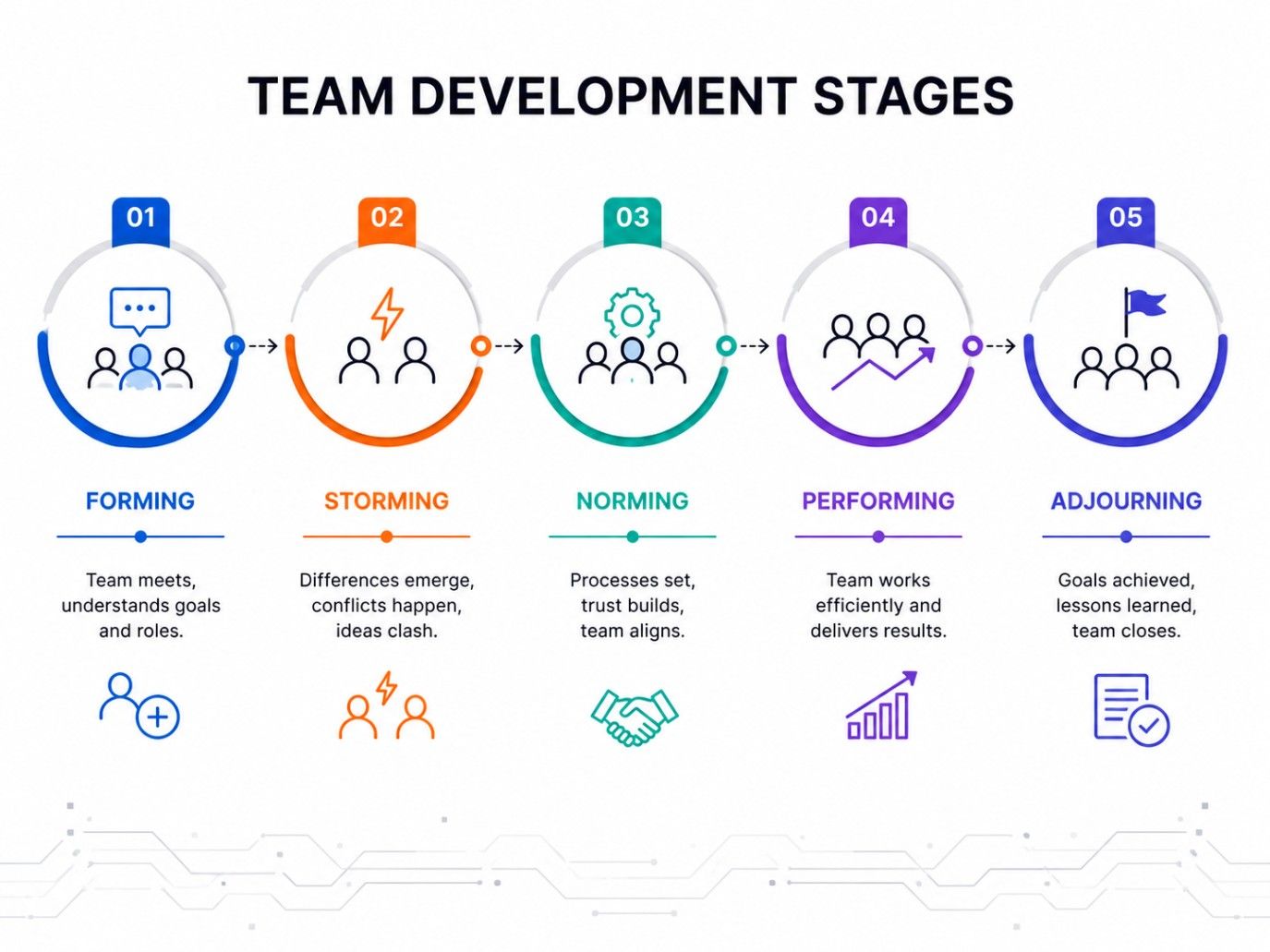
Introduced by psychologist Bruce Tuckman in 1965, the model originally included four stages: Forming, Storming, Norming, and Performing, with Adjourning added later. Today, it is widely used to strengthen leadership, improve collaboration, manage conflicts, and enhance overall team performance.
Although every team is unique, most teams experience similar patterns as they evolve. The stages of team development typically involve:
By understanding these phases, leaders can provide appropriate guidance and support at every step, helping teams navigate obstacles more effectively.
Also read : Management process: Definition, Features & function
Free Courses
The 5 stages of team development describe the natural progression teams follow as they work together. Each stage has distinct characteristics, leadership requirements, and expected outcomes. While teams generally move through these stages in sequence, they may occasionally return to an earlier stage when significant changes occur.
Here's a quick overview of each stage:
Stage |
Primary Focus |
Team Experience |
| Forming | Orientation and relationship building | Team members meet, understand objectives, and learn about one another. |
| Storming | Conflict and adjustment | Differences in opinions, work styles, and expectations begin to surface. |
| Norming | Collaboration and trust | Team members establish shared norms, strengthen relationships, and improve communication. |
| Performing | Productivity and autonomy | The team works efficiently toward common goals with minimal supervision. |
| Adjourning | Closure and reflection | The project concludes, achievements are recognized, and lessons are documented. |
Although every stage plays an important role, teams spend different amounts of time in each phase depending on factors such as project complexity, leadership effectiveness, organizational culture, and team composition.
Also Read: Resource Management: Meaning, Importance, Types, Process, and Career
Management Courses to upskill
Explore Management Courses for Career Progression
IIIT-B & IIM, Udaipur
Chief Technology Officer & AI Leadership ProgrammeIIM Kozhikode
PCP in AI for Business ProfessionalsEvery team follows a unique journey, but most experience similar patterns as they work toward a common goal. The 5 stages of team development describe how team dynamics evolve, from initial introductions to project completion. Understanding what happens during each stage allows leaders to respond appropriately, reduce friction, and help the team progress more effectively. Below is a detailed look at each stage, including its characteristics, recommended leadership style, practical actions, and common challenges.
The Forming stage is the initial phase where team members meet, understand project goals, and learn their roles.
While enthusiasm is high, uncertainty remains, and members rely on leadership for guidance and direction.
A direct and directive leadership approach works best during this stage. Leaders should provide structure, establish expectations, and ensure everyone understands the team's purpose.
Some common challenges during the Forming stage include:
Successfully navigating the Forming stage creates the foundation for stronger collaboration in the next phase.
Also Read: Complete Guide to Resource Management Projects: Key Steps, Tools, and Strategies
The Storming stage is when conflicts arise as team members express different opinions, work styles, and priorities. Although challenging, resolving these differences strengthens collaboration, trust, and teamwork, preparing the team for the next stage.
A coaching and supportive leadership style is most effective. Leaders should guide discussions, encourage collaboration, and help resolve disagreements without taking complete control of every situation.
Teams often struggle with:
Rather than viewing the Storming stage as a setback, organizations should recognize it as an opportunity to strengthen communication and build trust.
Also Read: Difference Between Business, Profession, and Employment: Definitions and Key Distinctions
Once conflicts are addressed, teams gradually enter the Norming stage. Members begin understanding each other's strengths, respect different perspectives, and establish shared ways of working. Communication becomes more open, collaboration improves, and the team develops stronger relationships built on trust.
Instead of focusing on individual opinions, members prioritize collective success and willingly support one another.
A facilitative and participative leadership style is appropriate during this stage. Leaders encourage collaboration while allowing the team to contribute more actively to decisions.
Although the team functions more effectively, leaders should continue monitoring for:
The Norming stage establishes the stability needed for teams to reach their highest level of performance.
Understanding the stages of team development is the first step toward becoming an effective leader. Explore upGrad's Leadership and Management programs
IIM Kozhikode Strategic AI for Business Professionals - Leadership for an AI-First World
The Performing stage represents the highest level of team maturity. Team members work together efficiently, understand their responsibilities, and solve problems with minimal supervision. Trust is well established, communication is effective, and individuals are motivated to achieve shared objectives.
Rather than relying heavily on the leader for everyday decisions, the team demonstrates autonomy, accountability, and confidence.
A delegating leadership approach is most effective. Leaders focus on providing strategic direction while empowering the team to make operational decisions independently.
Even high-performing teams can encounter obstacles such as:
Leaders should continue supporting the team without unnecessary micromanagement, ensuring members remain engaged and motivated.
The Adjourning stage occurs when a project is completed or the team disbands. Also known as the mourning or transforming stage, it focuses on recognizing achievements, reflecting on lessons learned, and helping members transition to new responsibilities.
While productivity goals have been achieved, this phase is important because it provides closure and ensures valuable knowledge is retained for future projects.
A celebratory and reflective leadership approach helps teams conclude projects positively while encouraging continuous learning.
Some teams may experience:
Taking time to celebrate accomplishments and document lessons learned helps organizations improve future projects while maintaining employee engagement.
A software development team progresses through all five stages as it builds a new application. The team starts by defining goals and assigning roles (Forming), works through disagreements over technical decisions (Storming), establishes effective workflows and trust (Norming), collaborates efficiently to deliver the project (Performing), and finally reviews lessons learned while celebrating the project's success (Adjourning).
Although the 5 stages of team development are typically presented in sequence, real-world teams do not always move through them in a straight line. A team that has reached the Performing stage may temporarily return to the Storming stage when significant changes occur, such as:
These setbacks are a normal part of team development rather than signs of failure. Effective leaders recognize the team's current stage, adjust their leadership style accordingly, and provide the guidance needed to help the team regain momentum and continue progressing toward high performance.
Also read : Financial Risk Management: A Complete Beginner's Guide
Teams may encounter several challenges as they progress through different development stages. Recognizing these issues early helps leaders maintain collaboration and productivity.
Challenge |
Description |
| Poor Communication | Unclear expectations and inconsistent communication can lead to misunderstandings and confusion. |
| Role Ambiguity | Undefined responsibilities reduce accountability and may result in duplicated or overlooked tasks. |
| Team Conflicts | Disagreements, particularly during the Storming stage, can affect collaboration and team morale if left unresolved. |
| Lack of Trust | Limited trust makes it difficult for team members to share ideas, collaborate, and support one another. |
| Resistance to Change | New team members, changing priorities, or updated processes can create uncertainty and slow progress. |
| Low Engagement | Employees who feel undervalued or excluded may participate less, reducing motivation and overall team performance. |
Strong leadership and consistent communication help teams progress successfully through every stage of development.
Following these best practices can improve collaboration and overall performance:
Tuckman's Model vs Other Team Development Models
Although Tuckman's model is widely recognized, organizations may also use other frameworks depending on their objectives.
Framework |
Primary Focus |
Best For |
| Tuckman's Model | Team development over time | Project teams, leadership development, workplace collaboration |
| GRPI Model | Goals, Roles, Processes, and Interpersonal Relationships | Diagnosing team performance issues |
| Belbin Team Roles | Individual behavioral strengths within teams | Role allocation and team composition |
Tuckman's model explains how teams evolve, while frameworks like GRPI and Belbin focus on improving team effectiveness from different perspectives. Many organizations combine these models to strengthen collaboration and leadership.
Do read : Supply Chain Management Salary in India in 2026
The stages of team development provide a practical framework for helping teams evolve into cohesive and high-performing units. By understanding the 5 stages of team development Forming, Storming, Norming, Performing, and Adjourning leaders can improve collaboration, resolve conflicts, and support stronger team performance.
Since team development is not always linear, teams may revisit earlier stages as circumstances change. With effective leadership, open communication, and continuous learning, organizations can successfully guide teams toward long-term success and productivity.
Want to explore more about Team management? Book your free 1:1 personal consultation with our expert today.
Understanding the stages of team development helps managers recognize how teams evolve and respond to challenges at each phase. Instead of reacting to conflicts or slow progress, leaders can adjust their management style, improve communication, and build trust. This approach creates a more collaborative work environment and helps teams achieve better results over time.
Yes. Remote and hybrid teams typically move through the same development stages as in-person teams. The difference is that building trust and communication often takes longer because interactions are mostly virtual. Regular check-ins, collaborative tools, and clear expectations help distributed teams progress more effectively through each stage.
There is no fixed timeline. Some teams reach the Performing stage within a few weeks, while others may take several months. The speed depends on factors such as team size, leadership, project complexity, communication, and previous experience working together. Consistent support and collaboration usually accelerate the process.
The five stages of project team development are Forming, Storming, Norming, Performing, and Adjourning. During these stages, team members move from getting acquainted and defining roles to resolving conflicts, working efficiently, and eventually completing the project. The model helps project managers understand team dynamics and guide members toward higher productivity.
The 7 C's of team building commonly include Communication, Collaboration, Commitment, Contribution, Cooperation, Coordination, and Conflict Resolution. These principles encourage stronger relationships, improve teamwork, and help teams achieve shared goals. Organizations often combine these concepts with team development models to strengthen overall team performance.
A new team generally progresses through the same five stages identified by Bruce Tuckman: Forming, Storming, Norming, Performing, and Adjourning. Every new team experiences these phases differently depending on its objectives, leadership, and members. Understanding the stages of team development helps teams navigate each phase more effectively.
While Tuckman's model focuses on five stages, team-building discussions often include terms such as trust, communication, collaboration, accountability, leadership, conflict resolution, and continuous improvement. These concepts support healthy team development and help members work together more effectively throughout a project's lifecycle.
Yes. Team development is rarely a straight path. A team may return to the Storming stage when new members join, leadership changes, priorities shift, or organizational restructuring occurs. Temporary setbacks are normal, and effective leadership helps the team rebuild trust and regain momentum
Leaders should observe team behaviors rather than relying on assumptions. Frequent conflicts often indicate Storming, while open collaboration and shared responsibility suggest Norming or Performing. Monitoring communication patterns, decision-making, and overall productivity provides valuable insights into where the team stands.
The stages of team development are valuable across almost every industry, including IT, healthcare, education, finance, construction, manufacturing, and marketing. Any organization that relies on collaboration can use this framework to improve teamwork, manage conflicts, and increase productivity regardless of team size or project type.
Organizations cannot eliminate the natural stages of team growth, but they can help teams progress faster by setting clear goals, defining responsibilities, encouraging open communication, providing regular feedback, and resolving conflicts early. Investing in leadership development and team-building activities also creates a stronger foundation for long-term success.
699 articles published
Sriram K is a Senior SEO Executive with a B.Tech in Information Technology from Dr. M.G.R. Educational and Research Institute, Chennai. With over a decade of experience in digital marketing, he specia...
Get Free Consultation
By submitting, I accept the T&C and
Privacy Policy
Top Resources
Certification
3 Months
Certification
6 Months
O.P. Jindal Global University
Masters in International Accounting and Finance (Accredited by ACCA, UK)Master's Degree
12 Months