Social Learning Theory: Principles, Examples, Applications
By upGrad
Updated on Jul 02, 2026 | 8 min read | 2.25K+ views
Share:

All courses
Certifications
More
By upGrad
Updated on Jul 02, 2026 | 8 min read | 2.25K+ views
Share:
Table of Contents
Social Learning Theory is Developed by psychologist Albert Bandura, the theory makes a simple but powerful point: we don't just learn by trial and error, we learn by watching others. Whether it's picking up a new skill, adopting an attitude, or absorbing a value, a lot of it happens just by observing the people around us.
Social Learning Theory builds a bridge between behaviorism and cognition. Traditional behavioral psychology said learning happens purely through reinforcement, while Social Learning Theory pushes back a little on that and explains that there is more going inside our heads than just responding to rewards.
In this blog, you'll learn about social learning theory, who developed it, why it matters, how it works in classrooms, workplaces, and everyday life.
Explore Online MBA Courses from upGrad and build expertise on human behavior, understand it’s key to roles in psychology, HR, and education.
Popular Management Programs
Social learning theory is about how people learn from others, by observing, by thinking about what they observe, and then decide if they want to imitate that behavior. This is different from traditional theory whether people got rewards or punishments, and the behavior changes accordingly.
Social learning theory says that people also need to pay attention, acknowledging that our thoughts, beliefs, and mental processes play a real role in how we learn, especially when we're learning through observation rather than direct experience. This theory is also called the Bandura social learning theory, later known as Social Cognitive Theory.
Read for Better Insights: Organizational Behavior Model: Comprehensive Guide to Understanding and Application
Albert Bandura gave the Social Learning Theory, he is a Canadian American psychologist, he transformed the modern psychology through his work. His research showed that people do not just learn from being rewarded or punished rather by watching others and remembering what they do.
One of his famous studies is the Bobo Doll Experiment. It demonstrated that kids who saw adults being mean to a doll were more likely to be mean to the doll. The Bobo Doll Experiment showed a powerful influence from watching others.
Today, Albert Bandura social learning theory remains widely used in:
Feature |
Explanation |
| Learning through observation | People learn by watching others. |
| Cognitive processing | Thinking and memory influence learning. |
| Role models | Parents, teachers, peers, managers, and media all serve as models. |
| Motivation | People imitate behaviors they believe will produce positive outcomes. |
| Environment | Social surroundings shape learning opportunities. |
The Bandura social learning theory remains relevant because modern learning happens everywhere, even outside the classrooms. The theory explains why role models have such an influence on the behavior of people.
Instead of thinking that learning is passive, Bandura social learning theory says that people always watch, think about what they see, and decide which behaviors they want to adopt.
For example:
Free Courses
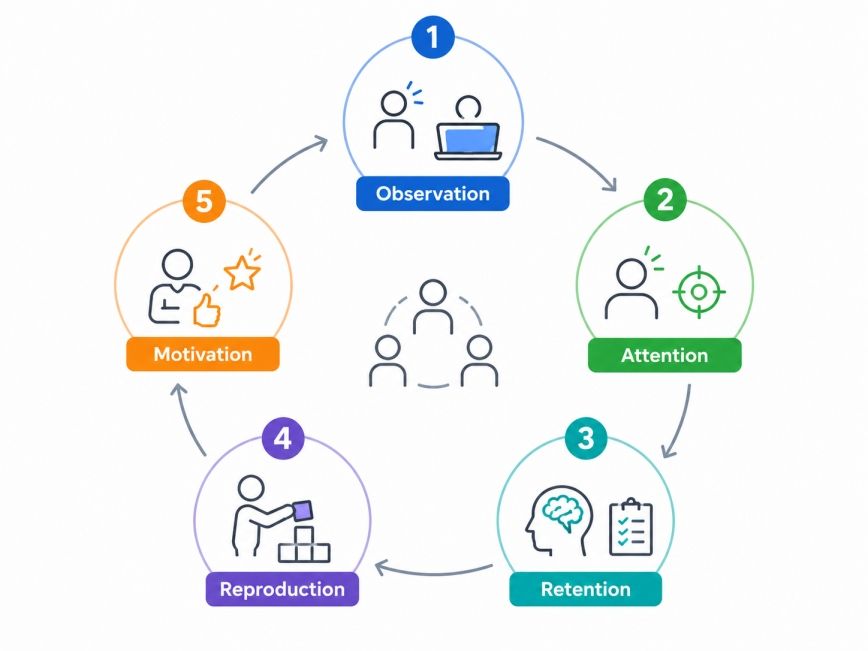
The principles of social learning theory are important to understand because it is easier to see why social learning theory is still a deal in education organizational learning, psychology, and leadership development.
A lot of people are interested in "What are the 5 principles of social learning theory?" Even though different books explain social learning theory in different ways, there are five main ideas that basically sum up what social learning theory is all about.
Observation is the starting point of learning. People watch someone perform a task before attempting it themselves. Without careful observation, learning becomes much harder.
Examples include:
Not every behavior gets noticed. A charismatic teacher often captures attention more effectively than someone reading directly from slides.
People pay attention to models they find:
Watching alone is not enough. Learners must remember what they observed. This explains why demonstrations often produce better learning outcomes than verbal instructions alone.
Retention improves through:
The learner now attempts the behavior. A medical student, for example, may observe a surgical procedure several times before performing it under supervision.
Success depends on:
People imitate behaviors only when they believe it is worthwhile. Therefore, when observing someone being punished, they may feel discouraged from imitating.
Motivation may come from:
These four stages is an explanation to why simply watching someone does not automatically lead to learning and each stage builds on the previous one.
Bandura identified four mental processes required for observational learning.
Stage |
Meaning |
Example |
| Attention | Notice the behavior | Watching a teacher solve a math problem |
| Retention | Remember the behavior | Recalling each problem-solving step |
| Reproduction | Perform the behavior | Solving a similar question independently |
| Motivation | Decide whether to continue | Practicing because good grades follow |
Ace your next finance interview with confidence. The MBA Career Acceleration Program from O.P. Jindal Global University is designed to enhance your business knowledge, leadership capabilities, and career readiness for competitive roles.
Management Courses to upskill
Explore Management Courses for Career Progression
IIIT-B & IIM, Udaipur
Chief Technology Officer & AI Leadership ProgrammeAlbert Bandura social learning theory is special because it includes observation, thinking, memory, and motivation. This approach is different from earlier behaviorist approaches.
Another takeaway is that just because we learn something does not mean we will do it immediately. We might understand the correct behavior today but will only apply it when we need to. This makes social learning theory useful for explaining human behavior in the real world, where decisions depend on context, goals, and personal judgment.
Nowadays, as people are learning online, Albert Bandura’s social learning theory remains just as relevant today as they were.
Although observation is central, reinforcement still plays an important role. Bandura described three common forms:
A theory can be easily understood through action. The social learning theory remained relevant for decades because it makes sense of things that are happening to us in our everyday life. From childhood to professional life, people often watch and learn before trying to do it themselves.
Education is one of the strongest areas where Albert Bandura social learning theory is applied.
Teachers do much more than explain concepts. They demonstrate behaviors, model problem-solving techniques, and create environments where students learn from both instructors and classmates.
Students also learn indirectly by observing how classmates respond to challenges, collaborate in teams, and present their ideas. This is one reason that collaborative learning has become increasingly popular in schools and universities.
Some practical classroom applications include:
Related Article: Evolving online education: Learning Together
Organizations also rely heavily on social learning theory, even if they don't use the term explicitly.
Think about your first week at your new job. Much of what you learned likely came from watching experienced coworkers rather than reading manuals.
Companies use observational learning in several ways:
Healthcare professionals frequently learn through observation before performing procedures themselves. This reduces errors while improving confidence and decision-making.
Examples include:
Digital platforms have made observational learning more accessible than ever. Watching an expert demonstrate a coding technique or explaining a financial model allows learners to understand concepts faster than reading instructions alone.
People now develop new skills through:
However, technology also presents challenges. Online audiences may imitate misinformation if unreliable sources appear credible. This reinforces the importance of choosing trustworthy role models and evidence-based content.
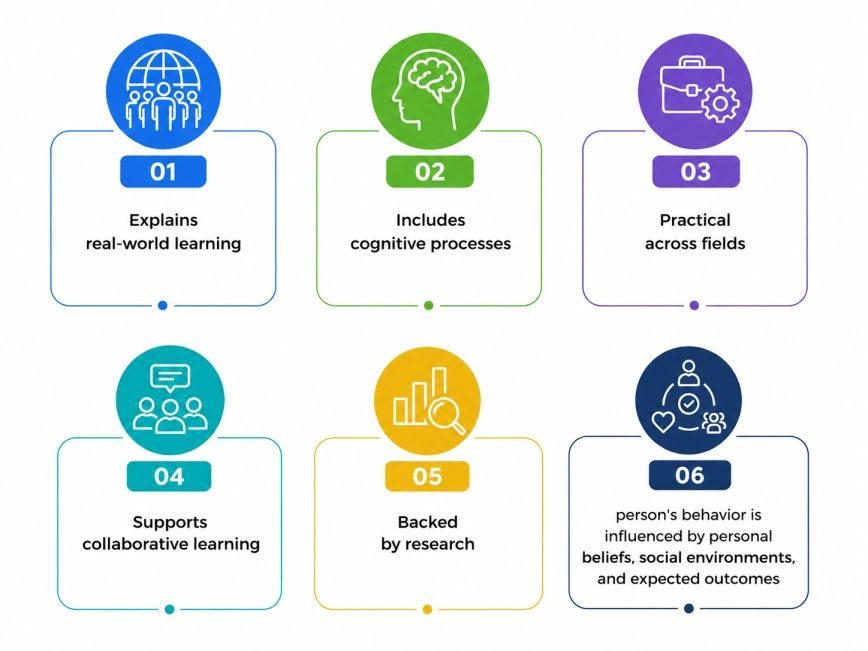
The biggest strength of the theory is its ability to explain learning in real-life situations. It recognizes that people are active thinkers who learn from experience, observation, and social interaction.
Some major advantages include:
Another strength is flexibility.
Bandura's social learning theory acknowledges that a person's behavior is influenced by personal beliefs, social environments, and expected outcomes.
Although highly influential, the theory does not explain every type of learning.
Some common criticisms include:
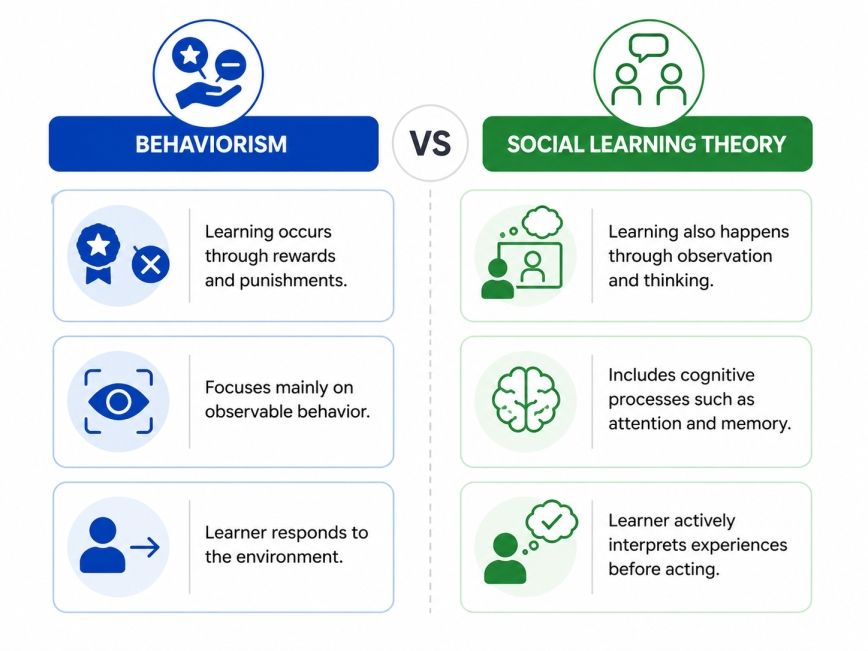
Many learners confuse social learning theory with behaviorism because both discuss reinforcement. The shift toward cognitive processes made Albert Bandura social learning theory a bridge between traditional behaviorism and modern cognitive psychology.
The difference is significant.
Behaviorism |
Social Learning Theory |
| Learning occurs through rewards and punishments. | Learning also happens through observation and thinking. |
| Focuses mainly on observable behavior. | Includes cognitive processes such as attention and memory. |
| Learner responds to the environment. | Learner actively interprets experiences before acting. |
Social learning theory continues to shape the way we understand human learning because it reflects how people actually acquire knowledge in everyday life. We rarely learn in isolation. The lasting impact of Albert Bandura social learning theory lies in its balanced view of learning.
It recognizes that rewards and consequences matter, but so do attention, memory, confidence, and social context. As learning environments continue to evolve, the core ideas behind Bandura social learning theory remain highly relevant.
The main idea is that people learn by watching others, remembering what they observe, and deciding whether to imitate those behaviors. Bandura social learning theory emphasizes that learning involves cognitive processes such as attention, memory, and motivation, not just external reinforcement.
The five core principles commonly associated with social learning theory are observation, attention, retention, reproduction, and motivation. Together, these explain how people notice a behavior, remember it, practice it, and decide whether repeating it will be beneficial.
A simple example is a child learning polite behavior by watching parents say "please" and "thank you." In the workplace, a new employee may learn how to conduct client meetings by observing an experienced manager. These situations illustrate what is social learning theory in everyday life.
Teachers apply Bandura social learning theory by demonstrating concepts, encouraging peer collaboration, using role-play, and providing constructive feedback. Students benefit from observing both teachers and classmates, making learning more interactive than relying on lectures alone.
Yes. Social media has expanded opportunities for observational learning. People regularly learn new skills, cooking techniques, coding practices, language tips, and fitness routines by watching creators online. At the same time, users should evaluate sources carefully because misinformation can also spread through observation.
Social learning theory focuses on learning through observation and imitation. Social Cognitive Theory, which Bandura developed later, expands this idea by placing greater emphasis on self-efficacy, self-regulation, and the reciprocal relationship between personal factors, behavior, and the environment.
Yes, Albert Bandura believed people have agency and are not controlled entirely by their environment. According to Albert Bandura social learning theory, individuals actively interpret experiences, make decisions, and choose whether to imitate observed behaviors based on personal goals and expected outcomes.
The founder of social learning theory was psychologist Albert Bandura. His research showed that people can learn by observing others without directly experiencing rewards or punishments. His work transformed educational psychology and later evolved into Social Cognitive Theory.
Many students search for a Bandura social learning theory PDF when preparing assignments or research projects. The best approach is to access university libraries, Google Scholar, publisher websites, or your institution's academic databases to obtain legal and reliable copies of Bandura's books and research papers rather than relying on unofficial sources.
Social theory refers to frameworks used to understand human behavior, relationships, institutions, and society. It helps explain why people act the way they do and how social structures influence individuals. Social learning theory is one example that focuses specifically on learning through observation.
Social theory is a broad field that explains how societies function and change. Four widely studied approaches are functionalism, conflict theory, symbolic interactionism, and social learning theory. While the first three explain society at a macro or micro level, social learning theory focuses on how individuals learn behaviors through observation and interaction.
972 articles published
We are an online education platform providing industry-relevant programs for professionals, designed and delivered in collaboration with world-class faculty and businesses. Merging the latest technolo...
Get Free Consultation
By submitting, I accept the T&C and
Privacy Policy
Top Resources
Certification
3 Months
Certification
6 Months
O.P. Jindal Global University
Masters in International Accounting and Finance (Accredited by ACCA, UK)Master's Degree
12 Months