CPM Project Management: A Guide to Planning and Scheduling Projects
By upGrad
Updated on Jun 15, 2026 | 7 min read | 2.66K+ views
Share:

All courses
Certifications
More
By upGrad
Updated on Jun 15, 2026 | 7 min read | 2.66K+ views
Share:
Table of Contents
CPM project management is a useful technique for planning, scheduling, and controlling projects. It does not matter if you are working on a construction project, software implementation, product launch, or a manufacturing process. CPM project management helps you find the important tasks that affect how long it takes to complete the project.
It is very important for project managers to understand what CPM project management is because it gives them a way to organize activities to figure out how long things will take and use resources in a smart way. By paying attention to the tasks, teams can avoid delays and get better results.
In this guide, you will learn what CPM project management stands for, how the method works, etc. You will also learn about the difference between PERT and CPM project management and how companies use PERT and CPM project management to make plans and decisions.
Explore Management Courses from upGrad and understand why CPM project management remains one of the most valuable project planning techniques for managers and professionals.
Popular Management Programs
The Critical Path Method (CPM) in full form of project management is a technique that people use to plan projects. This technique helps figure out which tasks are most important and have to be done on time so the whole project can finish when it is supposed to.
That is why Critical Path Method is so important, in project management and people use CPM to make sure everything gets done on time.
The concept of project planning was developed in the 1950s by engineers at DuPont and Remington Rand. These engineers wanted to make project planning and execution; they worked on the concept of project planning to make it more useful for people who were managing projects.
In words what is Critical Path Method in project management? It is a method that helps managers identify:
Read: Types of Project Management: Methods, Industries, and Best Practices
Free Courses
Every project consists of multiple activities. Some things can happen at the same time, but other things need to wait for something else to be done first.
The CPM figures out which tasks are really important for finishing the project on time. These tasks are what we call the Critical Path.
If any task on the Critical Path gets delayed, then the whole project gets delayed. This is because the Critical Path is the sequence of tasks that directly affects when the project is completed. The Critical Path is really important so if anything goes wrong with the Critical Path it can cause problems for the project.
Component |
Description |
| Activity | A specific task in a project |
| Dependency | Relationship between tasks |
| Duration | Estimated time required |
| Critical Path | Longest sequence of dependent tasks |
| Float | Amount of delay allowed without affecting completion |
Suppose a company is developing a mobile application.
Task |
Duration |
| Requirements Gathering | 5 Days |
| Design | 4 Days |
| Development | 10 Days |
| Testing | 5 Days |
| Deployment | 2 Days |
Since each task depends on the previous one, the total project duration becomes 26 days.
This sequence becomes the critical path because any delay in one activity delays the final delivery.
Management Courses to upskill
Explore Management Courses for Career Progression
IIIT-B & IIM, Udaipur
Chief Technology Officer & AI Leadership ProgrammeOrganizations use CPM project management because it provides visibility into project timelines. Instead of managing tasks individually, managers can focus on activities that truly affect project completion.
Some major benefits include:
For beginners learning project management, understanding what CPM in project management is often one of the first steps toward mastering project planning techniques.
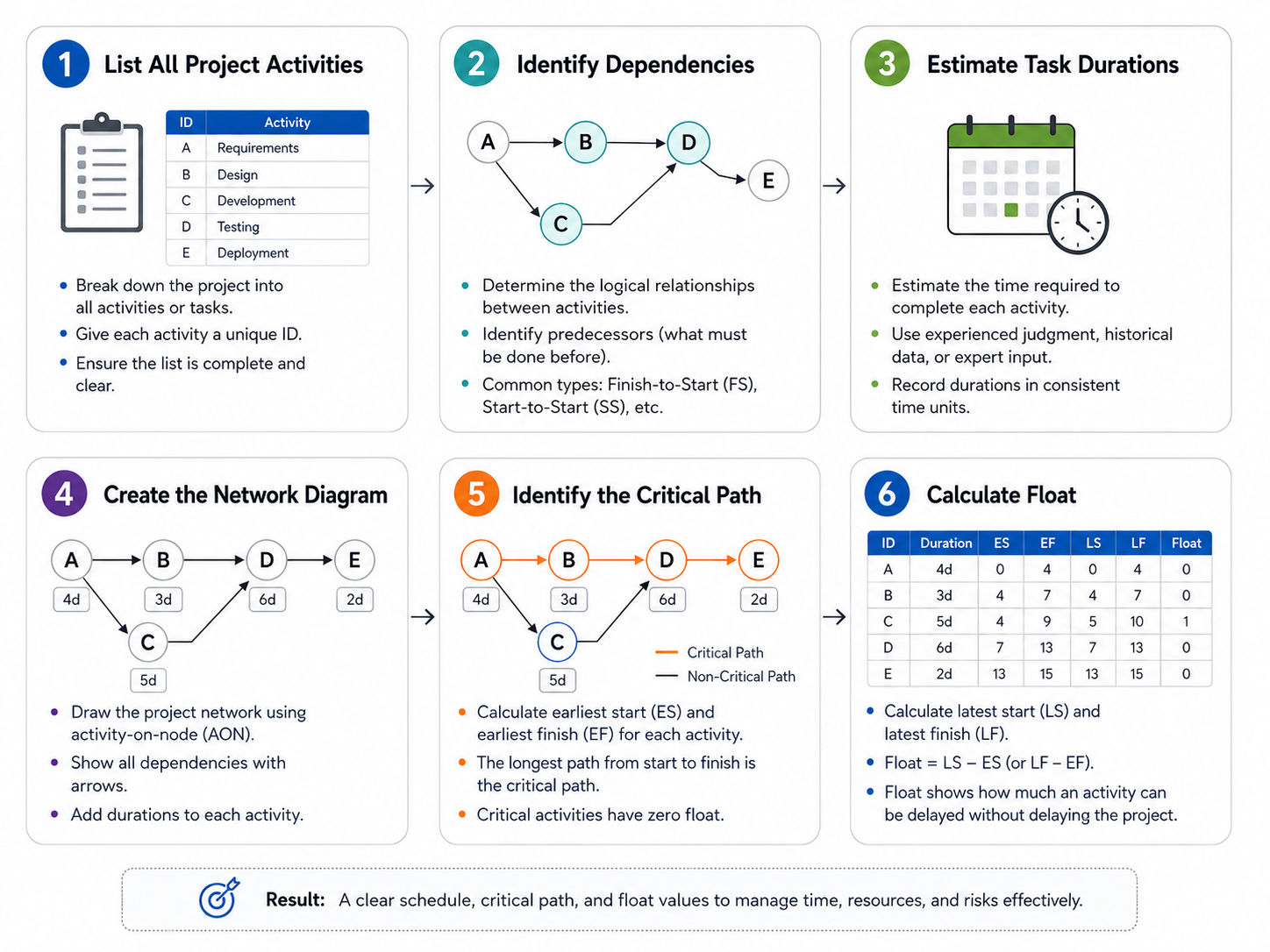
Creating a CPM schedule follows a structured process. While modern project management software automates many calculations, understanding the underlying steps remains important.
Start by identifying every task required to complete the project.
For example, in a website development project:
Missing activities can result in inaccurate schedules.
Determine which tasks rely on others.
For example:
Activity |
Depends On |
| UI Design | Requirement Analysis |
| Development | UI Design |
| Testing | Development |
| Deployment | Testing |
Dependencies help create the project network.
Assign realistic durations to every activity.
Best practices include:
Accurate estimates improve CPM reliability.
A network diagram visually represents task relationships.
The diagram shows:
This step is critical in CPM project management because it reveals the structure of the project.
Calculate all possible paths from the project start to finish.
The path with the longest duration becomes the critical path.
Managers should monitor these activities closely because they directly affect project completion.
Float refers to the amount of time a task can be delayed without affecting the overall schedule.
Tasks with zero floats belong to the critical path.
Many teams struggle because they:
A practical approach is to review the critical path regularly throughout the project lifecycle.
When implemented correctly, CPM project management becomes a powerful framework for keeping projects on track and reducing uncertainty.
Many professionals encounter both techniques during their careers. Understanding PERT and CPM in project management helps managers choose the right approach for different project types.
Although they are often discussed together, they serve slightly different purposes.
The difference between PERT and CPM in project management can be understood through several factors.
Factor |
PERT |
CPM |
| Focus | Time estimation | Scheduling and control |
| Duration Estimates | Multiple estimates | Single estimate |
| Suitable For | Research projects | Construction and operations |
| Nature | Probabilistic | Deterministic |
| Complexity | Higher | Lower |
PERT stands for Program Evaluation and Review Technique.
Unlike CPM, PERT focuses on uncertainty in task duration.
Instead of using one estimate, PERT uses:
This provides a more flexible planning model.
Also Read: Difference between PERT and CPM Explained with Examples
Use CPM when:
Examples include:
Use PERT when:
Examples include:
Also Read: What Is a PERT Chart? Meaning, Diagram, Template
In modern project environments, many companies combine PERT and CPM in project management. Understanding the difference between PERT and CPM in project management allows managers to select the most suitable planning approach based on project complexity and uncertainty.
PERT helps estimate uncertain timelines, while CPM identifies critical activities.
Together, they provide:
Also Read: Project Manager Skills: The 8 Most Important Ones
Despite being developed decades ago, CPM remains one of the most effective project planning techniques used worldwide.
Improved Project Visibility: Managers gain a clear understanding of task relationships and project flow.
Better Time Management: Critical activities receive more attention, reducing scheduling risks.
Efficient Resource Allocation: Teams can allocate resources to high-priority activities.
Early Risk Identification: Potential delays become visible before they impact project completion.
Improved Decision-Making: Project leaders can evaluate trade-offs and take corrective action faster.
Benefit |
Impact |
| Better Scheduling | Reduces delays |
| Resource Optimization | Improves efficiency |
| Increased Visibility | Better planning |
| Risk Management | Fewer surprises |
| Cost Control | Better budget management |
No project management method is perfect.
Some limitations include:
For highly uncertain projects, combining CPM with other techniques often produces better results.
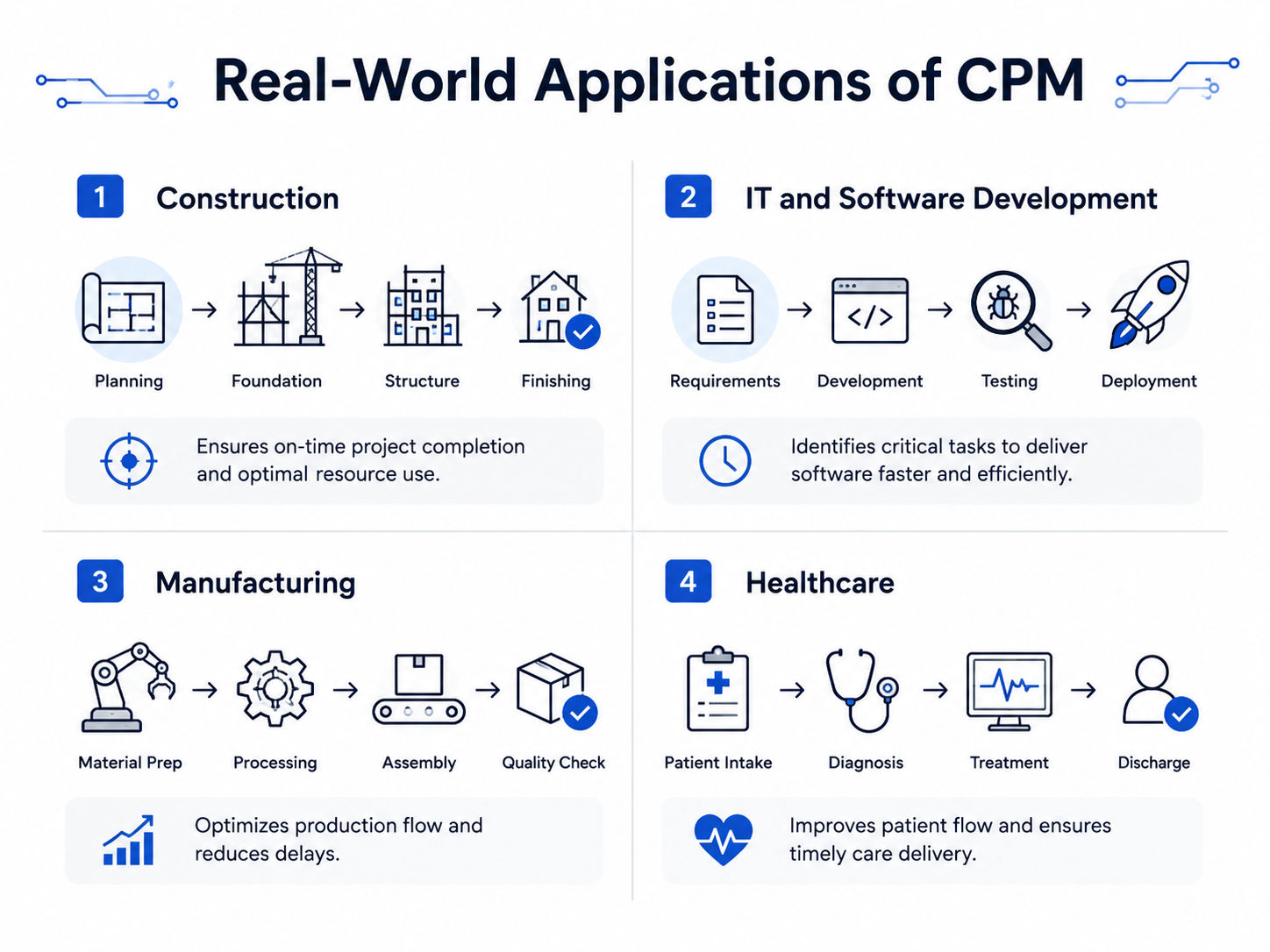
CPM project management is widely used across industries.
Builders use CPM to manage activities such as:
Technology teams apply CPM to:
Manufacturers use CPM for:
Hospitals apply CPM during:
Imagine a company launching a new e-commerce platform. Several activities can occur simultaneously, such as content creation and payment gateway setup. However, deployment cannot happen until development and testing are complete.
Using CPM project management, the company can identify critical tasks, prioritize resources, and reduce launch delays. As projects become more complex, CPM continues to provide a structured framework for managing timelines and achieving predictable outcomes.
Also Read: CPM in Digital Marketing: Calculation, Costs & Strategies in 2025
CPM project management remains one of the most effective project scheduling techniques available today. By identifying the critical path, managers can focus on activities that directly influence project completion and make better planning decisions.
While CPM works best for predictable projects, combining PERT and CPM in project management often creates a more balanced approach that addresses both scheduling and uncertainty.
Whether you're managing a construction project, software deployment, manufacturing initiative, or business transformation, CPM provides the clarity and structure needed to deliver projects on time and within scope.
Want to explore more about CPM project management? Book your free 1:1 personal consultation with our expert today.
CPM helps project managers identify tasks that directly impact the completion date of a project. This visibility improves planning, resource allocation, and monitoring. It also helps teams respond quickly to delays before they affect the entire project timeline.
CPM is widely used in construction, manufacturing, engineering, healthcare, information technology, and infrastructure development. Any industry that manages projects with clearly defined activities and timelines can benefit from CPM scheduling techniques.
CPM can support agile environments when used for high-level planning and dependency management. However, agile projects often rely on iterative scheduling methods that provide greater flexibility than traditional CPM models.
By highlighting critical activities, CPM allows managers to focus attention on tasks that have the greatest impact on delivery dates. Early identification of bottlenecks helps teams take corrective action before delays escalate.
Popular tools include Microsoft Project, Primavera P6, Smartsheet, Monday.com, and Project Manager. These platforms automate critical path calculations and provide visual scheduling dashboards for project teams.
Yes. Even small projects benefit from CPM because it improves task sequencing and planning. The level of detail may be lower, but identifying dependencies and critical activities remains valuable.
Float represents the amount of time a task can be delayed without affecting the project's completion date. It is calculated by comparing the earliest and latest possible start and finish times of an activity.
A Gantt chart visually displays project schedules, while CPM identifies the critical path behind those schedules. Many project management tools combine both methods to improve planning and reporting.
Yes. CPM helps managers understand where resources are needed most. Since critical tasks directly affect deadlines, resources can be prioritized for activities that have the greatest project impact.
A CPM schedule should be reviewed regularly throughout the project lifecycle. Updates are especially important when task durations change; risks emerge, or project scope expand.
Absolutely, despite advances in project management methodologies, CPM remains a foundational scheduling technique. Many organizations continue to use it because it provides clear visibility into timelines, dependencies, and project risks.
975 articles published
We are an online education platform providing industry-relevant programs for professionals, designed and delivered in collaboration with world-class faculty and businesses. Merging the latest technolo...
Get Free Consultation
By submitting, I accept the T&C and
Privacy Policy
Top Resources
Certification
3 Months
Certification
6 Months
O.P. Jindal Global University
Masters in International Accounting and Finance (Accredited by ACCA, UK)Master's Degree
12 Months