MBA Business Analytics Syllabus: Complete Curriculum and Subject Guide
By Sriram
Updated on Aug 11, 2026 | 7 min read | 7.31K+ views
Share:

All courses
Certifications
More
By Sriram
Updated on Aug 11, 2026 | 7 min read | 7.31K+ views
Share:
An MBA in Business Analytics combines core business management principles with data analytics, statistical techniques, and modern technologies. The program equips students to analyze complex datasets, uncover meaningful patterns, and generate actionable insights that support strategic planning, operational efficiency, and data-driven decision-making across various business functions and industries.
In this blog, you'll learn the complete MBA Business Analytics Syllabus, semester-wise subjects, key technical and managerial concepts, practical tools, project work, and the skills employers expect from graduates. Whether you're considering this specialization or preparing for admission, this overview will help you understand what the program actually teaches and how it prepares students for analytics careers.
Explore upGrad's MBA programs to build skills in product management, business strategy, customer-centric design, leadership, and data-driven decision-making for today's digital business environment.
Popular MBA Programs
An MBA in Business Analytics combines traditional business management education with analytical, statistical, and technology-driven decision-making. Unlike a general MBA, this specialization focuses heavily on data interpretation, predictive modeling, business intelligence, and analytical problem-solving.
The MBA Business Analytics Syllabus aims to bridge the gap between business strategy and data science. Students learn how to analyze large datasets, identify trends, forecast outcomes, and communicate insights to stakeholders.
Modern organizations generate enormous amounts of information from customer interactions, sales transactions, marketing campaigns, supply chains, and digital platforms. Businesses need professionals who can extract value from this data and support strategic decisions.
The curriculum typically includes three major learning areas:
| Learning Area | Focus |
| Business Management | Marketing, Finance, Operations, HR |
| Analytics & Statistics | Data Analysis, Predictive Modeling, Statistical Methods |
| Technology & Tools | SQL, Python, Business Intelligence Tools, |
This blend of business knowledge and analytical expertise makes the specialization valuable across industries including banking, healthcare, consulting, e-commerce, manufacturing, and technology.
Also Read : Online MBA Program – Is It Worth the Cost?
Free Courses
Most universities divide the MBA Business Analytics Syllabus into four semesters. The first year focuses on management foundations and analytical fundamentals, while the second year introduces advanced analytics, electives, and industry projects.
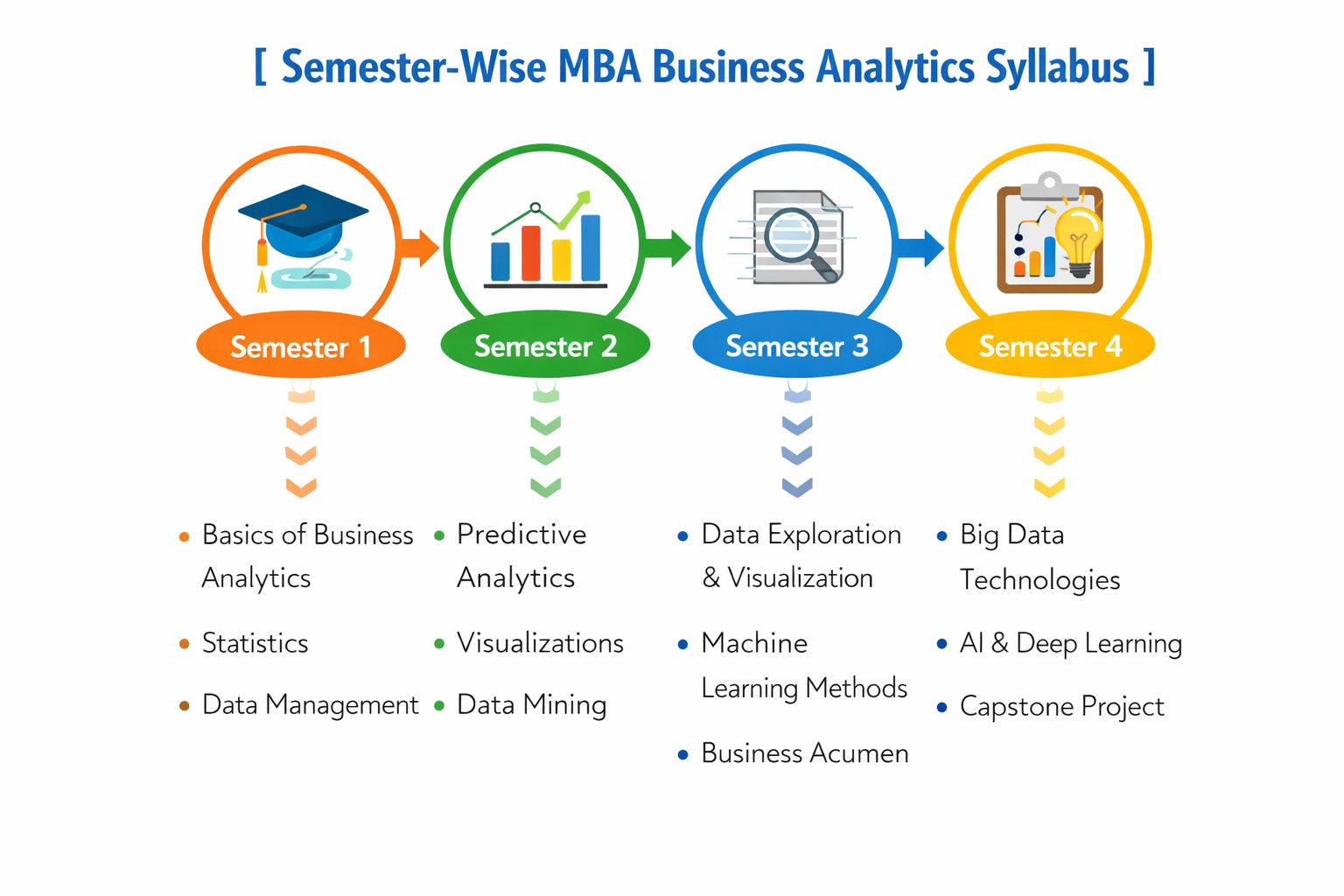
The first semester builds core business knowledge while introducing quantitative concepts.
Common subjects include:
Business Statistics becomes particularly important because many advanced analytics subjects depend on statistical concepts such as probability, hypothesis testing, and regression analysis.
Students begin applying analytical thinking to business functions.
Key subjects often include:
In this semester, students start working with datasets and basic analytical tools.
This semester usually represents the core of the business analytics MBA syllabus.
Students explore:
Many institutions introduce software platforms and analytics tools during this period.
The final semester focuses on practical implementation.
Students commonly complete:
These projects often simulate real-world business challenges and require students to present actionable recommendations.
Also Read : How Can I Do MBA? A Complete Guide
MBA Courses to upskill
Explore MBA Courses for Career Progression
O.P.Jindal Global University
MBA (with Career Acceleration Program by upGrad)Become interview ready with Career Services
PSB MBA + IIML Certification
MBA from Paris School of Business with Certification from IIM LucknowThe business analytics syllabus for MBA programs includes a mix of quantitative, technological, and business-focused subjects. Each subject develops a specific skill set required in analytics-driven roles.
The following subjects form the foundation of most MBA Business Analytics programs.
Business Statistics provides the quantitative foundation required for advanced analytics. Students learn how to collect, analyze, and interpret data to support business decisions.
Key topics covered include:
These concepts play a critical role in predictive modeling, forecasting, and data-driven decision-making across business functions.
Predictive Analytics focuses on using historical data to forecast future outcomes. Organizations use these techniques to identify trends, anticipate risks, and improve planning accuracy.
Common applications include:
As businesses increasingly rely on data for strategic planning, predictive analytics has become one of the most valuable areas within the MBA Business Analytics syllabus.
Business Intelligence (BI) helps organizations transform raw data into actionable insights through reports, dashboards, and performance metrics.
Students typically learn:
Business Intelligence enables managers and executives to monitor performance in real time and make informed decisions based on accurate data.
Marketing Analytics applies data analysis techniques to understand customer behavior and evaluate marketing effectiveness. It helps businesses optimize campaigns and improve customer engagement.
Key areas of study include:
With marketing budgets under constant scrutiny, organizations increasingly depend on analytics to maximize return on investment and improve targeting strategies.
Financial Analytics uses quantitative methods and analytical models to support financial planning, forecasting, and risk management.
Students commonly explore:
This subject is particularly important for careers in banking, investment management, corporate finance, and financial consulting, where data-driven decision-making is essential.
Do Read : What is Business Analytics? Career, Salary & Job Roles [2023]
Modern analytics professionals need more than theoretical knowledge. Employers expect graduates to work with industry-standard tools and technologies.
As a result, the MBA Business Analytics Syllabus increasingly includes hands-on training through labs, projects, internships, and business simulations.
The following technologies commonly appear in analytics programs.
| Tool or Technology | Purpose |
| Excel | Data analysis and reporting |
| SQL | Database querying |
| Python | Data analytics and automation |
| R Programming | Statistical analysis |
| Tableau | Data visualization |
| Power BI | Business intelligence dashboards |
| Hadoop | Big data processing |
| SPSS | Statistical modeling |
Practical learning often includes:
Practical learning often involves real-world projects where students analyze business data, identify operational challenges, and recommend improvements. These experiences help bridge the gap between classroom concepts and workplace applications.
Students also learn to work with messy datasets, validate insights, and communicate findings effectively to both technical and non-technical stakeholders. As technologies like AI and cloud analytics continue to evolve, universities regularly update the business analytics MBA syllabus to align with industry needs.
Also Read : Best Business Analytics Courses 2025: Your Guide to Choosing the Right Program
Understanding the MBA Business Analytics Syllabus also helps students evaluate career opportunities after graduation. The curriculum aligns closely with the growing demand for professionals who can combine business understanding with analytical expertise.
The following table highlights how syllabus components connect to career roles.
| Syllabus Area | Related Career Roles |
| Predictive Analytics | Data Analyst, Risk Analyst |
| Marketing Analytics | Marketing Analyst |
| Financial Analytics | Financial Analyst |
| Business Intelligence | BI Analyst |
| Machine Learning Fundamentals | Analytics Consultant |
| Data Visualization | Business Analyst |
The demand for analytics professionals continues to expand because businesses increasingly rely on evidence-based decision-making rather than intuition alone.
Students who actively engage with projects, internships, and analytical tools during their MBA often develop stronger problem-solving capabilities and become more competitive in the job market.
The MBA Business Analytics Syllabus blends business management with analytics, statistics, and technology to help students make data-driven decisions. It covers key areas such as predictive analytics, business intelligence, and machine learning while emphasizing practical learning through projects, internships, and industry tools.
This specialization prepares graduates for careers in analytics, consulting, finance, marketing, and business strategy.
Ready to start your journey? Book a free consultation with upGrad today to find the best path for your career.
The MBA Business Analytics Syllabus helps you build strong analytical and decision-making skills. You learn how to work with data, interpret patterns, and support business decisions using statistics and tools. You also develop problem-solving skills, business thinking, and the ability to connect numbers with real business outcomes in practical scenarios.
You don’t need advanced coding skills at the start, but basic knowledge of tools like Python or SQL becomes useful later. The MBA Business Analytics Syllabus introduces coding gradually through practical assignments. You mainly focus on applying tools to solve business problems rather than deep programming or software development.
Most MBA Business Analytics Syllabus programs include tools like Excel, SQL, Tableau, Power BI, and sometimes Python or R. You use these tools to analyze datasets, build dashboards, and create reports. Employers expect you to understand how to turn raw data into simple business insights using these platforms.
If you come from a non-technical background, the MBA Business Analytics Syllabus may feel challenging at first. Topics like statistics and data tools require practice. However, most programs start from basics. With consistent effort and real-world examples, you can gradually understand concepts and apply them in business situations.
The MBA Business Analytics Syllabus focuses more on business decision-making using data. It connects analytics with marketing, finance, and operations. MBA Data Science goes deeper into programming, algorithms, and model building. If you want a business-facing role, analytics fits better. Data science suits technical and engineering-focused careers.
You often work on real business problems like customer churn analysis, sales forecasting, or marketing campaign evaluation. The MBA Business Analytics Syllabus includes capstone projects where you analyze datasets, build reports, and suggest solutions. These projects help you understand how companies actually use data for daily decisions.
Yes, the MBA Business Analytics Syllabus supports many non-IT roles. You can work in finance, marketing, HR analytics, or operations. Companies in these areas now rely on data for decisions. You don’t need to become a software expert. You need to understand data and apply it to business problems.
Statistics forms the base of the MBA Business Analytics Syllabus. You use it to understand patterns, test ideas, and make predictions. Topics like regression, probability, and hypothesis testing help you interpret data correctly. Without statistics, it becomes difficult to build meaningful insights or trust analytical results in business decisions.
Internships are a key part of the MBA Business Analytics Syllabus because they connect classroom learning with real work. You may work on live datasets, reporting tasks, or business dashboards. This experience helps you understand how companies use analytics daily and improves your confidence before entering full-time roles.
Graduates from the MBA Business Analytics Syllabus get opportunities in banking, e-commerce, consulting, healthcare, and retail. These industries rely heavily on data for decisions. You may work on customer behavior analysis, financial forecasting, or operations optimization depending on the company’s needs and your specialization area.
The MBA Business Analytics Syllabus remains highly relevant in 2026 because businesses continue to depend on data-driven decisions. Companies want professionals who can analyze trends and improve performance. If you enjoy working with data and business problems, this specialization gives you strong long-term career opportunities across multiple industries.
725 articles published
Sriram K is a Senior SEO Executive with a B.Tech in Information Technology from Dr. M.G.R. Educational and Research Institute, Chennai. With over a decade of experience in digital marketing, he specia...
Speak with MBA expert
By submitting, I accept the T&C and
Privacy Policy
From MBA to Dream Job - Explore Our Alumni Success Stories
Top Resources
Master's Degree
13 Months
Master's Degree
12 Months
Master's Degree
15 Months