Artificial Intelligence in Software Testing: Transforming Quality Assurance
By Sriram
Updated on Jun 15, 2026 | 6 min read | 7.3K+ views
Share:

All courses
Certifications
More
By Sriram
Updated on Jun 15, 2026 | 6 min read | 7.3K+ views
Share:
Table of Contents
Artificial intelligence in software testing uses technologies such as machine learning, natural language processing, and computer vision to improve and automate QA processes. Unlike traditional testing methods, AI enables adaptive and intelligent decision-making, helping teams generate tests, detect defects, optimize workflows, and deliver high-quality software faster and more efficiently.
In this blog, you'll learn how AI is used in testing, the major methods and applications, real-world examples, benefits, limitations, and what the future of intelligent testing looks like. Whether you're a developer, QA engineer, or AI student, this guide will provide practical insights into modern testing practices.
Discover upGrad's Artificial Intelligence and Machine Learning programs and learn how to build, deploy, and optimize intelligent systems using technologies that are driving innovation across IT industries, healthcare, finance, and other sectors.
Popular AI Programs
Artificial intelligence is changing the face of software testing. Machine learning, natural language processing, and predictive analytics are being used to automate and enhance the process of testing software. Unlike traditional automation, which relies on fixed scripts, AI-powered testing learns from historical data, identifies patterns, predicts failures, and enhances test coverage.
Facing more complex software systems and faster development cycles in Agile and DevOps environments, AI enables faster, smarter and more efficient testing, reducing manual effort while improving the quality and reliability of software.
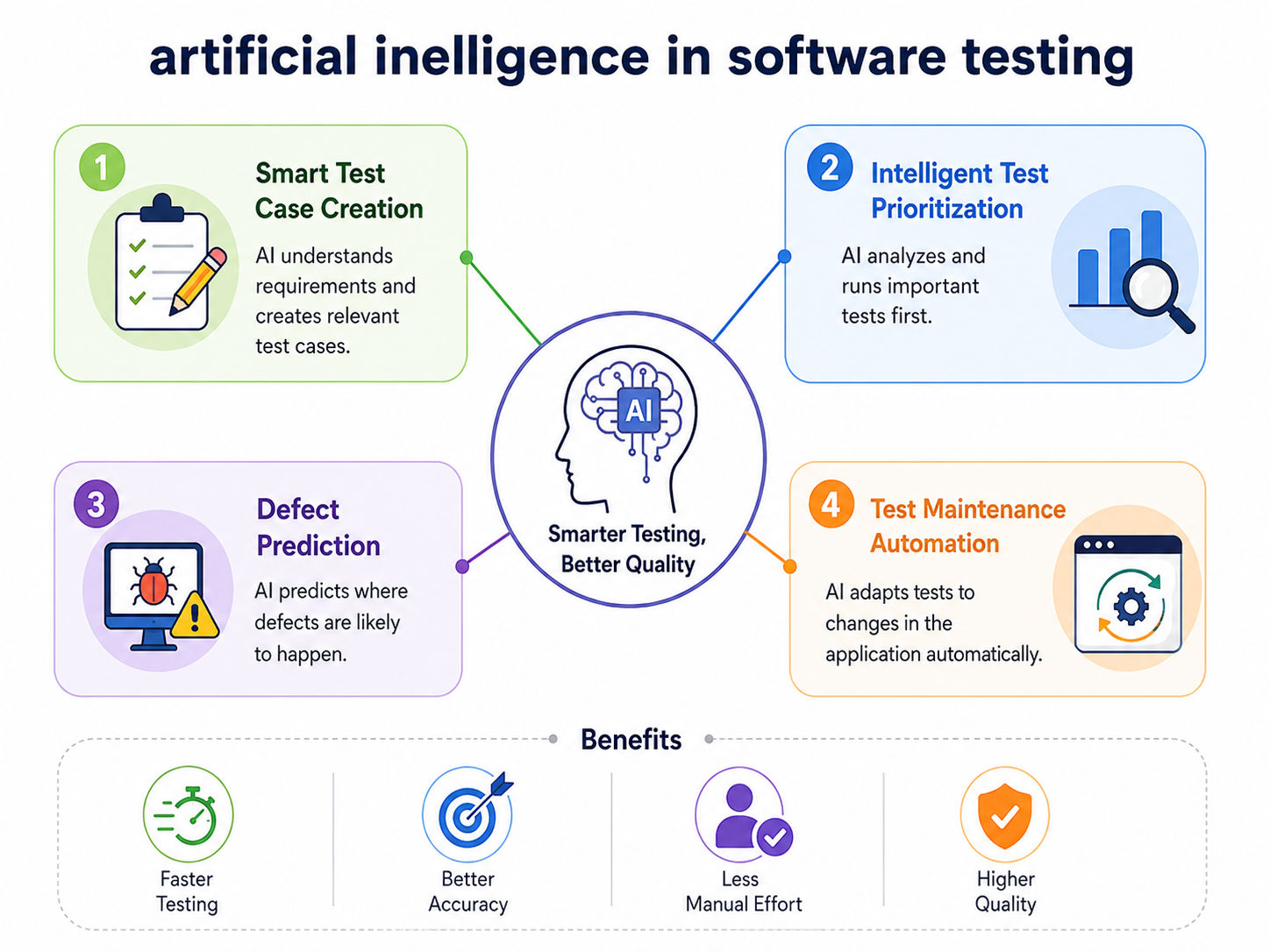
A simple example illustrates the difference. Suppose an e-commerce application changes its button location after a UI update. Traditional automation scripts may fail immediately. An AI-powered testing tool can identify the new element based on attributes and continue execution with minimal human intervention.
The table highlights the differences between traditional and AI-based testing approaches.
Aspect |
Traditional Testing |
AI-Based Testing |
| Test Creation | Manual scripting | Automated generation |
| Maintenance | High effort | Self-healing scripts |
| Defect Detection | Rule-based | Pattern-based |
| Adaptability | Limited | High |
| Test Optimization | Manual | AI-driven |
This shift matters because modern applications frequently change. Mobile apps, cloud-native systems, and microservices generate thousands of test scenarios. AI helps teams manage this scale without dramatically increasing effort.
Today, organizations increasingly view testing as an intelligent process rather than a purely manual activity.
Also read: Top 20 Challenges of Artificial Intelligence: Key Issues and Solutions for 2026
Free Courses
Testing is powered by AI and relies on a number of underlying technologies. Different methods solve different problems, and no one method works everywhere. Knowing these techniques helps teams choose the right solution for their projects.
AI techniques in software testing involve data-driven learning and automation. These methods allow systems to get better with time rather than following static instructions.
The following list explains the major AI methods used in testing.
Machine learning models use past testing data to find patterns. For example, they can predict which modules are most likely to have defects based on previous releases.
A team working on a banking application might find that payment modules fail consistently after updates. The AI system learns this pattern and automatically prioritizes those tests.
NLP converts human language into executable test cases. Testers can write requirements in plain English, and AI tools generate testing scripts.
For instance:
Requirement: "Users should receive an error message for invalid login attempts."
An NLP system can transform this requirement into automated test scenarios.
UI testing frequently breaks when visual elements change slightly. Computer vision algorithms recognize elements based on appearance rather than fixed locators. This reduces maintenance effort dramatically in web and mobile applications.
The table below summarizes common AI techniques and their uses.
AI Method |
Testing Application |
| Machine Learning | Defect prediction |
| NLP | Test generation |
| Computer Vision | UI validation |
| Reinforcement Learning | Test optimization |
| Predictive Analytics | Risk assessment |
Although these approaches improve efficiency, they also require quality training data. Poor datasets can lead to inaccurate predictions and missed defects.
This is why successful AI adoption depends as much on data quality as it does on algorithms.
Must Read: 28+ Top Generative AI Tools in 2025: Key Benefits and Uses
AI Courses to upskill
Explore Artificial Intelligence Courses for Career Progression
Software testing has become increasingly complex as applications grow in size and release cycles become shorter. Manual testing and traditional automation often struggle to keep pace with frequent updates and changing user requirements.
This is where artificial intelligence in software testing creates value. AI-powered tools help teams automate repetitive tasks, improve test accuracy, and make smarter decisions throughout the testing lifecycle.
The following table summarizes the key benefits of AI-driven testing.
Benefit |
Impact on Testing |
| Faster Test Execution | Reduces testing time and accelerates releases |
| Better Test Coverage | Identifies more test scenarios and edge cases |
| Defect Prediction | Detects high-risk areas early |
| Lower Maintenance | Minimizes script failures through self-healing |
| Smart Test Prioritization | Executes the most relevant tests first |
AI drastically reduces the time it takes to run and analyse tests. Instead of manually executing thousands of test cases, AI systems automate the execution and failure identification in real time.
Such speed is particularly useful in Agile and DevOps environments where teams frequently deploy updates. Faster testing means organisations can release software more confidently and more quickly.
Traditional testing can overlook unusual user behaviours or edge cases. AI reviews past data, application usage patterns and system behaviour to create wider test scenarios.
This allows teams to validate more application paths and decreases the chance of defects entering production.
One of the greatest benefits of AI is its ability to predict defects before they turn into major problems. Machine learning models analyse historical bugs, code changes and testing history to find high-risk modules.
For instance, if a payment component often breaks after updates, AI can focus on testing that particular module in upcoming releases.
Automation scripts are costly and time-consuming to maintain. Minor UI modifications can break existing test scripts and require manual updates.
AI-powered self-healing automation solves this challenge by automatically identifying changed elements and updating scripts as appropriate. This reduces maintenance effort and increases test stability.
In big applications running every test case for each release may not be possible. The AI decides which tests to run based on risk level, code changes and past failures.
This helps to make sure that the most important functions are covered first and also helps to reduce unnecessary test execution.
Below are the points that illustrate how AI enhances the efficiency of testing:
AI-powered testing provides confidence that apps perform reliably across all devices, browsers and operating systems. this allows teams to spot problems earlier and create smoother user experiences with fewer customer complaints.
In the competitive software market today, even minor bugs can affect user trust. AI helps organizations scale their development efforts while maintaining quality.
AI has many benefits, but it works best when combined with human insight. Skilled testers are still very important in exploratory testing, business validation and interpreting AI-driven insights. The most effective QA teams use AI as a collaborative tool rather than a complete replacement for human judgment.
Also read : how to Implement Machine Learning Steps: A Complete Guide
As AI adoption grows, organizations are increasingly integrating intelligent tools into their QA workflows. While AI delivers significant improvements in efficiency and accuracy, it is not a perfect solution.
Successful implementation requires investment, reliable data, and skilled teams. Artificial intelligence in software testing works best when combined with strong engineering practices and human expertise rather than replacing them entirely.
Implementing AI-driven testing often introduces several technical and operational challenges. Organizations that overlook these limitations may struggle to achieve expected results.
The following table highlights the major challenges associated with AI-powered testing.
Challenge |
Impact on Testing |
| High Setup Costs | Requires investment in tools and infrastructure |
| Poor Data Quality | Leads to inaccurate predictions |
| Model Bias | Can produce unreliable results |
| Integration Complexity | Difficult to fit into existing workflows |
| Lack of Explainability | Reduces trust in AI decisions |
Adopting AI testing tools often involves purchasing software, training teams, and integrating systems into existing workflows. For small organizations, these costs can be a significant barrier.
Although AI may reduce long-term testing costs, the initial setup often requires substantial resources.
AI systems learn from the past data. Incomplete or inaccurate previous test results, bug reports, or code histories may lead AI models to make poor predictions.
In other words, the effectiveness of AI greatly depends on the quality of data used to train it.
Machine learning models can sometimes develop bias if they are trained on small or unbalanced datasets. This can lead to some defects being ignored and others being over emphasised.
Regular monitoring and retraining are essential to maintain model accuracy.
Many organizations already use established testing frameworks and CI/CD pipelines. Integrating AI tools into these environments can be complex and time-consuming.
Teams often need to modify workflows, update infrastructure, and train employees to work effectively with AI-driven systems.
One practical issue is interpretability. But when an AI model labels a test as high risk, teams may not always know why.
This lack of transparency can erode trust in automated systems, particularly in highly regulated industries.
Healthcare, banking, finance and other industries have stringent compliance requirements. In these environments, testing decisions frequently need to be documented and auditable.
Organisations may encounter regulatory hurdles using AI in critical applications as some AI models operate as “black boxes.”
Also read: How to Become a Software Tester: Skills, Certifications & Salary
However, AI adoption in software testing is growing rapidly despite these limitations. The next generation of intelligent QA systems are being shaped by advances in machine learning and generative AI.
Here are the trends that will shape the future of artificial intelligence in software testing:
Generative AI is already showing promising capabilities. Large language models can assist in generating test scripts, summarizing failures, and even generating documentation, which saves QA teams time and effort.
But AI is not expected to take away the testing work altogether. Exploratory testing, understanding business requirements, and decision-making still require human expertise.
The future of testing is not about replacing people with AI. Instead, it is about empowering skilled testers with intelligent tools that improve speed, accuracy, and software quality.
Artificial intelligence is reshaping how software teams deliver quality at speed in fast-paced development environments. Organisations can use machine learning, predictive analytics and intelligent automation to reduce testing efforts and increase accuracy.
But tools alone are not enough for adoption. To get the most value, teams need reliable data, thoughtful implementation, and human expertise. The development of AI technologies will make software testing more adaptive, intelligent and integrated into every stage of development.
The knowledge of these technologies today will be an important skill for the future of software engineering for developers, testers and AI professionals.
Ready to start your journey? Book a free consultation with upGrad today to find the best path for your career.
AI automates repetitive testing tasks, prioritizes important test cases, predicts defects, and reduces maintenance efforts. This allows teams to release software faster while maintaining quality. AI also helps optimize regression testing by selecting only the most relevant tests after code changes.
No. AI handles automation and pattern recognition effectively, but human testers still provide critical thinking, exploratory testing, and business understanding. Most organizations use AI as an assistant that enhances human capabilities rather than replacing testers entirely.
industries such as finance, healthcare, e-commerce, telecommunications, gaming, and automotive heavily use AI-driven testing. These sectors often manage complex systems and frequent releases that benefit from intelligent automation.
Professionals should understand software testing fundamentals, automation frameworks, machine learning basics, scripting languages, and CI/CD practices. Familiarity with AI-based testing platforms also improves career opportunities.
Self-healing automation allows test scripts to adapt automatically when application elements change. Instead of failing due to modified UI locators, AI identifies alternative attributes and continues execution successfully.
Machine learning analyzes historical testing data to identify patterns associated with failures. It predicts risky modules and helps teams focus testing efforts where defects are most likely to occur.
Initial implementation costs can be high because organizations need tools, infrastructure, and training. However, long-term savings often come from reduced maintenance efforts and faster release cycles.
Data quality directly affects AI performance. Incomplete or biased datasets may generate incorrect predictions and reduce testing accuracy. Reliable historical data improves model effectiveness significantly.
Yes. Modern AI systems use natural language processing and generative models to create test cases from requirements, user stories, and application behavior. Human review still ensures correctness and coverage.
Risks include inaccurate predictions, model bias, lack of transparency, integration challenges, and overdependence on automation. Teams should monitor AI systems regularly and validate outputs carefully.
Future developments include autonomous testing agents, generative AI for test creation, predictive quality monitoring, and deeper integration with DevOps pipelines. These advancements will help teams deliver software faster while maintaining reliability.
730 articles published
Sriram K is a Senior SEO Executive with a B.Tech in Information Technology from Dr. M.G.R. Educational and Research Institute, Chennai. With over a decade of experience in digital marketing, he specia...
Speak with AI & ML expert
By submitting, I accept the T&C and
Privacy Policy
Top Resources
Master's Degree
18 Months
Executive Diploma
12 Months
IIIT Bangalore
Executive Programme in Generative AI & Agentic AI for LeadersIndia’s #1 Tech University
Dual Certification
5 Months