MBA After MBBS: Scope, Salary, Career Options, and Is It Worth It?
By upGrad
Updated on Aug 11, 2026 | 7 min read | 2.53K+ views
Share:

All courses
Certifications
More
By upGrad
Updated on Aug 11, 2026 | 7 min read | 2.53K+ views
Share:
MBA with an MBBS opens doors that a clinical career alone rarely does. Doctors who take this path find themselves well-positioned for leadership roles in hospital administration, healthcare, consulting, and pharmaceutical management, fields that offer strong compensation without the relentless hours that come with residency.
For medically trained professionals looking to grow in a different direction, it is one of the more practical and rewarding routes available. Many doctors today are considering doing an MBA after they finish their MBBS.
In this blog, you will learn about doing an MBA after MBBS. This includes Who can do it, benefits, what areas you can specialize in, jobs, salary etc.
Explore Online MBA Courses from upGrad and understand why combining business education with a medical degree remains one of the smartest careers moves for healthcare professionals today.
Popular MBA Programs
The biggest reason doctors choose an MBA is simple. Healthcare today is not about taking care of patients. It also involves managing operations, making strategic plans using technology handling finances, understanding policy, and overseeing management. An MBA degree helps doctors learn about the business side of healthcare. This way they can use their knowledge to make important decisions in their roles.
Also Read: MBA Healthcare Management: Career, Scope, Salary & More
Yes. If you have finished your MBBS from a college you can apply for most MBA programs in India and other countries. Most business schools take people who have graduated from any field of study. They do not care what subject you studied long as you have a degree from a good college.
You can do an MBA after completing your MBBS. Many people who have done MBBS are now doing MBA programs, in India and abroad.
Some common reasons include:
Also Read: Hospital Management Career: Scope & Skills Needed
An MBA is not a replacement for medical specialization. It is a different career direction altogether.
Factor |
MBA After MBBS |
MD/MS After MBBS |
| Focus | Management and business | Clinical specialization |
| Patient Interaction | Limited | Extensive |
| Career Path | Leadership and corporate roles | Practicing specialist |
| Skills Developed | Strategy, operations, finance | Clinical expertise |
| Industry Options | Diverse healthcare sectors | Medical practice |
Many healthcare organizations increasingly seek professionals who understand both medicine and business. This combination creates a unique professional profile.
An MBA may be suitable if you:
Also Read: MBA in Healthcare Management Scope in India: Careers, Salaries, and What to Expect
Free Courses
One of the most searched questions is about the scope of MBA after MBBS. The good news is that healthcare is one of India's fastest-growing sectors, creating opportunities for medically trained professionals with management expertise.
Doctors with an MBA are sought after across a surprisingly wide range of industries, each offering roles that reward both clinical knowledge and business acumen.
Hospitals need people who know about clinical workflows and also know how to run the hospital operational smoothly.
Hospitals really need these kinds of professionals to make sure everything works well. They need to know about workflows and operational efficiency to do their job properly.
Common roles include:
Consulting firms work with hospitals. They also work with governments. These firms work with companies. Additionally, they work with healthcare startups.
Responsibilities include:
Doctors with management education are highly valued in pharma companies.
Roles include:
The growth of digital healthcare has created demand for professionals who understand medicine and technology.
Popular roles include:
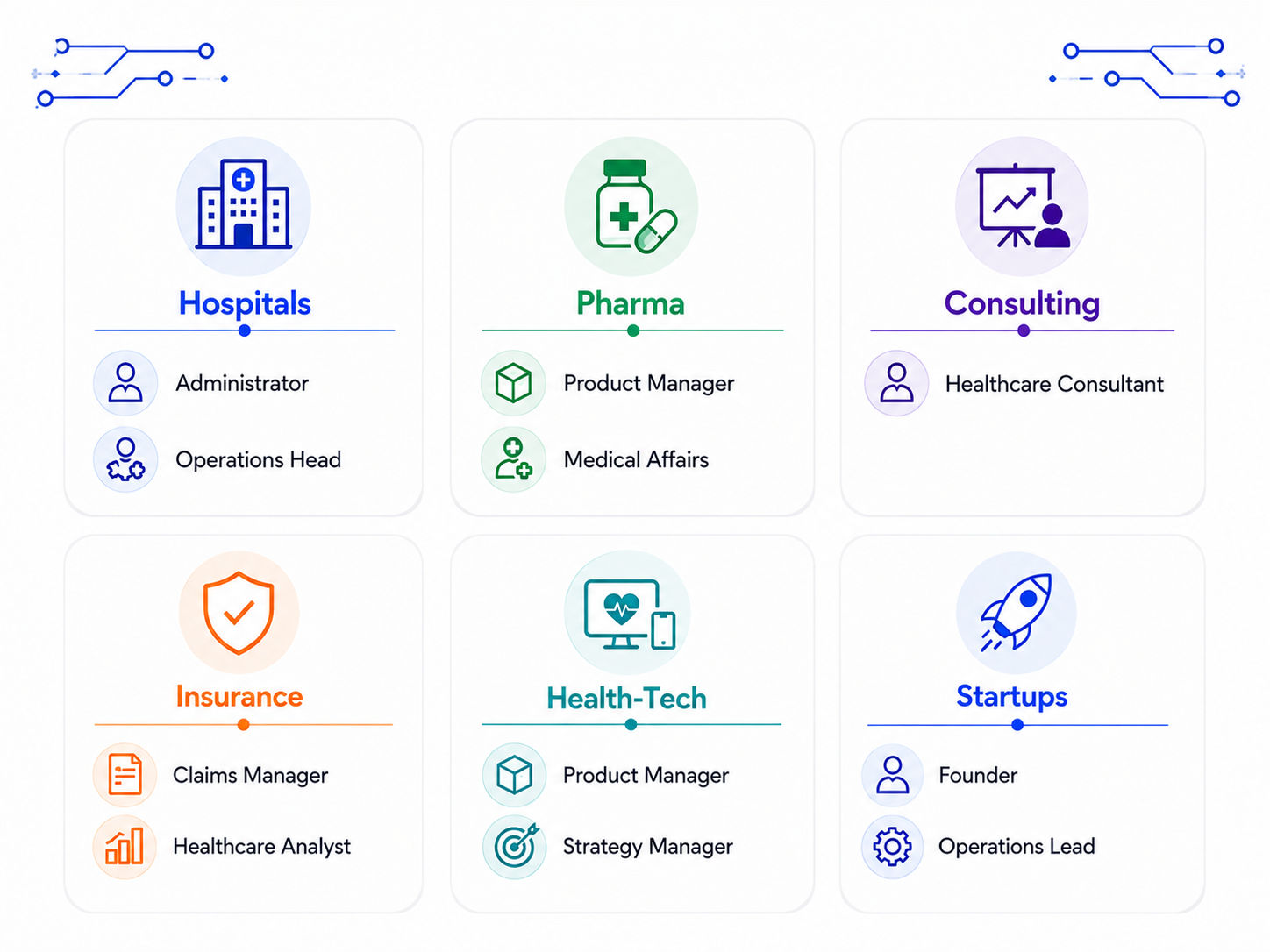
The scope of MBA after MBBS continues to expand as healthcare becomes more technology-driven and business-focused. Industry experts also note growing opportunities in healthcare analytics, digital health, and healthcare consulting.
Sector |
Common Roles |
| Hospitals | Administrator, Operations Head |
| Pharma | Product Manager, Medical Affairs |
| Consulting | Healthcare Consultant |
| Insurance | Claims Manager, Healthcare Analyst |
| Health-Tech | Product Manager, Strategy Manager |
| Startups | Founder, Operations Lead |
Also Read: What is Healthcare Management (HCM)? Key Types and Responsibilities
An MBA is not a shortcut to instant success.
Your outcomes depend on:
MBA Courses to upskill
Explore MBA Courses for Career Progression
O.P.Jindal Global University
MBA (with Career Acceleration Program by upGrad)Become interview ready with Career Services
PSB MBA + IIML Certification
MBA from Paris School of Business with Certification from IIM LucknowChoosing the right specialization is one of the most important decisions when pursuing an MBA after MBBS.
Not every MBA specialization aligns equally well with a medical background.
This is the most natural choice for doctors.
Subjects include:
Best suited for:
This specialization is about strategy and solving problems.
Ideal for professionals who enjoy:
A strong option for doctors interested in the pharmaceutical industry.
Career opportunities include:
Healthcare organizations require efficient operations.
Key areas include:
Healthcare is becoming increasingly data driven.
Skills developed:
Specialization |
Best For |
| Healthcare Management | Hospital leadership |
| Consulting | Strategy roles |
| Pharma Management | Pharmaceutical industry |
| Operations | Hospital operations |
| Analytics | Data-driven healthcare roles |
Most MBBS graduates pursue MBA admission through:
Some good business schools are happy to take people who do not have engineering backgrounds like those who studied medicine.
If you want to be a leader in healthcare, what you specialize in is just as important as the business school you go to.
The topic of MBA after MBBS salary attracts a lot of interest. It's natural to wonder how much money you can make.
The salary for MBA after MBBS depends on multiple factors.
These include:
Typical entry-level salaries may vary across sectors.
Career Path |
Approximate Starting Range |
| Hospital Administration | ₹6–12 LPA |
| Pharma Management | ₹8–18 LPA |
| Healthcare Consulting | ₹10–25 LPA |
| Health Insurance | ₹7–15 LPA |
| Health-Tech | ₹8–20 LPA |
These figures vary depending on company, city, and MBA institution.
Professionals with 5-10 years of experience often move into leadership positions.
Potential roles include:
Industry reports indicate significant salary growth at this stage, especially in consulting, health-tech, and hospital leadership positions.
Also Read: MBA Healthcare Management Salary in India
The biggest influences on MBA after MBBS salary include:
Senior professionals can progress to roles such as:
Healthcare management remains one of the more stable and growth-oriented sectors within management careers.
For doctors interested in management, strategy, or healthcare business, the return on investment can be strong over the long term.
However, salary alone should not be a deciding factor.
The better question is whether you enjoy management-oriented work. That determines long-term satisfaction more than compensation.
Choosing an MBA after MBBS is not about leaving medicine behind. It is about applying medical knowledge in a different way. For doctors interested in leadership, healthcare strategy, consulting, hospital administration, pharmaceuticals, or entrepreneurship, an MBA can unlock opportunities that traditional clinical careers may not provide.
If you're still asking, "can I do MBA after MBBS?", the answer is yes. The more important question is whether your interests align with management and leadership. If they do, an MBA could be one of the most rewarding career decisions you make.
Want personalized guidance on MBA after MBBS? Speak with an expert for a free 1:1 counselling session today.
Yes. Many MBA programs in India accept fresh MBBS graduates. However, some executive MBA programs prefer candidates with prior professional experience. Work experience can strengthen your profile but is not always mandatory.
The scope of MBA after MBBS includes hospital management, healthcare consulting, pharmaceutical management, health insurance, healthcare analytics, and health-tech companies. The healthcare sector continues to create demand for professionals with both medical and managerial expertise.
Healthcare and Hospital Management is often considered the most relevant specialization. However, Consulting, Operations, Analytics, and Pharmaceutical Management can also offer strong career opportunities depending on your interests.
MBA after MBBS salary varies widely by institution and role. Entry-level compensation often ranges from ₹6-20 LPA, while experienced professionals can earn significantly higher packages depending on industry and leadership responsibilities.
Neither option is universally better. MD/MS is ideal for those who want clinical specialization and patient care. MBA is better suited for professionals interested in management, leadership, business strategy, and healthcare administration.
Many top MBA colleges in India accept CAT scores. Some institutions also accept XAT, NMAT, SNAP, or GMAT scores depending on their admission criteria.
Yes. Many consulting firms hire MBBS graduates with MBA qualifications for healthcare strategy, operations improvement, market analysis, and healthcare transformation projects.
Healthcare management offers strong growth opportunities, leadership exposure, and industry relevance. It is particularly suitable for doctors who enjoy organizational leadership and strategic decision-making.
Absolutely, pharmaceutical companies actively recruit doctors with management education, for roles in product management, medical affairs, business development, and commercial strategy.
Yes. Many doctors pursue global MBA programs after gaining some work experience. International programs can provide broader exposure to healthcare systems, management practices, and global career opportunities.
An MBA can provide valuable knowledge in finance, operations, marketing, leadership, and business strategy. These skills can be highly useful for doctors interested in launching clinics, healthcare startups, or digital health ventures.
972 articles published
We are an online education platform providing industry-relevant programs for professionals, designed and delivered in collaboration with world-class faculty and businesses. Merging the latest technolo...
Speak with MBA expert
By submitting, I accept the T&C and
Privacy Policy
From MBA to Dream Job - Explore Our Alumni Success Stories
Top Resources
Master's Degree
13 Months
Master's Degree
12 Months
Master's Degree
15 Months