Embodied AI Explained and Future Applications
By Sriram
Updated on Jun 15, 2026 | 6 min read | 2.73K+ views
Share:

All courses
Certifications
More
By Sriram
Updated on Jun 15, 2026 | 6 min read | 2.73K+ views
Share:
Table of Contents
Embodied AI is a part of intelligence that makes virtual programs have a real-life body. It brings together machine learning, computer vision, and robotics to see, understand, learn from, and talk to the world.
Embodied AI combines these technologies; the goal is to make machines that can actively perceive and interact with their surroundings. They can learn from what they see and experience; it helps machines understand and respond to the world.
If you are a student or you have a job or you just want to know what is happening with intelligence, this guide will help you understand embodied artificial intelligence.
Explore Artificial Intelligence Courses and Machine Learning Courses Online from upGrad and discover why embodied AI is becoming one of the most important developments for engineers, innovators, and business leaders who want to understand how intelligent systems are moving from screens into the real world.
Popular AI Programs
Artificial intelligence systems that can see and learn from the world around them and interact with them are called Embodied AI. These systems have a body or a physical form that lets them do this. Embodied AI is different from the artificial intelligence that just exists in computer programs.
For example, think about chatbots. It can talk to people, but it cannot touch things or move around a room. Now think about a robot that works in a warehouse. This robot can identify objects and find its way around obstacles, pick boxes, learn from what happens, and change what it does when things change. This robot is an example of an Embodied AI.
To make it simple, Embodied AI is an intelligence that can feel, think, and act in the real world. Embodied AI systems can sense the world to think about what they sense and act on it. This is what makes Embodied AI special.
Also Read: Applications of Artificial Intelligence and Its Impact
Key Characteristics
Feature |
Description |
| Perception | Uses cameras, sensors, microphones, or touch systems |
| Decision-making | Processes information and selects actions |
| Physical interaction | Moves through or manipulates real environments |
| Learning | Improves through experience and feedback |
| Adaptation | Responds to changing situations in real time |
Humans learn through doing things; a kid learns about gravity when they drop something and see what happens. Embodied AI is similar; it does not just learn information and words; it learns through direct experience in the world.
When Embodied Artificial Intelligence sees something, act and learns from it, that is what gets researchers excited about Embodied AI. They think Embodied AI can help make AI that is more useful and smarter.
That difference might sound simple, but it changes how AI understands and responds to the world. It really changes things at its core. AI works differently because of it.
Traditional AI |
Embodied AI |
| Exists as software | Exists in physical systems |
| Learns mainly from data | Learns from real-world interaction |
| Cannot physically manipulate objects | Can interact with the physical environment |
| Limited environmental awareness | Constantly senses its surroundings |
| Examples: chatbots, recommendation engines | Examples: robots, drones, autonomous vehicles |
Free Courses
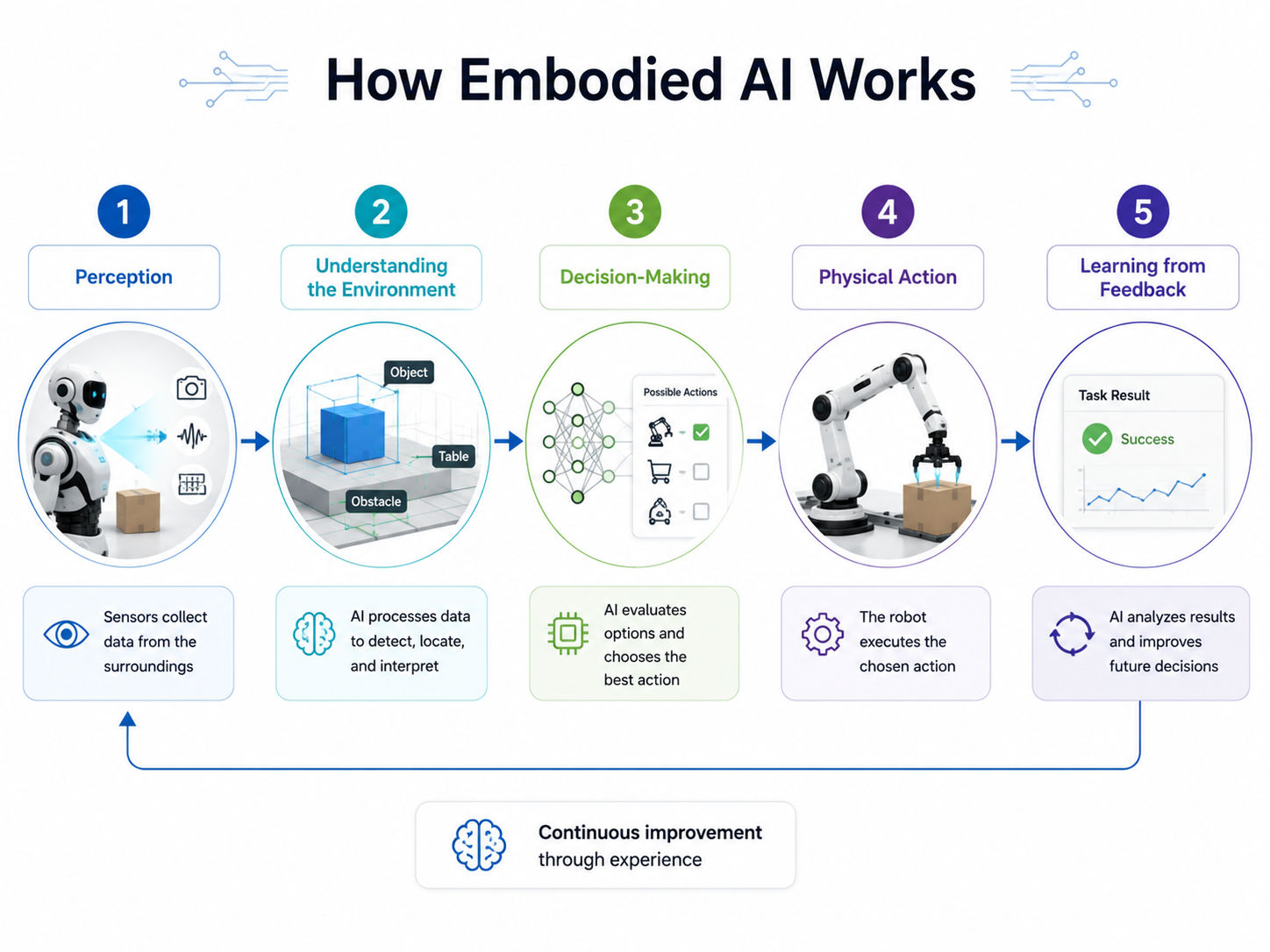
To really understand what embodied AI is, you have to think of it like a circle. It senses something then it tries to understand what that is. After that embodied AI decides what to do, then it acts on that decision. When embodied AI acts, it learns from that experience and is repeated all over again.
The robot gets information from its surroundings using cameras, LiDAR sensors, microphones, and other tools.
A delivery robot, for example, uses cameras and sensors to know where it is and to see what is in its path. The robot needs this information to move around safely. It uses GPS systems to find the location. The cameras and sensors help the robot to avoid things in its path.
Once the system has data, it analyzes it to answer questions. Like what objects are nearby? Is there a person on the way? Is the path clear?
It also figures out what needs to happen. This stage uses computer vision, machine learning, and language understanding. Where they all work together.
The system looks at its choices and chooses the best ones. This might mean turning left to get around something slowing down when it sees people picking up a box or changing its route completely.
Modern AI that works with its surroundings uses models to make better plans and adapt to new situations it hasn't seen before. These models help the AI handle complex tasks. The system still relies on these AI models to handle more complex planning. It uses them to adapt when it encounters situations it has not seen before.
The decision is carried out by using motors, wheels, robotic arms, actuators, or other mechanical parts. This step makes embodied AI different from types of AI.
Embodied AI uses these systems to take action. It is the action that sets it apart. It does not stop the analysis. It physically does something.
After acting, the system observes the result and updates its behavior accordingly. Drop an object too often? Adjust the grip. A route keeps causing delays? Find a better one. An unexpected obstacle keeps appearing? Update the navigation approach. Over time, this feedback loop makes the system meaningfully better.
Core Technologies
Technology |
Role |
| Machine Learning | Pattern recognition |
| Computer Vision | Object and scene understanding |
| Robotics | Physical movement and control |
| Sensor Systems | Environmental awareness |
| Reinforcement Learning | Learning through trial and error |
| Large Language Models | Understanding and following instructions |
Together, these technologies make it possible for a machine to function intelligently in dynamic, unpredictable physical environments.
Also Read: Robotics AI Engineer Job Description
AI Courses to upskill
Explore Artificial Intelligence Courses for Career Progression
Embodied AI is not a distant concept. It is already operating across a wide range of industries.
Self-driving cars and trucks are among the most visible examples. They continuously observe roads, detect pedestrians, predict how traffic will move, make driving decisions, and adjust to changing conditions, all without a human directing each action. Every mile driven feeds back into the system and makes it more capable.
Modern manufacturing robots can assemble products, move materials, inspect quality, and work alongside human employees. Unlike older industrial robots that simply repeat fixed instructions, newer systems can adapt when conditions change on the factory floor.
Also Read: Applications of Robotics: Industrial & Everyday Use Cases
Large logistics companies use embodied AI to handle inventory movement, package sorting, route optimization, and order fulfillment. These systems take on the repetitive, physically demanding work so human workers can focus elsewhere.
Hospitals and care facilities are exploring embodied AI for patient assistance, surgical support, rehabilitation devices, and hospital logistics. The goal is not to replace healthcare workers but to free them up for tasks that genuinely require human judgment and care.
Also Read: How AI in Healthcare is Changing Diagnostics and Treatment
Drones equipped with embodied AI can inspect infrastructure, monitor crops, support emergency response teams, and deliver supplies. They use onboard sensors and AI to navigate independently, without needing a human operator guiding every move.
Humanoid robots attract a lot of attention because they move and interact in ways that feel familiar. Potential applications range from customer service and household assistance to elder care and manufacturing support. That said, it is worth noting that humanoid robots and embodied AI are not the same thing. Many embodied AI systems look nothing like a human.
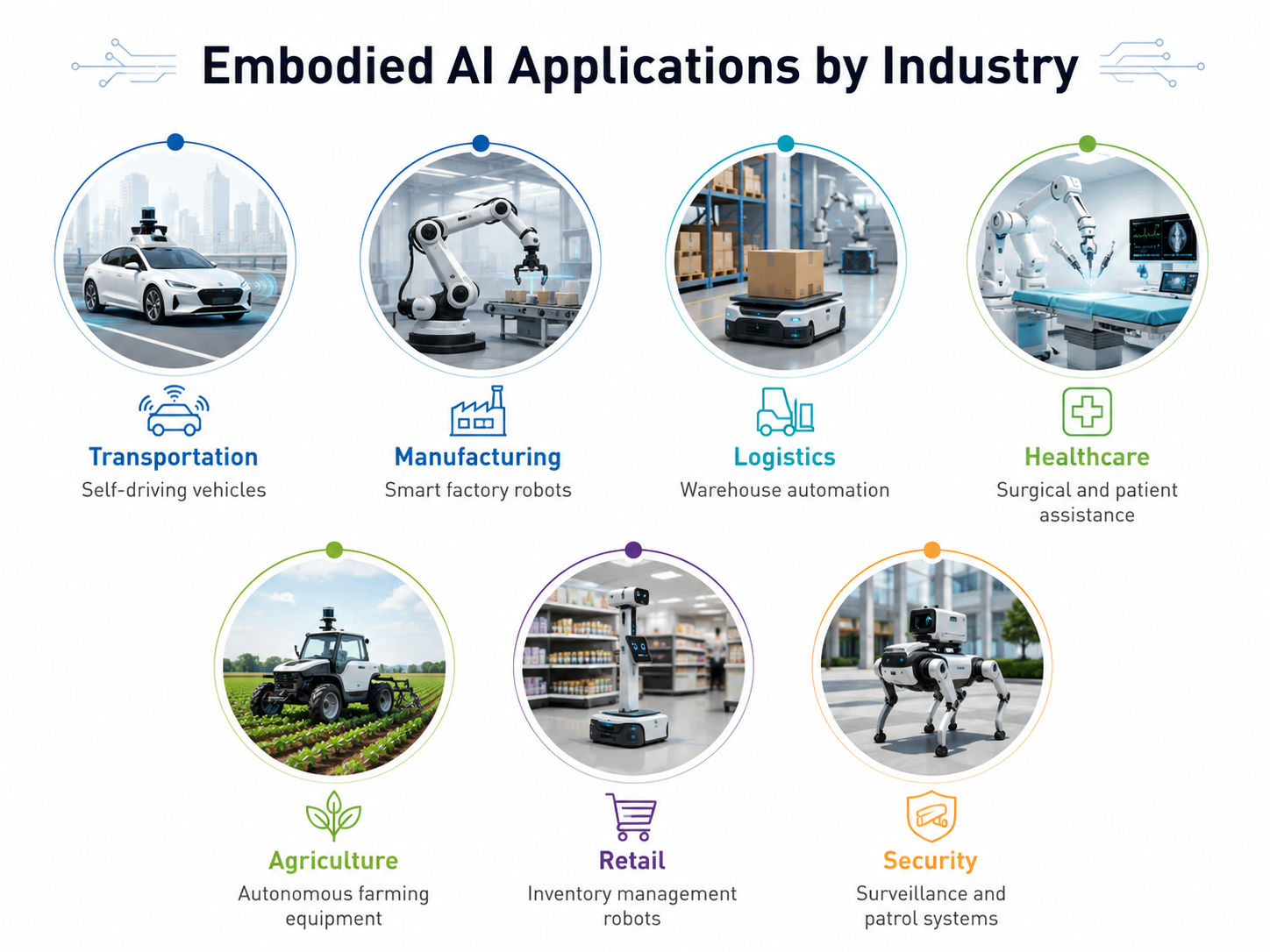
Industry |
Example Use Cases |
| Transportation | Self-driving vehicles |
| Manufacturing | Smart factory robots |
| Logistics | Warehouse automation |
| Healthcare | Surgical and patient assistance |
| Agriculture | Autonomous farming equipment |
| Retail | Inventory management robots |
| Security | Surveillance and patrol systems |
One of the clearest advantages of embodied AI is that it learns through interaction rather than relying solely on pre-collected datasets. That often leads to more practical, grounded decision-making. Beyond that, it opens the door to automating physical tasks that are repetitive, dangerous, or time-consuming, things like warehouse operations, industrial inspections, and hazardous environment monitoring.
Unlike fixed-rule machines, embodied AI can also adjust when something unexpected happens. That adaptability is a significant advantage in real-world settings where conditions rarely stay the same for long. Looking further ahead, these systems could collaborate with humans more naturally than anything currently available.
Subscribe to upGrad's Newsletter
Join thousands of learners who receive useful tips
Safety is the biggest concern. A machine operating in physical spaces alongside people must avoid causing harm, and that is a genuinely hard engineering problem. Development costs are also high. Building intelligent robots requires advanced sensors, powerful computing hardware, complex mechanical systems, and large amounts of training data that can be expensive and time-consuming to gather.
The physical world is also just harder to navigate than a digital one. Weather, lighting conditions, unexpected obstacles, and unpredictable human behavior all create complications that software-only AI rarely has to deal with.
Embodied AI marks a genuine shift in what artificial intelligence can do. These systems do not just process information; they perceive the world around them, make decisions, take physical action, and get better over time through experience. From autonomous vehicles and warehouse robots to healthcare assistants and smart drones, embodied AI is already reshaping how industries operate.
The challenges around safety, cost, and real-world complexity are real, but progress in robotics, machine learning, and large AI models is moving quickly. As AI becomes more capable of understanding and acting within physical environments, embodied AI looks set to sit at the center of the next major chapter in automation and intelligent systems.
Want to explore more about Embodied AI? Book your free 1:1 personal consultation with our expert today.
Embodied AI is artificial intelligence that exists in a physical system such as a robot, drone, or autonomous vehicle. It can sense its environment, make decisions, and perform actions in the real world. Unlike traditional AI software, it learns through direct interaction and experience.
Generative AI creates content such as text, images, code, or audio. Embodied AI focuses on interacting with physical environments through sensors and actions. While generative AI produces information, embodied AI performs real-world tasks and learns from physical experiences.
No. Robotics refers to machines capable of movement or physical action. Embodied AI refers to the intelligence that allows those machines to perceive, learn, adapt, and make decisions. A robot can exist without advanced AI, but embodied AI combines both intelligence and physical interaction.
Many researchers believe intelligence develops through interaction with the physical world. Embodied AI allows machines to learn from experience, adapt to changing situations, and solve practical problems. This could lead to more capable and flexible AI systems.
Examples include autonomous vehicles, warehouse robots, delivery drones, robotic vacuum cleaners, healthcare robots, and industrial automation systems. These technologies use sensors and AI to interact with their surroundings and perform tasks independently.
Yes. Many embodied AI systems use feedback mechanisms to improve performance over time. By analyzing outcomes and adjusting behavior, they can become more accurate, efficient, and adaptable in future situations.
Manufacturing, logistics, healthcare, transportation, agriculture, retail, and defense are among the leading adopters. These industries benefit from automation, improved efficiency, and the ability to perform complex physical tasks.
Professionals often need knowledge of machine learning, robotics, computer vision, programming, sensor technologies, and data science. Understanding AI models and physical systems together is particularly valuable in this field.
Some researchers consider embodied AI an important path toward Artificial General Intelligence (AGI). The ability to learn from physical interaction may help machines develop broader understanding and adaptability across different tasks and environments.
Major challenges include safety, high hardware costs, real-world unpredictability, energy consumption, and data collection. Creating systems that perform reliably in diverse environments remains a difficult engineering problem.
Embodied AI is more likely to automate repetitive, dangerous, or physically demanding tasks. While some roles may change, many experts expect humans and intelligent machines to work together, with people focusing on creativity, judgment, and complex decision-making.
727 articles published
Sriram K is a Senior SEO Executive with a B.Tech in Information Technology from Dr. M.G.R. Educational and Research Institute, Chennai. With over a decade of experience in digital marketing, he specia...
Speak with AI & ML expert
By submitting, I accept the T&C and
Privacy Policy
Top Resources
Master's Degree
18 Months
Executive Diploma
12 Months
IIIT Bangalore
Executive Programme in Generative AI & Agentic AI for LeadersIndia’s #1 Tech University
Dual Certification
5 Months