AI in Logistics: Benefits, Use Cases, Trends and Future Impact
By Sriram
Updated on Jun 04, 2026 | 6 min read | 2.38K+ views
Share:

All courses
Certifications
More
By Sriram
Updated on Jun 04, 2026 | 6 min read | 2.38K+ views
Share:
Table of Contents
AI in logistics is changing everything, as supply chains have become more complicated than before. Companies now manage global suppliers, higher customer demands, uncertain demand, and growing transport costs. This brings intelligence and logistics operations together. It helps businesses make choices, reduce costs, boost delivery precision, and build stronger supply chains.
In this guide, you will learn what AI in logistics is, how it functions. Its main uses, real-life advantages, obstacles, and future directions in logistics and supply chain management are also covered. If you are a student, business executive, or logistics expert, this article gives you a grasp of AI logistics.
Explore Artificial Intelligence Courses from upGrad and discover how AI is solving logistics' most persistent challenges. How AI route optimization and demand forecasting to warehouse automation and real-time supply chain decision-making.
Popular AI Programs
AI in logistics is about using intelligence to make logistics better, utilizing machine learning, predictive analytics, computer vision, and automation to improve logistics operations.
Traditional logistics systems need people to plan everything, and they use old data. AI logistics systems go a step further. They use real-time data to make logistics operations better; analyze, identify patterns, and recommend actions automatically.
Logistics has always been about moving the right thing to the right place at the right time. AI makes that possible on a scale no human team could manage alone, and it all starts with data. Every second, an AI-powered logistics system is quietly listening.
It pulls live signals from GPS devices tracking vehicles on the move, warehouse sensors monitoring stock levels, and transportation management systems juggling hundreds of shipments simultaneously.
It reads inventory databases to understand what is available, cross-references customer orders to understand what is needed, and layers in weather reports and live traffic networks to anticipate what might get in the way.
None of these sources mean much in isolation. But when AI brings them together, something powerful happens, patterns emerge, risks become visible, and decisions that once took hours can be made in seconds. Resulting in a logistics operation that does not just react to the world. I reads it.
Also Read: What is Supply Chain Management: Components, Process & Benefits
Free Courses
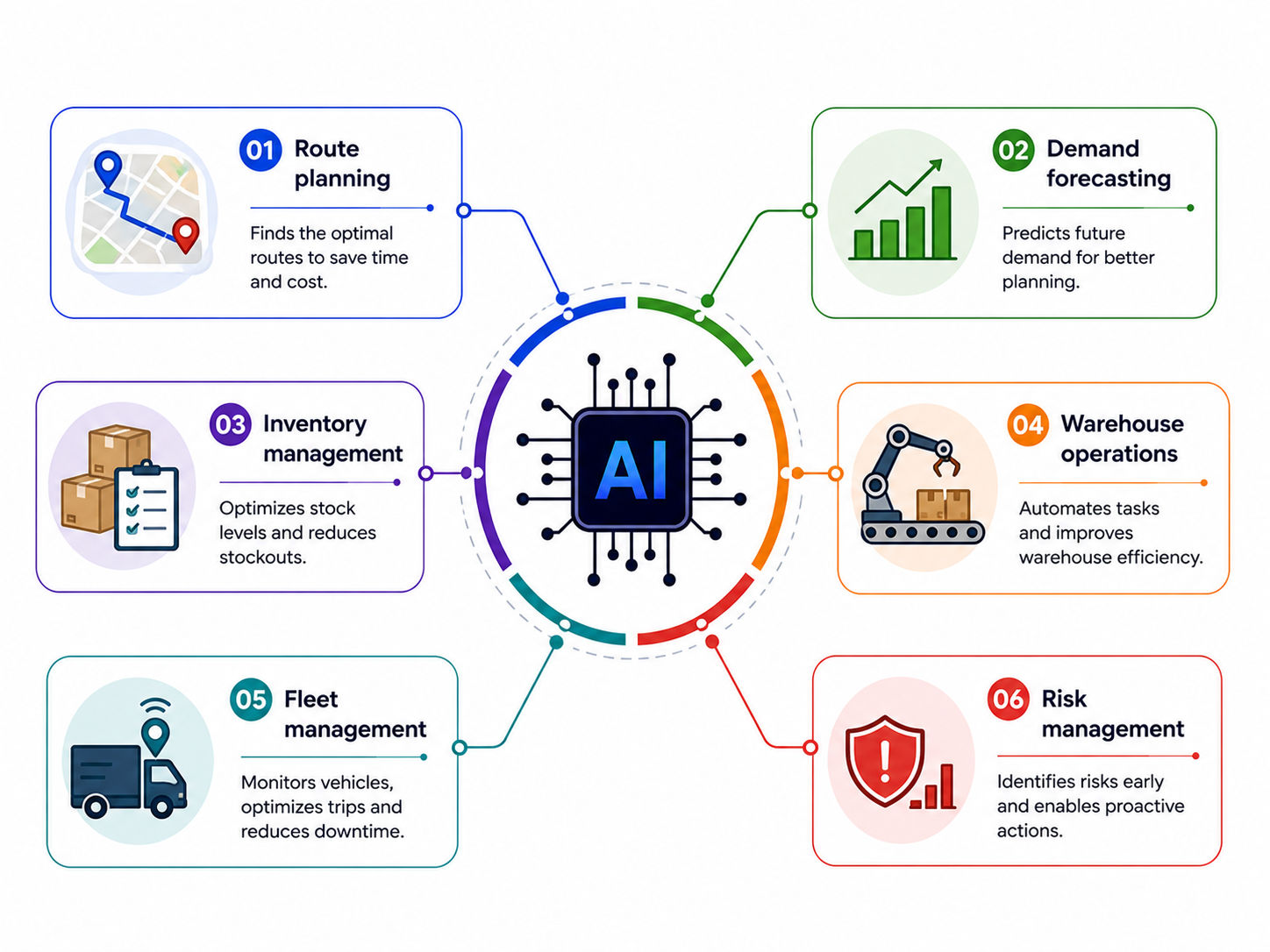
AI does not just support logistics operations; it quietly powers the decisions that keep supply chains moving.
Here is what it actually does, and why each function matters.
Function |
What AI actually does |
| Route planning | Analyses live traffic, fuel costs, and delivery windows simultaneously, then picks the route that saves the most time and money, every single trip |
| Demand forecasting | Reads historical data, seasonal trends, and market signals to predict what customers will need before they even place the order |
| Inventory management | Keeps stock in a constant state of balance not too much, not too little reducing waste and ensuring the right items are always available |
| Warehouse operations | Takes over the repetitive work of picking, sorting, and moving goods so human teams can focus on tasks that genuinely need their judgement |
| Fleet management | Monitors every vehicle in real time, flagging maintenance needs early before small issues become expensive ones |
| Risk management | Scans for disruptions - weather, supplier delays, port congestion and surfaces warnings early enough for teams to respond before impact is felt |
Traditional Logistics |
AI Logistics |
| Reactive decisions | Predictive decisions |
| Manual planning | Automated planning |
| Static routes | Dynamic optimization |
| Historical analysis | Real-time insights |
| Limited forecasting | Advanced forecasting |
Also Read: What is Logistics Management? Understanding Its Types, Functions, Processes, and More
AI Courses to upskill
Explore Artificial Intelligence Courses for Career Progression
The real proof of AI's value is not in theory; it is in the operations it is actively transforming. Across warehouses, fleets, and forecasting desks, organizations are putting AI to work in ways that are measurably changing how logistics runs.
Predicting what customers will need before they need it has always been logistics' hardest problem. AI is finally making accurate, large-scale forecasting a practical reality.
By processing historical sales, seasonal patterns, market trends, economic indicators, and shifting customer behavior simultaneously, AI gives planners a far clearer view of what is coming and far less room for costly error.
Industry analysts predict 70% of large organizations will adopt AI-based forecasting by 2030, driven by its ability to sharpen planning and reduce forecasting errors.
Transportation costs eat into logistics margins more than almost anything else. AI attacks that problem directly, continuously recalculating routes to find the fastest, most cost-efficient path forward.
Rather than relying on static maps or manual planning, AI evaluates live traffic, fuel costs, road closures, delivery priorities, and vehicle availability in real time adapting every route as conditions change on the ground.
The modern warehouse looks nothing like it did a decade ago. AI-powered technologies are taking over physical work, making facilities faster, more accurate, and far less dependent on manual labour.
Autonomous robots navigate warehouse floors. Smart picking systems retrieve items with precision. Computer vision inspects goods at speed. Automated sorting keeps fulfilment lines moving without interruption. Industry forecasts suggest that by 2030, half of all new warehouses in developed markets could become predominantly robot-operated facilities.
Too much stock ties up capital. Too little creates stockouts. Getting the balance exactly right has always been a guessing game until AI replaced the guesswork with precision.
AI continuously monitors inventory movement, flags slow-moving products, predicts upcoming demand shifts, and recommends replenishment schedules, so businesses always hold the right amount of stock at exactly the right moment.
A single vehicle breakdown can ripple through an entire logistics network. AI stops that from happening by spotting warning signs long before a breakdown ever occurs.
AI maintenance systems track engine performance, fuel efficiency, component wear, and driver behavior across every vehicle in a fleet of surfacing potential issues early enough for teams to act, not react.
Customers want answers instantly “where is my order”, when will it arrive, what went wrong. AI makes sure those answers are always available, without putting pressure on support teams.
AI chatbots and virtual assistants handle shipment tracking, delivery updates, and common issue resolution around the clock, freeing human agents to focus on the complex cases that genuinely need their attention.
AI adoption delivers significant advantages, but organizations must also address several implementation challenges.
Also Read: Applications of Artificial Intelligence and Its Impact
AI does not just make logistics faster; it makes it fundamentally smarter. From the warehouse floor to the boardroom, the advantages compound across every layer of the supply chain.
Logistics teams spend enormous amounts of time on tasks that follow predictable patterns. AI takes those tasks off their plate entirely freeing people to focus on work that actually needs human thinking.
Shipment scheduling, route planning, inventory monitoring, and order processing, all handled automatically, consistently, and without the fatigue that slows human performance over time.
Good decisions in logistics depend on processing enormous amounts of information quickly. That is exactly what AI does at a speed and scale that no human team can match.
The result is faster planning, sharper forecasting, fewer operational errors, and decisions grounded in data rather than intuition. Teams stop reacting and start leading.
Every inefficiency in a logistics operation has a price tag. AI systematically finds and eliminates those inefficiencies by turning marginal savings across multiple areas into meaningful bottom-line impact.
Fuel consumption drops when routes are optimized. Inventory costs fall when stock levels are precisely managed. Delivery failures become rarer. Labor is allocated where it is genuinely needed.
You cannot manage what you cannot see. AI gives logistics managers a live, unified view of their entire operation, so nothing moves without their awareness, and nothing stalls without their knowledge.
Vehicle locations, inventory status, delivery progress, and operational bottlenecks, all visible in real time. Problems surface before they escalate. Interventions happen while there is still time to act.
Logistics is one of the world's largest contributors to carbon emissions. AI is becoming one of the most practical tools available to change that not through sacrifice, but through smarter operations.
By optimizing routes, managing capacity more intelligently, and improving transportation planning, AI helps logistics networks do more with less fuel and less environmental impact. Research suggests that these improvements can reduce freight-related emissions by 10–15%.
Also Read: AI Automation Explained: Tools, Benefits, and How It Differs From Automation
Despite the benefits, implementation is not always straightforward. Organizations must also address these implementation challenges.
Subscribe to upGrad's Newsletter
Join thousands of learners who receive useful tips
Logistics is getting smarter fast. Here's where things are headed.
Unlike traditional AI tools that provide recommendations, agentic systems can perform tasks independently.
Agentic AI does the work of booking freight, scheduling shipments, adjusting inventory, and coordinating suppliers without waiting for a human to pull the trigger. Adoption is accelerating, and it's only going to move faster.
A fresh generation of logistics startups is giving companies tools they didn't have five years ago
They focus on:
Before rearranging a warehouse or rerouting a supply chain, companies can now simulate it virtually first. Digital twins' model everything from warehouse layouts to full network disruptions making costly mistakes far less likely.
Human error becomes an exception, not the norm. The goal is faster fulfillment with fewer operational errors. Robotics, computer vision, and AI decision-making are converging into warehouses that are faster, more accurate, and increasingly self-sufficient.
Greener operations are turning sustainability from a goal into a measurable outcome.
AI can support:
AI logistics is no longer a future concept. It is already transforming transportation, warehousing, inventory management, and supply chain planning. From demand forecasting and route optimization to predictive maintenance and warehouse automation. At the same time, businesses must address challenges such as data quality, workforce readiness, and system integration.
As technology continues to evolve, the role of ai logistics will only expand. Companies that invest in the right data foundations, processes, and talent today will be better positioned to build resilient, intelligent, and competitive supply chains tomorrow.
Want personalized guidance on AI in Logistics? Speak with an expert for a free 1:1 counselling session today.
AI logistics is the use of artificial intelligence to improve transportation, warehousing, inventory management, and delivery operations. It helps businesses analyze data, automate tasks, and make faster decisions. The goal is to reduce costs while improving operational efficiency.
AI improves supply chains by predicting demand, optimizing inventory, improving forecasting accuracy, and identifying disruptions before they become major problems. This allows organizations to plan more effectively and respond faster to market changes.
Common applications include demand forecasting, route optimization, warehouse automation, predictive maintenance, inventory management, and customer service automation. These use cases help businesses improve efficiency across the entire supply chain.
No. AI is primarily designed to support logistics professionals rather than replace them. Human expertise remains essential for strategic planning, exception management, supplier relationships, and complex operational decisions.
AI in transport logistics helps optimize delivery routes, monitor fleet performance, predict vehicle maintenance needs, and improve shipment tracking. This leads to faster deliveries, lower fuel costs, and better customer experiences.
Professionals often benefit from skills in data analytics, supply chain management, logistics operations, machine learning basics, business intelligence tools, and digital transformation. Understanding both technology and operations is increasingly valuable.
Most ai logistics startups focus on visibility platforms, freight optimization, warehouse automation, predictive analytics, autonomous planning, and supply chain intelligence. Their solutions help businesses modernize operations more quickly.
Yes. Many cloud-based AI solutions are now affordable for smaller companies. Businesses can use AI for inventory forecasting, route planning, demand prediction, and customer support without making large infrastructure investments.
Common barriers include poor data quality, outdated systems, integration difficulties, limited AI expertise, and unclear implementation strategies. Organizations often achieve better results when they address these issues before deployment.
AI reduces unnecessary fuel consumption through route optimization and better capacity planning. It can also improve fleet efficiency, reduce empty miles, and support greener transportation decisions that lower emissions.
The future of ai in supply chain and logistics includes agentic AI, autonomous warehouses, advanced forecasting, digital twins, and real-time decision systems. Businesses will increasingly combine human expertise with AI-driven automation to improve resilience and efficiency.
727 articles published
Sriram K is a Senior SEO Executive with a B.Tech in Information Technology from Dr. M.G.R. Educational and Research Institute, Chennai. With over a decade of experience in digital marketing, he specia...
Speak with AI & ML expert
By submitting, I accept the T&C and
Privacy Policy
Top Resources
Master's Degree
18 Months
Executive Diploma
12 Months
IIIT Bangalore
Executive Programme in Generative AI & Agentic AI for LeadersIndia’s #1 Tech University
Dual Certification
5 Months