AI as a Service (AIaaS): A Complete Guide to Benefits, Use Cases, and Business Impact
By Sriram
Updated on Jun 10, 2026 | 6 min read | 4.51K+ views
Share:

All courses
Certifications
More
By Sriram
Updated on Jun 10, 2026 | 6 min read | 4.51K+ views
Share:
Table of Contents
AI as a Service (AIaaS) delivers artificial intelligence capabilities through cloud-based platforms, allowing businesses to use technologies such as machine learning, natural language processing, and computer vision without building their own infrastructure. Through APIs and software tools, organizations can deploy AI solutions quickly, reduce costs, and access advanced capabilities without extensive technical expertise.
This blog covers what AI as a Service is, how it works, its business model, real-world applications, leading providers, benefits, challenges, and practical considerations for organisations looking to adopt AI solutions.
Build practical AI and ML skills with upGrad’s Artificial Intelligence Courses. Learn machine learning, generative AI, and emerging technologies while working on real-world projects.
Popular AI Programs
AI as a Service (AIaaS) is a cloud-based delivery of artificial intelligence functionality using a subscription or pay-as-you-go model. Instead of building AI models, managing infrastructure, and hiring large teams of AI specialists, businesses can access ready-to-use AI services through APIs, cloud applications, and managed platforms.
Organisations leverage AIaaS to embed machine learning, natural language processing, computer vision, predictive analytics, and generative AI capabilities into their workflows with minimal setup.
Unlike traditional AI development, in which companies must build and manage everything in-house, AIaaS vendors manage infrastructure, model training, updates, scaling, and security.
The table below highlights the difference between traditional AI deployment and AIaaS.
Feature |
Traditional AI Development |
AI as a Service |
| Infrastructure | Managed internally | Managed by the provider |
| Initial Cost | High | Low |
| Deployment Speed | Months | Days or weeks |
| AI Expertise Required | Extensive | Moderate |
| Maintenance | Internal teams | Provider-managed |
| Scalability | Limited by resources | Highly scalable |
A simple example is a customer support chatbot powered by a cloud AI provider. Instead of building a language model from scratch, a business can connect to an AI service through an API and start handling customer queries almost immediately.
This approach has significantly lowered the barrier to AI adoption across industries such as healthcare, finance, retail, manufacturing, education, and logistics.
Do read : How to Build Your Own AI System: Step-by-Step Guide
Free Courses
AIaaS platforms combine cloud computing, pre-trained AI models, APIs, and managed infrastructure to deliver AI functionality to users.
Businesses interact with these services through web applications, dashboards, SDKs, or APIs.
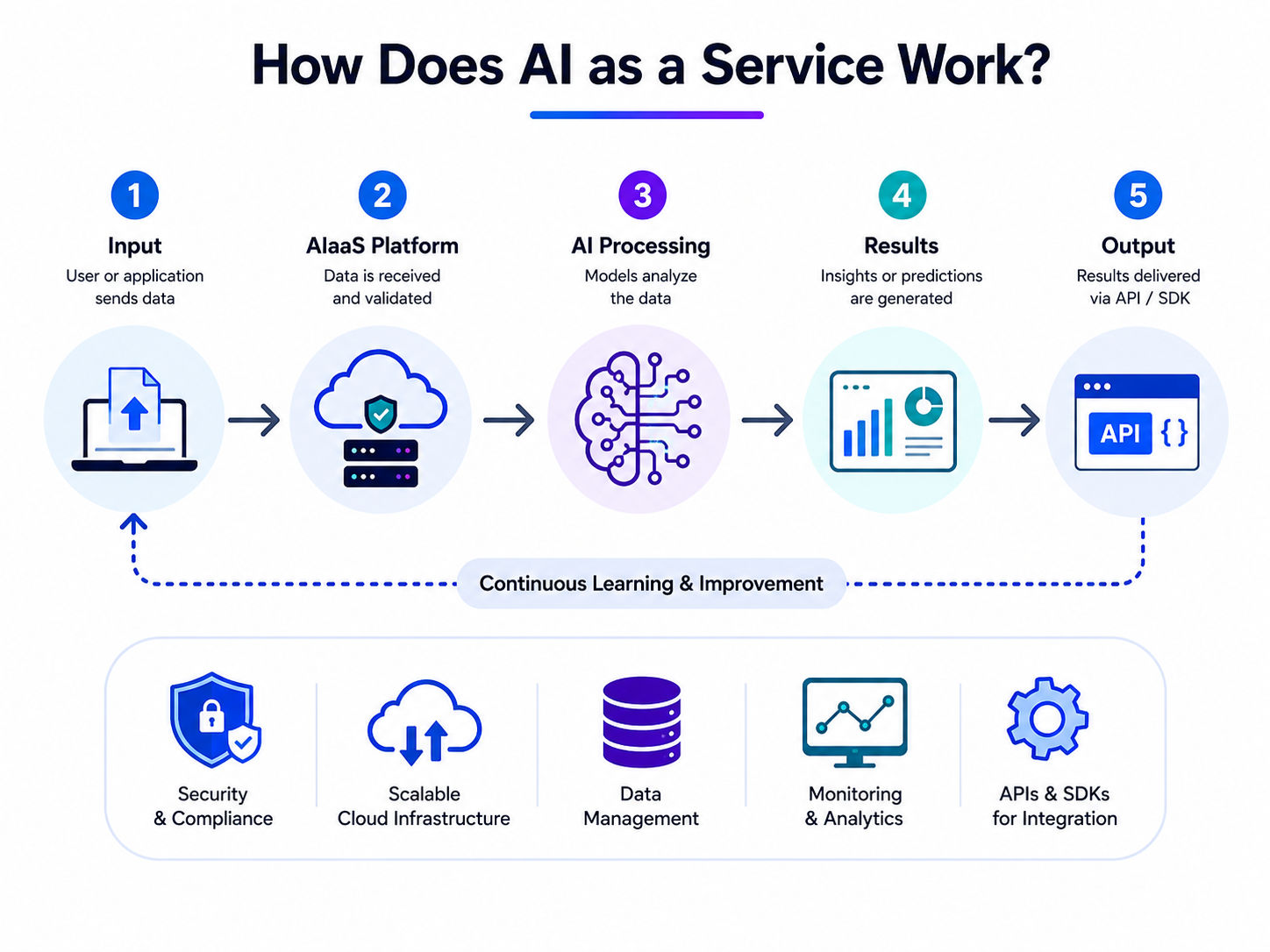
A typical AIaaS workflow looks like this:
For example, consider an e-commerce platform using AI-powered recommendation engines.
Developers often prefer AIaaS because it eliminates the need to manage GPU clusters, model deployment pipelines, and infrastructure scaling.
Modern AIaaS platforms typically offer:
One practical advantage is flexibility. A startup can begin with a small usage plan and scale usage as customer demand grows without rebuilding its technology stack.
Also Read : Applications of Artificial Intelligence and Its Impact
AI Courses to upskill
Explore Artificial Intelligence Courses for Career Progression
The AI as a service business model follows principles similar to Software as a Service (SaaS), where customers pay for access rather than ownership.
Instead of purchasing expensive AI infrastructure, businesses consume AI capabilities on demand.
Most AIaaS providers use one or more of the following pricing approaches:
Pricing Model |
Description |
| Subscription | Fixed monthly or annual fee |
| Pay-as-you-go | Charges based on usage |
| Tiered Pricing | Different feature levels based on plan |
| Enterprise Contracts | Customized agreements for large organizations |
| API Consumption | Charges per request or token usage |
This model benefits both providers and customers.
For providers:
For customers:
A practical example is a financial services company using fraud detection APIs. Instead of building a fraud detection system internally, it pays only for transactions analyzed by the AI platform.
However, businesses should also evaluate long-term costs. While AIaaS reduces initial expenses, high-volume applications may generate significant recurring costs over time.
Organizations often perform cost-benefit analyses before choosing between AIaaS and custom-built AI solutions.
The decision usually depends on:
For many organizations, AIaaS provides the fastest path to implementing AI while maintaining operational flexibility.
Must Read: How to Build Your Own AI System: Step-by-Step Guide
Many companies already use AI-powered services without realizing they are leveraging AIaaS platforms behind the scenes.
Here are some common AI as a service examples across different sectors.
Businesses deploy AI chatbots and virtual assistants to handle customer inquiries, ticket routing, and self-service support.
Benefits include:
Healthcare providers use AIaaS for:
AI helps clinicians process large volumes of medical data more efficiently.
Financial institutions apply AIaaS to:
These systems often analyze thousands of transactions within seconds.
Retail companies leverage AIaaS for:
This improves both customer experience and operational efficiency.
Manufacturers use AI services for:
Predictive maintenance alone can reduce downtime significantly.
Educational platforms use AI to:
Many online learning platforms now integrate generative AI to improve learner engagement.
These examples demonstrate how AIaaS enables businesses to deploy sophisticated AI capabilities without building complex machine learning systems internally.
Do read : AI in Logistics: Benefits, Use Cases, Trends and Future Impact
Several major technology companies offer comprehensive AI services through cloud platforms.
The list below highlights some of the most widely used AIaaS providers in the market:
Provider |
Key AI Services |
| Google Cloud | Vertex AI, generative AI, machine learning |
| Microsoft Azure | Azure AI Services, OpenAI integrations |
| Amazon Web Services (AWS) | SageMaker, AI APIs, forecasting |
| IBM | Watson AI solutions |
| OpenAI | Language models and generative AI APIs |
| NVIDIA | AI infrastructure and model deployment |
| Oracle | Enterprise AI services |
| Salesforce | AI-powered CRM solutions |
These AI as a service companies provide different capabilities depending on organizational needs.
When evaluating providers, organizations should consider:
A startup focused on conversational AI may prioritize language model quality, while a healthcare provider may focus more heavily on compliance and data governance.
The right provider often depends on business goals rather than simply choosing the largest platform.
AI as a Service helps businesses adopt artificial intelligence quickly without investing heavily in infrastructure or specialized teams. However, while AIaaS offers flexibility and scalability, organizations must also consider factors such as data security, ongoing costs, and vendor dependence before implementation..
Benefits:
The following advantages drive widespread adoption of AIaaS.
Benefit |
Business Impact |
| Lower Costs | Reduces infrastructure investment |
| Faster Deployment | Accelerates implementation |
| Scalability | Supports business growth |
| Access to Expertise | Leverages provider innovation |
| Continuous Updates | Improves performance over time |
| Global Availability | Supports distributed operations |
Organizations can experiment with AI solutions quickly and scale successful projects without major infrastructure investments.
Challenges :
The following challenges commonly arise during AIaaS adoption.
Challenge |
Consideration |
| Data Privacy | Sensitive data may require additional controls |
| Vendor Dependence | Switching providers can be difficult |
| Ongoing Costs | Usage-based pricing can increase expenses |
| Compliance Requirements | Industry regulations may restrict usage |
| Customization Limits | Pre-built models may not fit all use cases |
A common problem involves highly specialised workflows. Pre-trained AI services tend to work well for general tasks, but organisations with niche requirements may still need custom model development.
Governance is another practical issue. Businesses require explicit policies around data usage, model monitoring and responsible AI use.
Early action by companies on these challenges generally leads to better long-term results from AI investments.
AI as a Service is moving beyond simple automation toward intelligent systems that can generate content, automate workflows, and support decision-making. As AI technology advances, businesses will gain access to more powerful tools without managing complex infrastructure.
Key trends shaping the future include:
As AI adoption grows, AIaaS will make advanced AI capabilities more accessible, scalable, and practical for organizations of all sizes.
Also Read : Understanding the Key Elements of AI
Artificial Intelligence as-a-Service (AIaaS) provides advanced artificial intelligence via cloud-based platforms, removing the need for expensive infrastructure and deep in-house knowledge. It accelerates the adoption of AI within organisations in an agile and scalable fashion.
AIaaS supports innovation across industries, from automation and analytics to generative AI applications. Choosing the right provider and understanding its limitations can help businesses maximize the value of their AI investments.
Want personalized guidance on AI and upskilling? Speak with an expert for a free 1:1 counselling session today.
Traditional cloud software provides predefined features for specific business functions. AI as a Service goes a step further by offering intelligence-driven capabilities such as prediction, content generation, image recognition, and decision support. Instead of following fixed rules, AI systems learn from data and improve outputs over time. This makes AIaaS suitable for dynamic business challenges that require analysis, automation, or personalization.
Yes. One of the biggest advantages of AIaaS is accessibility. Small businesses can use ready-made AI tools for customer support, marketing automation, sales forecasting, and document processing without hiring data scientists. Most platforms offer user-friendly interfaces and APIs, allowing teams to implement AI solutions with limited technical expertise and lower upfront investment.
Businesses should look beyond pricing. Key considerations include data security, compliance support, scalability, integration capabilities, model performance, and customer support. It's also important to assess whether the provider offers customization options and transparent usage costs. Evaluating these factors early can prevent operational challenges as AI adoption grows.
It can be, but organizations must carefully review the provider's security controls and compliance certifications. Industries such as healthcare, banking, and insurance often require strict data governance measures. Businesses should verify encryption standards, data residency options, access controls, and regulatory compliance before deploying sensitive workloads on an AIaaS platform.
Many organizations start with practical use cases that deliver measurable value quickly. These include customer service chatbots, recommendation engines, fraud detection systems, sentiment analysis, demand forecasting, document extraction, and generative AI tools for content creation. Companies often expand into more advanced applications once they gain experience with AI adoption.
AIaaS providers offer access to large language models and multimodal AI systems through APIs. Businesses can use these services to generate text, summarize documents, create code, answer customer questions, or analyze content. Instead of training large models internally, organizations leverage provider-managed infrastructure and pay based on usage.
While AIaaS reduces initial investment, ongoing costs can increase as usage grows. API requests, data storage, model training, premium features, and high-volume processing may lead to higher monthly expenses. Businesses should estimate long-term usage patterns and monitor consumption regularly to avoid unexpected operational costs.
Yes, many providers allow developers to fine-tune models, create custom workflows, and integrate proprietary datasets. However, the level of customization varies between platforms. Organizations with highly specialized requirements should evaluate whether a provider's flexibility aligns with their business processes before committing to a solution.
AIaaS reduces the time required to deploy intelligent solutions by eliminating infrastructure setup and complex model management. Teams can experiment with AI-powered features quickly and focus on solving business problems instead of maintaining technical systems. This often helps organizations modernize processes faster and improve operational efficiency.
Not entirely. AIaaS simplifies deployment, but organizations still need people who understand business goals, data quality, governance, and implementation strategy. Many companies use AIaaS to reduce technical complexity while relying on internal teams to manage workflows, evaluate results, and ensure responsible AI usage.
AIaaS is expected to become more specialized and industry-focused. Providers are increasingly offering domain-specific solutions for healthcare, finance, manufacturing, and education. Generative AI, autonomous agents, multimodal systems, and real-time analytics will likely become standard offerings, making AI capabilities more accessible and practical for businesses of all sizes.
725 articles published
Sriram K is a Senior SEO Executive with a B.Tech in Information Technology from Dr. M.G.R. Educational and Research Institute, Chennai. With over a decade of experience in digital marketing, he specia...
Speak with AI & ML expert
By submitting, I accept the T&C and
Privacy Policy
Top Resources
Master's Degree
18 Months
Executive Diploma
12 Months
IIIT Bangalore
Executive Programme in Generative AI & Agentic AI for LeadersIndia’s #1 Tech University
Dual Certification
5 Months