AI Chatbot for Business: A Complete Guide to Use Cases, Benefits, and Implementation
By Sriram
Updated on Jun 17, 2026 | 7 min read | 4.42K+ views
Share:

All courses
Certifications
More
By Sriram
Updated on Jun 17, 2026 | 7 min read | 4.42K+ views
Share:
Table of Contents
AI chatbots for business are intelligent virtual assistants that automate customer interactions, qualify leads, and streamline daily operations. Unlike traditional rule-based systems, modern chatbots use conversational AI to deliver personalized experiences. They provide 24/7 support, integrate with CRM platforms, automate repetitive tasks, and help businesses reduce costs while improving efficiency, scalability, and customer satisfaction.
In this blog , you'll learn how business chatbots work, where companies use them, the technologies behind them, implementation best practices, and common challenges. Whether you're a student, developer, or working professional, this article provides practical insights beyond basic definitions.
Explore Artificial Intelligence Courses on upGrad to learn how modern chatbots work, understand the technologies behind them, and build practical skills in conversational AI.
Popular AI Programs
Businesses today interact with customers across websites, mobile apps, social media, and messaging platforms. Managing these conversations manually can be time-consuming and costly, especially as customer expectations for instant responses continue to grow.
An AI chatbot for business helps automate these interactions by understanding user queries, retrieving information, and generating relevant responses in real time. This enables businesses to provide faster support while improving operational efficiency.
To understand its value, it's important to see what happens behind the scenes when a customer sends a message to a chatbot.
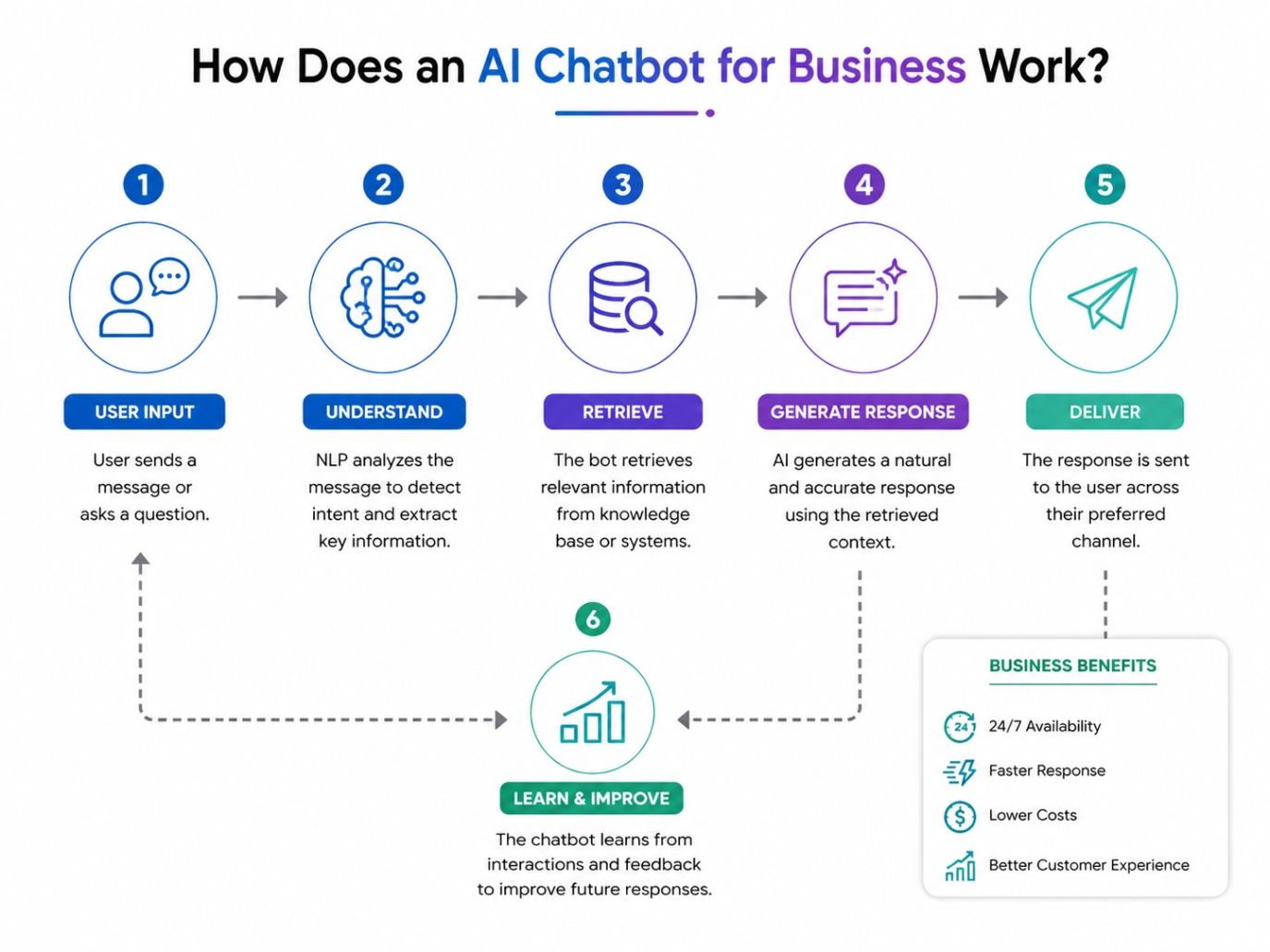
The following steps explain how an AI chatbot processes a customer conversation.
Every interaction begins when a customer asks a question through a website, app, or messaging platform.
For example:
The chatbot receives the input and prepares it for analysis.
The chatbot uses Natural Language Processing (NLP) to analyze the user's message and determine its meaning.
It identifies:
For instance, the chatbot understands that "Track my package" and "Where is my order?" have the same intent.
Once the intention is identified, the chatbot retrieves information from connected systems.
These systems may consist of:
This integration allows an AI chatbot for business to provide accurate and personalized answers.
The chatbot uses machine learning models or large language models to generate a response based on available information and conversation history.
For example:
Customer: "Is my order shipped?"
Chatbot: "Yes, your order was shipped yesterday and is expected to arrive on Friday."
Modern chatbots can also handle follow-up questions without losing context.
Businesses are continuously monitoring the performance of chatbots and improving responses over time.
A good chatbot isn’t just a question-answering machine. It gives a smart interface to the business systems for the user. As AI technology develops, an AI chatbot for business becomes more accurate, personalized and can handle more complex interactions.
Free Courses
Businesses in all industries use chatbots to automate tasks, improve customer service, and increase efficiency. AI-powered systems are transforming how organizations interact with users, from retail to healthcare.
An AI chatbot for business enables companies to offer faster responses, lower operational costs, and deliver personalised experiences at scale.
The table below highlights how different industries use AI chatbots and the benefits they achieve
Industry |
Common Use Case |
Business Benefit |
| Retail & E-commerce | Product recommendations and order tracking | Higher sales and customer satisfaction |
| Banking & Finance | Account inquiries and fraud alerts | Faster service and improved security |
| Healthcare | Appointment scheduling and patient support | Reduced administrative workload |
| Education | Student assistance and course guidance | Better learner engagement |
| Human Resources | Employee onboarding and policy queries | Increased productivity |
| Travel & Hospitality | Booking assistance and travel updates | Enhanced customer experience |
| Telecommunications | Technical support and billing inquiries | Reduced support costs |
| Insurance | Claim processing and policy information | Faster claim resolution |
| Real Estate | Property recommendations and lead generation | Improved lead conversion |
| IT & SaaS Companies | Customer support and troubleshooting | Better customer retention |
Businesses often start with simple chatbot use cases such as answering FAQs and later expand into advanced automation. As AI technology evolves, chatbots are becoming an essential tool for improving efficiency and delivering better customer experiences.
Also Read : Best AI Chatbot: A Guide to Choosing the Right AI Assistant in 2026
AI Courses to upskill
Explore Artificial Intelligence Courses for Career Progression
Businesses increasingly adopt AI chatbots to improve efficiency, automate repetitive tasks, and enhance customer experiences. However, successful implementation requires more than deploying advanced technology.
An AI chatbot for business delivers significant value when supported by quality data, strong integrations, and continuous monitoring. At the same time, organizations must address challenges such as accuracy, security, and maintenance.
The table below compares the key benefits and challenges businesses encounter when implementing AI chatbots:
Aspect |
Benefits |
Challenges |
| Customer Support | Provides 24/7 assistance and instant responses | May misunderstand complex queries |
| Operational Efficiency | Automates repetitive tasks and reduces workload | Requires regular updates and maintenance |
| Cost Savings | Lowers customer service costs over time | Initial implementation can be expensive |
| Scalability | Handles thousands of conversations simultaneously | Performance depends on data quality |
| Customer Experience | Delivers faster and personalized interactions | Incorrect responses may reduce trust |
| Employee Productivity | Allows teams to focus on high-value tasks | Human oversight is still necessary |
| Data Management | Retrieves information quickly from systems | Raises privacy and compliance concerns |
| System Integration | Connects with CRM and business tools | Integration can be technically complex |
Choosing the best AI chatbot for business requires balancing accuracy, customization, security, and cost. In practice, companies achieve the best outcomes when chatbots work alongside human employees rather than replacing them entirely.
Implementing an AI chatbot is not simply a matter of choosing a platform or model. Businesses need to plan carefully, incorporate the right data sources and continuously improve performance.
The better customer experiences and operational efficiency are the results of a well-designed chatbot. The most value from an AI chatbot for business comes when it is aligned with business goals and user needs.
Set goals such as improved customer support or lead generation.
Clear objectives help to effectively measure chatbot success.
Know your chatbot users and the questions they tend to ask.
This allows for relevant and personalized interactions.
Find a chatbot platform that can scale and has the features you need.
Make sure it integrates with your existing business tools.
Connect the chatbot to CRM systems, databases and APIs.
Good data means better, more personalized answers.
Before going live, try various user scenarios.
This helps to catch errors and improve the user experience.
Monitor chatbot performance according to customer feedback and metrics.
Continuous improvements result in long-term effectiveness.
AI chatbots are rapidly transforming how businesses interact with customers, automate support, and manage operations. With advancements in natural language processing and machine learning, they are becoming smarter, faster, and more human-like.
Here’s how they will shape the future of business communication and growth:
Also Read: Generative AI vs Traditional AI: Which One Is Right for You?
An AI chatbot for business helps organizations automate customer interactions, improve support efficiency, and streamline daily operations. From answering queries to assisting employees, chatbots enable faster and more personalized experiences. However, successful implementation depends on quality data, strong integrations, and ongoing monitoring.
As AI technology evolves, chatbots will become more intelligent and context-aware. The best AI chatbot for business balances automation with human oversight to ensure accuracy and trust. Businesses that adopt AI strategically today will be better prepared for the future of conversational AI.
Ready to start your journey? Book a free consultation with upGrad today to find the best path for your career.
AI chatbots improve customer experience by providing instant responses, personalized recommendations, and round-the-clock support. Customers no longer need to wait for an agent to answer simple questions. Businesses can also maintain consistent communication across websites, apps, and messaging channels, leading to faster issue resolution and higher customer satisfaction.
Yes, small businesses can use chatbots to automate repetitive tasks such as answering FAQs, scheduling appointments, and capturing leads. An AI chatbot for business helps smaller teams handle more customer interactions without increasing staffing costs, making operations more efficient and scalable.
Industries such as retail, banking, healthcare, education, and hospitality have seen significant benefits from chatbot adoption. However, almost any industry with frequent customer interactions can use chatbots to improve service quality, reduce workload, and streamline operations. The use case matters more than the industry itself.
Not always. Many modern chatbot platforms provide no-code or low-code interfaces that allow businesses to create workflows without programming skills. However, advanced customization, integrations, and enterprise deployments often require developers to configure APIs, databases, and business systems.
The cost varies depending on features, integrations, and deployment scale. Basic chatbots may cost a few hundred dollars per month, while enterprise solutions can require larger investments. Businesses should also account for maintenance, training, and optimization costs rather than focusing only on initial setup expenses.
Yes, modern chatbots commonly integrate with CRM platforms, helpdesk systems, payment gateways, and databases. These integrations allow chatbots to access customer information and deliver personalized responses. A well-integrated AI chatbot for business can automate workflows and improve operational efficiency.
Traditional chatbots rely on predefined rules and decision trees, while AI chatbots use machine learning and natural language processing to understand context. This allows AI-powered systems to handle varied user inputs, follow-up questions, and more complex conversations with greater flexibility.
Businesses track metrics such as customer satisfaction scores, resolution rates, average handling time, and escalation frequency. Monitoring these indicators helps identify gaps in performance and optimize the chatbot over time. Successful chatbot deployment depends on continuous improvement rather than one-time implementation.
AI chatbots can automate repetitive tasks, but they cannot fully replace human expertise in complex situations. Many organizations use a hybrid approach where chatbots handle routine queries while agents manage sensitive or complicated issues. This often creates better customer experiences and higher productivity.
Security depends on the chatbot platform and implementation practices. Businesses should use encryption, access controls, and compliance measures to protect sensitive information. Industries such as healthcare and finance often require additional safeguards to meet regulatory requirements and maintain customer trust.
Businesses should evaluate factors such as integration capabilities, scalability, security, customization options, and ease of use. The best AI chatbot for business is not always the one with the largest model but the one that aligns with business goals and delivers reliable user experiences.
730 articles published
Sriram K is a Senior SEO Executive with a B.Tech in Information Technology from Dr. M.G.R. Educational and Research Institute, Chennai. With over a decade of experience in digital marketing, he specia...
Speak with AI & ML expert
By submitting, I accept the T&C and
Privacy Policy
Top Resources
Master's Degree
18 Months
Executive Diploma
12 Months
IIIT Bangalore
Executive Programme in Generative AI & Agentic AI for LeadersIndia’s #1 Tech University
Dual Certification
5 Months