Generative AI for Business: Benefits, Use Cases, Challenges, and Future Trends
By Sriram
Updated on Jun 17, 2026 | 9 min read | 2.31K+ views
Share:

All courses
Certifications
More
By Sriram
Updated on Jun 17, 2026 | 9 min read | 2.31K+ views
Share:
Table of Contents
Generative AI for business is changing the way companies work. It helps them talk to each other, helps customers, and make good choices. This technology was first an idea but now it is a useful tool that many parts of a company use like marketing, sales and customer support. Companies big and small are looking at how generative AI can help teams work faster, reduce boring and repetitive tasks, and find new ways to grow.
In this blog, you’ll learn what generative AI for business is, how it works, what is good about it, and how companies are using it. Whether you are a business owner, or someone just exploring AI, this article will help you understand how generative AI can be useful in business can help and where humans are still needed.
Ready to move beyond using AI tools and start applying them strategically in business? Explore upGrad's Agentic AI Courses Online covering generative AI for business.
Generative AI Courses to upskill
Explore Generative AI Courses for Career Progression
IIIT Bangalore
Executive Diploma in Machine Learning and AI360° Career Support
Generative AI for business is about using intelligence systems that can create content. These systems can generate insights, answer questions, write code, summarize information, and automate tasks that need knowledge.
Traditional automation tools follow fixed rules. Generative AI is different because it can understand context. It generates outputs based on users' prompts and business data.
Also Read: Generative AI Fundamentals: A Practical Guide to Understanding How Modern AI Works
Generative AI models are taught with a lot of datasets, so they can recognize patterns in language, pictures, code, and other kinds of information. This way AI can understand the input.
Businesses use these systems to:
Factor |
Traditional AI |
Generative AI |
| Primary Function | Predicts outcomes | Creates new content |
| Input Type | Structured data | Structured and unstructured data |
| Flexibility | Rule-based | Context-aware |
| Use Cases | Forecasting, fraud detection | Writing, coding, design, chatbots |
| Human Interaction | Limited | High |
Also Read: Generative AI vs Traditional AI: Which One Is Right for You?
Research from McKinsey estimates that generative AI could add between $2.6 trillion and $4.4 trillion in annual economic value globally. The majority of this value is expected to come from customer operations, marketing, software engineering, and research functions.
To really make it work, you need to do more than just get an AI tool. Organizations need to have an idea of how they will use the artificial intelligence tool they need to have clear use cases, governance policies, and human oversight.
For businesses, the appeal is simple:
Also Read: Easy Guide to the Generative AI Course Syllabus
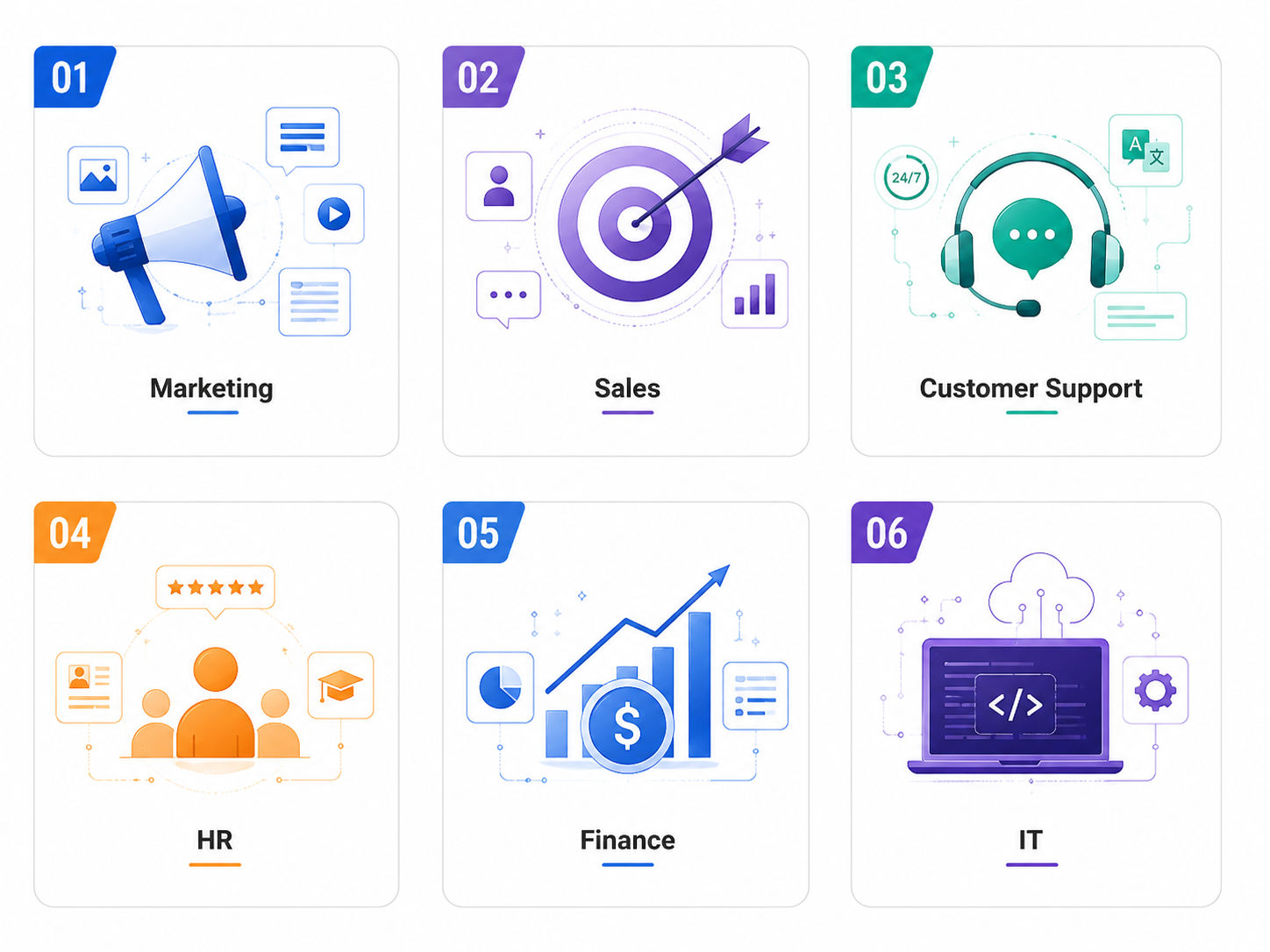
The biggest shift is that generative AI supports knowledge work rather than only repetitive operational tasks.
Business Function |
Common Applications |
| Marketing | Content creation, campaign ideation |
| Sales | Personalized outreach, proposal drafting |
| Customer Support | AI chatbots, ticket resolution |
| HR | Job descriptions, onboarding materials |
| Finance | Report generation, document analysis |
| IT | Code generation, debugging assistance |
Also Read: Top Generative AI Use Cases: Applications and Examples
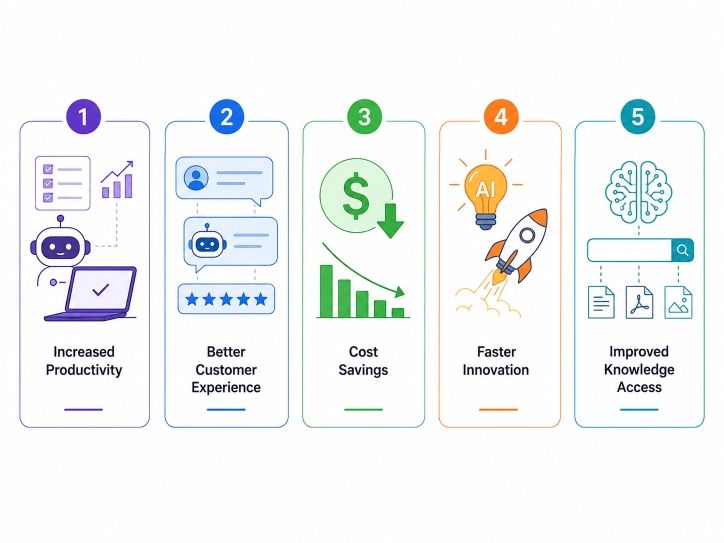
The growing interest in generative AI for business comes from its ability to improve both efficiency and creativity.
In customer service environments, studies have shown productivity improvements of around 14% when AI assistants support agents with responses and knowledge retrieval.
Employees spend significant time on repetitive tasks such as:
Generative AI helps complete many of these activities faster.
Generative AI helps companies do what people expect from them. This is done with the help of chatbots and virtual assistants.
Customers expect:
Benefits include:
While AI introduces technology costs, many organizations report meaningful efficiency gains when implementation is focused on high-volume processes. Businesses can reduce costs by automating daily repetitive work.
Common areas include:
People do not have to spend a lot of time creating first drafts. Employees can create a first version in just a few minutes. Then later they can focus on making the version better. This way, employees can progress more.
Teams can experiment more quickly with:
Many businesses struggle with information scattered across systems.
Generative AI can:
The strongest argument for generative AI for business comes from real-world applications.
Marketing teams are among the earliest adopters. AI speeds up content production while allowing marketers to focus on strategy and creativity.
Common applications include:
AI-powered support systems can:
This helps support teams handle larger volumes without sacrificing service quality.
Sales professionals use AI for:
The goal is to reduce administrative work and increase selling time.
Research suggests AI-assisted coding can improve output and accelerate routine development tasks when paired with human review.
Developers use generative AI to:
AI in the HR department reduces manual tasks while improving consistency.
HR teams use AI for:
Also Read: Artificial Intelligence in HR: How AI Is Revolutionizing HRM
Business operations teams leverage AI for:
To adopt generative AI successfully, you need to plan it out, make rules for it, and know what to expect realistically for artificial intelligence.
Do not try to use AI everywhere, all at once.
Instead look for the areas where the employees spend a lot of time doing repeatedly and that require a lot of knowledge and information, like paperwork or answering the same question.
Examples include:
With no governance, the company will have more problems with the way it operates and with the law. This means that businesses will have a lot of operational and legal risks.
Organizations should define:
People often think that AI should work independently. This is a big mistake. AI needs help from humans to work properly.
In reality:
Many implementation failures happen because employees lack training. They need to understand both the benefits and limitations of AI.
Effective AI adoption requires:
Track metrics such as:
Metric |
Why It Matters |
| Time Saved | Productivity gains |
| Cost Reduction | Financial impact |
| Customer Satisfaction | Service quality |
| Employee Adoption | Usage success |
| Revenue Impact | Business growth |
Also Read: Top Generative AI Use Cases: Applications and Examples
Businesses often face:
Recent studies also highlight a "productivity paradox" where employees spend time reviewing and correcting AI outputs. This reinforces the need for thoughtful implementation rather than blind adoption.
Generative AI is moving beyond content generation. Recent studies show a problem called the "productivity paradox."
In this paradox, employees waste time checking and fixing what AI systems produce. This means we need to think about how we use AI instead of just using it without thinking.
Future business applications are expected to include:
Generative AI for business is no longer a future concept. It is already helping organizations improve productivity, streamline operations, enhance customer experiences, and accelerate innovation. The biggest opportunities lie in supporting employees, automating repetitive work, and making knowledge more accessible across the organization.
At the same time, successful adoption requires governance, training, and human oversight. Businesses that approach generative AI strategically will be better positioned to improve efficiency and stay competitive as the technology continues to evolve.
Want to explore more about Generative AI for business? Book your free 1:1 personal consultation with our expert today.
Generative AI for business refers to AI systems that can create content, answer questions, generate insights, write code, and automate knowledge-based tasks. Businesses use it to improve productivity and reduce manual work. It helps employees focus on higher-value activities instead of repetitive tasks.
Small businesses can use generative AI for marketing content, customer support, email drafting, social media management, and business documentation. The technology helps smaller teams accomplish more without significantly increasing operational costs or headcount.
Generative AI is changing how work gets done rather than completely replacing most jobs. Many organizations use AI to assist employees, automate repetitive tasks, and improve efficiency. Human expertise remains essential for decision-making, creativity, and quality control.
Industries such as technology, retail, healthcare, finance, education, and professional services are seeing strong benefits. These sectors rely heavily on information processing, customer interactions, and content creation, making them ideal candidates for AI-powered improvements.
Common risks include inaccurate outputs, privacy concerns, compliance issues, and overreliance on automated systems. Businesses can reduce these risks through governance frameworks, employee training, and human review processes before using AI-generated content or recommendations.
Costs vary depending on the platform, number of users, and level of customization. Some tools offer affordable subscription plans, while enterprise implementations may require larger investments in infrastructure, integration, and governance capabilities.
Yes. Generative AI can assist agents, automate responses, summarize conversations, and provide instant answers to common customer questions. This often leads to faster response times and improved customer experiences while reducing support workloads.
Organizations typically track metrics such as time savings, cost reduction, employee productivity, customer satisfaction, and revenue growth. Measuring outcomes against predefined goals helps determine whether AI initiatives are delivering meaningful business value.
Professionals benefit from understanding prompt writing, critical thinking, workflow design, data literacy, and AI governance principles. Technical expertise can help, but many business-focused AI roles prioritize practical problem-solving and decision-making skills.
Traditional AI focuses on prediction, classification, and pattern recognition. Generative AI creates new content such as text, images, code, and reports. While both technologies deliver value, generative AI is especially useful for knowledge work and creative tasks.
Future trends include AI agents, workflow automation, advanced personalization, multimodal AI systems, and deeper integration with enterprise software. Businesses are expected to move from isolated experiments toward AI-enabled workflows embedded across daily operations.
727 articles published
Sriram K is a Senior SEO Executive with a B.Tech in Information Technology from Dr. M.G.R. Educational and Research Institute, Chennai. With over a decade of experience in digital marketing, he specia...
Speak with AI & ML expert
By submitting, I accept the T&C and
Privacy Policy