Pruning in Machine Learning: What It Is and How It Works
By Sriram
Updated on Jun 23, 2026 | 6 min read | 1.73K+ views
Share:

All courses
Certifications
More
By Sriram
Updated on Jun 23, 2026 | 6 min read | 1.73K+ views
Share:
Table of Contents
Pruning in machine learning is a technique used to simplify machine learning models by removing unnecessary parts that don't contribute much to prediction accuracy. It is most commonly used in decision trees and neural networks to reduce complexity, improve efficiency, and prevent overfitting.
A model that memorizes training data often struggles with new data. That's where pruning helps. It trims away less useful branches, parameters, or nodes, making the model smaller and easier to generalize.
This blog covers everything you need to know about pruning: what it means, why it matters, the difference between pre-pruning and post-pruning in machine learning, the main types of pruning in machine learning, and how to decide which approach fits your use case.
Explore upGrad's Data Science, AI, and Machine Learning programs to build a strong foundation in machine learning, data analysis, model development, supervised and unsupervised learning, and real-world AI applications. Gain hands-on experience with industry tools and learn how to turn data into actionable insights.
Popular AI Programs
Pruning in machine learning is the process of removing parts of a model that aren't adding value. Those parts could be branches in a decision tree, neurons in a neural network, or filters in a convolutional layer. Think of it like trimming a plant. You cut the weak branches, so the healthy ones grow stronger. Hence, the model remains useful and runs more efficiently.
Why does this matter? A model that's too large:
Pruning addresses all three and is one of the most widely used model optimisation techniques in production ML systems.
Pruning isn't limited to one model type. You'll see it used in
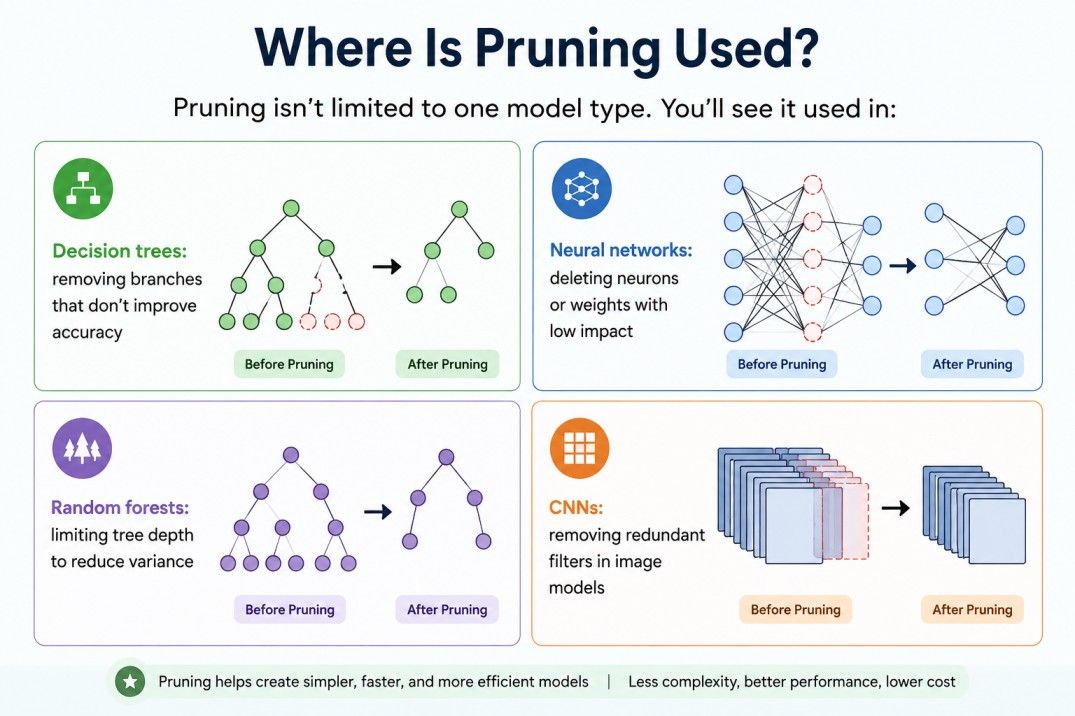
The core idea stays the same across all of them. Cut what isn't working. Keep what is.
Free Courses
This is where most people get confused. Pre-pruning and post-pruning in machine learning both aim to simplify models, but they do it at different stages.
Feature |
Pre-Pruning |
Post-Pruning |
| Definition | Limits model growth during training. | Removes unnecessary parts after training. |
| When It Happens | During training | After training |
| Approach | Applies constraints from the start. | Trims the fully trained model. |
| Control Level | High | Moderate |
| Risk | Can underfit if too restrictive. | Requires extra computation. |
| Compute Requirement | Lower | Higher |
| Training Speed | Faster | Slower |
| Model Complexity | Prevents excessive growth. | Reduces existing complexity. |
| Common Use Cases | Decision trees, shallow neural networks | Neural networks, large decision trees |
| Best For | Faster training and lower resource use | Better optimization after full training |
Also read: Understanding Decision Tree In AI: Types, Examples, and How to Create One
Common pre-pruning strategies include:
Pre-Pruning Technique |
Description |
Purpose |
| Max Depth | Limits how many levels a tree can grow. | Helps prevent overfitting. |
| Min Samples Split | Splits a node only if it has enough data points. | Avoids unreliable branches. |
| Min Impurity Decrease | Splits only when impurity drops by a set amount. | Ensures each split adds value. |
These parameters are set before training begins. You're essentially telling the model "don't bother growing in directions that won't help." The downside? If you set these limits too tightly, the model might stop learning before it captures real patterns. It's a calibration problem.
Advantages of Pre-Pruning |
Limitations of Pre-Pruning |
| Faster training | Can remove useful patterns too early |
| Smaller tree size | May lead to underfitting |
| Lower memory usage | Important relationships may be missed |
| Reduced computational cost | Choosing the right threshold can be difficult |
Post-pruning is more thorough. You let the model learn freely, then evaluate each part. The ones that don't improve performance on a validation set get removed.
Reduced error pruning is one of the simplest post-pruning techniques. You remove a branch and check if the accuracy drops. If it doesn't, the branch wasn't useful. Gone.
Cost complexity pruning (also called weakest link pruning) is used in scikit-learn. It assigns a cost to each node based on how much accuracy it contributes. Nodes below a threshold get removed.
Post-pruning tends to produce more accurate results than pre-pruning because the model has already seen the full data. But it takes more time and compute.
Advantages of Post-Pruning |
Limitations of Post-Pruning |
| Better accuracy in many cases | Longer training time |
| Lower risk of underfitting | Additional computational resources needed |
| More informed pruning decisions | Higher processing overhead after training |
Many machine learning practitioners prefer post-pruning because it allows the model to explore all possible patterns before simplifying the structure.
Do read: Data Preprocessing in Machine Learning: 11 Key Steps You Must Know!
AI Courses to upskill
Explore Artificial Intelligence Courses for Career Progression
There are several types of pruning in machine learning, and they vary by model type, pruning strategy, and what's being removed.
Individual weights in a neural network are set to zero if they fall below a threshold. The network architecture stays the same, but sparse weights reduce computation during inference.
This works well for large language models and image classifiers where many weights are redundant.
Entire neurons or filters are removed from the network. This is a more aggressive form of pruning that actually changes the model's structure.
It's harder to implement but results in a genuinely smaller model, not just a sparse one.
Also read: Top 10+ Optimizers in Deep Learning for Neural Networks in 2025
Type |
What Gets Removed |
Hardware Benefit |
| Unstructured | Individual weights (randomly) | Low without sparse hardware |
| Structured | Neurons, filters, layers | High, works on standard hardware |
Unstructured pruning is flexible but tricky to accelerate on regular GPUs. Structured pruning is easier to deploy because standard hardware handles it well.
Global pruning is more aggressive and often more effective, but it can accidentally gut important layers if you're not careful.
You don't have to prune all at once. Iterative pruning removes a small fraction of weights, retrains the model briefly, and repeats the cycle. Each round, the model adapts to the changes.
This tends to preserve accuracy better than one-shot pruning, especially in large models.
Must read: Explore 8 Must-Know Types of Neural Networks in AI Today!
Here's the honest picture: pruning helps in most cases, but it's not zero-risk.
Done well, pruning:
Done poorly, pruning degrades accuracy. If you remove neurons that were actually encoding useful patterns, the model loses that knowledge permanently.
The general rule is that models can tolerate up to 50-90% weight sparsity without major accuracy loss, but this varies widely. Always validate on a held-out test set after pruning.
When to Prune |
When Not to Prune |
| The model is too slow for production latency requirements. | The model is already close to its minimum viable accuracy. |
| You're deploying to edge devices with limited memory. | You haven't performed hyperparameter tuning yet. |
| The model is overfitting and validation accuracy has plateaued. | The dataset is small and the model cannot afford to lose capacity. |
Do read: Basic CNN Architecture: How the 5 Layers Work Together
Decision tree pruning and neural network pruning share the same goal but work differently.
Decision tree pruning is more interpretable. You can see exactly which branch you're removing and why. Pre-pruning and post-pruning in machine learning are most commonly discussed in the context of decision trees, because the structure is visible and easy to reason about.
Neural network pruning is less transparent. You're removing weights or neurons from a black box. The impact isn't always predictable.
Aspect |
Decision Trees |
Neural Networks |
| Interpretability | High | Low |
| Pruning difficulty | Low | High |
| Common method | Cost complexity, reduced error | Magnitude-based, structured |
| Retraining needed? | No | Yes (fine-tuning) |
| Use case | Classification, regression | Deep learning, CV, NLP |
If you're new to ML, start with decision tree pruning. The logic is cleaner, and the results are easier to verify.
Pruning in machine learning helps create models that are smaller, faster, and better at handling new data. By removing unnecessary branches, parameters, or nodes, pruning reduces overfitting and improves efficiency without sacrificing meaningful performance.
Whether you're working with decision trees or deep neural networks, understanding pruning techniques is essential for building practical machine learning systems. Choosing between pre-pruning and post-pruning in machine learning depends on your dataset, computational resources, and accuracy goals. When applied correctly, pruning turns complex models into efficient solutions that perform well in real-world environments.
Ready to start your journey? Book a free consultation with upGrad today to find the best path for your career.
A model may need pruning when it performs exceptionally well on training data but poorly on validation or test data. Other indicators include high memory consumption, large model size, and slow inference speed. Pruning can help simplify the model while improving its ability to generalize to unseen data.
Not necessarily. Limiting model depth early can prevent useful patterns from being learned. Pruning allows the model to first explore the data fully and then removes unnecessary components. This often produces a better balance between accuracy and complexity, particularly for larger datasets.
Yes. Pruning can make models easier to understand by removing redundant branches, nodes, or parameters. In decision trees, the impact is especially noticeable because fewer branches make the reasoning process more transparent. Simpler models are often easier to interpret and debug.
Yes. Pruned models perform fewer computations during inference, which can significantly reduce prediction time. This is particularly useful in real-time applications such as recommendation systems, fraud detection platforms, and mobile applications where fast responses are critical.
Feature selection removes irrelevant input variables before training begins. Pruning removes unnecessary components from the trained model itself. Both techniques reduce complexity and improve efficiency, but they operate at different stages of the machine learning workflow and solve different optimization challenges.
Yes. Ensemble models such as random forests and gradient boosting systems can benefit from pruning-related techniques. Limiting tree depth, reducing unnecessary branches, and controlling model complexity can improve generalization performance while reducing computational requirements.
Pruning in deep learning involves removing less important weights, neurons, filters, or connections from a neural network. The goal is to reduce model size and computational cost while maintaining accuracy. It is commonly used in image recognition, natural language processing, and large-scale AI systems.
Yes. Pruning and quantization are often used together to optimize machine learning models. Pruning removes redundant parameters, while quantization reduces numerical precision. Combining both techniques can significantly reduce storage requirements and improve inference efficiency without causing major accuracy loss.
Truncation removes data, features, or model components based on predefined limits without necessarily evaluating their usefulness. Pruning removes components after assessing their contribution to performance. Because pruning is performance-driven, it generally preserves model quality more effectively than simple truncation.
Pruning in AI helps optimize machine learning and deep learning models by removing unnecessary parameters or structures. It improves efficiency, reduces hardware requirements, and lowers deployment costs. Many modern AI systems use pruning to run effectively on smartphones, edge devices, and cloud platforms.
After pruning, it's important to track validation accuracy, precision, recall, F1 score, inference time, memory usage, and model size. Evaluating only accuracy can be misleading. A successful pruning strategy should improve efficiency while maintaining strong predictive performance across multiple metrics.
730 articles published
Sriram K is a Senior SEO Executive with a B.Tech in Information Technology from Dr. M.G.R. Educational and Research Institute, Chennai. With over a decade of experience in digital marketing, he specia...
Speak with AI & ML expert
By submitting, I accept the T&C and
Privacy Policy
Top Resources
Master's Degree
18 Months
Executive Diploma
12 Months
IIIT Bangalore
Executive Programme in Generative AI & Agentic AI for LeadersIndia’s #1 Tech University
Dual Certification
5 Months