Decision Making Models: The Complete Guide for Business and Leadership
By upGrad
Updated on May 15, 2026 | 0.6k+ views
Share:

All courses
Certifications
More
By upGrad
Updated on May 15, 2026 | 0.6k+ views
Share:
Table of Contents
Decision making models are structured frameworks that guide individuals and organizations through the process of evaluating options and arriving at well-reasoned choices.
They break complex decisions into repeatable steps such as defining the problem, gathering information, weighing alternatives, and reviewing outcomes. Decisions are made systematically rather than instinct alone.
This guide covers the most important models in use today, how they compare, how to choose the right one, and what the future of decision making looks like in an AI-driven world. By the end, you will have a practical toolkit you can apply at work.
Want to go deeper into strategic thinking, leadership decision making, and management frameworks? Explore upGrad's Management Programs.
Popular Management Programs
Poor decisions cost organizations time, money, and trust. According to McKinsey, only 20 percent of organizations say they excel at decision making, and most leaders report that much of the time they spend on decisions is used ineffectively.
That gap is not just about intelligence or experience. It is about having a structured way to approach choices. That’s why decision making models matter for several reasons.
Also read: Techniques of Decision-Making: Top Tools & Methods for 2026
Free Courses
There is no single best decision making model. Each one was built for a specific context. Here is a breakdown of the most widely used ones.
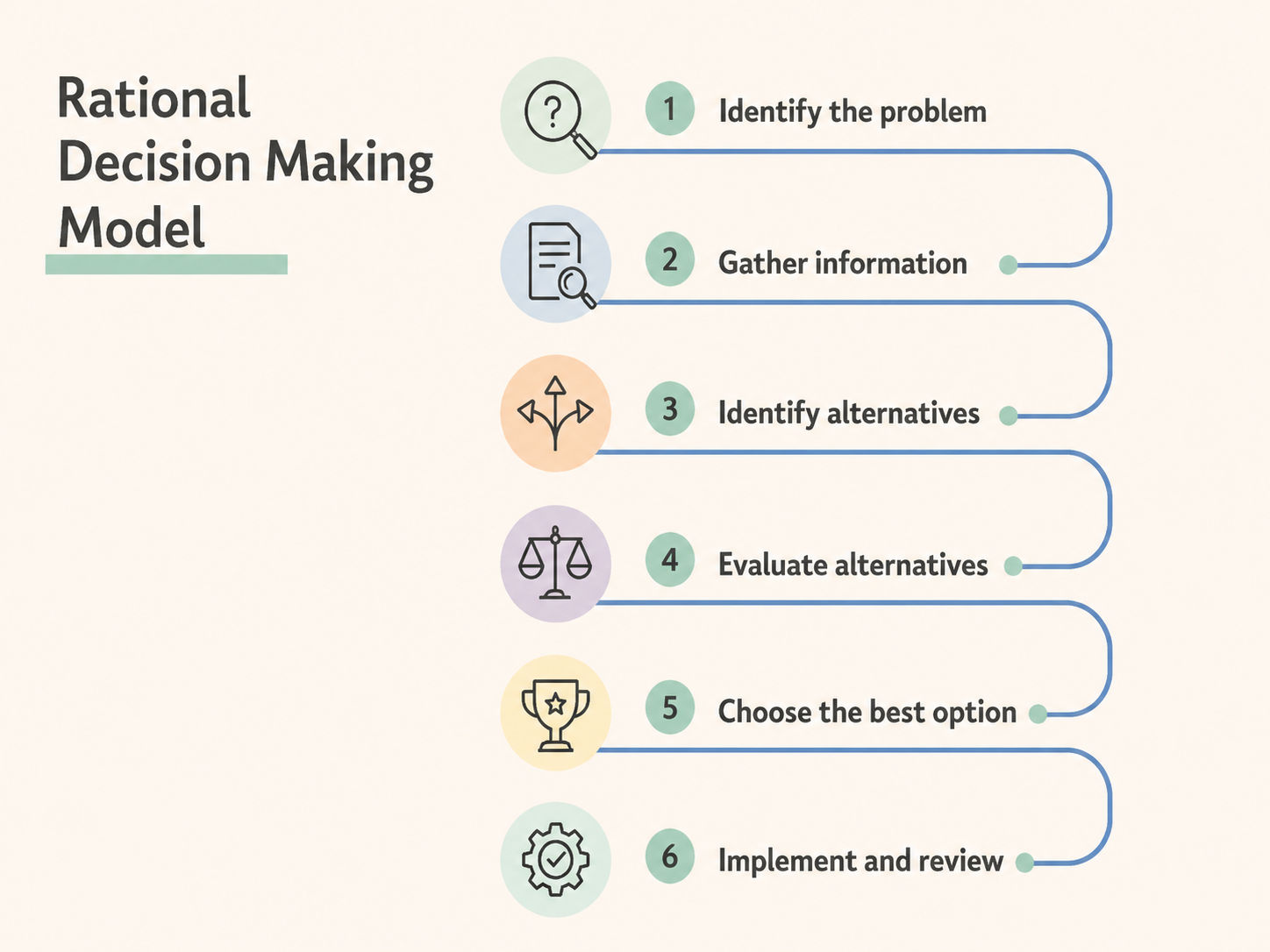
This is the classic, step-by-step approach. It assumes you have access to complete information and unlimited time.
Best for: Well-defined problems with clear data, such as choosing a vendor or setting a budget.
Limitation: Real-world decisions rarely offer complete information or unlimited time.
Introduced by Herbert Simon, this model acknowledges that humans are limited by time, information, and cognitive capacity. Instead of finding the perfect solution, decision makers "satisfice". They choose the first choice that meets a minimum threshold of acceptability.
Best for: Day-to-day operational decisions where speed matters more than perfection.
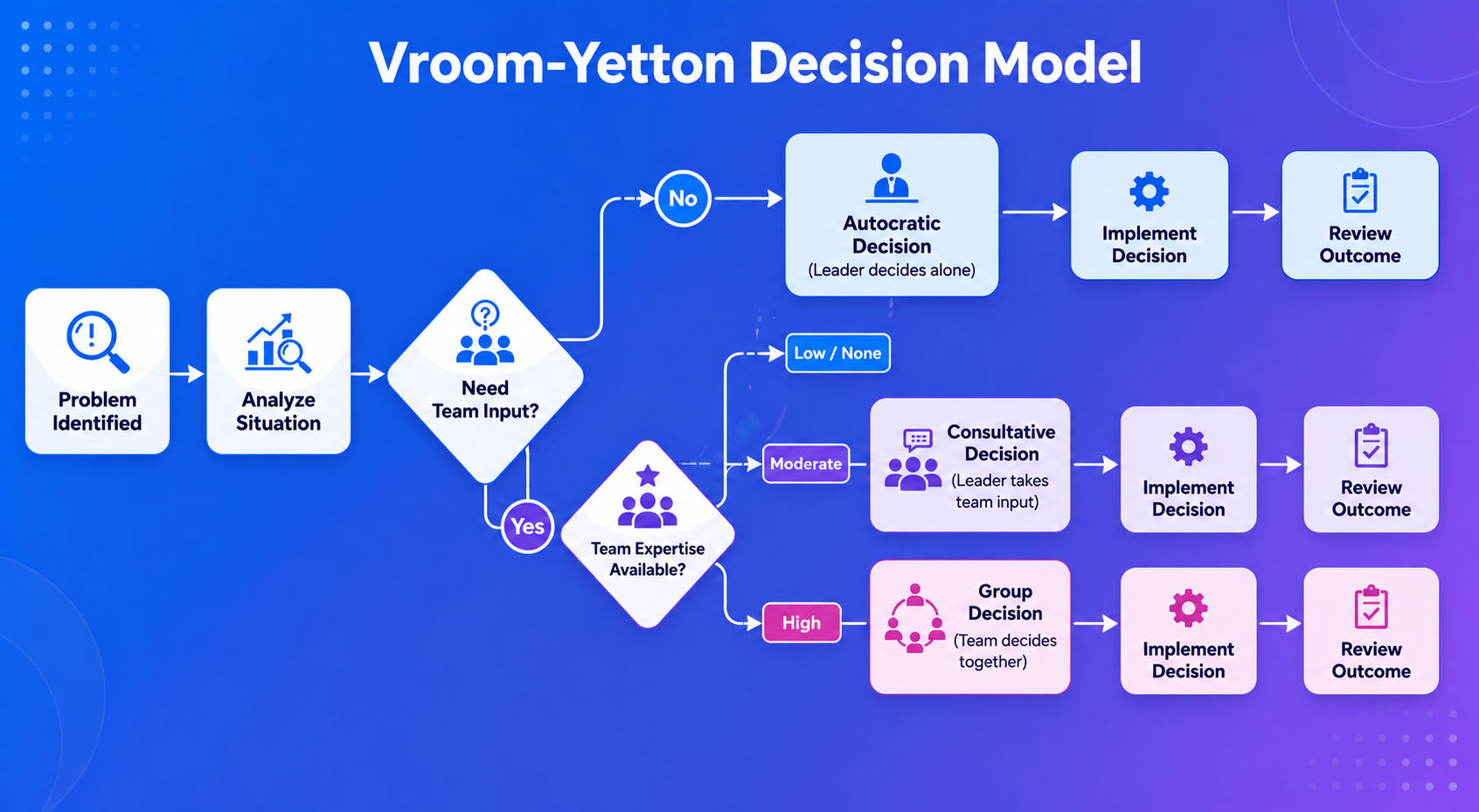
This model helps leaders decide how to make a decision, not just what decision to make. It uses a decision tree format to determine the right level of team involvement, ranging from fully autocratic to fully collaborative.
Key variables it considers:
Best for: Leadership decisions where team involvement and morale are important.
SWOT stands for Strengths, Weaknesses, Opportunities, and Threats. It is one of the most widely used strategic decision making models across industries.
Best for: Strategic planning, market entry decisions, and competitive analysis.
A decision tree maps out every viable option and its likely consequences in a branching visual format. Each branch is a choice; each node is an outcome. It often includes probability values and expected value calculations.
Best for: Complex decisions with multiple outcomes and quantifiable probabilities, such as investment choices or product launches.
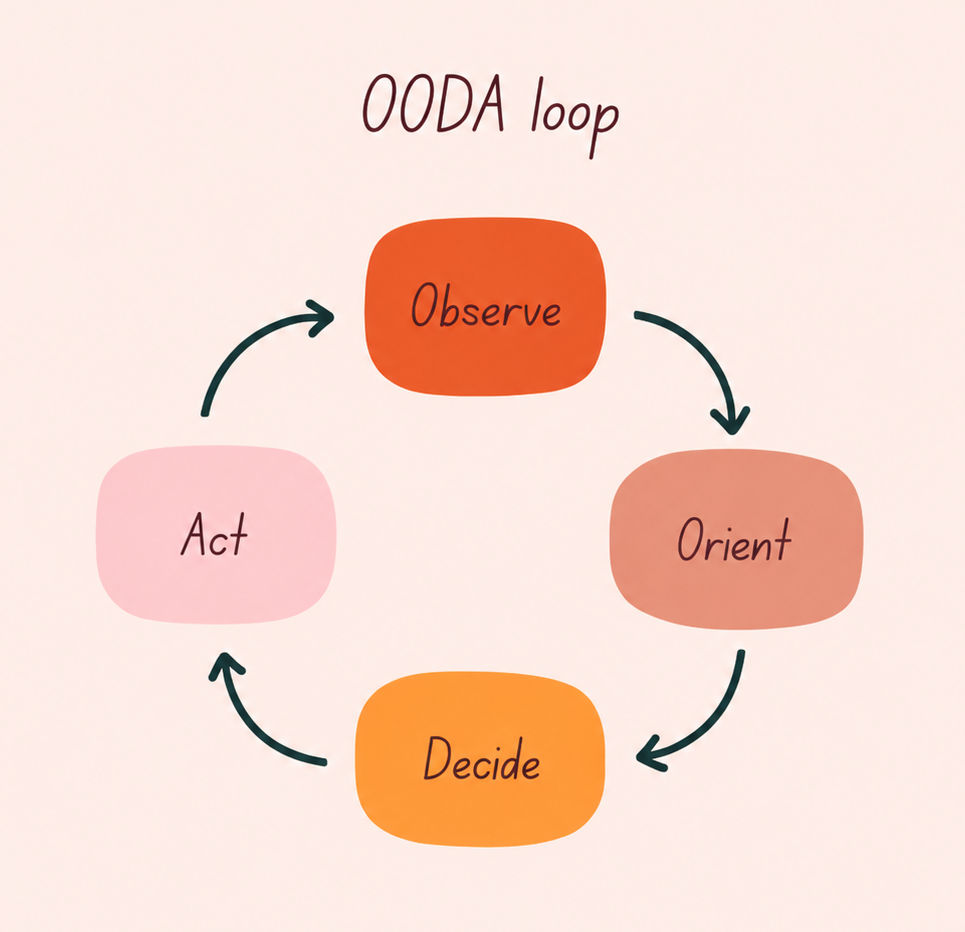
Developed by military strategist John Boyd, OODA stands for Observe, Orient, Decide, Act. It is a fast, cyclical decision making model designed for rapidly changing environments.
Steps:
Best for: Startups, crisis response, competitive business environments, and any situation requiring agility.
This is a financial decision making model that quantifies the costs and benefits of each option. If benefits outweigh costs, you proceed. If not, you reconsider.
Best for: Capital allocation, project prioritization, and any decision with a measurable financial impact.
Note: It works best when you can reliably estimate values. For intangible benefits like brand reputation or employee morale, it has clear limitations.
This model involves all stakeholders in reaching a mutually acceptable decision. It does not require unanimous agreement but does require that everyone can live with the outcome.
Best for: High-stakes team decisions, organizational policy changes, and situations where implementation depends on group buy-in.
Limitation: It can be slow. It works poorly in time-critical situations.
Also read: Top 20+ Best Business Analysis Techniques to Master in 2025
Management Courses to upskill
Explore Management Courses for Career Progression
IIIT-B & IIM, Udaipur
Chief Technology Officer & AI Leadership ProgrammeIIM Kozhikode
PCP in AI for Business ProfessionalsThese two terms are often used interchangeably, but they refer to different things.
Decision making models are structured processes that guide you through a decision step by step. They are prescriptive. They tell you how to decide. Examples include the Rational Model, OODA Loop, and Vroom-Yetton.
Decision making frameworks are broader systems that provide principles, context, or perspective. They help you understand a situation before choosing a model. The Cynefin Framework, for example, is technically a sense-making framework that helps you identify which decision model to apply.
Think of it this way: a framework is the map, and a model is the route you take.
| Aspect | Decision Making Model | Decision Making Framework |
| Purpose | Guide the decision process | Provide context or structure for thinking |
| Structure | Step-by-step | Principle-based |
| Example | Decision Tree, Rational Model | Cynefin, SWOT |
| Output | A clear decision or recommendation | Insight, orientation, or strategy |
Also read: SWOT Analysis in Strategic Management: Success Guide
AI is not replacing human decision making. It is reshaping it.
Faster data processing. Traditional decision making models rely on analysts spending days or weeks gathering data. AI tools can surface insights in seconds, compressing the first few steps of the Rational Model dramatically.
Predictive modeling. Machine learning enhances the Decision Tree model by calculating probability values automatically based on historical patterns, removing much of the manual estimation.
Bias detection. AI tools can flag when a decision-making process shows patterns of cognitive bias, something human-led models struggle to catch.
Real-time feedback loops. The OODA Loop's effectiveness depends on how quickly you can "observe." AI-powered dashboards provide live data that makes real-time decision cycles much more actionable.
Natural language processing in consensus building. AI tools are now able to summarize stakeholder feedback at scale, making it easier to apply Consensus Decision Models in large organizations where collecting input used to be painfully slow.
Also read: How to Develop Time Management Skills of Employees?
The next decade will see significant shifts in how decision making models are designed and applied.
Hybrid human-AI models will become standard. Rather than choosing between human intuition and algorithmic recommendations, organizations will design workflows that combine both at each step.
Adaptive models will replace static ones. Current models assume a fixed structure. Future decision tools will adjust their steps based on live data and changing conditions.
Ethical decision frameworks will gain prominence. As ESG investing and responsible AI become business priorities, decision making models will increasingly include ethics checkpoints alongside financial and operational metrics.
Personalized decision support. Individual leaders will have AI-powered tools that learn their specific decision styles, biases, and domains of expertise, and offer nudges accordingly.
Decentralized decision making. As organizations become flatter and more distributed, decision making models will need to work across teams without centralized leadership, favoring models like Consensus and OODA Loop variants.
Also read: How to Improve Career Skills for Success & Employability 2026
Strong decision making is a skill, and like any skill, it improves with the right tools. Decision making models give you structure, reduce cognitive bias, and make your thought process transparent to others. Whether you are making a quick operational call or a long-term strategic investment, there is a model designed for exactly that kind of problem.
The key is not to pick one model and apply it to everything. The best decision makers understand the full toolkit and know when to use what. Start by building familiarity with the models covered in this guide. Then practice applying them to real situations at work. Over time, they become second nature.
For professionals looking to sharpen decision-making skills further, book a free consultation call with upGrad to understand which course will suit your career goal better.
The Rational Decision-Making Model is the best starting point for beginners. It follows a logical, linear sequence, define the problem, explore options, evaluate, decide, and review. It is easy to understand and applies to a wide range of everyday business decisions, making it a solid foundation before learning more advanced models.
The OODA Loop is best when speed matters more than thoroughness. It is ideal for fast-changing situations such as a product launch crisis, competitive response, or emergency operations. If your environment is shifting rapidly and a slow, analytical process would cause you to miss the window for action, OODA is the right tool.
Yes, absolutely. While decision making models were developed in business and military contexts, they are equally useful for personal choices such as career changes, financial planning, and relocation decisions. The Cost-Benefit Analysis and Decision Tree translate very naturally to high-stakes personal decisions.
Bounded rationality is the idea that real decision makers cannot be fully rational because they have limited time, limited information, and limited cognitive capacity. It matters because it reflects how decisions are actually made, not just how they should be made in theory. Understanding this helps you design better processes and set realistic expectations for outcomes.
The Cynefin Framework helps you first classify the type of problem you are dealing with before deciding how to act. It prevents the common mistake of applying best practices to complex problems or over-analyzing simple ones. Once you identify the correct domain, Clear, Complicated, Complex, or Chaotic, you can choose the most appropriate response strategy.
SWOT Analysis stays highly relevant, particularly in the early stages of strategic planning. Its simplicity is both a strength and a limitation. For modern use, many organizations complement SWOT with PESTLE analysis (which adds macro-environmental factors) or follow it with a more structured decision model to turn insights into actionable choices.
Decision making models are used across virtually every industry, but they are prominent in healthcare (resource allocation and clinical decisions), finance (investment and risk decisions), technology (product strategy and build-vs-buy decisions), manufacturing (supply chain and quality decisions), and government (policy design and crisis management).
The Rational Model assumes you have complete information, unlimited time, and can find the optimal solution. Bounded Rationality accepts that none of those conditions are usually true. In practice, most real-world decisions follow bounded rationality. You work with what you have and choose the first option that is good enough to move forward.
Decision making models create a structured process that forces you to consider multiple options, gather evidence, and evaluate criteria systematically. This makes it harder for cognitive biases like anchoring, confirmation bias, or groupthink to go unchecked. When the process is documented, it also becomes easier for others to spot where bias may have influenced a conclusion.
The Vroom-Yetton model helps leaders decide how much team involvement a decision requires. It uses a series of diagnostic questions to determine whether a decision should be made alone, with consultation, or collaboratively. It is particularly useful in management contexts where getting the process wrong can hurt team morale or lead to poor implementation.
Yes. Most MBA and management programs cover decision making models as part of courses in strategy, organizational behavior, and leadership. Models like SWOT, Decision Trees, and Cost-Benefit Analysis are standard curriculum. Programs focused on leadership also cover collaborative models like Vroom-Yetton and sense-making frameworks like Cynefin.
The most common mistake is applying the wrong model to the wrong situation, for example, using the Rational Model in a fast-moving crisis where speed is critical, or using Bounded Rationality for a high-stakes, irreversible decision that deserves thorough analysis. Choosing the right model for the context is just as important as following the model correctly.
Yes, many online management and analytics courses teach strategic decision-making using real business scenarios, data analysis, and problem-solving frameworks. Platforms like upGrad offer industry-focused programs that help professionals develop analytical thinking and leadership-driven decision-making skills.
1226 articles published
We are an online education platform providing industry-relevant programs for professionals, designed and delivered in collaboration with world-class faculty and businesses. Merging the latest technolo...
Get Free Consultation
By submitting, I accept the T&C and
Privacy Policy
Top Resources
Certification
3 Months
Certification
6 Months
O.P. Jindal Global University
Masters in International Accounting and Finance (Accredited by ACCA, UK)Master's Degree
12 Months