Innovation Management
By upGrad
Updated on May 11, 2026 | 10 min read | 2.37K+ views
Share:

All courses
Certifications
More
By upGrad
Updated on May 11, 2026 | 10 min read | 2.37K+ views
Share:
Table of Contents
Innovation management is the practice of organizing ideas, creativity, and improvements to generate value for organizations. It enables companies to design new products, enhance services, streamline operations, and remain competitive in evolving markets. By focusing on innovation management, businesses can adapt quickly to customer needs and market trends.
This blog explores its meaning, importance, types, processes, benefits, challenges, and strategies, showing how companies leverage innovation management to drive growth, efficiency, and long-term success in competitive industries.
Explore Management Courses from upGrad to build essential innovation management skills, cultivate creative thinking, strategic problem-solving, and adaptive leadership, empower your team to drive breakthrough ideas and organizational change, foster a culture of experimentation and collaboration across all levels, and develop the forward-thinking mindset needed to lead innovation with confidence, agility, and lasting impact.
Popular Management Programs
Innovation management is a structured approach organizations use to generate, evaluate, and implement new ideas. It enables businesses to enhance their products, services, technologies, and internal processes while aligning creativity with strategic goals. At its core, innovation management transforms ideas into practical solutions that drive value and competitive advantage.
Simply put, it is the systematic process of organizing, developing, and applying innovations to strengthen business performance. In today’s fast-changing environment, where customer expectations shift rapidly and technology evolves constantly, companies that fail to innovate risk falling behind and struggling to survive.
Free Courses
Innovation management is the strategic framework used to organize, develop, and execute fresh ideas. It ensures that a company’s creative sparks are systematically converted into tangible value, helping organizations remain agile and future-proof.
Rather than relying on luck, a structured approach allows organizations to:
The Risk of Inaction: Without a formal strategy, even successful companies risk becoming obsolete as the market evolves around them.
Innovation management is not limited to technology companies. Businesses across industries use it to improve performance and customer experience.
| Element | Objective |
| Idea Generation | Fostering an environment where creative thinking thrives. |
| Research & Analysis | Validating ideas against real-world market demands. |
| Product Development | Turning abstract concepts into functional solutions. |
| Collaboration | Breaking silos to leverage collective expertise. |
| Risk Management | Identifying potential pitfalls to minimize costly failures. |
| Continuous Improvement | Refining processes to ensure sustainable, long-term growth. |
Innovation isn't exclusive to tech giants; it is a versatile tool used across all sectors:
A business can be full of creative minds, but without Innovation Management, those ideas remain theoretical and never reach the market.
While these terms are often used interchangeably, they represent different stages of progress:
Organizations that encourage experimentation and calculate risk-taking often achieve better innovation outcomes. Strong innovation management systems usually include:
Also Read: Design Thinking – 6 Lessons in Innovation and Marketing Excellence
Management Courses to upskill
Explore Management Courses for Career Progression
IIIT-B & IIM, Udaipur
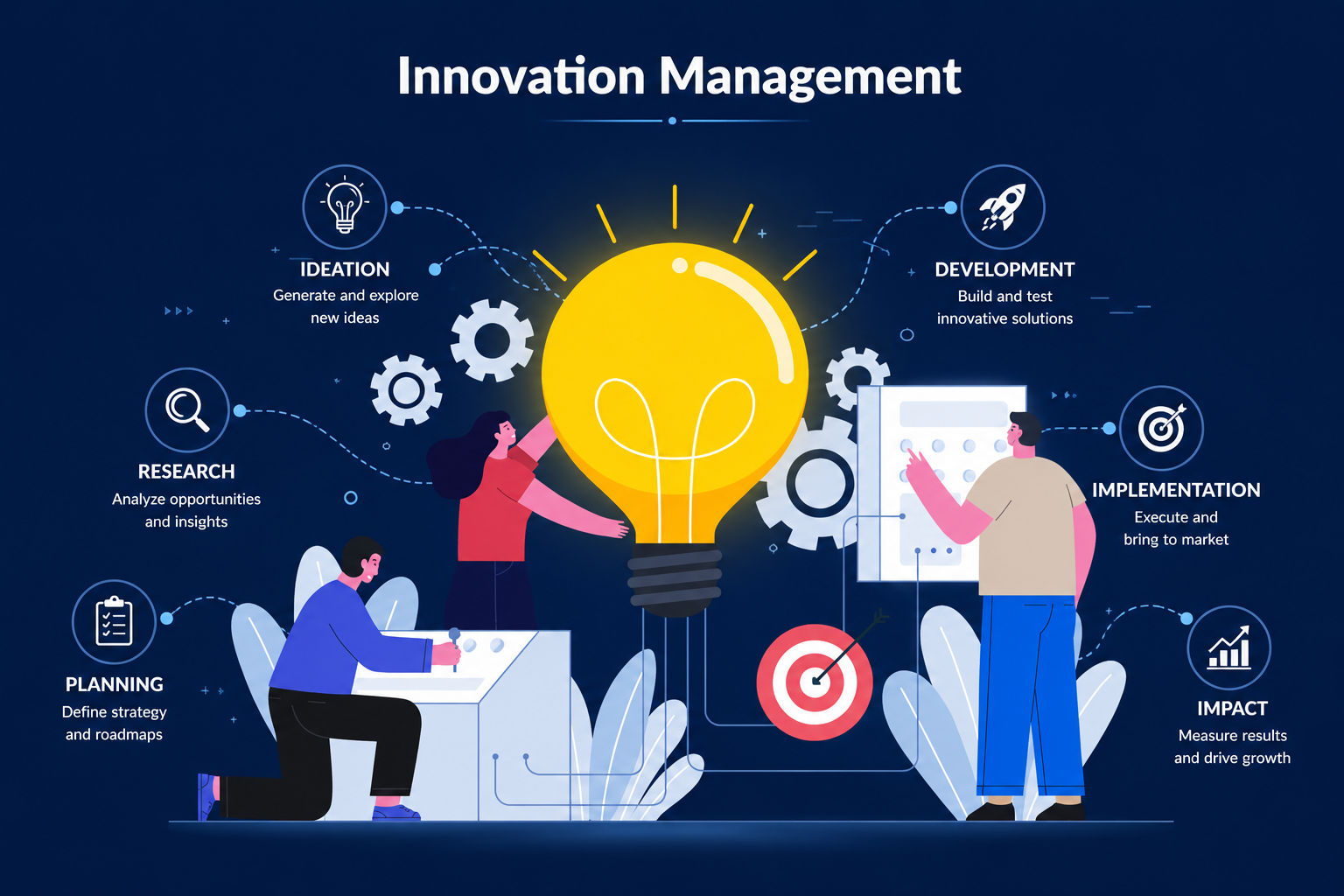
Chief Technology Officer & AI Leadership ProgrammeInnovation management provides a structured pathway that guides organizations from idea creation to successful execution. A clear process enhances efficiency, reduces uncertainty, and transforms creativity into measurable outcomes.
The journey begins with gathering fresh ideas from employees, customers, market insights, and industry trends. Cross-departmental collaboration often leads to stronger, more practical ideas.
Organizations foster idea generation through:
Not every idea is worth pursuing. Careful evaluation ensures resources are invested wisely.
Key Evaluation Factors:
This stage helps prioritize high-value opportunities.
Factor |
Importance |
| Market demand | Gauges customer interest |
| Feasibility | Tests practical implementation |
| Cost | Estimates required investment |
| Risk | Identifies potential challenges |
| Profitability | Assesses financial potential |
Approved ideas move into development, where prototypes, pilots, or test versions are created. Testing uncovers issues early, ensuring smoother large-scale implementation.
Activities include:
Once validated, innovations are rolled out across operations or markets. Strong communication and leadership support are critical for success.
Implementation may involve:
Innovation doesn’t stop at launch. Continuous monitoring ensures relevance and long-term success.
Performance Metrics:
Organizations with innovation-driven leadership adapt faster to market changes. Leadership is the backbone of innovation success. Effective leaders:
Innovation thrives on collaboration. Cross-functional teams combine expertise from:
Innovation management creates lasting advantages that drive sustainable organizational growth. Companies that continuously innovate consistently achieve stronger market positions, deeper customer loyalty, and greater operational efficiency making innovation not just a strategy but a long-term competitive necessity.
One of innovation management's greatest benefits is helping businesses stay ahead of the competition. Organizations that embrace innovation can launch superior products, deliver exceptional customer experiences, enter untapped markets, and adapt to industry shifts far more quickly strengthening both market position and brand reputation.
Customer expectations evolve constantly, and innovation management enables organizations to respond swiftly and effectively. Companies that deeply understand customer pain points are better positioned to design smarter, more valuable solutions that build loyalty and long-term trust.
Innovation Area |
Customer Benefit |
| Faster services | Better convenience |
| Improved products | Higher satisfaction |
| Digital solutions | Easier accessibility |
| Personalized experiences | Stronger engagement |
Also Read: The Evolution of Business Strategy: From Industrial Age to AI-Powered Decision Making
Innovation management strengthens internal processes, reduces waste, and boosts overall productivity. By embracing innovation strategically, businesses can streamline operations and allocate resources more effectively across the organization.
Innovative organizations consistently uncover new and diversified revenue streams that fuel long-term financial growth. By systematically developing and implementing fresh ideas, businesses unlock new value and maintain a decisive competitive advantage in evolving markets.
Employees are more motivated, creative, and committed when organizations actively encourage participation and innovative thinking. Innovation-driven workplaces cultivate a culture where people feel empowered, recognized, and inspired to contribute their best ideas.
Rapid technological shifts, changing customer behaviors, and economic uncertainties demand organizational flexibility. Innovation management equips businesses with the agility to navigate disruption, manage risk, and recover challenges with greater speed and confidence.
Many of the world's most successful companies treat innovation management as a strategic priority, continuously evolving their products, services, and business models to maintain industry leadership.
Company |
Innovation Focus |
| Apple | Product innovation |
| Amazon | Customer experience innovation |
| Tesla | Technological innovation |
| Netflix | Business model innovation |
Also read: Leadership in the AI Era: Adapting for Success
Despite its many advantages, innovation management presents real challenges that organizations must navigate carefully. Balancing bold innovation ambitions with realistic planning and disciplined risk management remains essential for sustainable success.
Building an effective innovation management system requires practical strategies that create supportive environments and clear processes. When organizations invest in culture, people, and technology, innovation becomes more impactful and sustainable.
A strong culture of innovation encourages employees to share ideas freely without fear of criticism. When employees feel valued and respected, they contribute more and better ideas.
Organizations can foster this culture by:
Training and continuous learning help employees build innovative thinking skills.
Effective Development Methods:
Ongoing learning builds innovation capabilities across teams.
Method |
Purpose |
| Workshops | Enhance problem-solving |
| Leadership programs | Develop innovation leaders |
| Skill training | Strengthen technical expertise |
| Mentorship | Encourage knowledge sharing |
Digital tools are central to modern innovation management. Technology accelerates decision-making and improves efficiency.
Businesses leverage technology for:
Different departments bring unique perspectives to innovation projects. Promoting collaboration strengthens the entire innovation process.
Collaboration across functions helps organizations:
Successful innovation begins with understanding customers. Customer-driven innovation increases the likelihood of market success.
Organizations should regularly collect:
Defining measurable goals keeps innovation efforts focused and aligned.
Examples of Innovation Goals:
Clear objectives guide teams toward meaningful outcomes.
Monitoring performance helps organizations refine strategies and make smarter decisions. Tracking results ensures continuous improvement in innovation strategies.
Key Metrics:
Also Read: Best Management Course from IIT Delhi
Innovation management helps organizations turn ideas into practical business solutions. It supports growth, improves efficiency, strengthens customer relationships, and helps businesses remain competitive in changing industries.
The systematic process of organizing, developing, and implementing new ideas, products, or processes to create value and maintain a competitive advantage allows organizations to adapt faster and create long-term success.
Businesses that invest in innovation management build stronger cultures, improve collaboration, and create more opportunities for growth. As technology and customer expectations continue to evolve, innovation management will remain essential for sustainable business performance.
Innovation management is the process businesses use to generate, develop, and implement new ideas. It helps organizations improve products, services, and operations while creating value for customers and maintaining competitiveness in the market.
Innovation management helps businesses adapt to changing markets, improve efficiency, and create better customer experiences. Organizations that innovate consistently are more likely to achieve long-term growth and stay ahead of competitors.
The main stages include idea generation, evaluation, development, testing, implementation, and continuous improvement. Each stage helps organizations reduce risks and improve the chances of successful innovation outcomes.
Creativity focuses on generating ideas, while innovation management focuses on implementing ideas effectively. Businesses need structured processes to turn creative concepts into practical and profitable solutions.
Innovation management helps companies create better products, faster services, and improved customer experiences. Businesses that understand customer needs can develop solutions that increase satisfaction and loyalty.
Almost every industry benefit from innovation management, including healthcare, technology, education, finance, manufacturing, and retail. Innovation helps organizations improve efficiency, customer service, and long-term competitiveness.
Common challenges include resistance to change, budget limitations, implementation risks, and lack of leadership support. Organizations must balance creativity with strategic planning and effective execution.
Companies can encourage innovation by creating open communication, rewarding creative thinking, providing training opportunities, and supporting collaboration across teams. Employees contribute more ideas when they feel supported and valued.
Leadership helps create innovation-focused cultures, allocate resources, and support experimentation. Strong leaders encourage employees to share ideas and guide organizations through innovation-related changes and challenges.
Technology improves innovation management through automation, data analysis, collaboration tools, and customer insights. Digital solutions help businesses develop ideas faster and improve decision-making processes.
Companies like Apple, Amazon, Tesla, and Netflix use innovation management to improve products, customer experiences, and business models. Their focus on continuous improvement helps them maintain strong market positions.
1008 articles published
We are an online education platform providing industry-relevant programs for professionals, designed and delivered in collaboration with world-class faculty and businesses. Merging the latest technolo...
Get Free Consultation
By submitting, I accept the T&C and
Privacy Policy
Top Resources
Certification
3 Months
Certification
6 Months
O.P. Jindal Global University
Masters in International Accounting and Finance (Accredited by ACCA, UK)Master's Degree
12 Months