Will AI Replace Software Engineers? The Truth About AI, Coding, and Future Careers
By Sriram
Updated on Jul 09, 2026 | 263 views
Share:

All courses
Certifications
More
By Sriram
Updated on Jul 09, 2026 | 263 views
Share:
Table of Contents
Key Takeaways
This blog explains how AI is changing software engineering, what it can and can't do, and whether it will replace software engineers or make them more productive.
AI is changing software engineering, and the best way to stay ahead is by building the right skills. Explore upGrad's AI course to gain hands-on experience in AI tools, modern programming, system design, and real-world software engineering projects.
Popular AI Programs
AI can generate code, fix bugs, write tests, and automate repetitive programming tasks. However, software engineering involves much more than writing code. Engineers design systems, understand business needs, solve complex problems, and make technical decisions that AI can't handle on its own.
As AI coding assistants become more capable, many professionals and students are asking whether software engineers will be replaced by AI. While AI can automate repetitive programming tasks, software engineering still requires human expertise, critical thinking, and technical decision-making.
Rather than replacing developers, AI is changing how they work. Engineers who use AI effectively can automate routine tasks and focus on innovation, architecture, and problem-solving.
The rise of tools like GitHub Copilot, ChatGPT, Claude, and Gemini has raised concerns because they can:
Even so, software engineering isn't just about coding. Building reliable software also requires planning, security, collaboration, and long-term decision-making.
Do read: Top Artificial Intelligence Tools & Frameworks for 2026
Software engineers do more than write code. They understand business requirements, design scalable systems, evaluate technical trade-offs, and work with stakeholders to build reliable products.
For example, AI can generate a payment feature, but an engineer must make sure it's secure, scalable, and compliant with industry standards. AI is a powerful assistant, but human expertise remains essential for delivering high-quality software.
Here are some responsibilities that remain firmly in human hands:
AI Can Do |
Software Engineers Do |
| Generate code from prompts | Design complete software architecture |
| Suggest bug fixes | Solve complex business problems |
| Create documentation | Gather and analyze requirements |
| Write repetitive functions | Make engineering trade-offs |
| Automate routine coding tasks | Collaborate with teams and stakeholders |
| Speed up development | Take ownership of software quality |
Notice the difference. AI focuses on execution. Software engineers focus on solving problems.
Also read: Job Opportunities in AI: Salaries, Skills & Careers
Many companies aren't replacing software engineers with AI. Instead, they're using AI to improve productivity.
Developers now use AI to generate code, review suggestions, and automate repetitive tasks, allowing them to spend more time on system design, innovation, and solving complex problems.
The future isn't about AI replacing software engineers. It's about developers using AI to work faster, smarter, and more efficiently.
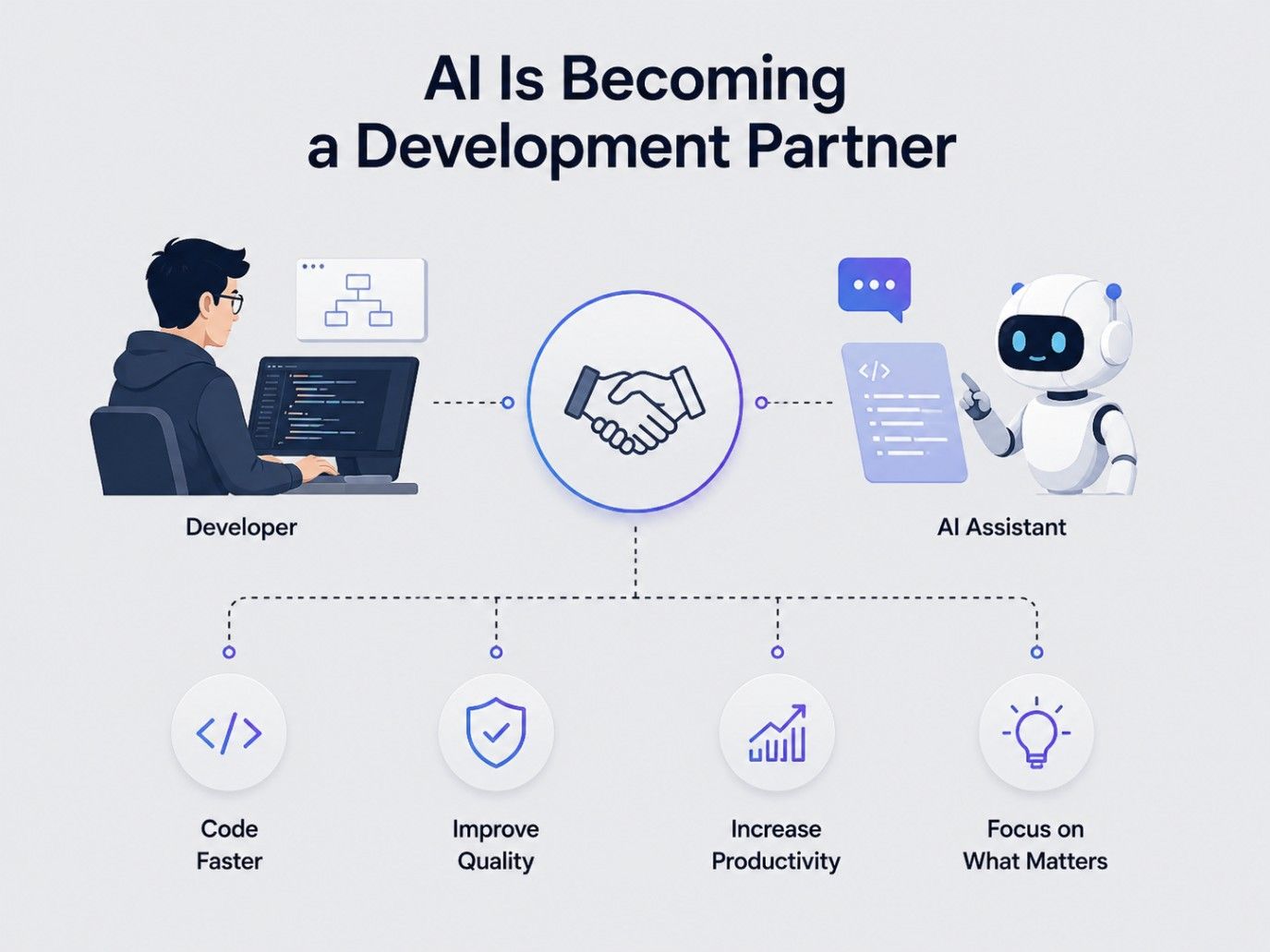
AI works like a coding assistant, but it still needs human guidance. Engineers must review AI-generated code for accuracy, security, and performance before it's deployed.
Also read: AI Engineer Salary in India [For Beginners & Experienced] in 2026
AI is transforming software engineering, but it's not replacing the profession. Instead of eliminating jobs, AI is automating repetitive tasks such as writing boilerplate code, generating documentation, and basic debugging. This allows engineers to focus on higher-value responsibilities that require human expertise.
Today, software engineers spend more time:
If you're wondering will software engineers be replaced by AI, the evidence suggests that AI is transforming engineering roles rather than eliminating them. Developers who learn to work with AI tools are likely to have stronger career opportunities in the years ahead.
While AI can accelerate development, it cannot replace human judgment, creativity, or strategic decision-making. Engineers who learn to work effectively with AI will be better positioned for future opportunities.
A common misconception is that if AI automates several tasks, it automatically replaces the job. That's rarely how technology changes industries.
AI Can Automate |
Human Engineers Still Own |
| Writing repetitive code | Software architecture |
| Generating documentation | Product planning |
| Basic debugging | Complex troubleshooting |
| Code suggestions | Technical decision-making |
| Creating unit tests | System integration |
| Code translation | Customer-focused problem solving |
Notice the pattern. AI reduces manual effort, while engineers continue to own the outcome.
Also read: Why AI Is The Future & How It Will Change The Future? | upGrad blog
AI will have a greater impact on roles focused on repetitive coding than on specialized fields like cloud computing, cybersecurity, distributed systems, and AI development, where human judgment remains essential.
Companies also increasingly value engineers who can effectively use AI tools alongside their programming skills. The ability to review AI-generated code, identify errors, and apply AI efficiently is becoming a key competitive advantage.
Explore upGrad's Executive Post Graduate Programme in Applied AI and Agentic AI to build in-demand skills in generative AI, agentic AI, prompt engineering, large language models (LLMs), AI automation, machine learning, and real-world AI application development through hands-on projects and industry-relevant learning.
Free Courses
The impact of AI goes beyond writing code. It's changing how software is planned, developed, tested, and maintained.
Many organizations now treat AI as another member of the engineering team. Developers still make the important decisions, while AI helps accelerate everyday tasks.
This shift is creating a new development workflow.
Software projects involve far more than programming.
A typical workflow includes:
AI now contributes to several of these stages.
For example, it can:
That allows engineers to focus on higher-value work instead of repetitive development tasks.
One of AI's biggest benefits is productivity.
Imagine a developer building an API. Instead of writing hundreds of routine lines manually, they ask an AI assistant to generate the initial structure. The developer then reviews the code, improves it, tests it, and connects it with the rest of the application.
Many companies report that developers complete common tasks more quickly when AI is integrated into their workflow.
Software engineering isn't becoming easier. It's becoming different. Today's engineers need skills beyond programming.
Some of the most valuable abilities include:
These skills become even more valuable as AI handles repetitive coding.
Rather than acting solely as programmers, many developers now work as technical decision-makers.
Their responsibilities include:
AI can generate answers. Engineers remain responsible for making the right decisions.
Must read: Types of AI: From Narrow to Super Intelligence with Examples
AI Courses to upskill
Explore Artificial Intelligence Courses for Career Progression
AI has made impressive progress, especially in routine programming work. Modern coding assistants can save developers hours each week by handling repetitive tasks that don't require deep business knowledge.
Still, automation has limits. AI performs best when the task is well-defined and similar examples already exist in its training data.
Today, AI can automate many common development activities, including:
These capabilities make development faster, especially for repetitive work.
Once projects become more complex, human expertise becomes essential.
Consider these scenarios:
It can't fully understand the business context, organizational priorities, or long-term consequences of every technical decision.
The strongest software teams aren't replacing developers with AI. They're combining both.
A practical workflow often looks like this:
Stage |
AI's Role |
Engineer's Role |
| Planning | Suggest ideas | Define requirements |
| Development | Generate code | Review and improve |
| Testing | Create test cases | Validate results |
| Debugging | Suggest fixes | Identify root causes |
| Deployment | Recommend configurations | Approve and monitor releases |
The more important question is whether AI can consistently deliver secure, reliable, maintainable software that solves real business problems without human guidance. That's a much higher bar, and it's one where experienced software engineers continue to make the biggest difference.
Must read: Artificial Intelligence Engineer Job Description
AI has become an impressive coding assistant. It can generate functions, explain algorithms, and even build simple applications from a prompt. Yet software engineering isn't just about producing code. It's about solving problems that involve people, processes, and technology.
That's where human engineers still have a clear advantage.
A retailer wants to improve online sales. A hospital needs a secure patient portal. A logistics company wants faster delivery tracking. Before writing a single line of code, engineers must understand what the business wants to achieve and what users actually need.
AI doesn't truly understand those objectives. It predicts the next likely output based on patterns, but it can't ask meaningful follow-up questions or negotiate priorities between stakeholders.
That's why engineers spend time in meetings, gather requirements, and translate business needs into technical solutions.
Writing code is one thing. Designing an entire system is another.
Software engineers decide how applications should be structured, how different services communicate, how databases are organized, and how systems remain reliable as traffic grows. Every architectural decision affects cost, performance, scalability, and maintenance.
Consider an e-commerce platform expecting millions of users during a holiday sale.
An AI tool can generate parts of the application. An experienced engineer decides whether to use microservices or a monolithic architecture, how to distribute traffic, and how to prevent downtime during peak demand.
Those decisions rely on experience rather than pattern matching.
Many aspects of software development can't be automated because they depend on communication, creativity, and judgment.
Software engineers regularly:
These responsibilities require trust and accountability.AI can suggest options. Humans choose the right one.
Software Engineers |
AI Systems |
| Understand business goals | Follow prompts |
| Design system architecture | Generate code snippets |
| Collaborate with teams | Process existing information |
| Solve new problems | Recognize learned patterns |
| Take ownership of decisions | Require human supervision |
| Balance technical and business priorities | Focus on task execution |
If an AI generates faulty code, someone must identify the issue, fix it, and accept accountability. That responsibility always belongs to the engineering team.
Do read: AI Impact on Jobs: 16 Critical Shifts in Work, Skills, and Employment
AI can generate code much faster than humans for routine programming tasks, making it an excellent tool for improving developer productivity.
However, building secure, scalable, and maintainable software requires human expertise. Software engineers make critical architectural decisions, solve complex business problems, and ensure code quality capabilities that AI cannot fully replicate.
AI is particularly effective at automating repetitive and time-consuming software development tasks. By handling routine activities, it helps developers improve productivity and focus on more complex engineering work.
It can:
These capabilities help developers save time and reduce routine work.
Software projects rarely follow predictable patterns.
Unexpected customer requirements appear. Budgets change. Regulations evolve. Security risks emerge. Teams disagree on implementation approaches.
Human engineers navigate these situations every day because they combine technical knowledge with critical thinking.
For example, an AI assistant might recommend a technically correct database structure.
A software architect may reject that suggestion because it increases long-term infrastructure costs or doesn't support future business growth.
That kind of judgment can't be generated from a prompt alone.
The table below highlights the key differences between AI and human software engineers across important development capabilities.
Capability |
AI |
Human Engineer |
| Coding speed | Excellent | Very Good |
| Pattern recognition | Excellent | Good |
| System architecture | Limited | Excellent |
| Business understanding | Very Limited | Excellent |
| Creativity | Limited | Excellent |
| Collaboration | Very Limited | Excellent |
| Accountability | None | Full |
| Long-term maintenance | Limited | Excellent |
AI complements software engineers rather than replacing them.
The strongest developers aren't competing against AI. They're using it to work faster while applying their own experience where it matters most.
AI has advanced rapidly, but it still faces important limitations that prevent it from replacing software engineers.
Understanding these limitations helps explain why human oversight remains essential throughout the software development lifecycle.
AI Limitation |
Why Human Engineers Are Still Needed |
| Lacks Business Context | Make strategic decisions based on business needs. |
| Can Generate Incorrect Code | Review, validate, and fix AI-generated code. |
| Struggles With Large Systems | Manage complex architectures and integrations. |
| Cannot Replace Human Review | Test, secure, and optimize software before release. |
| Lacks Judgment | Ensure software is reliable, scalable, and user-focused. |
AI is creating new career opportunities by changing the skills companies look for, not by eliminating software engineering roles.
Growing AI adoption has increased demand for roles such as:
These roles build on core software engineering skills like programming, cloud computing, APIs, and system design.
Businesses still need software engineers to build applications, secure systems, integrate AI into products, and review AI-generated code. As AI adoption grows, engineers who combine strong programming skills with AI expertise will have the best career opportunities.
Software engineers who combine technical expertise with AI knowledge are likely to have more career opportunities.
Focus on developing skills such as:
Technical Skills |
AI-Related Skills |
| Software architecture | Prompt engineering |
| Cloud computing | AI-assisted development |
| System design | AI model evaluation |
| API development | AI integration |
| Cybersecurity | Responsible AI practices |
| DevOps | AI workflow automation |
The future belongs to engineers who can adapt.Learning AI doesn't replace software engineering skills. It builds on them.
AI is changing how software engineers work, not replacing them. As AI handles routine coding tasks, engineers can focus on solving complex problems, designing systems, and delivering better software.
Software engineers will increasingly use AI to generate code, review suggestions, and speed up development while focusing on architecture, system design, and business requirements.
Future engineers will need skills in AI-assisted development, cloud computing, software security, distributed systems, and collaboration. These capabilities will become even more valuable as AI adoption grows.
Current trends point to higher productivity, not replacement. AI helps developers work faster, but human engineers remain responsible for technical decisions, code quality, and delivering reliable software.
AI is unlikely to replace software engineers entirely. Instead, it is automating repetitive development tasks, allowing engineers to focus on system design, problem-solving, security, innovation, and business needs. Human judgment, creativity, and decision-making remain essential for building reliable software.
The future belongs to engineers who can effectively collaborate with AI. By combining strong software engineering fundamentals with AI tools, developers can work more efficiently, deliver higher-quality solutions, and stay competitive in an evolving technology landscape.
Ready to start your journey? Book a free consultation with upGrad today to find the best path for your career.
AI is unlikely to replace software engineers completely. While it can automate coding, testing, and documentation, it cannot replicate human judgment, system design, collaboration, or business understanding. Engineers who combine software development expertise with AI skills will continue to play a critical role in building reliable applications.
Some entry-level coding tasks are becoming automated, but this doesn't mean coding jobs are disappearing. Instead, many roles are evolving to include AI-assisted development, code review, and system optimization. Companies continue hiring developers who can combine technical skills with AI capabilities.
Roles involving system architecture, cybersecurity, cloud engineering, DevOps, embedded systems, and AI engineering are less likely to be automated. These positions require strategic thinking, complex decision-making, and collaboration across teams,areas where human expertise remains essential.
Jobs requiring creativity, critical thinking, and complex decision-making are expected to remain resilient. Examples include software engineers, cybersecurity specialists, and AI engineers. These professionals solve unique business challenges, design scalable systems, and make decisions that AI cannot independently handle.
Skills such as software architecture, system design, cloud engineering, cybersecurity, stakeholder communication, and technical leadership are difficult to automate. These capabilities require human judgment, creativity, and strategic thinking, making them valuable even as AI becomes more advanced.
Software engineers can stay competitive by learning AI-assisted development, cloud computing, DevOps, cybersecurity, and system design. Developing strong problem-solving and communication skills is equally important, as organizations increasingly seek professionals who can effectively combine AI tools with engineering expertise.
Yes. AI can generate code, but it cannot fully understand business goals, customer needs, or software architecture. Learning software engineering provides the foundation needed to build, review, secure, and maintain applications while using AI as a productivity tool rather than a replacement.
AI is not expected to reduce salaries for skilled software engineers significantly. Instead, professionals who can work effectively with AI tools and build modern applications may see better career opportunities, while demand for highly specialized engineering roles is expected to remain strong.
Yes, although expectations are changing. Employers increasingly value junior developers who understand programming fundamentals and can use AI coding assistants effectively. Practical skills, project experience, and the ability to review AI-generated code are becoming important hiring criteria.
Industries such as finance, healthcare, e-commerce, manufacturing, telecommunications, government, and cloud computing continue to invest heavily in software development. These sectors require engineers to build secure, scalable, and compliant applications while integrating AI into existing systems responsibly.
The biggest advantage of AI is increased productivity. It helps developers generate code, automate repetitive tasks, identify bugs, and speed up testing, allowing engineers to spend more time on architecture, innovation, performance optimization, and solving complex business problems.
724 articles published
Sriram K is a Senior SEO Executive with a B.Tech in Information Technology from Dr. M.G.R. Educational and Research Institute, Chennai. With over a decade of experience in digital marketing, he specia...
Speak with AI & ML expert
By submitting, I accept the T&C and
Privacy Policy
Top Resources
Master's Degree
18 Months
Executive Diploma
12 Months
IIIT Bangalore
Executive Programme in Generative AI & Agentic AI for LeadersIndia’s #1 Tech University
Dual Certification
5 Months