What Is AI Slop? Meaning, Examples & Why It Matters
By upGrad
Updated on Oct 14, 2026 | 5 min read | 4.66K+ views
Share:

All courses
Certifications
More
By upGrad
Updated on Oct 14, 2026 | 5 min read | 4.66K+ views
Share:
Table of Contents
Key Highlights
Explore upGrad’s Artificial Intelligence courses to learn about machine learning, deep learning, generative AI, and real-world AI applications. Choose a programme that fits your experience and career goals, and build practical skills through projects and expert guidance.
Popular AI Programs
AI slop is modern slang that is used for poor-quality, largely produced AI content that is produced with the intention of getting clicks. This kind of content lacks human contribution, accuracy, or any originality. These are in the form of nonsensical images, repetitive articles, misleading videos, and posts that basically give no value to anyone.
The goal is volume, clicks, and ad revenue, if they can get any.
This is very similar to junk mail, which is produced in bulk because it costs almost nothing to make and there is a possibility that a small share of it can catch a click or an ad impression.
The idea became mainstream when Merriam-Webster named "slop" its 2025 Word of the Year.
The word "slop" originally meant liquid waste or low-grade food scraps fed to pigs. Around 2022, online communities began using it for sloppy output from AI image generators.
Developer Simon Willison helped push the word into wider use in 2024. He compared it to spam. Spam is unwanted email, while AI Slop meaning is unwanted artificial intelligence-generated content. The term stuck because it perfectly conveyed just how unpleasant the activity was.
Also Read: The Future Scope of Artificial Intelligence in 2026 and Beyond
There are mainly three reasons why AI Slop is created:
Remember the Facebook pages that filled feeds with AI images of "Shrimp Jesus"? Researchers at Stanford studied that wave of posts in 2024. Many of the pages were chasing reach and payouts, and plenty of real people still left comments of faith under images that were clearly fake.
Here are some terms used frequently
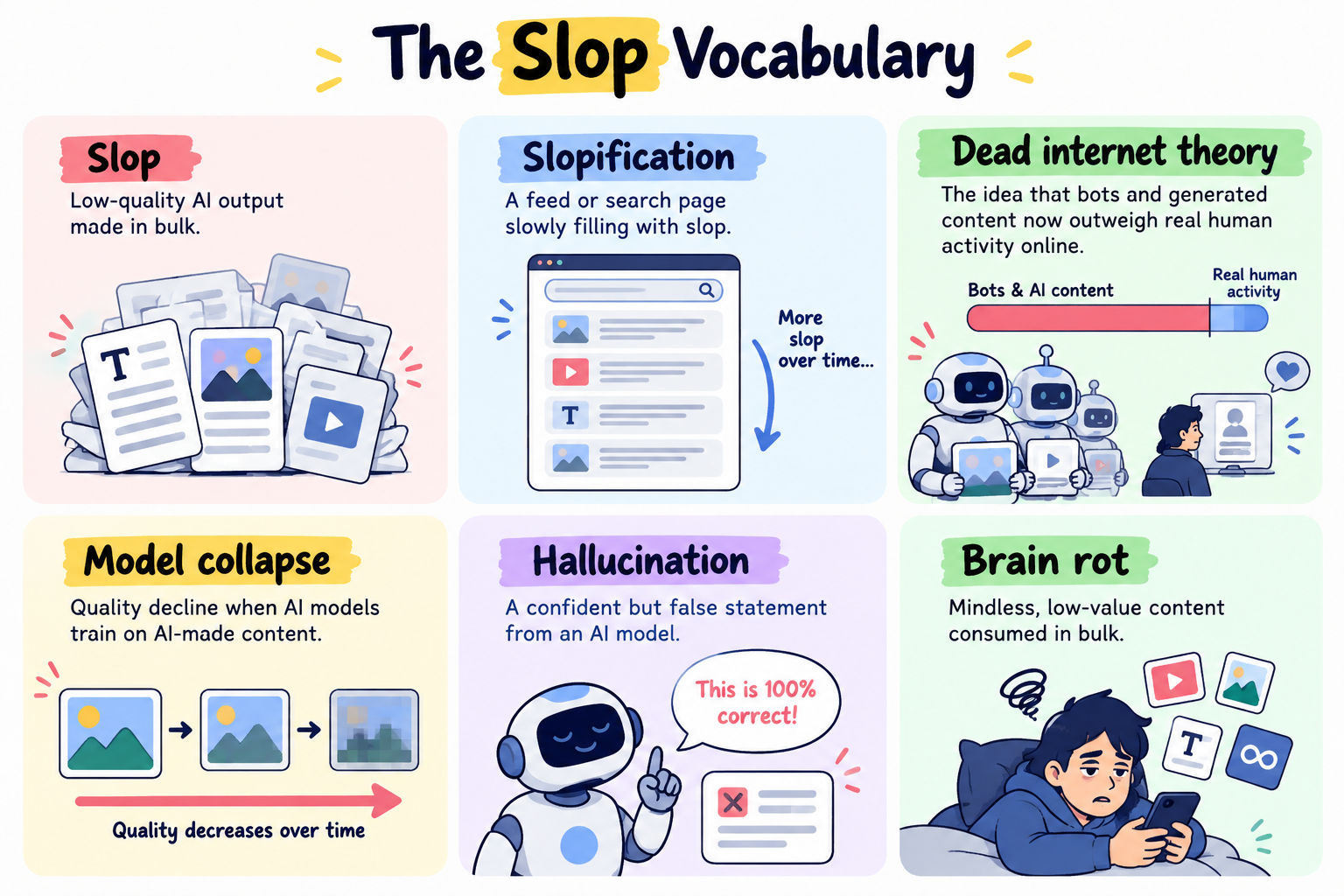
Main Characteristics of AI Slop
Here are the main characteristics of AI Slop:
Also Read: Why AI Is The Future & How It Will Change The Future?
Free Courses
Here are the different types of AI slop can be created in different formats.
Here are they:
Sloppy text involves mass-produced SEO content, manufactured product reviews, cheap books sold through online platforms without being edited by a human, etc. In 2023, Amazon restricted the number of books that could be uploaded in one day due to an abundance of such content.
Sloppy images include fake "historical" images, impossible creatures, and engagement images, such as those featuring "Shrimp Jesus." Also, art websites and image stock websites struggle with huge numbers of generated images that bury human work.
Also Read: AI Course Fees and Career Opportunities in India for 2026
Text-to-video technology was responsible for making this one take off. Some typical instances include stock footage edited together with a robotic voice-over and ridiculous short videos that serve only as clickbait.
The Audio Version has its own version. Streaming sites have been forced to pull huge numbers of spam songs uploaded all at once, and fake voices narrating fraudulent videos.
This is one of the most dangerous kinds because it seems believable. This kind includes invented bios, quotes, and reviews that never existed and were written by customers.
One famous case happened in 2023. Lawyers in a New York case filed cited legal cases that an AI chatbot made up. The text sounded very much like actual legal language.
Type |
Common example |
Usual goal |
| Text | Mass-produced SEO articles | Ad revenue, search traffic |
| Images | Fake photos, bait images | Engagement, follower growth |
| Video | Voiceover clip farms | Views, platform payouts |
| Audio | Bulk-uploaded spam tracks | Streaming royalties |
| Fake authority | Invented experts and reviews | Trust, sales, influence |
Also Read: How to Learn Artificial Intelligence: A Step-by-Step Roadmap
AI Courses to upskill
Explore Artificial Intelligence Courses for Career Progression
As AI slop is increasingly making its place in our feeds, it's important that we think about it from the perspective of authenticity and ethics. It changes what people are consuming and believing. It makes it difficult for people to trust content.
It dilutes the original content. It makes it difficult to search for original and trustworthy content. It increases fake information, and people unknowingly will try to implement that fake information. Search results get diluted.
If a person is searching for information regarding health issues or finance, then he or she would come across five pages of duplicate and unverified content before coming across any information that comes from an expert on the matter.
Moreover, when everything has become a deepfake, you will find yourself questioning even the authentic ones. There is another more subtle consequence of deepfakes. When everyone makes deepfakes, no one believes anything. Genuine footage of an actual incident becomes a "must be AI."
Errors also spread faster than corrections. A false claim written once by a model can be copied across hundreds of sites in a day.
Model collapse adds another twist. If future AI models train on today's slop, their output could get worse. The tools are, in effect, eating their own waste.
Illustrators, writers and musicians now compete with endless free copies of their style. Their work is scraped, imitated and undercut by accounts that publish hundreds of items a day.
Harvard Business Review described "workslop" in 2025, meaning AI-made documents that look polished but lack substance.
AI is reshaping how businesses make decisions, and leaders need to keep pace. IIM Kozhikode's Strategic AI for Business Professionals programme helps you apply AI to real business problems, no coding required.
Here's where people get stuck. Plenty of useful material is made with AI. The difference lies in the human effort wrapped around it.
Factor |
AI slop |
Good AI-assisted content |
| Human review | None or minimal | Edited and fact-checked |
| Accuracy | Unchecked, often wrong | Verified against sources |
| Originality | Recycled, generic | Adds experience, data or insight |
| Purpose | Volume, clicks, ad money | Answers a real reader need |
| Accountability | No named author | Clear author or brand |
These terms seems very similar as they mean almost similar. But they are used for different perspectives.
Term |
Core idea |
How it differs from AI slop |
| Spam | Unwanted mass messages | Spam can be human-written, while slop is AI-made |
| Misinformation | False information | Slop can be harmless nonsense and still not be false |
| Clickbait | Misleading headlines | Clickbait can be hand-crafted and need no AI |
A single post can be all four at once. An AI-written article with a false headline, posted in bulk, is slop, spam, misinformation and clickbait together.
Also Read: Top 10 Artificial intelligence Models
Here is how you can identify AI slop:
Begin with the source. Who is the author, and have you seen their work elsewhere? The lack of an author or an unknown author from stock photos should be the first warning signal.
Then consider the actual content of the material.
There are two quick tests that you may conduct to spot AI-generated sloppiness. You may try to run a reverse image test to track down where the picture was used first. And check the statistics against the original source. If it cannot be found there, it’s AI slop.
Not quite. Detection systems make false positives and false negatives alike. People writing English as a second language often get marked wrong.
This year OpenAI pulled its own text classifier due to poor performance, which gives an idea of the difficulty of the task. Their detector score is always a hint, never a verdict
The best clue about the authenticity of something is its contents. Examine the sources and verify the information and the writer's history. A page can pass every detector and still be useless, and a page can fail one and still be excellent.
Also read: 24 Artificial Intelligence Facts, Stats, and Surprises
You don't need to avoid AI. You need to avoid publishing without thinking. Most of this comes down to habits.
Be honest about the tradeoff. This takes time, and it cuts into the speed that makes AI tempting in the first place. A team that used to publish 40 posts a month might publish 12. But those 12 will actually get read, shared and trusted.
Avoiding AI isn’t the issue here. What you must do is publish thoughtfully. It mostly comes down to being mindful of certain habits.
Be clear about the compromise. This takes time and reduces the very speed that was appealing about using AI tools to begin with. An organization that once posted 40 articles per month may publish only 12, but each of those 12 gets read and shared and believed.
A quick before and after shows the difference. A slop line reads "Customer service is important for every business." A useful line reads "Our support team cut average reply time from 9 hours to 2 after we added a shared inbox." One is filler. The other tells the reader something.
Conclusion
AI slop isn't a technology problem as much as a care problem. The tools aren't the villain. The villain is publishing anything, at any volume, with nobody willing to stand behind it.
It’s becoming easier for consumers to catch it, and the search engines have cracked down on bulk-produced content. The companies and individuals who will succeed are those who use artificial intelligence as a draft helper and the human being in control of the final edit.
Next time you're about to hit publish, ask one question. Would you send this to a friend?
Ready to start your journey? Book a free consultation with upGrad today to find the best path for your career.
Similar Reads:
Poor AI content is not illegal on its own. The problem arises when it violates other laws like fraud, false reviews, plagiarism or copyright, trademark violation, defamation or misleading ads. There are also places where AI media comes under disclosure laws, and that list keeps evolving.
Google doesn't penalize content because it's AI-generated. Spam policies are aimed at the use of scaled content, which means pages mass-produced to manipulate search rankings. Helpful and accurate pages get ranked regardless of whether they were written by a person or a tool. Not helpful AI slop normally gets deindexed sooner or later.
No. Content generated by ChatGPT and any other similar service will turn into slop if it is published in its raw form, without any checks and without adding anything unique to it. If a writer uses it as an outline and adds his knowledge, facts and edits it, the output will turn out fine.
AI slop is prevalent on platforms that reward engagement. Facebook, YouTube Shorts, TikTok, Instagram, and Twitter have had floods of AI slop. Retail websites, audio streaming sites, and even search results also accumulate significant amounts of AI slop, since the cost of uploading is low, and the review process takes a long time.
Frequently use the "Not interested" and "mute" tools because they train the algorithm. Unfollow any page which generates bulk posts of images or videos. Follow creators who have an established identity and history. Platforms now have options which restrict AI marked content in your feed.
Click the report button on the post and pick the most appropriate option, either spam, misinformation, or misleading content. Many platforms also have an explicit option for AI-generated media. Reports related to fake profiles, scams, and impersonations will be more effective than the others.
Yes, in cases where the readers would care, for instance, news articles, product reviews, health tips or recommendations. The proper labeling will safeguard credibility and prevent legal issues in countries requiring disclosure. In case of routine tasks, like correction of grammatical errors or picture sizing, it is unlikely that any labeling would be expected from a brand.
The audience is quick to recognize the generic writing, strange pictures, or mistakes in the facts. One article may ruin the reputation of all other articles written by the same brand. It is also possible that customers will believe that the customer support or product reviews are as careless as the article in question.
No. An hallucination is a particular mistake when the model claims to be sure about something untrue – for example, providing made-up citations. AI slop is a more general term describing low-quality mass-produced content. Slop can include hallucinations, but it can also be factual and shallow at the same time.
Most probably, in its quantity. New technologies become cheaper and faster, which will lead to an increase in their use. However, the quality control systems are evolving as well. Platforms introduce labels, search engines fight spam produced in scale, and users learn how to recognize it. It seems that there will be more AI slop, and people will turn to known brands.
Yes. Generated absurd memes and surreal video clips can amuse people because all of them understand that the information provided is untrue and nobody tries to deceive anyone. The problem appears when such a low-effort strategy is extended to news, recommendations, reviews or even artworks.
1038 articles published
We are an online education platform providing industry-relevant programs for professionals, designed and delivered in collaboration with world-class faculty and businesses. Merging the latest technolo...
Speak with AI & ML expert
By submitting, I accept the T&C and
Privacy Policy
Top Resources
Master's Degree
18 Months
Executive Diploma
12 Months
IIIT Bangalore
Executive Programme in Generative AI & Agentic AI for LeadersIndia’s #1 Tech University
Dual Certification
5 Months