Characteristics of Artificial Intelligence: What Makes AI Think and Act
By Sriram
Updated on Sep 28, 2026 | 6 min read | 1.84K+ views
Share:

All courses
Certifications
More
By Sriram
Updated on Sep 28, 2026 | 6 min read | 1.84K+ views
Share:
Table of Contents
The characteristics of artificial intelligence describe the abilities that allow machines to imitate certain aspects of human intelligence. Not every AI system has every characteristic, but modern AI solutions usually combine several of them.
AI doesn't work the way most people imagine. It doesn't follow a fixed script or run on magic. The characteristics of artificial intelligence define exactly how these systems process information, make decisions, and get better over time without someone rewriting their code every time.
This blog breaks down each core characteristic in plain language. You'll understand what makes AI different from regular software, where these traits show up in real life, and why some of them come with trade-offs worth knowing about.
Explore upGrad's artificial intelligence programs to develop practical skills in large language models (LLMs), generative AI, machine learning, model evaluation, NLP, and data-driven decision-making.
Popular AI Programs
AI systems share a set of defining traits that separate them from traditional programs. A regular program does exactly what you tell it. AI learns what to do.
Here's the thing, though: not every AI system has all these characteristics equally. A chess engine and a medical diagnosis tool are both AI, but they're built differently and prioritise different traits. What they share is a common foundation.
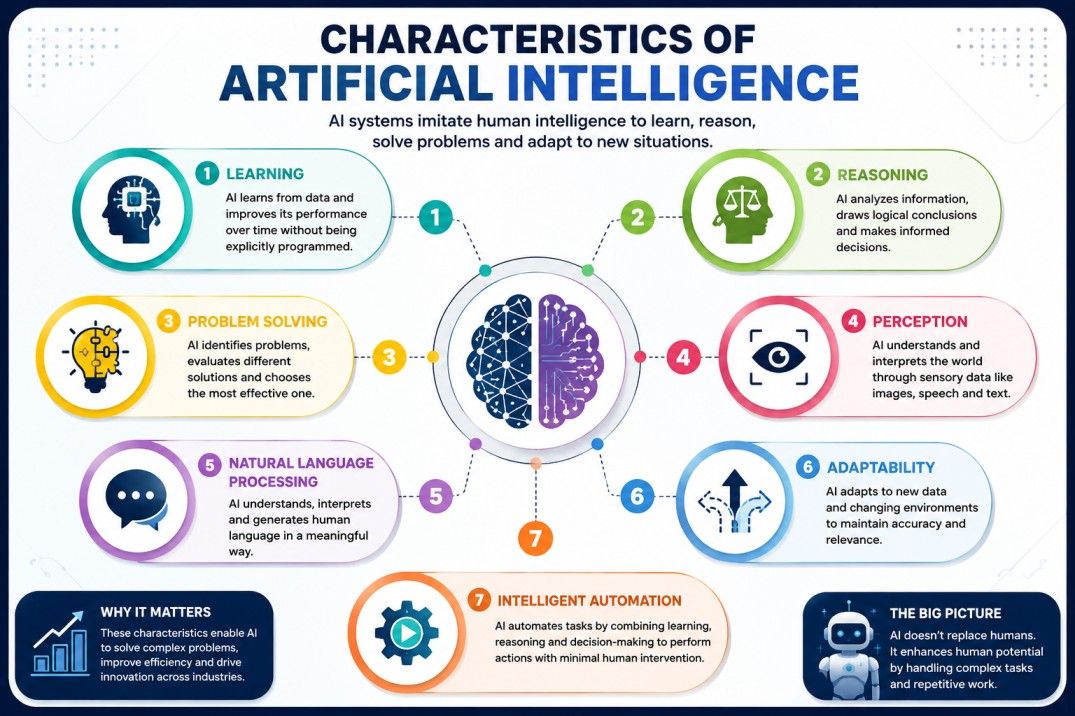
The main characteristics of artificial intelligence include:
Free Courses
This is probably the most talked-about trait. AI learns from examples instead of explicit instructions, and that changes everything about how it behaves.
Take a spam filter. You don't program it with a list of every spam message ever written. You feed it thousands of examples of spam and not-spam, and it figures out the patterns. When a new phishing email shows up with slightly different wording, the model still catches it because it's learned the underlying pattern, not just the surface details.
That's machine learning at work. And it's why AI gets better the more data it sees.
Adaptability goes one step further
A system that only learns during training is useful. One that adapts in real time is what makes AI genuinely practical.
Take streaming platforms as an example. Their recommendation engines don't rely only on what you watched six months ago. They also consider what you skipped, rewatched, searched for, and even when you're most active. As your habits change, the recommendations change too.
Learning Type |
How It Works |
Real-World Example |
| Supervised Learning | Learns from labelled examples where the correct output is already known | Email spam detection |
| Unsupervised Learning | Finds hidden patterns and relationships without labelled data | Customer segmentation |
| Reinforcement Learning | Learns through trial, error, and rewards for successful actions | Game-playing AI and robotics |
Learning isn't always perfect. The quality of an AI model depends heavily on the quality of its training data. If the data is biased, outdated, or incomplete, the AI can produce inaccurate or unfair results.
For instance, a model trained mostly on data from one demographic may perform poorly for people from other groups.
You'll notice AI doesn't always get it right on the first try. That's expected, but one of the defining characteristics of artificial intelligence is its ability to improve with experience rather than deliver perfect results from day one.
Do read: Types of AI: From Narrow to Super Intelligence with Examples
AI Courses to upskill
Explore Artificial Intelligence Courses for Career Progression
Reasoning is what separates AI from simple automation. A basic automation tool follows a fixed sequence of instructions. AI evaluates multiple options and selects the most suitable one using logic, probability, or patterns learned from data.
Consider a navigation app. It doesn't simply suggest the shortest route. It also checks live traffic, road closures, your driving habits, and historical traffic data before recommending the best path. That's AI reasoning working across multiple inputs in real time.
The reasoning approach depends on the problem being solved.
A chatbot answering customer questions uses language models to understand context and generate responses. A warehouse robot, however, relies on reinforcement learning to plan movements, avoid obstacles, and improve efficiency through repeated experience. Both systems demonstrate reasoning, but they reach decisions in very different ways because they're trained for different tasks.
Reasoning Approach |
How It Works |
Example |
Limitation |
| Rule-based Reasoning | Uses predefined rules and logical conditions to make decisions | Tax calculation software, expert systems | Struggles with new or unexpected situations |
| Machine Learning and Neural Networks | Learns patterns from large datasets instead of relying on fixed rules | Medical image analysis, recommendation systems | Decisions can be difficult to explain, creating the "black box" problem |
This difference becomes especially important in industries like healthcare, finance, and law. When AI helps make critical decisions, people often need to understand why a particular recommendation was made. That's why explainable AI has become an active area of research alongside improving AI accuracy.
Explore upGrad's Executive Post Graduate Certificate in AI-Native Software Engineering to build production-ready skills in AI-assisted software development, large language models (LLMs), generative AI, AI agents, prompt engineering, MLOps, intelligent application development, and modern software engineering workflows.
AI systems need input before they can make decisions. Perception is how they collect and interpret that input.
Humans rely on sight, hearing, touch, taste, and smell to understand the world. AI systems work differently. They process information from images, text, speech, videos, and sensor data to recognize objects, understand language, and respond to changing conditions.
Computer vision is one of the clearest examples of AI perception.
A decade ago, accurately identifying a dog in a photograph was considered a difficult research problem. Today, it's a standard feature in smartphone cameras, photo libraries, and social media platforms. AI achieves this by learning visual patterns from millions of labelled images rather than memorizing individual pictures.
Perception also improves through learning.
Data Type |
AI Technology |
Common Applications |
| Images and videos | Computer Vision | Face recognition, medical imaging, quality inspection |
| Text | Natural Language Processing (NLP) | Chatbots, document analysis, sentiment analysis |
| Speech | Speech Recognition | Voice assistants, transcription software |
| Sensor data | IoT and AI Analytics | Autonomous vehicles, smart factories, predictive maintenance |
An AI model trained on 100,000 medical scans can usually detect abnormalities more accurately than one trained on only 1,000 scans because it has encountered a much wider variety of cases. The underlying algorithm may remain the same, but richer training data helps the model recognize subtle patterns more effectively.
Still, AI perception has limits.
An AI system can only analyze the information it receives. If an object is outside the camera's view, hidden behind another object, or missing from the available data, the model can't infer its presence. Unlike humans, AI doesn't fill gaps using common sense or personal experience. Its understanding is limited to what its sensors or input data provide.
Must read: Generative AI Chatbot: How Intelligent Conversational Systems Work
This characteristic is one of the biggest reasons AI feels so different today than it did a few years ago. The ability to understand and generate human language has transformed AI from a behind-the-scenes technology into a tool that millions of people interact with every day.
Natural Language Understanding (NLU) goes beyond recognizing words. It helps AI interpret context, user intent, ambiguity, and tone. If you ask an AI assistant, "Can you pull up that report from last Tuesday?", it doesn't simply search for the exact words. It uses previous interactions and available context to identify the report you're most likely referring to.
NLU Capability |
What It Does |
Everyday Example |
| Text understanding | Interprets written language and context | AI summarizing a document |
| Intent recognition | Identifies what the user wants | Understanding "Book me a flight" as a travel request |
| Context awareness | Uses previous conversation to improve responses | Remembering follow-up questions in a chat |
| Language generation | Produces natural, human-like responses | AI chatbots and writing assistants |
Processing human language is far from simple.
People use slang, abbreviations, sarcasm, incomplete sentences, and implied meanings every day. To handle this complexity, AI relies on several technologies working together, including tokenization, contextual embeddings, language models, and response generation.
Large language models such as GPT and Gemini are built around this capability. Their primary function is to understand language patterns well enough to generate useful responses. They don't store knowledge or reason like humans. Instead, they predict the most likely response based on patterns learned from vast amounts of text.
Do read: 24 Artificial Intelligence Facts, Stats, and Surprises
Strength |
Limitation |
| Understands natural conversations | Can generate incorrect but convincing answers |
| Handles multiple languages | Doesn't truly "understand" facts like humans |
| Maintains conversational context | Depends on training data quality |
| Generates fluent responses quickly | May misinterpret ambiguous prompts |
One practical point is easy to overlook.
AI systems can sound highly confident even when the information they generate is inaccurate. That's not necessarily a failure of language understanding. It's a result of producing fluent, natural-sounding text based on probability rather than verified facts. That's why it's always a good idea to verify important information before relying on AI-generated responses.
Do read: Image Recognition Machine Learning: Brief Introduction
AI's ability to automate isn't just about speed. It's about making decisions at a scale no human team could match.
A fraud detection system at a major bank processes millions of transactions daily. It flags suspicious activity in milliseconds. No human analyst could review each transaction in real time. AI can, and it doesn't get tired or distracted.
That's where automation and decision-making combine. The AI isn't just running a faster version of a human process. It's doing something structurally different: making judgment calls at volume.
This characteristic is also where ethical questions surface fast. When AI is making decisions about loan approvals, hiring, or medical treatment, the stakes are high. The automation characteristic that makes AI powerful also means errors get repeated at scale before anyone notices.
Application Area |
What AI Automates |
Key Benefit |
| Finance | Fraud detection, credit scoring | Speed and consistency |
| Healthcare | Image analysis, drug discovery | Pattern detection across large datasets |
| Retail | Inventory management, recommendations | Real-time personalisation |
| Manufacturing | Quality control, predictive maintenance | Reduced downtime and human error |
The goal isn't to remove humans from the loop. It's to let AI handle the volume so humans can focus on the decisions that actually need judgment.
The characteristics of artificial intelligence explain why AI has become such an important part of modern technology. Learning, reasoning, problem-solving, perception, natural language processing, adaptability, and intelligent automation allow machines to perform tasks that once required human intelligence.
At the same time, AI isn't a replacement for human judgment. It works best when paired with quality data, thoughtful design, and expert oversight. If you're beginning your AI journey, understanding these characteristics first will make advanced topics like machine learning, deep learning, and generative AI much easier to grasp.
Ready to start your journey? Book a free consultation with upGrad today to find the best path for your career.
There isn't a single most important characteristic because AI systems rely on multiple capabilities working together. However, learning is often considered the foundation since it enables AI to improve from data instead of following fixed instructions. Without learning, most modern AI applications wouldn't become more accurate over time.
If you're asked to list the characteristics of artificial intelligence, the core traits include learning, reasoning, problem-solving, perception, natural language understanding, adaptability, and intelligent automation. Together, these capabilities help AI process information, make decisions, and perform tasks that normally require human intelligence.
These characteristics determine what an AI system can and can't do. For example, learning helps improve predictions, perception enables image recognition, and reasoning supports decision-making. Understanding these traits helps businesses and individuals choose the right AI solution for specific problems.
Machine learning is a subset of artificial intelligence that focuses on enabling systems to learn from data. The characteristics of artificial intelligence describe broader capabilities such as reasoning, perception, language understanding, and automation, while machine learning provides one of the methods used to achieve them.
Industries including healthcare, finance, manufacturing, retail, education, and transportation rely heavily on AI. These sectors use different AI characteristics for applications such as medical diagnosis, fraud detection, predictive maintenance, personalized recommendations, and intelligent customer support to improve efficiency and decision-making.
No. Different AI applications are designed for different purposes. A facial recognition system emphasizes perception and pattern recognition, while a conversational AI focuses on language understanding and reasoning. Most AI systems combine only the characteristics required to solve their specific tasks effectively.
AI performs only as well as the data and algorithms behind it. Biased datasets, incomplete information, or changing environments can reduce accuracy. AI also lacks human intuition and common sense, making human oversight essential in critical fields such as healthcare, finance, and legal services.
AI improves by learning from new data and feedback. As models process additional examples, they recognize patterns more accurately and refine their predictions. This continuous learning allows recommendation engines, fraud detection systems, and language models to become more effective after deployment.
Many advanced AI models produce accurate predictions without clearly explaining how they reached a decision. This lack of transparency, often called the "black box" problem, raises concerns in industries where accountability matters. Explainable AI aims to make these decisions easier for humans to understand and trust.
Generative AI tools combine several AI characteristics, including learning, reasoning, and natural language understanding, to create text, images, code, and other content. They analyze patterns from large datasets and generate responses based on probability rather than memorizing or retrieving fixed answers.
Once you understand the characteristics of artificial intelligence, the next step is exploring machine learning, deep learning, neural networks, computer vision, and natural language processing. Learning these topics helps you understand how AI systems are designed, trained, evaluated, and applied across industries.
730 articles published
Sriram K is a Senior SEO Executive with a B.Tech in Information Technology from Dr. M.G.R. Educational and Research Institute, Chennai. With over a decade of experience in digital marketing, he specia...
Speak with AI & ML expert
By submitting, I accept the T&C and
Privacy Policy
Top Resources
Master's Degree
18 Months
Executive Diploma
12 Months
IIIT Bangalore
Executive Programme in Generative AI & Agentic AI for LeadersIndia’s #1 Tech University
Dual Certification
5 Months