LISP in Artificial Intelligence: What It Is and Why It Still Matters
By Sriram
Updated on Jun 26, 2026 | 6 min read | 2.04K+ views
Share:

All courses
Certifications
More
By Sriram
Updated on Jun 26, 2026 | 6 min read | 2.04K+ views
Share:
Table of Contents
Lisp in artificial intelligence has played a major role in shaping modern AI research. Long before today's machine learning frameworks became popular, researchers relied on Lisp to build expert systems, symbolic reasoning programs, and natural language processing applications. Its flexible structure and ability to process symbolic data made it one of the first programming languages designed for AI research.
LISP is one of the oldest programming languages still in active use, and it was built specifically for the kind of symbolic reasoning that AI depends on. If you're studying AI or working in it, LISP in artificial intelligence isn't just history. It's a foundation that shaped how we think about machines and logic.
This blog covers what LISP is, its full form, how it works, where it's used, and why it's still relevant.
Explore upGrad's Artificial Intelligence programs to master AI fundamentals, symbolic reasoning, machine learning, deep learning, natural language processing, and build real-world AI solutions.
Popular AI Programs
LISP stands for List Processing. That's the full form of LISP in artificial intelligence, and the name itself tells you what it does. It processes lists. And in AI, almost everything can be represented as a list.
Developed by John McCarthy in 1958 at MIT, LISP was the second high-level programming language ever created, right after FORTRAN. McCarthy didn't design it as a general-purpose language. He built it to work with symbolic expressions, which are exactly what you need when you want a machine to reason, not just calculate.
The introduction to LISP in artificial intelligence starts with one idea: treat code and data the same way. In LISP, a program is a list. Data is a list. A function call is a list. That single decision made LISP unusually flexible for AI tasks like theorem proving, natural language processing, and knowledge representation.
Early AI researchers needed a language that could handle:
LISP handled all of this naturally. Other languages at the time were built for scientific computation. LISP was built for thought.
LISP uses a format called S-expressions (symbolic expressions). Everything is wrapped in parentheses.
Here's a simple example:
(+ 3 5) This adds 3 and 5. The operator comes first, then the operands. This is called prefix notation.
A function definition looks like this:
(defun square (x)
 (* x x))
This defines a function called square that multiplies a number by itself. It's readable once you're used to the structure, but there's no way around it: the parentheses are heavy, and beginners do find them disorienting at first.
Feature |
Description |
| S-expressions | All code written as nested lists |
| Prefix notation | Operator placed before operands |
| Dynamic typing | Variable types checked at runtime |
| Garbage collection | Automatic memory management |
| Recursion | Functions call themselves natively |
Do read: Top Artificial Intelligence Applications Across Industries
Free Courses
Not every programming language suits AI work equally. LISP has specific features that make it fit naturally into AI development. Let's look at what actually matters.
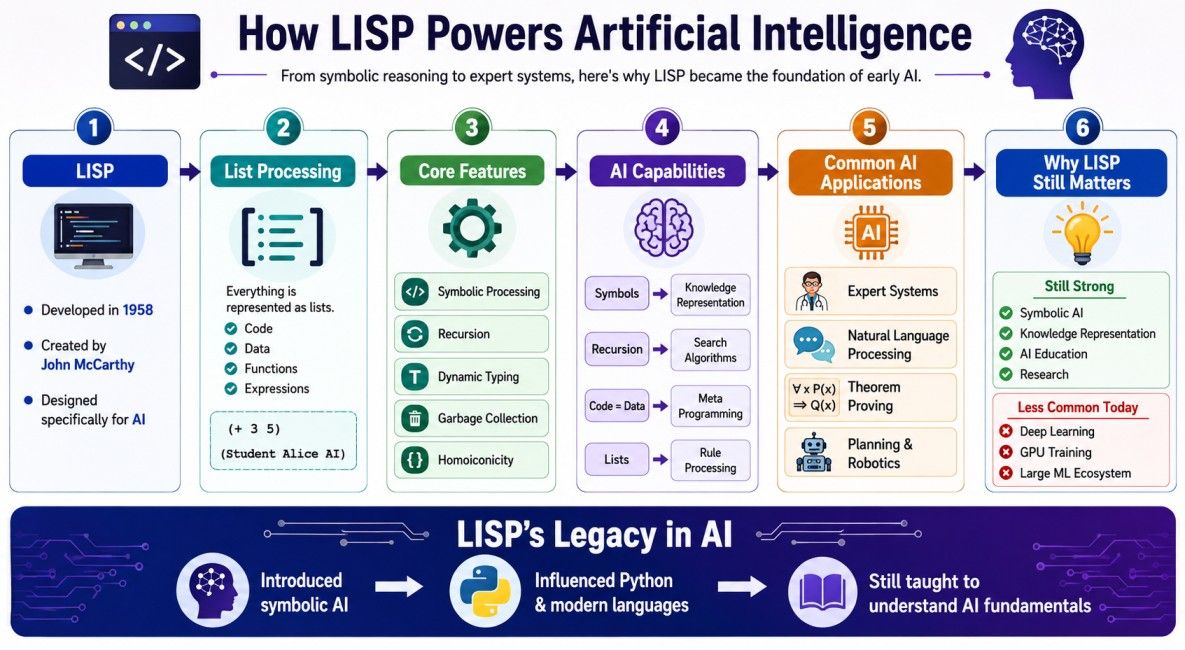
LISP works with symbols, not just numbers. A symbol can represent anything: a concept, a rule, a word, a relationship. This makes it ideal for tasks where the machine needs to work with meaning, not measurement.
Think about a medical diagnosis system. It doesn't compute numbers. It matches symptoms to rules. LISP can represent those rules directly and reason over them.
AI problems are often recursive by nature. Searching a decision tree, parsing a sentence, solving a logic puzzle. All of these involve breaking a problem into smaller versions of the same problem. LISP handles recursion cleanly.
(defun factorial (n)
 (if (<= n 1)
     1
     (* n (factorial (- n 1)))))
This function calls itself until it reaches a base case. That's recursion. LISP was designed for this.
Do read: Types of AI: From Narrow to Super Intelligence with Examples
This is a technical word, but the idea is simple. In LISP, code and data look the same. A list is data. A list is also executable code. This means LISP programs can write and modify their own code at runtime.
That's a powerful property. It allows for meta-programming, where the program reasons about its own structure. Not many languages can do this cleanly.
LISP introduced the REPL, which stands for Read-Eval-Print Loop. You type an expression, LISP reads it, evaluates it, and prints the result. Immediately.
This made LISP an early favorite for AI research because you could experiment in real time. You didn't need to compile and run a full program just to test one idea.
LISP was one of the first languages to automate memory management. The programmer doesn't need to manually allocate or free memory. This matters in AI programs that create and destroy large data structures constantly.
Explore upGrad's Applied AI and Agentic AI Executive Programme to master generative AI, AI agents, RAG, multi-agent systems, LLMs, and production-ready AI applications through hands-on projects.
AI Courses to upskill
Explore Artificial Intelligence Courses for Career Progression
The introduction to LISP programming in artificial intelligence usually starts with expert systems. These were early AI programs that encoded human knowledge as rules and applied logic to reach conclusions.
The most famous AI system built in LISP is MYCIN, developed in the 1970s at Stanford. It diagnosed bacterial infections and recommended antibiotics. It wasn't just an algorithm. It was a knowledge base with rules like "if symptom A and symptom B, then condition C is likely."
LISP let researchers encode this kind of conditional reasoning directly. No translation needed between the logic and the code.
Early NLP systems were largely built in LISP. Parsing sentences, identifying grammar structures, and building semantic representations, all of this maps well to the list-processing power of LISP.
SHRDLU was an early NLP program written in LISP that could understand and respond to commands about a virtual world of blocks. It's primitive by today's standards, but it was a major milestone in AI history.
Also read: AI vs ML vs DL: Why These Terms Are Everywhere
Older machine learning systems, especially those based on symbolic AI and rule-based learning, were built in LISP. The language let researchers prototype quickly, test hypotheses, and modify programs without rebuilding everything from scratch.
Modern ML has largely moved to Python, but many foundational concepts were first explored in LISP environments.
Application Area |
LISP's Role |
| Expert Systems | Rule encoding and inference |
| NLP | Parsing and semantic representation |
| Theorem Proving | Symbolic logic and deduction |
| Planning Systems | Goal-based reasoning |
| Robotics (early) | Sensor-to-action reasoning |
Also read: Exploring the 6 Different Types of Sentiment Analysis and Their Applications
LISP doesn't exist in a vacuum. Today's AI developers mostly use Python, and some work with Prolog or Julia. Where does LISP fit now?
This comparison is worth going through honestly, without overstating things in either direction.
Python became the dominant AI language because of its ecosystem. Libraries like TensorFlow, PyTorch, and scikit-learn made deep learning accessible to anyone with a laptop and a dataset. LISP doesn't have that ecosystem.
But Python borrowed a lot from LISP. First-class functions, lambda expressions, list comprehensions. These ideas came from LISP and were adapted into Python's syntax over time.
Factor |
LISP |
Python |
| Age | 1958 | 1991 |
| Primary Use in AI | Symbolic AI, expert systems | Machine learning, deep learning |
| Ecosystem | Limited | Massive |
| Learning Curve | Steep (parenthesis-heavy syntax) | Gentle |
| Speed | Varies by implementation | Slower than C, but fast enough |
| Recursion | Native strength | Functional but limited stack |
Prolog is another AI-focused language built for logic programming. It's declarative. You define facts and rules, and Prolog figures out how to satisfy queries.
LISP is procedural and functional. You define how to compute something. The two languages actually complement each other in certain AI research contexts.
Prolog is better at constraint satisfaction and logic proofs. LISP is better at flexible, general AI programming where you need to build systems that evolve.
LISP isn't the right choice if you're building a neural network or training a large language model. Python wins that comparison easily. But if you're working on symbolic AI, building an expert system, or doing academic research on knowledge representation, LISP is still a legitimate option.
Must read: Simple Guide to Build Recommendation System Machine Learning
LISP isn't a single language. It has evolved into several dialects over the decades, and different branches have been used for different AI tasks.
The most widely used dialect today. Standardized in 1994, Common Lisp is a full-featured language with a rich standard library. It's what most serious LISP programmers use when they're building production systems.
A minimalist dialect of LISP. Scheme strips out many features and focuses on simplicity and purity. It's often used in academic settings and as a teaching language for programming language theory.
A modern dialect that runs on the Java Virtual Machine. Clojure brought LISP ideas to the JVM ecosystem and added strong support for concurrent programming. It's used in some industry settings today, though not primarily for AI.
A special-purpose dialect used to extend the Emacs text editor. Not an AI tool, but worth knowing exists since it's one of the most actively used LISP environments today.
Dialect |
Best For |
| Common Lisp | General AI programming, production use |
| Scheme | Academic work, teaching |
| Clojure | JVM-based systems, concurrency |
| Emacs Lisp | Emacs customization |
Also read: Applications of Artificial Intelligence and Its Impact
Being direct about the limitations matters here. LISP has real constraints that explain why it's not the first choice for most AI projects today.
Advantages of Lisp |
Limitations of Lisp |
| Excellent for symbolic computation and rule-based AI applications. | Much smaller AI ecosystem than Python, with far fewer libraries. |
| Supports recursion naturally, making search and reasoning algorithms easier to build. | Doesn't offer popular deep learning frameworks like PyTorch or TensorFlow. |
| Treats code as data, allowing programs to generate or modify other programs. | Parenthesis-heavy syntax can feel unfamiliar and challenging for beginners. |
| Automatic garbage collection reduces manual memory management. | Most AI job roles expect Python rather than Lisp skills. |
| Strong functional programming support encourages clean and modular code. | Smaller community means fewer tutorials, examples, and online support. |
| Enables rapid prototyping for AI research and experimentation. | Not designed for GPU-accelerated tensor operations used in modern deep learning. |
| Well suited for knowledge representation, symbolic reasoning, and expert systems. | Better suited for symbolic AI than today's data-driven machine learning workflows. |
That said, none of this means LISP is dead. It means it's specialized. And specialized tools still matter in the right context.
Do read: Data architecture: Definition, Overview, Components Explained
Here's a question worth sitting with: if Python dominates AI, why does LISP appear in AI curricula at all?
Because LISP teaches you to think differently.
When you learn LISP, you're forced to think recursively. You can't rely on loops the way you do in Python. You break problems into base cases and recursive cases. That mental discipline carries over to every language you use after.
LISP also teaches functional programming at a deep level. Functions as values, higher-order functions, lazy evaluation. These ideas are now present in Python, JavaScript, Scala, and Haskell. Learning them in LISP, where they're foundational rather than optional, builds a stronger conceptual base.
AI programs built in LISP also tend to be transparent. The logic is explicit. You can read a rule-based system in LISP and understand exactly why it made a decision. That's not always true in a trained neural network.
LISP in artificial intelligence is more than a historical artifact. It was the language that made AI programming possible in the first place, and it introduced ideas that every modern AI language has borrowed or built on. Its role has narrowed as deep learning took over, but its influence hasn't.
Studying LISP gives you a window into how AI reasoning works at a foundational level, and that understanding doesn't expire when the syntax goes out of fashion.
Ready to start your journey? Book a free consultation with upGrad today to find the best path for your career.
LISP stands for LISt Processing, a programming language created to process symbolic information rather than only numerical data. That's why it became closely associated with artificial intelligence research. The full form of LISP in artificial intelligence reflects its core purpose of working with lists and symbolic expressions.
LISP is used in AI because it handles symbolic reasoning, recursive functions, and knowledge representation efficiently. These capabilities allow developers to build expert systems and reasoning engines more naturally than many traditional programming languages. It was designed with AI problems in mind from the beginning.
LISP is a high-level programming language developed for symbolic computation. A simple example is the expression (+ 5 3), which returns 8 using prefix notation. More advanced examples include expert systems, theorem provers, and language-processing programs that reason with symbols instead of only numbers.
John McCarthy introduced LISP in 1958 while working at MIT. Often called the father of artificial intelligence, he designed the language specifically to support AI research. His work influenced not only AI programming but also many concepts found in modern programming languages today.
The answer depends on the type of AI you're building. Python is the preferred language for machine learning and deep learning because of its extensive libraries. LISP remains stronger for symbolic AI, rule-based systems, and research involving logic and knowledge representation.
Yes, although its role has become more specialized. Modern AI relies heavily on Python for neural networks, while LISP continues to be used in symbolic AI, automated reasoning, academic research, and programming language development. Its concepts still influence many current AI technologies.
The introduction to LISP programming in artificial intelligence begins with understanding lists, recursion, and symbolic expressions. Unlike procedural languages, LISP represents both code and data as lists. This unique design makes it easier to manipulate knowledge structures and logical rules within AI systems.
LISP is still used in research institutions, universities, aerospace, defense, financial technology, and specialized software development. Organizations working on theorem proving, symbolic reasoning, or language design continue to value LISP because of its flexibility and expressive programming model.
Yes, but mainly for symbolic AI applications rather than deep learning. Developers can build planning systems, knowledge-based applications, expert systems, and reasoning engines using LISP. Most production machine learning applications, however, are developed with Python because of its larger ecosystem.
Learning LISP helps students understand the foundations of artificial intelligence. It strengthens concepts like recursion, functional programming, symbolic computation, and knowledge representation. Even if you primarily use Python later, these concepts improve your overall understanding of AI algorithms and system design.
Many programming languages have adopted ideas that first appeared in LISP. Features such as garbage collection, first-class functions, lambda expressions, and functional programming styles all trace their roots to LISP. Understanding these concepts provides valuable insight into modern software and AI development.
730 articles published
Sriram K is a Senior SEO Executive with a B.Tech in Information Technology from Dr. M.G.R. Educational and Research Institute, Chennai. With over a decade of experience in digital marketing, he specia...
Speak with AI & ML expert
By submitting, I accept the T&C and
Privacy Policy
Top Resources
Master's Degree
18 Months
Executive Diploma
12 Months
IIIT Bangalore
Executive Programme in Generative AI & Agentic AI for LeadersIndia’s #1 Tech University
Dual Certification
5 Months