Reasoning in Artificial Intelligence: Types, How It Works, Examples & Applications
By upGrad
Updated on Sep 29, 2026 | 4 min read | 2.42K+ views
Share:

All courses
Certifications
More
By upGrad
Updated on Sep 29, 2026 | 4 min read | 2.42K+ views
Share:
Table of Contents
Key Highlights
Ready to build your AI skills? Explore upGrad’s AI courses in India to learn practical AI concepts, work on hands-on projects, and develop skills aligned with today’s AI-driven roles.
Popular AI Programs
Artificial Intelligence has come a long way in case of resolving tasks. Now AI systems can use reasoning to find out solutions to even complicated tasks. Reasoning in artificial intelligence is the ability of AI systems to take some examples of reasoning and deduce those to come to conclusions on their own.
This process takes known information, applies logic or learned patterns, and reaches a new conclusion that wasn't stored anywhere in advance.
For example,
Imagine your phone’s weather prediction AI tool says:
“It’s raining outside, so take an umbrella.”
The AI takes two pieces of information: that rain is falling, and you may get wet; hence you need an umbrella.
That process of using information to reach a conclusion is called reasoning in AI.
The system doesn't simply match one keyword with one answer. It connects several pieces of information before reaching a conclusion.
These three ideas are closely related:
Concept |
What it means |
Simple example |
| Learning | Finding patterns from data | Learning that certain transactions are linked to fraud |
| Reasoning | Drawing conclusions from information | Determining whether a new transaction appears suspicious |
| Problem-solving | Finding a way to reach a goal | Selecting the best response to a detected fraud attempt |
AI learning helps a system acquire patterns or knowledge. Reasoning uses that knowledge to reach conclusions. Problem-solving then uses those conclusions to select a possible solution.
This is the reason reasoning is important. An AI system can have tens of thousands of facts but still require reasoning in order to link them together to draw a conclusion in an unknown situation.
Free Courses
The AI reasoning process generally starts from data and leads to some kind of conclusion, suggestion, or action. The actual process varies depending on the architecture used by AI.
A simplified workflow looks like this.
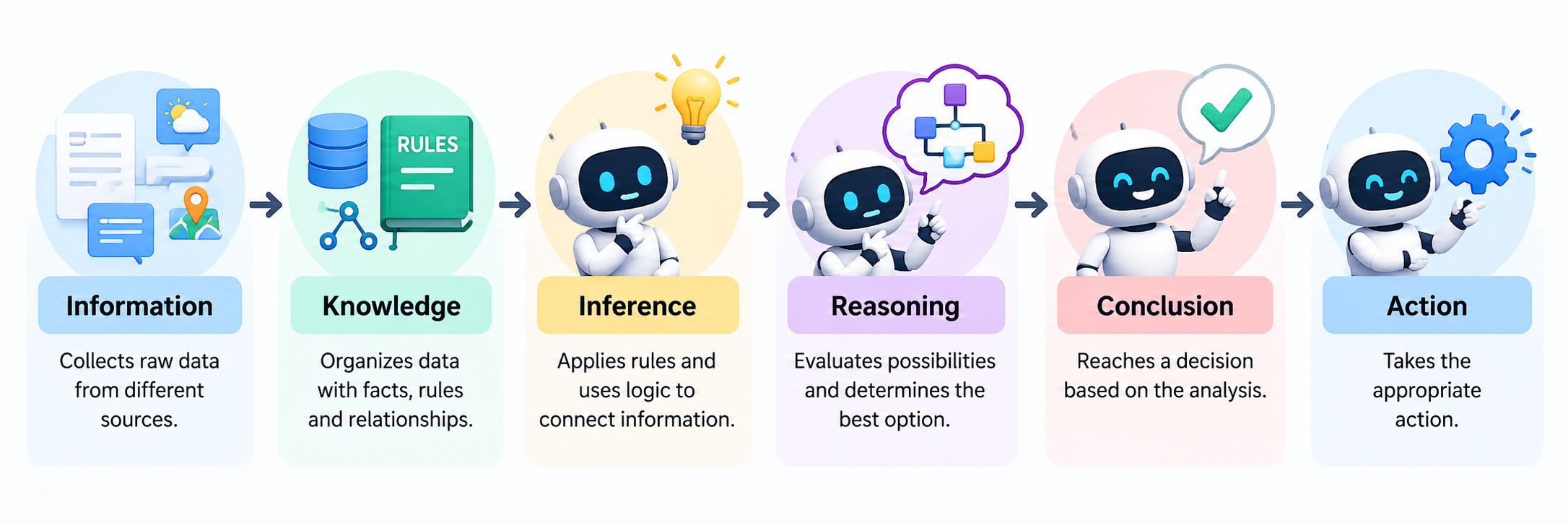
The system first receives facts, observations, rules, or other information. It then identifies which pieces are relevant and applies an appropriate reasoning method.
Knowledge representation provides AI systems with an approach for the storage of facts, relationships, rules, and concepts for their use in reasoning.
A system might represent that a customer has missed several payments, that missed payments increase credit risk, and that certain conditions require further review.
Knowledge representation and reasoning in artificial intelligence are very related to each other since the stored knowledge becomes valuable when the system is able to make conclusions based on it. Knowledge graphs, rules, ontologies, and other structures can help represent these relationships.
The inference engine is the component of a reasoning system that uses rules and other types of reasoning on the given information.
Let us consider the example of a system having a rule that a transaction initiated from an unusual place, along with unusual spending patterns, suggests potential fraud. When both conditions appear, the inference process can produce a new conclusion.
That's different from simply retrieving a stored fact. The system is deriving something from what it already knows.
Do read: 24 Artificial Intelligence Facts, Stats, and Surprises
Good reasoning needs relevant information. However, you cant rely on its conclusions if the system that it uses is incomplete, outdated or irrelevant.
Grounding connects an AI response to relevant information, such as retrieved documents, databases, rules, or other trusted sources. Context also tells the system which information matters for the current problem.
Without the right context, even a technically capable system can reach a poor conclusion.
Consider an AI system helping a bank detect suspicious transactions.
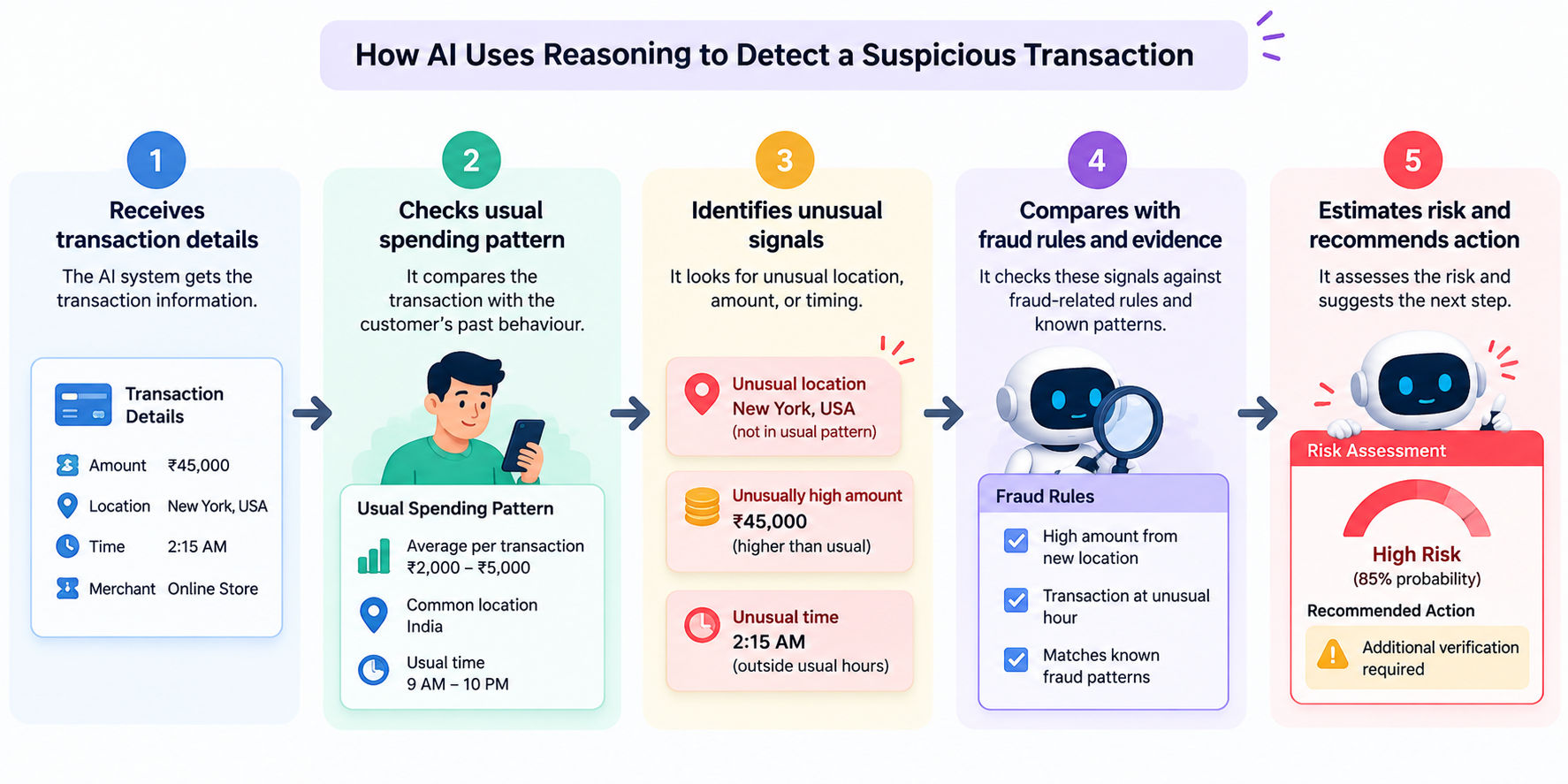
That's just a very simple example of reasoning in artificial intelligence. The system isn't relying on one signal. It combines several pieces of evidence before reaching a decision.
Take your AI knowledge further with the IIMK AI for Business Professionals Certificate Program . Learn how AI, GenAI, and Agentic AI can support smarter business decisions and real-world applications.
AI Courses to upskill
Explore Artificial Intelligence Courses for Career Progression
There are different types of reasoning for handling different kinds of problems. Some go from rules to particulars, some from many observations to a rule, and some deal with uncertainty or time and space. Real-life systems are usually made up of several types combined.
Here are the types:
Deductive reasoning starts with a general rule and then applies it to a specific situation to reach a conclusion. If the rules and facts are true, the answer is guaranteed.
For instance, if the system is aware that all the accepted applications satisfy certain conditions and the given application satisfies the same conditions, it can be deduced that the application falls under the rule.
The conclusion is drawn from the premises. This is why deduction is helpful in rule-based AI systems.
In contrast to deductive reasoning, inductive reasoning analyzes specific observations and determines the common pattern or rule from them.
For instance, an artificial intelligence can analyze thousands of transactions and find out that certain features occur in those transactions where fraud is committed. The result isn't guaranteed to be true. It's a conclusion based on observed evidence.
Abductive reasoning is aimed at finding the most probable explanation of an observed phenomenon.
For example, let us assume that some manufacturing machine stopped working suddenly. The AI would consider various factors, such as temperatures, maintenance history, vibrations, etc., and would determine the most probable reason for this situation.
This is helpful when the amount of information does not allow us to come to the definite conclusion.
Related Article: Hidden Markov Model in Machine Learning: Key Components, Applications, and More
The analogy allows an AI system to make a conclusion basing on similarities between different situations.
For example, if there was some problem with a customer and it was solved in some way, an AI would compare the current situation with the previous one and determine how to solve it.
The quality of the result depends on whether the two situations are genuinely similar.
Common-sense reasoning involves everyday knowledge. If someone leaves an ice cream outside on a hot afternoon, a person expects it to melt. An AI system needs knowledge about temperature, objects, time, and physical behaviour to reach the same conclusion.
This remains challenging because human common sense contains countless assumptions that aren't always written down.
Probabilistic reasoning in artificial intelligence deals with uncertainty by assigning or estimating probabilities.
For example, a medical AI system might estimate that several possible conditions are consistent with a patient's symptoms rather than declaring one diagnosis with absolute certainty.
Fuzzy reasoning handles concepts that aren't simply true or false. A temperature can be described as slightly warm, warm, or very warm depending on the situation.
Both approaches are useful when real-world information isn't perfectly clear.
Spatial reasoning helps AI understand relationships involving position, distance, direction, and physical surroundings. It's useful in robotics, navigation, and autonomous systems.
Temporal reasoning deals with time and event sequences. An AI system might need to determine what happened first, what is happening now, and what could happen next.
Forward and backward reasoning in artificial intelligence can also support rule-based problem-solving. Forward reasoning starts with known facts and derives new conclusions, while backward reasoning starts with a goal and works back toward the facts needed to support it.
Decision-making becomes harder when an AI system has several possible actions and incomplete information. Reasoning helps it connect evidence with possible outcomes before selecting a response.
A system might first identify the goal, gather relevant information, evaluate available evidence, and consider possible actions. It then applies rules, probabilities, learned patterns, or other reasoning methods to reach a conclusion.
For example, an autonomous vehicle doesn't simply identify another vehicle on the road. It needs to consider position, speed, distance, road conditions, traffic rules, and possible movements before deciding how to respond.
The same principle applies to business systems, healthcare tools, cybersecurity systems, and robots. The inputs differ, but the reasoning task involves connecting information to an appropriate decision.
Good reasoning also requires knowing when information isn't enough. A system that treats uncertain evidence as certain can produce a confident but incorrect result.
Also Read: Bayesian Networks and How They Work: A Guide to Belief Networks in AI
AI systems can approach reasoning in different ways. Symbolic and neural approaches represent two broad directions, while neuro-symbolic systems combine elements of both.
Symbolic reasoning represents knowledge using explicit symbols, rules, relationships, or logical structures.
For example, a rule-based system might contain a condition that says if certain requirements are satisfied, a particular action should follow.
Its strength is clarity. The rules can be inspected and traced. Its limitation is that creating and maintaining those rules can become difficult when situations are messy or highly variable.
Must read: Generative AI Chatbot: How Intelligent Conversational Systems Work
Neural systems learn representations and patterns from data rather than depending entirely on manually written rules.
Large neural models can recognise relationships across complex data and use learned representations when producing an answer or prediction.
They can handle unstructured information well, but their internal processes aren't always easy to explain in simple rule-based terms.
Neuro-symbolic AI combines neural learning with symbolic knowledge or reasoning.
A system might use a neural model to understand unstructured information and then apply explicit rules to reason about the extracted information.
This approach is useful when a task needs both pattern recognition and structured reasoning.
Approach |
Main characteristic |
Example |
| Symbolic | Uses explicit rules and representations | Rule-based diagnosis |
| Neural | Learns patterns from data | Pattern-based classification |
| Neuro-symbolic | Combines learned patterns with structured reasoning | Interpreting data and applying domain rules |
Do read: Types of AI: From Narrow to Super Intelligence with Examples
Reasoning in artificial intelligence is useful wherever systems need to connect evidence, interpret context, or select actions rather than simply recognise a pattern.
Also Read: Comprehensive Artificial Intelligence Syllabus to Build a Rewarding Career
Reasoning can make AI systems more useful when a task involves several connected pieces of information.
Key advantages include:
But reasoning isn't a guarantee of accuracy.
AI systems can reach incorrect conclusions when their information is wrong, incomplete, biased, or poorly represented. Complex reasoning can also require significant computational resources.
Interpretability presents another challenge. A system might produce a useful result without giving users an explanation they can independently verify.
Non-monotonic reasoning in artificial intelligence is relevant when new information can change a previous conclusion. This reflects a common real-world challenge. A conclusion that seemed reasonable earlier might need to be revised after new evidence appears.
Want to explore more about management accounting? Book your free 1:1 personal consultation with our expert today.
Inference is the process of deriving a conclusion from available information, while reasoning describes the broader process of using knowledge, evidence, rules, and relationships to reach conclusions or decisions. Inference is therefore an important part of many AI reasoning systems, but the terms aren't always interchangeable.
Yes, AI systems can reason with incomplete information when they use approaches such as probabilistic reasoning, abductive reasoning, or reasoning under uncertainty. However, the quality of the result depends on the available evidence, assumptions, and methods used to handle what the system doesn't know.
AI systems can struggle when a problem requires common sense, hidden context, several dependent steps, or information that isn't explicitly available. Errors can also arise when the underlying data or knowledge is inaccurate, which means better reasoning methods alone won't solve every problem.
Probabilistic reasoning represents uncertainty by estimating how likely different possibilities are. Instead of treating every conclusion as completely true or false, the system evaluates available evidence and assigns probabilities to possible outcomes, which is useful for diagnosis, prediction, risk assessment, and decision support.
Forward reasoning starts with known facts and applies rules to derive new conclusions. Backward reasoning starts with a possible goal or conclusion and works backward to identify which facts or conditions would support it. Both approaches are useful in rule-based AI systems.
Non monotonic reasoning allows a conclusion to change when new information becomes available. For example, an AI system might initially assume that a road is open, then revise that conclusion after receiving information about an accident or road closure.
Reasoning can help reduce some incorrect outputs when a system checks evidence, follows explicit rules, retrieves relevant information, or verifies intermediate results. It doesn't eliminate hallucinations, though, because an AI system can still reason from incorrect information or produce an unsupported conclusion.
No. Generative AI focuses on producing content such as text, images, audio, or code. AI reasoning focuses on drawing conclusions, solving problems, or selecting actions from information and context. A generative AI model can also perform reasoning, so the two concepts can overlap.
Human reasoning draws heavily on experience, context, common sense, perception, emotions, and social knowledge. AI reasoning depends on the system's architecture, learned patterns, explicit knowledge, retrieved information, and programmed or learned methods, so its strengths and limitations differ from human reasoning.
The need for supervision depends on the application and its consequences. A low-risk recommendation may need limited oversight, while healthcare, financial, legal, or safety-related decisions can require careful human review because an AI system can still produce incorrect or incomplete conclusions.
No. AI reasoning is a capability that allows systems to draw conclusions, solve problems, or make decisions. Artificial general intelligence refers to a broader concept involving highly general capabilities across many tasks. A system can demonstrate reasoning without having general intelligence.
1002 articles published
We are an online education platform providing industry-relevant programs for professionals, designed and delivered in collaboration with world-class faculty and businesses. Merging the latest technolo...
Speak with AI & ML expert
By submitting, I accept the T&C and
Privacy Policy
Top Resources
Master's Degree
18 Months
Executive Diploma
12 Months
IIIT Bangalore
Executive Programme in Generative AI & Agentic AI for LeadersIndia’s #1 Tech University
Dual Certification
5 Months