Thematic Analysis: A Step-by-Step Guide to Understanding Qualitative Data
By upGrad
Updated on Sep 14, 2026 | 9 min read | 3.47K+ views
Share:

All courses
Certifications
More
By upGrad
Updated on Sep 14, 2026 | 9 min read | 3.47K+ views
Share:
Table of Contents
Key Highlights
Learn research methods like thematic analysis and use qualitative insight to guide strategic business decisions. Explore our Doctorate of Business Administration courses today.
Thematic analysis is a flexible method used to study qualitative data. It helps researchers find patterns in the data and these patterns are called themes.
This method does not rely on counting words or using strict statistical models. Instead, researchers read through the data carefully and this data can include interview transcripts, survey answers, open text responses, or social media posts.
Thematic analysis does not follow one fixed theory, unlike methods such as grounded theory or discourse analysis. Researchers can use it in two ways.
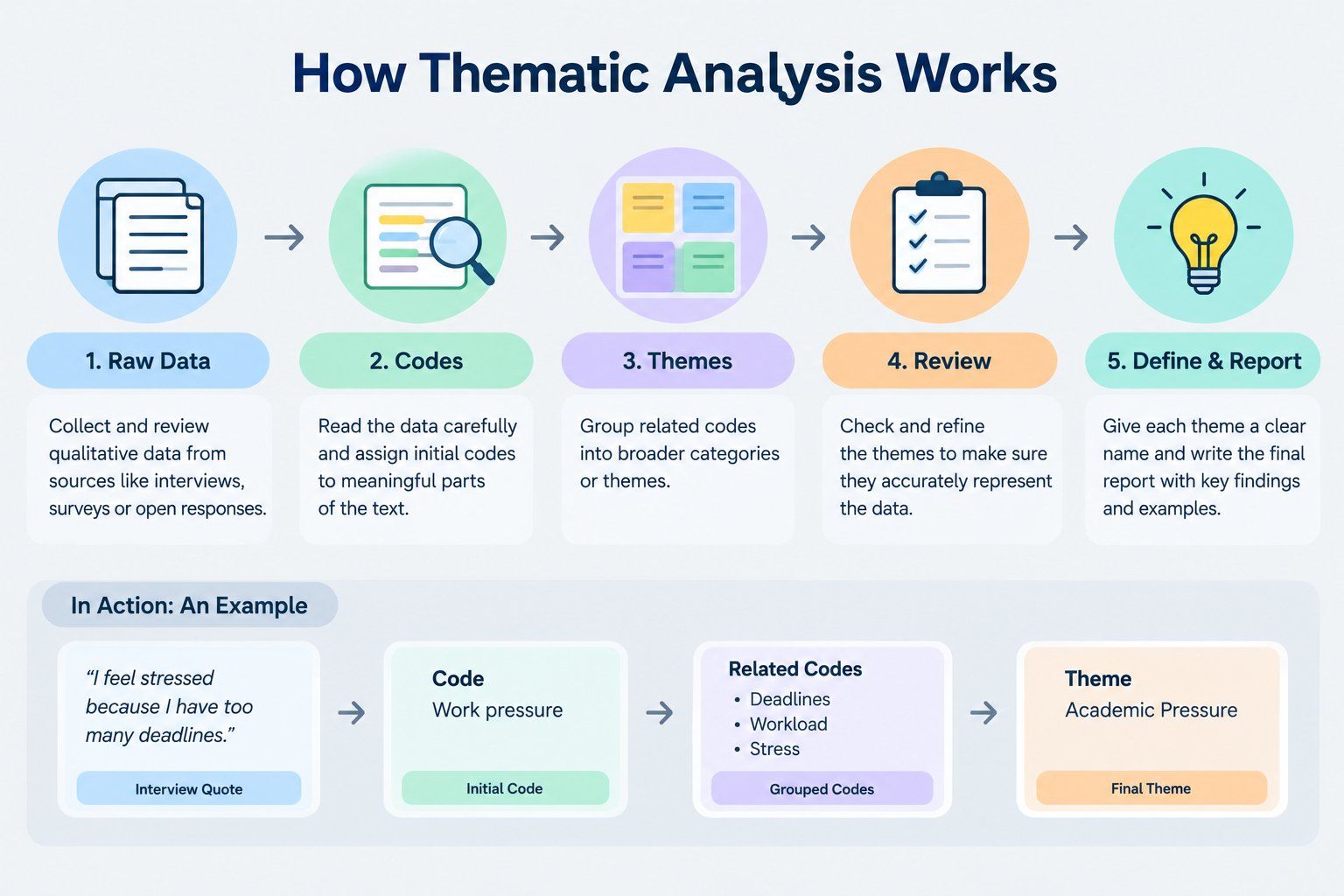
Thematic analysis is important because raw data can be messy. For example, a study may have hundreds of interview transcripts and this data is too large and unstructured to understand quickly. Without a clear method, researchers may only notice quotes that support their own ideas. This can lead to biased results.
Here, thematic analysis helps in many ways:
Also read: Qualitative vs. Quantitative Research : Differences and Methods
There are different types of thematic analysis. Researchers choose a type based on their goals and their data. Here are the main types.
1. Inductive Thematic Analysis
In this type, themes come directly from the data. The researcher does not use a fixed theory, they read the data with an open mind. Patterns and themes appear naturally as they read. This approach is useful when a topic is new or not well studied.
2. Deductive Thematic Analysis
The researcher starts with an existing theory or idea. They use this idea to guide their analysis. The data is then checked against this theory. This approach is useful when researchers already have a clear framework to test.
3. Semantic Thematic Analysis
Semantic Thematic Analysis focuses on the surface meaning of the data. The researcher looks at what people say directly. They do not try to find hidden meanings. This method sticks closely to the actual words used.
4. Latent Thematic Analysis
This type looks deeper than the words. The researcher tries to find hidden ideas, assumptions, or meanings behind the data. This method requires more interpretation. It often reveals insights that are not obvious at first glance.
5. Reflexive Thematic Analysis
This is the popular approach today and it was developed by Virginia Braun and Victoria Clarke. Braun and Clarke thematic analysis treats coding as a flexible and thoughtful process. And, the researcher plays an active role in shaping the themes. This method values the researcher's judgment and reflection.
6. Coding Reliability Thematic Analysis
This type is more structured. It often uses a fixed codebook. Multiple researchers may code the same data. Then, they check if their coding matches. This approach adds consistency, especially in large studies.
Each type has its own strengths. The right choice depends on the research question, the data type, and how much structure the study needs.
Golden Gate University's Doctor of Business Administration helps working professionals move from practitioner to expert, gaining the research skills, strategic insight, and credibility to lead at the highest level.
DBA Courses to upskill
Explore DBA Courses for Career Progression
IIIT-B & IIM, Udaipur
Chief Technology Officer & AI Leadership ProgrammeBraun and Clarke created a clear process for thematic analysis. It has six phases. These phases guide researchers from raw data to a final report. This process is not always straight and simple. Researchers often move back and forth between phases as they learn more.
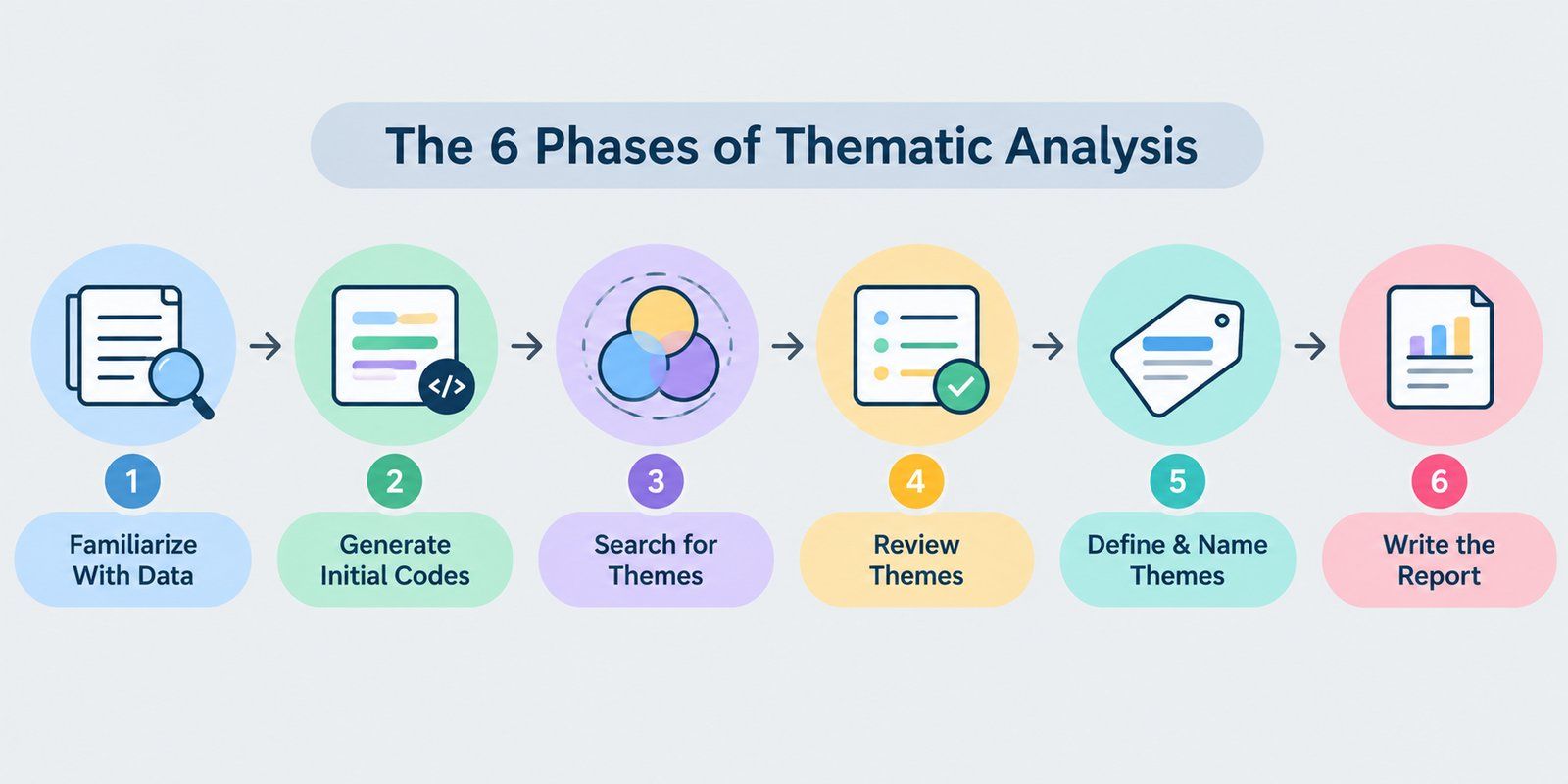
Phase 1: Familiarize Yourself With the Data
Before any coding begins, the data needs to be read closely, and more than once. A single read-through rarely captures everything, so researchers go back over the material to understand it fully. Early notes on ideas that stand out are common at this stage. This groundwork matters because it sets up everything that follows.
Phase 2: Generate Initial Codes
Once the data feels familiar, interesting parts get labeled with short tags called codes. Each code captures one specific idea. At this stage, researchers aim to:
Phase 3: Search for Themes
With a full set of codes in hand, similar ones get grouped together. These groups form the early themes. Unlike a code, a theme is broader. It connects several related codes into one larger pattern, turning scattered pieces of data into bigger, more meaningful ideas.
Phase 4: Review Themes
In this phase, the researcher checks the themes closely. They ask if each theme is supported by enough data. They also check if the themes make sense together. Some themes may be merged. Others may be split or removed. This step makes sure the themes are accurate and clear.
Phase 5: Define and Name Themes
After the themes settle into their final shape, each one needs a clear definition. This step involves:
Phase 6: Write the Report
The last step brings everything together in writing. Each theme gets explained in detail, backed by examples pulled directly from the data. A thematic analysis example report usually includes quotes, clear explanations, and a summary of the key findings, all building toward one clear, logical story.
Also read: Semantic Analysis in Natural Language Processing
Thematic analysis looks simple, but it is easy to make mistakes. These mistakes can weaken the quality of the research. Here are some common ones to avoid.
1. Treating Themes as Just Topics: A topic is just a subject that comes up in the data. A theme has a clear pattern and meaning behind it. Researchers should explain what a theme means, not just name a subject.
2. Coding Too Quickly: Some researchers rush through the coding phase. They skip parts of the data or code without deep thought. This leads to weak or shallow codes. Good coding takes time. It requires careful reading and reflection.
3. Forcing Data Into Themes: Sometimes, researchers already expect certain results. They may try to fit the data into these expectations. This can create false or misleading themes. The data should guide the themes, not the other way around.
4. Ignoring Contradictions in the Data
Data does not always agree with itself. Some participants may have different views. Ignoring these differences can weaken the analysis. Good research includes these contradictions and explains them.
5. Not Reviewing Themes Carefully
Some researchers skip the review phase. They accept their first set of themes without checking them again. This can lead to themes that do not fully match the data. Reviewing themes helps catch errors early.
6. Not Explaining the Analysis Process
Some researchers do not explain how they moved from data to themes. This makes the analysis hard to trust. A good report should show clear steps. This includes coding decisions and how themes were formed.
Also read: What are the 5 Steps of the Programming Process?
Thematic analysis is a powerful way to study qualitative data, as it helps researchers find patterns and meaning in the large amount of text. Researchers use this method in different ways based on their goals and data.
Like any other method, thematic analysis also has some risks. Like rushed coding, forced themes, or a weak review process that can lower the quality of results. So, reading the text carefully at each step will help in finding strong and more trustworthy patterns.
The thematic analysis turns raw opinions and stories into clear insights. If it is done well, it helps researchers, teams, and organizations make better decisions based on real human experience.
Have questions about the DBA program? Book a free consultation with upGrad's experts.
No, it is not hard to learn. The basic idea is simple: read the data and look for repeated patterns. It does take practice to do it well, but beginners can learn the process with guided steps and examples.
The 7 steps are: define the research question, collect data, clean the data, organize the data, analyze the data, interpret the results, and report the findings. Thematic analysis mainly supports the analysis and interpretation steps within this larger process.
Content analysis often counts how often words or ideas appear in the data. Thematic analysis focuses more on meaning and context. It looks for patterns, not just frequency.
No, it is not required. Some researchers use tools like NVivo or Atlas.ti to organize codes and themes. Others do it manually using spreadsheets or notes. The choice depends on the size of the data and personal preference.
The time depends on the size of the data set and the depth of analysis. A small project with a few interviews may take a few days. A large study with hundreds of transcripts can take several weeks.
Thematic analysis is a qualitative method. It focuses on meaning, context, and interpretation rather than numbers or statistics.
There is no fixed number. Most studies end up with between four and ten themes. The right number depends on the depth and range of the data collected.
Yes, it works well with small samples. It is often used in studies with a limited number of participants, since the focus is on depth and meaning rather than large-scale patterns.
Strong reading and interpretation skills help the most. Attention to detail, patience, and the ability to stay objective are also important. Familiarity with the research topic adds further value.
Yes, it is often used alongside other methods. For example, researchers may pair it with surveys, case studies, or quantitative data to get a fuller picture of a topic.
It is used by researchers, students, and professionals across many fields. This includes psychologists, UX researchers, healthcare workers, market researchers, and business analysts.
969 articles published
We are an online education platform providing industry-relevant programs for professionals, designed and delivered in collaboration with world-class faculty and businesses. Merging the latest technolo...
Speak with DBA expert
By submitting, I accept the T&C and
Privacy Policy