Qualitative Research: Methods, Types, Process and Examples
By Sriram
Updated on Aug 12, 2026 | 11 min read | 4.31K+ views
Share:

All courses
Certifications
More
By Sriram
Updated on Aug 12, 2026 | 11 min read | 4.31K+ views
Share:
Table of Contents
Key Highlights
Ready to deepen your research and business expertise? Explore the upGrad's Online Doctorate in Business Administration in India and build advanced skills for data-driven decision-making and leadership.
Popular upGrad Programs
Qualitative research explores people's experiences, perceptions, beliefs, motivations, and behaviours. It uses interviews, focus groups, observations, documents, and open-ended responses to understand a topic in depth.
For example, a university may find that students skip online classes. A survey can show how many students are affected, while qualitative research can reveal why, such as poor interaction, technical issues, or low motivation.
Qualitative research focuses on understanding experiences in context rather than reducing them to numbers.
Key characteristics include:
Researchers usually work with smaller, relevant participant groups and can explore new themes that emerge during the study. However, the process still requires clear planning, careful documentation, and ethical handling of participant information.
Free Courses
Qualitative research methods collect and explore non-numerical information such as experiences, opinions, behaviours, and perspectives. The method chosen depends on the research question and study design.
1. Interviews
Interviews allow researchers to explore individual experiences, opinions, and perspectives in depth. They may be structured, semi-structured or open-ended. Researchers can ask follow-up questions to clarify responses, reveal unexpected insights, and understand personal experiences that may not come thru other methods.
2. Focus Groups
Focus groups are a type of group interview in which a number of people are brought together to discuss a topic guided by a moderator. They help researchers understand the opinions that are shared, the disagreements, and the dynamics of the group.
Participants can engage with each other, bringing in new ideas and perspectives. However, it can be difficult to discuss sensitive topics openly.
3. Observation
Observation involves studying people's behaviours and interactions in real-world settings. It can reveal differences between what participants say and what they actually do. Researchers may participate in the setting or observe from outside, depending on the research question.
4. Document and Content Analysis
Document and content analysis is the study of existing materials such as reports, diaries, websites, minutes of meetings, transcripts and historical records. Researchers study these sources to find patterns, themes and useful insights. And it can also supplement interviews and observations.
5. Open-Ended Questionnaires
Open-ended questionnaires allow participants to describe their experiences, opinions and perspectives in their own words. They are useful when interviews are impossible or participants are not available. The researchers need to ask clear and neutral questions that allow the participants to give detailed answers without being influenced.
Also read: What is the DBA Degree Format - Coursework, Research, Dissertation
Recommended Courses to upskill
Explore Our Popular Courses for Career Progression
IIIT Bangalore
Executive Diploma in Machine Learning and AI360° Career Support
O.P.Jindal Global University
MBA from O.P.Jindal Global UniversityLive Case Studies and Projects
Different research questions call for different approaches. A study about workplace culture won't necessarily use the same design as a study about a patient's lived experience.
Ethnography explores culture, behaviour, relationships, and routines within a particular social setting.
A researcher studying remote work culture might observe meetings, communication patterns, informal interactions, and team routines to understand how employees experience the workplace.
Phenomenology studies lived experience. Researchers study how people experience and make sense of a particular event or situation.
For example, a researcher may interview first-time parents about what it was like to return to work after parental leave.
Grounded theory builds concepts or explanations from data that is collected. Researchers encode information, compare patterns and slowly develop categories that help explain the phenomenon under study.
This approach is useful in cases where existing explanations do not fully address the research problem.
A case study examines one bounded case in detail. The case could be a company, school, programme, community, event, or individual.
Researchers can combine interviews, documents, observations, and other evidence to develop a detailed picture of that case.
Narrative research examines personal stories and how people describe experiences over time.
A researcher might explore the career journey of an entrepreneur who moved from employment to starting a business.
Action research links investigation with practical improvement. A scientist sees a problem, proposes an action, sees the result, and thinks about what changed.
A teacher could use this approach to investigate low participation in class and to try out a different teaching activity.
Each type has a different focus. Researchers should start with the question, not a familiar design.
Read: Best PhD Programs in India in 2026: Which One Should You Choose?
Qualitative research methodology explains how and why a study is conducted. It connects the research question with participants, data collection, analysis, interpretation, and ethical considerations.
1. Choosing Participants
Choose participants with pertinent experiences or knowledge. Sampling methods commonly used are purposive, criterion, convenience, and snowball sampling depending on the population and research objectives.
2. Formulating Research Questions
Questions should be open-ended and neutral to allow participants to share their experiences in detail without being led to a particular answer.
3. Selecting a Method
The method should be based on the research question. Interviews explore the individual experience, focus groups examine group interaction and observational studies look at behavior in context. You can also use several methods to gain deeper insights.
Take your AI and business skills further with upGrad’s IIMK AI for Business Professionals Certificate Program and learn to apply AI for smarter, data-driven business decisions.
Research design is the overall structure that connects the research question with the methods used to answer it. It provides a framework for deciding who will participate, what data will be collected, and how that information will be examined.
The design should fit the purpose of the study. That's why a researcher shouldn't select a design simply because it's popular.
Common qualitative designs include:
Research design |
Main focus |
Example |
| Ethnographic | Culture and behaviour | Workplace culture |
| Phenomenological | Lived experience | Patient experiences |
| Grounded theory | Developing concepts | Understanding a new social process |
| Case study | One bounded case | Studying a company's change programme |
| Narrative | Personal stories | Career experiences |
| Action research | Practical improvement | Improving classroom participation |
Design and methodology are connected, but they're not identical. Methodology explains the reasoning behind the approach, while design describes how the study will be structured.
Read: Doctorate for Working Professionals: Eligibility, Career Benefits, and Growth Opportunities
A structured qualitative research process helps researchers move from a clear research question to meaningful insights. Each step supports consistency, transparency, and stronger findings.
The typical flow is
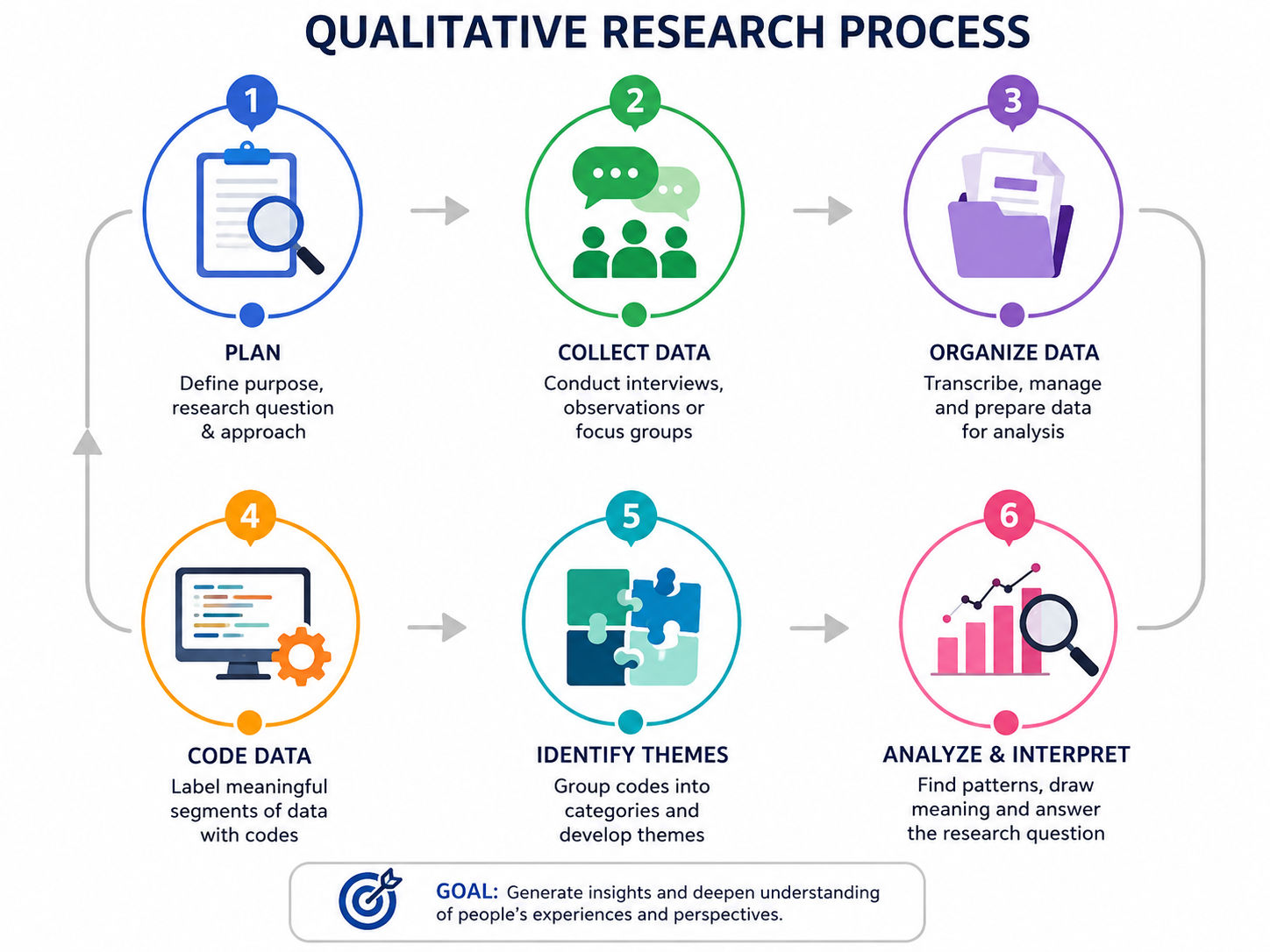
Detailed responses can reveal things that fixed survey options miss. That's the main strength of this approach.
Key advantages include:
Imagine a retailer discovering that customers are abandoning an online checkout. A rating question might show frustration. Interviews could reveal that customers don't understand delivery charges until the final step.
Do read : Is Doctorate in Business Administration worth it?
Qualitative research provides rich, detailed insights, but it also comes with certain challenges.
Understanding these limitations helps researchers interpret findings carefully and avoid overgeneralising results.
Qualitative research offers depth but has some challenges:
Read: List of Doctorate Degrees You Can Pursue at upGrad
A questionnaire can be useful when participants need to provide written responses in their own words. It's especially practical when respondents are spread across different locations or can't attend interviews.
A sample questionnaire for qualitative research should use clear, neutral, open-ended questions. It shouldn't suggest the answer that the researcher expects.
For example, ask "How would you describe your experience using the service?" rather than "Why did you enjoy using our service?"
Sample Questions
Research area |
Open-ended question |
| Education | How has online learning affected your study experience? |
| Healthcare | Can you describe your experience with the treatment? |
| Workplace | What challenges have you experienced while working remotely? |
| Marketing | What influenced your decision to choose this brand? |
| Customer service | How would you describe your interaction with customer support? |
A sample questionnaire for qualitative research can also include follow-up prompts such as "Can you tell me more about that?" or "What happened next?"
These prompts are useful because the first response isn't always the complete story.
Researchers should also avoid double-barrelled questions. Asking "How satisfied were you with the product and support team?" combines two separate topics.
A better questionnaire separates them. Participants can then explain each experience without having to fit both into one answer.
Read: Best PhD Programs in India in 2026: Which One Should You Choose?
Qualitative data analysis is a process that helps researchers convert detailed responses into clear and meaningful insights. It involves systematically identifying patterns and linking them to the research question.
The process usually involves becoming familiar with the data, coding important information, grouping codes, developing themes, and interpreting the findings taking into account different perspectives and contradictions.
Good questions depend on the research objective. That's why qualitative research questionnaire examples should be treated as starting points rather than templates to copy without changes.
Questions might explore learning experiences, classroom participation, teacher support, or challenges with online learning.
Example questions include:
Researchers might explore product experiences, purchase decisions, expectations, and service interactions.
Useful questions could include:
Questions can explore employee experiences, communication, management, workplace culture, or remote working.
For example
Questions can explore patient experiences, communication, treatment expectations, or access to services.
Researchers could ask:
These qualitative research questionnaire examples show how the same open-ended approach can be adapted to different contexts.
Researchers should still test their questions before full data collection. A question that seems clear to the researcher might be confusing to participants.
The best qualitative research questionnaire examples are therefore adapted to the actual audience, setting, and research question rather than copied word for word.
Qualitative research gives researchers a way to understand experiences, behaviours, perceptions, and meanings in depth. It works especially well when the reasons behind an issue matter as much as the measurable outcome.
The right approach starts with a clear research question. From there, researchers can choose an appropriate design, select relevant participants, collect useful information, analyse patterns, and connect the findings back to the original problem.
Good research doesn't simply collect more responses. It asks better questions, listens carefully, and treats the evidence with care.
Ready to start your journey? Book a free consultation with upGrad today to find the best path for your career.
Qualitative research is an approach used to understand experiences, meanings, opinions, and behaviours through non-numerical information. Examples include exploring how employees experience remote work, how patients perceive healthcare services, or how students experience online learning.
A qualitative research study investigates a topic in depth by exploring how people understand, experience, or interpret it. Instead of focusing primarily on numerical measurement, it seeks rich descriptions and contextual insights that can explain why people think or behave in particular ways.
Seven commonly cited types are ethnography, phenomenology, grounded theory, case study, narrative research, historical research, and action research. However, classifications can differ across academic sources because qualitative research designs are not universally grouped into one fixed list.
Five widely recognised features include understanding participants' perspectives, considering context, emphasising processes, allowing flexibility in research design, and developing concepts from collected data. These features help researchers examine complex experiences rather than reducing them to isolated numerical measures.
Examples include studying students' experiences with online learning, teachers' views on technology, workplace culture, consumer decision-making, patient experiences, family relationships, community participation, social inclusion, classroom behaviour, and employee experiences of organisational change. Each explores perspectives or experiences rather than simply measuring numerical outcomes.
There is no single universal list of seven major research types. Research may be classified by purpose, approach, design, or data type, such as exploratory, descriptive, experimental, qualitative, quantitative, and mixed-method research. The appropriate classification depends on the research objective and discipline.
Qualitative research focuses on meanings, experiences, and context using non-numerical data. Quantitative research focuses on measuring variables using numerical data and statistical analysis. In practice, researchers may combine both approaches when understanding a problem requires detailed explanations alongside measurable evidence.
There is no fixed participant number for every qualitative study. Sample size depends on the research question, design, participant group, and information required. Researchers often consider data saturation, where additional data no longer contributes meaningful new insights or themes.
Trustworthiness is strengthened through practices such as clear documentation, reflexivity, transparent analysis, and careful comparison of evidence. Researchers may also use multiple data sources or perspectives to support interpretations and demonstrate that findings are grounded in the collected evidence.
Qualitative findings are generally not intended for statistical generalisation to an entire population. Their value lies in providing detailed, contextual understanding. Researchers can instead explain how findings may offer transferable insights when the study context and participant characteristics are clearly described.
Good qualitative research questions are open-ended, focused, and exploratory. They typically ask how people experience, understand, or interpret something rather than seeking a simple yes-or-no response. Questions should also avoid assumptions and align closely with the study's research objectives.
730 articles published
Sriram K is a Senior SEO Executive with a B.Tech in Information Technology from Dr. M.G.R. Educational and Research Institute, Chennai. With over a decade of experience in digital marketing, he specia...
Get Free Consultation
By submitting, I accept the T&C and
Privacy Policy
Top Resources
Certification
3 Months
Certification
6 Months
O.P. Jindal Global University
Masters in International Accounting and Finance (Accredited by ACCA, UK)Master's Degree
12 Months