Explanatory Research: Methods, Design & Examples
By Sriram
Updated on Aug 17, 2026 | 10 min read | 4.41K+ views
Share:

All courses
Certifications
More
By Sriram
Updated on Aug 17, 2026 | 10 min read | 4.41K+ views
Share:
Table of Contents
Key Highlights
Ready to deepen your research and business expertise? Explore the upGrad's Online Doctorate in Business Administration in India and build advanced skills for data-driven decision-making and leadership.
Popular upGrad Programs
Why did sales fall? Why are some students performing better than others? Why do customers leave? These are the kinds of questions explanatory research tries to answer. It looks beyond what happened and explores the reasons, relationships, and factors behind an outcome.
For example, if a university finds that students with lower attendance score fewer marks, researchers might examine whether attendance explains this difference while considering study time, previous grades, and course difficulty.
Explanatory research doesn't automatically prove cause and effect. The strength of the finding depends on the research design, data quality, and other factors considered during analysis.
Researchers may use surveys, experiments, interviews, observations, case studies, or existing data based on what the study needs.
Free Courses
Research methodology defines how a study is planned, conducted, and analysed. Explanatory research fits into this process when the goal is to understand why something happens or how different factors are related.
It isn't the same as experimental research. An experiment is one research design that can help test cause-and-effect relationships, while explanatory research can also use surveys, interviews, observations, case studies, or existing data.
For example, a researcher studying employee turnover might examine whether workload, job satisfaction, and management support are linked to employees' intention to leave.
The research method should match the question. If you want to understand customer drop-offs, interviews might reveal why they happen, while transaction data can show which factors are linked to those drop-offs.
Research approach |
Main focus |
| Exploratory | Finding possible ideas or explanations |
| Descriptive | Understanding what is happening |
| Explanatory | Understanding why or how it happens |
| Experimental | Testing the effect of a changed factor |
Good research methodology connects the question, evidence, method, and analysis.
Read: Best PhD Programs in India in 2026: Which One Should You Choose?
The main purpose of explanatory research is to understand why or how something happens. It looks beyond an observed result and examines the factors and relationships that might explain it.
For example, if a retailer notices fewer repeat purchases, researchers might examine delivery delays, pricing, product quality, or customer service to understand what could be driving the change.
It can help researchers:
The goal isn't to force one answer. It's to use evidence to understand what may be behind an observed outcome.
Also Read: Top 10 Career Opportunities in India after PhD in 2026
Recommended Courses to upskill
Explore Our Popular Courses for Career Progression
IIIT Bangalore
Executive Diploma in Machine Learning and AI360° Career Support
O.P.Jindal Global University
MBA from O.P.Jindal Global UniversityLive Case Studies and Projects
Explanatory research goes beyond asking what happened. It focuses on understanding why or how something happens and examines the factors that may explain the outcome.
Its key characteristics include:
Key characteristics at a glance
Characteristic |
What it focuses on |
| Why and how questions | Understanding reasons behind an outcome |
| Variables | Examining relationships between factors |
| Hypotheses | Testing proposed explanations |
| Evidence | Supporting findings with data |
| Analysis | Identifying patterns and relationships |
| Alternative explanations | Considering other factors that may influence results |
These characteristics help researchers decide whether an explanatory approach fits their study and what kind of evidence they'll need.
Variables help researchers understand how different factors may be connected. The main types include independent, dependent, and control variables.
For example, a study may examine whether study time affects exam scores. Study time is the independent variable, while exam scores are the dependent variable.
Other factors, such as attendance, previous grades, and course difficulty, could also affect scores. Researchers need to consider them so the findings aren't misleading.
Ready to build stronger business and leadership skills? Explore the Master of Business Administration from Paris School of Business with IIM Lucknow Certification from upGrad and gain global business exposure with industry-relevant learning.
There isn’t one fixed method for explanatory research. The choice depends on the research question, data available, and how deeply the researcher needs to investigate the outcome.
Method |
Useful for |
Example |
| Experiment | Testing effects | Testing a new teaching method |
| Correlation | Finding relationships | Income and education |
| Survey | Collecting large-scale responses | Factors linked to customer churn |
| Case study | Studying complex situations | Reasons behind a failed project |
| Observation | Studying real behaviour | Classroom participation |
| Interviews | Understanding personal experiences | Reasons employees leave |
The method should match the question. A familiar method isn’t always the right one.
An explanatory research design is the plan that connects the research question with the evidence needed to investigate it.
A good design identifies what will be studied, which variables matter, who or what will provide the data, how the information will be collected, and how the findings will be analysed.
The design also affects how confidently researchers can interpret their results. An experiment may provide stronger evidence for a causal relationship than a simple observational study, while an interview may provide richer insight into personal experiences.
An explanatory research design must therefore match the claim being investigated. If you want to establish whether one factor causes another, your design needs to address alternative explanations rather than simply identify an association.
A clear process keeps the study focused. It also helps researchers avoid collecting large amounts of data without knowing what they want to explain.
The process usually starts with a research problem and ends with an evidence-based explanation. Researchers first define what they want to understand, identify relevant variables, and develop a research question or hypothesis.
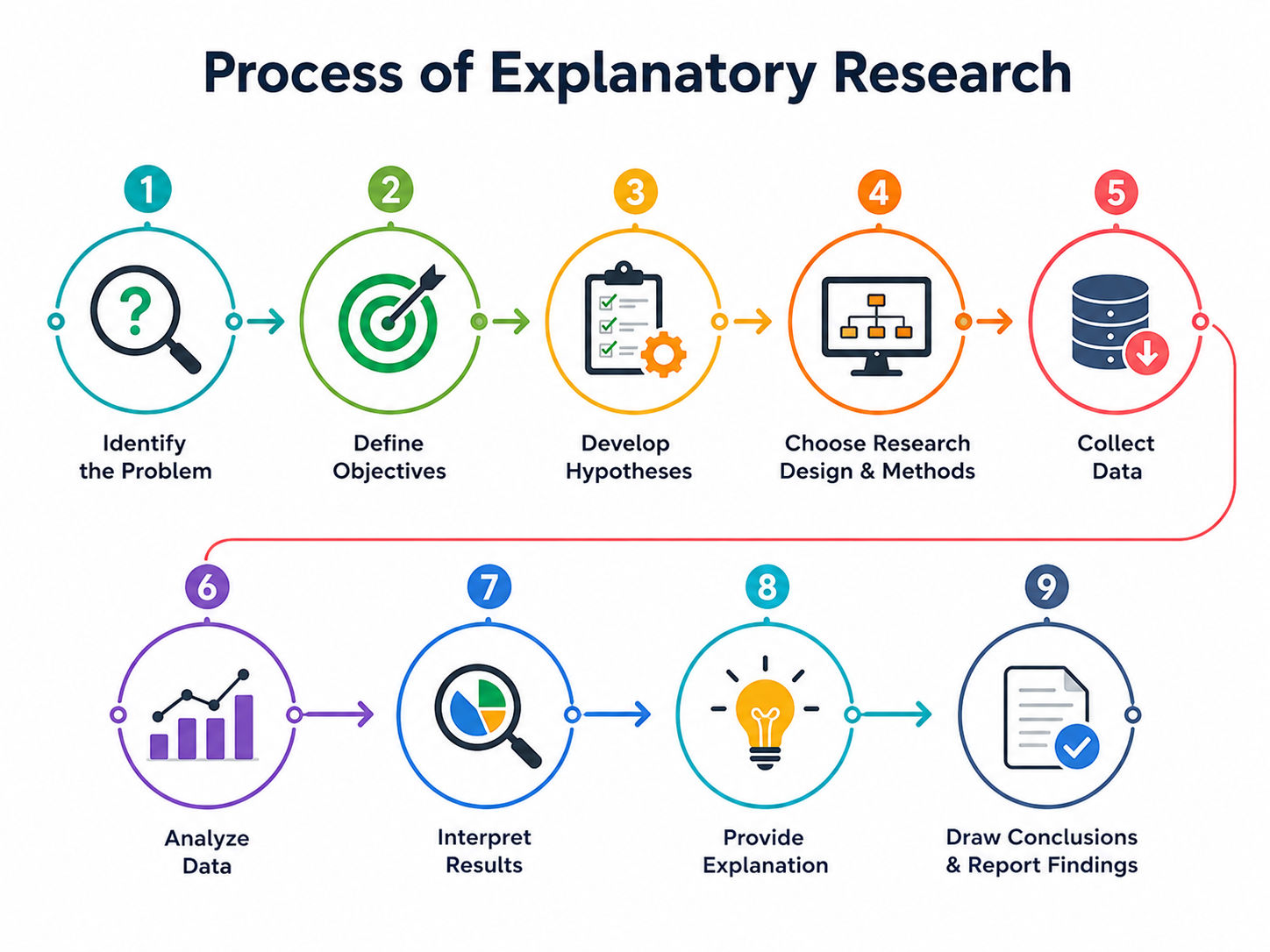
Next, they choose a suitable research design and collect the required data. Once the data is available, they analyse relationships and look for patterns that could explain the outcome.
The final step is interpretation. Researchers consider whether the findings support the proposed explanation, whether other factors could be involved, and what the results mean for future research.
A strong research question gives the entire study direction. Explanatory questions usually focus on why or how a phenomenon occurs rather than simply asking what exists.
For example, "What percentage of employees work remotely?" is mainly descriptive.
"How does remote work affect employee satisfaction?" is explanatory because it examines a relationship that needs investigation.
Good questions are focused, answerable, and connected to measurable or observable factors. They shouldn't contain several unrelated problems at once.
Here are a few examples.
A hypothesis is a testable statement about an expected relationship between variables.
For example, a researcher studying employee turnover might propose that higher workload is associated with a greater intention to leave.
A useful hypothesis identifies the factors being examined and makes a relationship clear. It should also be possible to collect evidence that supports or challenges the proposed relationship.
Hypotheses aren't mandatory for every explanatory study. Qualitative research may begin with open questions and develop explanations from participant data rather than testing a predetermined hypothesis.
Read: Types of Research Design: Key elements, Characteristics and More!
Explanatory research becomes easier to understand when you look at the question behind the study. Each example starts with an observed outcome and then investigates the factors that might explain it.
Area |
Research situation |
Factors examined |
| Business | Employee turnover is increasing. | Workload, management support, salary satisfaction, and career growth |
| Marketing | Customers add products to carts but don't complete purchases. | Delivery charges, pricing, payment options, and page experience |
| Education | Students show different academic performance. | Attendance, study habits, learning resources, and previous grades |
| Healthcare | Patients have different recovery times after similar treatments. | Age, health conditions, treatment adherence, and follow-up care |
| Social science | Crime rates vary across urban areas. | Employment, education, income, population density, and community services |
A relationship between two variables doesn't prove that one caused the other. Other factors may be influencing the result.
For example, people who exercise more may report better health. But diet, age, income, and existing health conditions could also affect those results.
To support a causal claim, researchers look at:
Experiments can provide stronger causal evidence because researchers control or change a factor and observe the outcome.
Observational studies can show useful relationships, but they need more caution when explaining cause and effect.
Exploratory research is useful when a problem isn't clearly understood and researchers need to discover possible ideas, factors, or questions.
Explanatory research starts with a more defined problem and investigates relationships or possible reasons behind an observed phenomenon.
Factor |
Exploratory research |
Explanatory research |
| Main purpose | Discover possibilities | Explain relationships |
| Typical questions | What might be happening? | Why or how is it happening? |
| Problem definition | Often less developed | Usually more defined |
| Hypothesis | Often developed during or after exploration | May be tested from the beginning |
| Outcome | New ideas or research questions | Evidence-based explanation |
A researcher might begin with exploratory interviews to discover why customers are dissatisfied. The findings could then inform an explanatory study that tests whether specific factors are associated with customer churn.
Also read: Types of Research Design: Key elements, Characteristics and More!
Explanatory research helps researchers understand relationships, test possible explanations, and explore why an outcome occurs.
However, the findings depend on the quality of the study. Poor sampling, missing variables, or biased data can weaken the results. A relationship also doesn't automatically prove causation, especially in observational studies.
Findings from one organisation, school, or location may not apply elsewhere. Researchers should consider these limits before drawing conclusions.
The key advantages include:
The main limitations include:
Also read: What is the DBA Degree Format - Coursework, Research, Dissertation
Use explanatory research when you want to understand why something happens or how different factors are connected.
It's a good choice when:
If the problem is still unclear, exploratory research may be a better starting point. If you only need to describe facts or patterns, descriptive research may fit better.
Explanatory Research is useful when a simple description isn't enough. It helps researchers investigate why or how something happens by examining relationships, testing explanations, and interpreting evidence carefully.
The strongest studies start with a focused question, identify relevant variables, select an appropriate design, and remain honest about what the evidence can show.
Once you understand that connection, the choice of method becomes much clearer. You're not just collecting data. You're using it to build a defensible explanation.
Ready to start your journey? Book a free consultation with upGrad today to find the best path for your career
No. Explanatory research can investigate relationships, mechanisms, and possible causes without proving a direct cause-and-effect relationship. Causal claims require stronger evidence and a suitable research design that addresses factors such as timing, alternative explanations, and confounding variables.
Yes. Explanatory research can use qualitative methods when researchers need to understand experiences, processes, or reasons behind a particular outcome. Interviews, focus groups, and case studies can reveal details that numerical data might miss, especially when researchers want to understand how a process unfolds.
Yes. Mixed methods can combine numerical findings with detailed participant insights. For example, researchers might first use survey data to identify an unexpected pattern and then conduct interviews to understand why that pattern occurred. This approach can connect measurable relationships with real-world experiences.
A strong question should focus on a specific outcome, relationship, process, or possible explanation. Questions often use terms such as why, how, or what factors. For example, “Why do first-year students who receive tutoring achieve different results?” gives the study a clear direction.
A testable hypothesis connects clearly defined variables and predicts a relationship that can be examined using evidence. Researchers should be able to identify the expected outcome and determine what data would support or challenge the proposed relationship rather than relying on a vague statement.
Explanatory research focuses on understanding why or how an outcome occurs, while causal research makes a more specific claim about cause and effect. An explanatory study can contribute to causal understanding, but its findings don't automatically establish that one variable directly caused another.
Yes. Existing datasets, published studies, institutional records, and other secondary sources can support an explanatory study. They can help researchers examine relationships across larger populations or longer periods, although the available variables, data quality, and original collection methods will affect what conclusions can reasonably be drawn.
A literature review helps researchers understand what is already known and where explanations remain uncertain. It can reveal established relationships, competing explanations, and gaps that shape the research question or hypothesis. Existing literature can also help researchers decide which variables deserve closer attention.
Researchers should ask whether other factors could explain the observed relationship. They should also consider whether the proposed cause occurred before the outcome and whether the study design supports a causal interpretation. Statistical significance alone isn't enough to establish cause and effect.
Common mistakes include choosing a design that doesn't match the research question, ignoring important variables, treating correlation as proof of causation, and making claims beyond the available evidence. Weak measurements and biased samples can also make an explanation look stronger than it really is.
Explanatory findings can reveal relationships, mechanisms, or unanswered questions that deserve deeper investigation. Researchers can use these findings to refine hypotheses, identify variables for later testing, or design stronger experiments and other studies that examine whether a proposed explanation holds across different populations or settings.
724 articles published
Sriram K is a Senior SEO Executive with a B.Tech in Information Technology from Dr. M.G.R. Educational and Research Institute, Chennai. With over a decade of experience in digital marketing, he specia...
Get Free Consultation
By submitting, I accept the T&C and
Privacy Policy
Top Resources
Certification
3 Months
Certification
6 Months
O.P. Jindal Global University
Masters in International Accounting and Finance (Accredited by ACCA, UK)Master's Degree
12 Months