What Is Quality Planning? Types, Process, Benefits and Examples
By Sriram
Updated on Sep 05, 2026 | 10 min read | 6.96K+ views
Share:

All courses
Certifications
More
By Sriram
Updated on Sep 05, 2026 | 10 min read | 6.96K+ views
Share:
Table of Contents
Key Highlights
Want to build stronger planning and leadership skills? Explore management certification courses and learn practical strategies to succeed in academics and your future career.
Popular Management Programs
Quality planning refers to the process of establishing the quality of a given entity, product, service, procedure, or project. It requires developing the standards by which a specified project is expected to meet or the criteria by which it will be assessed.
More importantly, it answers questions such as:
The primary aim of quality planning is to prevent defects rather than deal with them after they occur. It establishes quality objectives, processes, responsibilities, and measures to ensure that the team does consistent work.
In addition, quality planning is sometimes referred to as quality management planning. It may have various names in different companies, but the purpose remains the same - establish standards and set out processes that all team members should follow to achieve the desired result. For instance, developing an application for a mobile phone company requires the software designers to determine the quality requirements. They may include performance, security, friendliness of use, and a list of unacceptable errors.
Free Courses
Quality planning can be applied at different levels depending on what an organisation wants to improve. The following are common types of quality planning.
Project quality planning deals directly with the requirements set for the specific project. It addresses the customer’s expectations, project deliverables, standards, resources, testing, and quality measures.
For instance, in a construction project, quality planning would address the specifications of materials and final products, safety tests, inspections, and other relevant criteria.
Product Quality Planning deals with the control and improvement of the product quality in order to ensure its correspondence with the requirements and expectations of the customers. It includes all the details concerning the materials, construction, performance, safety, testing, acceptance, and other aspects of a product.
Manufacturers apply the principles of quality planning to products before their launch to detect possible defects and eliminate them in due time.
Process quality planning, in turn, focuses on processes and their elements. It establishes the necessary measures, techniques, and controls of a process to ensure that it will consistently produce high-quality products. For example, the manufacturing company should develop a process quality plan for its operations and specify the required conditions and inspections at various points of the production.
Supplier quality planning ensures that materials, components, or services purchased from outside suppliers are of the required standard. It can include such things as supplier evaluation, specifications, inspection, audit, and performance monitoring.
This is especially important when the quality of the final product depends to a large extent on the quality of the externally purchased items.
Strategic quality planning relates to the achievement of quality goals and provides a link between quality and the overall business plan of an organization. It may incorporate areas such as customer satisfaction, improvement, productivity, and conformance to standards and regulations.
This type of planning generally encompasses the overall scope of a project and can have an impact on quality planning activities at all levels of an organization.
The practical application of quality planning varies across industries. Here are some simple examples:
Industry |
Example |
| Manufacturing | Setting product specifications, production standards, and inspection criteria |
| Construction | Defining material, structural, safety, and workmanship standards |
| Software | Establishing testing procedures, performance targets, and defect-management processes |
| Healthcare | Setting service-quality, documentation, and patient-safety standards |
| Education | Defining assessment criteria, learning objectives, and evaluation standards |
For example, a software development team may decide that a new application should pass defined functional tests before release. It may also establish a maximum acceptable number of critical defects. These decisions are part of its quality planning process.
Similarly, a construction company may specify the grade of concrete, inspection frequency, safety requirements, and acceptable tolerances before construction begins. This gives workers and supervisors a common understanding of the expected quality.
Ready to lead with confidence? Enroll in upGrad's Certificate Programme in General Management for Young Leaders (YLP) from IIM Bangalore and build practical leadership, strategic thinking, and decision-making skills.
Management Courses to upskill
Explore Management Courses for Career Progression
IIIT-B & IIM, Udaipur
Chief Technology Officer & AI Leadership ProgrammeIIM Kozhikode
PCP in AI for Business ProfessionalsA structured quality planning process helps organisations translate expectations into practical actions. Although the exact process can vary, the following steps provide a useful framework.
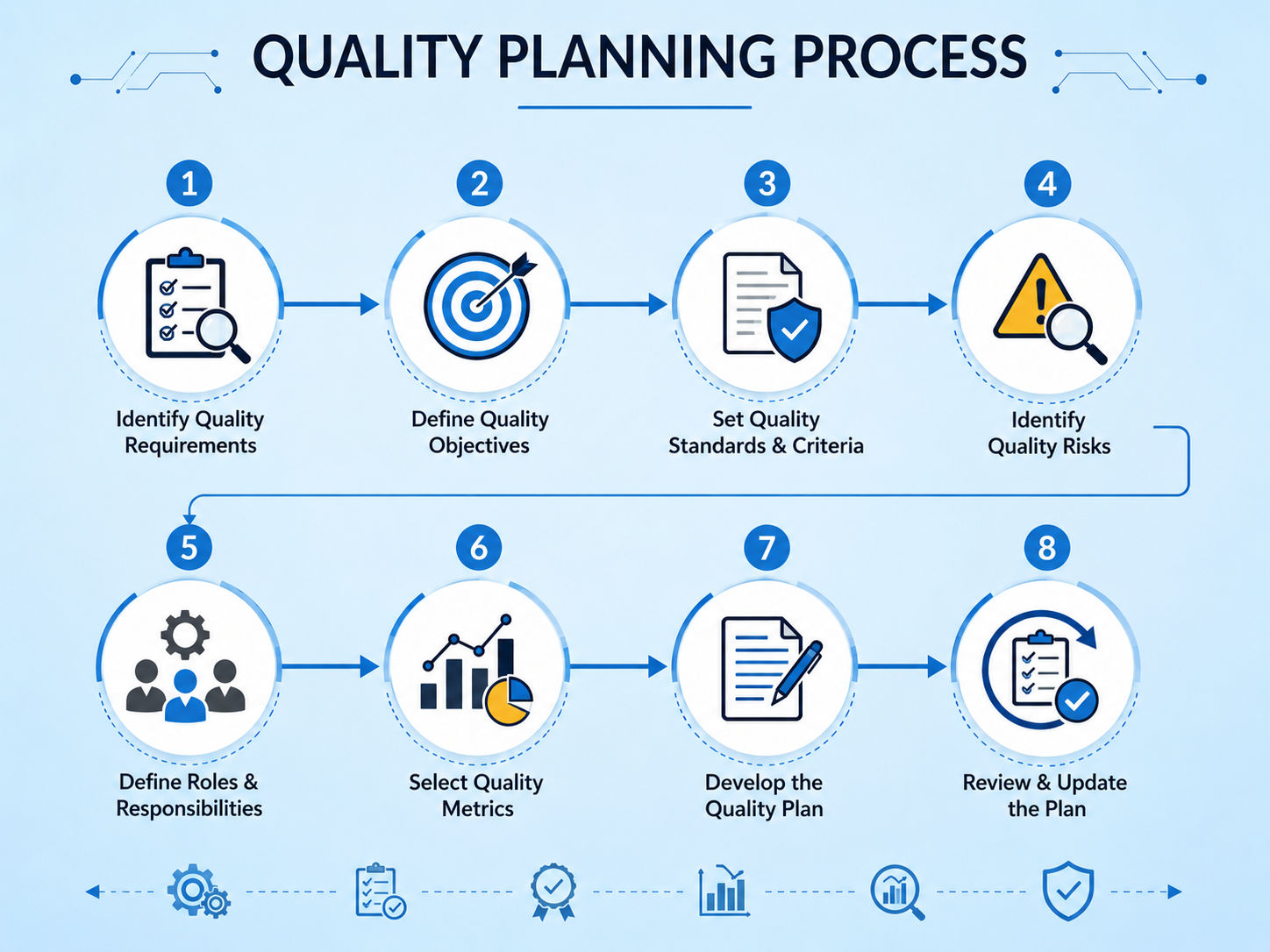
Begin by identifying the requirements set by customers, stakeholders, regulators, and other key figures. The requirements may include specifications on the quality, performance, safety, reliability, aesthetics, and functionality of products, services, or systems.
The requirements set the expectations for a project’s quality management system and serve as the foundation for all subsequent quality-related activities in a business.
After identifying quality requirements, the next step is use quality objectives to reduce the number of product defects by a given percentage during a certain ep is to develop quality objectives.
In other words, management should set specific targets that will be used to evaluate performance. For instance, an organisation may set a quality period.
This stage entails setting the quality standards and criteria for a service, good, or process. The standard should be compared against to assess whether the set quality objective has been met. For instance, organizations may set their quality standards in accordance with customer specifications, regulatory requirements, industry standards, and internal policies.
The criteria should be objective and define what will be measured and evaluated to ensure that the quality objectives are met.
At this point, the project team should come up with a list of all potential risks that could prevent the project, service, or process from meeting the set quality standards.
Therefore, the team should identify risks associated with quality defects, delays, inconsistencies, and other issues. Once risks have been identified, management can develop control measures and processes to avoid or mitigate them early enough to prevent expensive problems.
It is essential to define and document roles and responsibilities in relation to quality management. This will ensure that all team members understand their role in the quality control process. For instance, workers should know who conducts audits, inspections, and tests, and who approves, records, and responds to quality problems.
It is necessary to select quality metrics to help measure and evaluate the project, service, or product in accordance with the established standards. There are different quality metrics that may be used including percentages of defects, errors, and reworks, customer complaints, audit results, response time, and customer satisfaction surveys.
The information gathered during the preceding stages should be used to develop the quality management plan. The quality management plan contains the objectives, standards, criteria, roles and responsibilities, procedures, measures, and inspections required to meet quality standards.
However, the created document should capture practical aspects of quality management that are easy to follow and do not just exist on paper.
The quality management plan should be updated and reviewed on a regular basis. This is because there is a possibility that quality requirements may change throughout the project’s lifetime. Moreover, the document should be used to capture lessons learned and apply new insights to the project, process, or service.
Regular reviews also help organisations apply lessons learned to future work.
Also Read: Basic Components of Supply Chain Management
A quality plan usually comprises information about how the organization’s or project’s quality objectives and requirements will be met and measured. Although it can vary from company to company and project to project, a quality plan generally consists of the following elements:
Quality objectives: The goals related to quality that an organization or a project sets for itself
Quality standards: The criteria against which the produced software will be measured
Quality requirements: Customers’ or a company’s expectations about product or service quality
Roles and responsibilities: Information about who is responsible for quality management and control
Quality control activities: The list of QC activities including measurements, tests, and inspections
Quality assurance activities: The list of QA activities including audits and other reviews of the processes
Inspection and testing procedures: The procedures that detail what and when inspections and tests will be held
Quality metrics: The metrics that will be used to measure quality
Documentation and reporting: The procedures and rules for keeping quality records and reporting
Corrective and preventive actions: The actions needed to correct and prevent occurrences of defects
Review and approval: The procedures and rules for approval and review processes
In general, a quality plan should be developed in a way that makes it comprehensible to people who will carry out the procedures and measurements described in it. It should tie together the requirements and specify what actions and measurements pertain to which.
A quality control plan is a documented procedure that describes the methods of inspecting, monitoring, or measuring a product, service, or process to ensure that it meets specified standards.
Although quality planning deals with how quality will be achieved, quality control planning is more about measuring, inspecting, testing, and monitoring.
A typical quality control plan may contain:
For example, a manufacturing company may use a quality control plan to specify when products should be inspected, which dimensions should be measured, what equipment should be used, and what happens when a product falls outside the accepted tolerance.
The quality control plan therefore supports the broader quality planning process by translating quality requirements into specific control activities.
Also Read: Project Quality Management: Cost of Quality Concept Explained
Although quality planning and quality control are closely related, they serve different purposes.
Basis |
Quality Planning |
Quality Control |
| Purpose | Defines how quality will be achieved | Checks whether quality requirements are being met |
| Focus | Preventive | Monitoring and corrective |
| Timing | Mainly before and throughout execution | Mainly during and after work |
| Activities | Setting standards, objectives, and processes | Inspection, testing, and measurement |
| Outcome | Quality plan and quality framework | Quality results and corrective actions |
The main difference is that quality planning establishes the approach, while quality control checks actual results against defined requirements.
For instance, a project team may plan to test a software application against specific performance standards. The actual performance testing and defect identification are quality control activities.
Also Read: What is Quality Control (QC)? How Does QC Works?
Quality planning and quality assurance are also connected, but they are not the same.
Basis |
Quality Planning |
Quality Assurance |
| Focus | Planning quality requirements | Ensuring appropriate processes are followed |
| Nature | Planning-oriented | Process-oriented |
| Purpose | Establishes how quality will be achieved | Provides confidence that quality processes are effective |
| Examples | Defining standards, objectives, and metrics | Audits, process reviews, and evaluations |
Quality planning establishes what needs to be achieved and how the organisation intends to achieve it. Quality assurance focuses more on whether the processes used to achieve quality are suitable and consistently followed.
Also Read: Top 15 Benefits of Total Quality Management (TQM) for Business Success
Quality planning provides a framework for establishing quality expectations for teams before project implementation commences. Additionally, the process is key to identifying issues at an early stage and keeping projects on track.
The benefits of quality planning include the following:
Good quality planning starts with clear expectations and practical processes. A few simple practices can help teams manage quality better and avoid problems later.
Quality planning defines the standards, requirements, responsibilities, risks, and measures needed to achieve expected quality. It helps teams establish a clear approach before work begins and supports consistent results throughout the project's lifecycle.
A quality plan documents this approach, while a quality control plan focuses on inspections, testing, and measurements. Effective quality planning helps organisations prevent defects, reduce rework, improve consistency, and deliver results that meet customer and project expectations.
Ready to start your journey? Book a free consultation with upGrad today to find the best path for your career.
The main purpose of quality planning is to determine how a product, service, process, or project will meet defined quality requirements. It establishes standards, objectives, responsibilities, procedures, and measurements so teams can prevent quality problems and maintain consistent results throughout the work.
Responsibility for quality planning can vary by organisation and project. Project managers, quality managers, process owners, technical teams, and other stakeholders may contribute. In most cases, quality planning is a collaborative activity because requirements, processes, risks, and quality expectations involve multiple people.
Quality planning should begin early, preferably when project or product requirements are being defined. Starting early allows teams to establish standards, identify risks, allocate resources, and create appropriate quality procedures before major work begins. The plan should then be reviewed and updated as conditions change.
A quality planning document may include quality objectives, requirements, standards, responsibilities, procedures, metrics, inspection activities, testing methods, documentation requirements, risks, and corrective actions. The exact contents depend on the organisation, industry, project requirements, and applicable quality framework.
Quality planning is important because it gives project teams a clear understanding of expected standards and how those standards will be achieved. It can help identify risks early, reduce defects and rework, improve consistency, support resource planning, and increase the likelihood that project deliverables will meet stakeholder expectations.
The effectiveness of quality planning can be assessed using relevant quality metrics such as defect rates, rework levels, customer complaints, inspection results, testing outcomes, compliance rates, and customer satisfaction. Comparing actual results with predefined quality objectives can help determine whether the planning approach is working.
Without a clear quality plan, project teams may have different interpretations of quality requirements. This can result in inconsistent work, missed requirements, defects, additional rework, delays, and higher costs. A documented approach helps establish common expectations and gives teams a reference for managing quality.
Yes. Effective quality planning can reduce costs by helping teams identify risks and prevent defects before they become expensive problems. Fewer defects can mean less rework, fewer rejected outputs, reduced material waste, and fewer delays. The financial benefit depends on the project's size, complexity, and quality risks.
In manufacturing, quality planning can involve defining product specifications, material requirements, production procedures, inspection points, testing methods, tolerances, and acceptance criteria. Manufacturers may also establish supplier requirements and process controls to ensure that products consistently meet customer and regulatory expectations.
Common tools can include process flowcharts, checklists, cause-and-effect diagrams, risk assessment techniques, control charts, inspection plans, quality metrics, and process documentation. The choice depends on the type of work and the quality problems an organisation needs to prevent or manage.
A quality plan should be reviewed at appropriate stages of the project or process and whenever important requirements, risks, resources, or processes change. Regular reviews help ensure that the plan remains relevant. Major changes in scope, customer requirements, regulations, or processes may require an immediate review.
724 articles published
Sriram K is a Senior SEO Executive with a B.Tech in Information Technology from Dr. M.G.R. Educational and Research Institute, Chennai. With over a decade of experience in digital marketing, he specia...
Get Free Consultation
By submitting, I accept the T&C and
Privacy Policy
Top Resources
Certification
3 Months
Certification
6 Months
O.P. Jindal Global University
Masters in International Accounting and Finance (Accredited by ACCA, UK)Master's Degree
12 Months