What Is Guerrilla Marketing? Types, Examples, Benefits and Strategies
By upGrad
Updated on Oct 09, 2026 | 8 min read | 3.44K+ views
Share:

All courses
Certifications
More
By upGrad
Updated on Oct 09, 2026 | 8 min read | 3.44K+ views
Share:
Table of Contents
Key Highlights
Build the skills behind great campaigns with upGrad's digital marketing courses. Learn how to research audiences, plan budgets, and measure results, so your next idea is backed by data as well as creativity.
Guerrilla marketing is a method of promoting products and services at low cost through surprise and creativity. Here, brands use everyday places to run ads like a sidewalk, bus stop, staircase, or social media feed.
The goal behind guerrilla marketing is simple: make them feel something, then hand them a story they will want to share or remember. People can ignore ads, but they can’t ignore an experience.
Guerrilla marketing in business fits almost any industry. A local cafe can try it. So can a global bank or a software startup. Social media is fair game too. A guerrilla social media campaign might be a stunt, a challenge, or a post meant to start a conversation.
Also read: Creative Digital Marketing: What It Is and How to Get Started
Free Courses
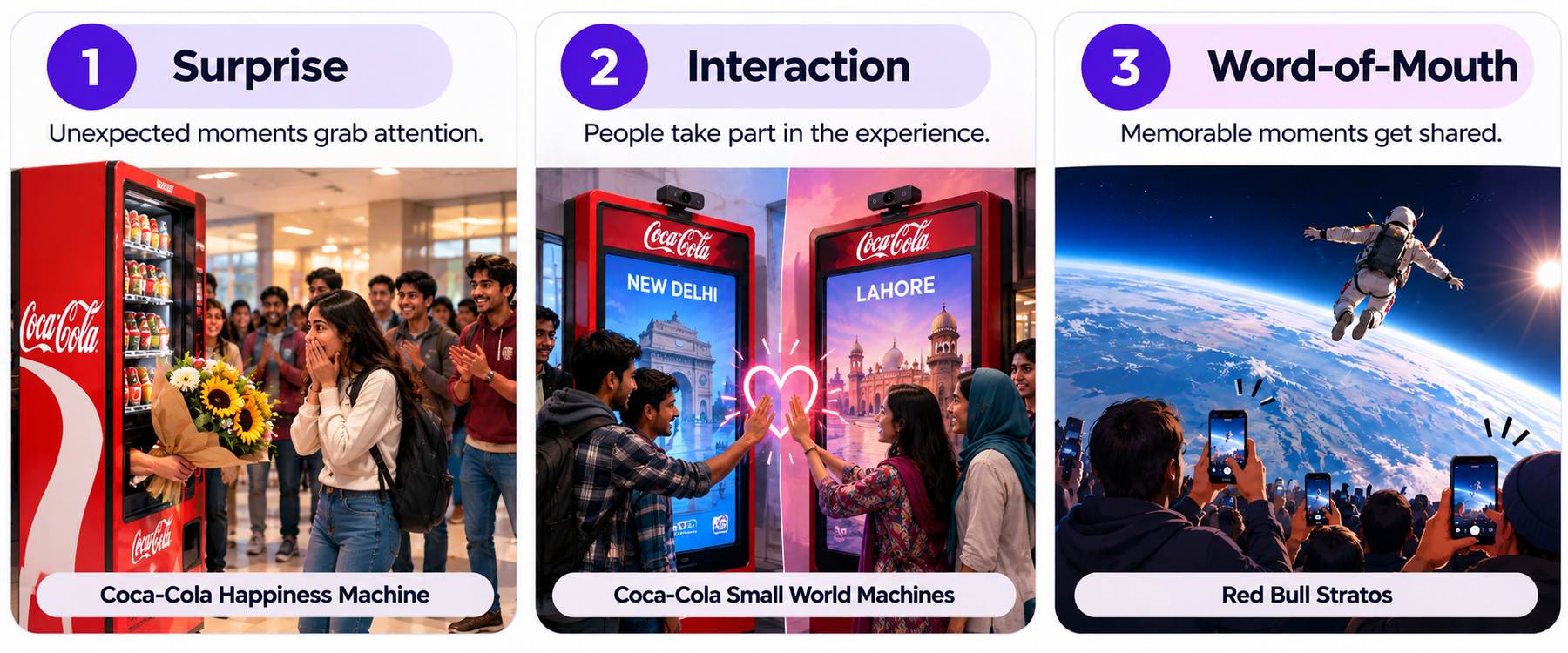
A guerrilla campaign can be identified by three main characteristics. These are what separate it from a regular ad.
In guerrilla campaigns, places that people do not expect are used for advertising. A subway station is a good example. Nobody goes there looking for a brand.
In 2009, Volkswagen turned the stairs at Odenplan station in Stockholm into a working piano. Each step played a note. As per the report of Volkswagen, more than 66% of people chose the stairs over the usual.
In a regular ad, people only watch. In guerrilla marketing, they take part.
In 2013, Coca-Cola placed two vending machines in shopping malls. One was in Lahore, and the other was in New Delhi. Each machine had a camera and a screen that showed the other city live. People in both cities could wave, draw shapes, and dance together through the glass. They had to touch the machine to join in, and that is why they stayed.
There are chances that an ad can be seen by fewer people on the street. But the majority of the audience comes from the people who film it and share it online.
Coca-Cola's 2010 Happiness Machine at St. John's University in New York worked this way. Students pressed a button and got a free drink, then flowers, then a giant sub sandwich. Hidden cameras caught their reactions. The video went online and travelled far beyond what the machine ever could.
Also read: Top 7 Digital Marketing Examples to Inspire Your Next Campaign
Types of Guerrilla Marketing
There are eight common types of guerrilla marketing. Some campaigns mix two or three of them. Here is how each one works.
This one uses public spaces like streets, parks, beaches, and walls. In 2005, Sony launched its Bravia TV in San Francisco by letting about 250,000 colourful rubber balls bounce down a hilly street. No one had to read anything; they just watched. The ad Sony shot there became famous.
The same idea, but inside, like think about malls, airports, metro stations, and cafes. People inside these places are often waiting. They have time to look around.
Coca-Cola's Small World Machines are a good case here too. Two machines, one in a Lahore mall and one in a New Delhi mall. Each showed a live feed of the other city. Strangers waved, drew, and danced together.
It is when a brand uses a big event for attention without paying to be an official sponsor.
At the 2010 World Cup, a group of women showed up at the Netherlands vs Denmark match in matching orange dresses. Bavaria, a Dutch beer brand, had given them out. Budweiser was the official sponsor. Security removed the group, and the story went global anyway.
Be careful here. Event organisers guard their sponsors. Ambush campaigns carry the highest legal risk of all ten types.
Here, people do something instead of just seeing something.
TNT put a big red button on a quiet town square in Belgium in 2012. A sign said, "Push to add drama." When someone pressed it, a full action scene played out around them. Use this type when the product is hard to explain on a poster.
In this, the brand makes the content, and the audience spreads it. Blendtec is the classic case. In 2006, the company began a video series called "Will It Blend?" The founder blended phones, golf balls, and rakes. Each video was cheap to shoot. Each one was fun to forward.
Ambient marketing hides the message in the surroundings. A lamp post, a manhole cover, or a wall becomes part of the ad. Folgers did this in New York. It placed cup-shaped covers over street steam vents.
The steam looked like it was rising from a hot coffee. The trick is to link your product to something people already see on their route.
People should not know they are being marketed to. That is the whole point.
In 2002, Sony Ericsson hired actors to pose as tourists in busy city spots. They asked strangers to take their photo using a new camera phone. Many people tried the phone and never knew it was a promotion.
It can backfire. If people find out later, they feel tricked. Many countries also require clear disclosure of paid promotion.
Street marketing puts real people on the ground. They hand out samples, run mini shows or simply talk to passersby.
Red Bull does this well. Its brand teams give out free cans near campuses, gyms and busy roads. It suits products that people can try in a few seconds. Food, drinks and apps are good fits.
Your goal |
Try this |
| Big visual moment in a city | Outdoor or ambient |
| Let people try the product | Experiential or street |
| Online reach on a small budget | Viral |
| Attention around a major event | Ambush (check the legal risk) |
Also read: 20+ Best Digital Marketing Blogs for Trends, Tips, and Tactics
Digital Marketing Courses to upskill
Explore Digital Marketing Courses for Career Progression
MICA Executive Alumni Status
Most guerrilla campaigns that work follow the same five rules. Break one and the whole idea can fall flat. Below are these five rules in detail:
If you want the attention of the audience, be creative. Volkswagen did not run a banner about taking the stairs. It turned the stairs into a piano; this level of thinking you need.
Before locking in an idea for your next campaign, ask your team: have we seen this type of idea before? If no, push your idea further.
People give any marketing campaign a few seconds, so it doesn’t matter whether it is guerrilla marketing or another type.
If someone has to read a paragraph twice to get it, the ad campaign has failed. The best ideas can be explained in one line. Like "Press the button, get a surprise." "Climb the stairs, play a song."
A fun stunt that has nothing to do with your product is a waste. People will remember the stunt and forget you. Red Bull sells energy and adrenaline. So it backs space jumps and cliff dives. Folgers sells hot coffee. So it made street steam look like a cup.
Ask yourself one thing. If we removed the logo, would people still guess who did it?
Guerrilla marketing is known for low cost, but it does not mean no cost. So, plan for the full bill for your campaigns, like:
Do not focus on reaching a huge random crowd. Focus on reaching the right audience. A pop-up bank booth at a college fest will reach students. The same booth in a corporate area will reach salaried staff. Pick the place where your buyer already walks, waits, or scrolls.
Also check the timing of your audience. A stunt at 7 a.m. in a metro station reaches commuters. At 3 p.m., it reaches almost nobody.
Also read: Digital Marketing Objectives: Full Guide with Types and Examples
To plan a guerrilla marketing campaign, you have to make eight decisions in the right order. A small cafe is used as the example in every step. This cafe sits near a college and wants to launch a new iced coffee.
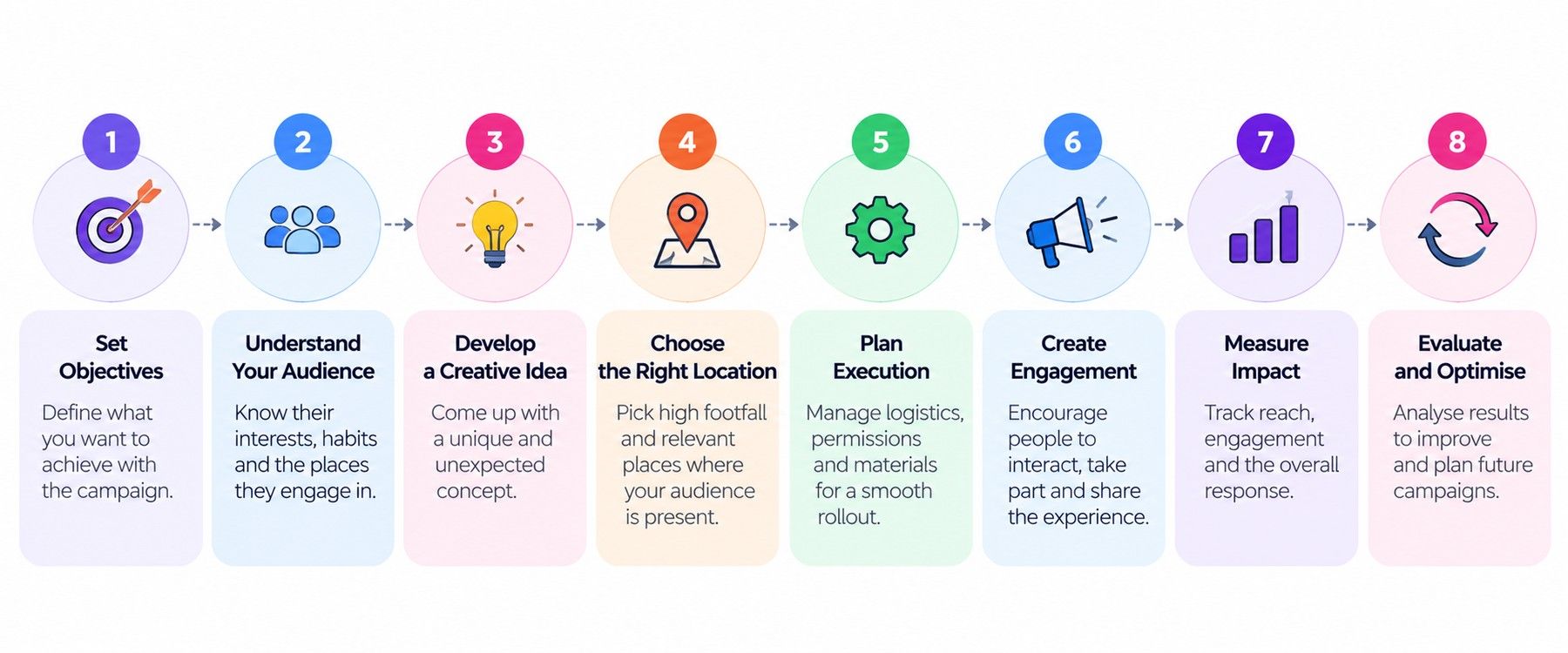
First, find out who exactly you are targeting. Check how old they are, where they go every day, and more stuff about them. Also see what they usually post online. All of this matters.
When we see this from a cafe example, they want to cater to college students between 18 and 22 years old. Almost every day, students use hostels, libraries, and bus stops. On Instagram, they post about food and exam memes.
Pick one realistic goal and give it a number. Like selling ten thousand products, or getting five thousand email newsletter sign-ups or sales calls.
Once your goal is decided, the format must be related to the goal. When awareness is the goal, outdoor and viral ideas work best. If you want more footfall, go for street and pop-up ideas.
The cafe's goal is reaching 200 students trying their iced coffee in week one, with 50 of them coming back.
Test every idea with three questions. Is it linked to the product? Would someone film it? Does it fit the budget? Sketch the winner on paper before you spend a rupee. If it won't fit in one drawing, it's too complicated.
The cafe's pick is simple. It leaves ice blocks on benches near the campus gate, each with a coffee cup frozen inside. The tag reads, "Melt it to find your free coffee."
Your timing for the ad and location are major factors that decide the success of your campaign. Check these things before launching a campaign:
The cafe chooses the campus gate at 4 p.m., when classes end. It asks the college office for written permission a week ahead.
Show the idea to one stranger. If they get it within five seconds, you're fine. If they don't, take something out.
Then look at the branding. Check that the logo is visible in a phone video as well as in a photo. The cup or the tag is a good spot, because the camera usually points there.
On the cafe's ice tag, there's one line of text and the logo, so it reads clearly even in a short clip.
Most brands plan the stunt and forget the filming. Then they have nothing good to post. Sort this out before launch day.
Check what is going viral and working in the market. If the trend matches the brand, use it; otherwise, skip it. Always use fresh trends; do not follow old trends, as they do not work effectively.
The students' exam season is close, so the cafe uses a tag "Study fuel inside." A second ice drop is planned for the week of the college fest.
Begin with the number you fixed in step 2, and then track a few more things.
What to track |
How |
| Free coffees claimed | Count the tags returned |
| Video views and shares | Platform analytics |
| Hashtag use | Search the tag |
| Walk-ins | Ask, "How did you hear about us?" |
| Repeat visits | Loyalty stamp card |
Then write down what worked and what didn't. Maybe 4 p.m. beat 1 p.m. Maybe the video got views, but few people walked in. Use those notes for the next round.
This is the core of a good guerrilla marketing strategy. It starts with the audience and ends with measurement, and what you learn at the end goes straight back into the start.
For the cafe, 140 tags came back in week one, short of the 200 target. Most were from the 4 p.m. drop. So next week it adds another 4 p.m. drop and moves the other one to the hostel entrance.
Great ideas need the right tools behind them. Explore MICA's Advanced Certificate in AI-Powered Digital Marketing & Communication and learn to combine creativity with AI-led marketing.
Subscribe to upGrad's Newsletter
Join thousands of learners who receive useful tips
Here are guerrilla marketing with examples. These are four campaigns that marketers still talk about, and each one works differently.
On 14 October 2012, Felix Baumgartner stepped out of a capsule about 39 km above New Mexico and fell back to Earth. He passed the speed of sound on the way down. More than 8 million people watched the jump live on YouTube, a record at the time. Over 3 million tweets followed.
Red Bull's logo sat on his suit and helmet. The brand slogan is "Red Bull gives you wings." The stunt was the slogan, so Red Bull needed no ad copy.
One honest note. This was not a low-budget idea, and Red Bull never shared the cost. What you can borrow is the fit. The stunt could only have come from this brand.
In 2010, Coca-Cola placed a vending machine at St. John's University in New York. Students put in a coin and got a Coke. Then the machine kept giving, with flowers and a giant sub sandwich. Hidden cameras filmed their faces, and the video went online.
Why does Coca-Cola use guerrilla marketing? Because Coke does not sell flavour. It sells a feeling. Its tagline at the time was "Open Happiness." A TV ad can say that Coke means happiness. A machine that hands out free food lets people see it.
What can you copy? Start with the feeling your brand promises. Then build a small moment that creates it for real.
In 2009, UNICEF's Tap Project put a vending machine in New York's Union Square. It looked normal until you read the labels. Here is what followed:
The machine did two jobs at once. It worked as a poster and as a donation box. Nobody had to be told that dirty water is a problem. They were holding it.
Also read: Features of Digital Marketing: What Actually Makes It Work
Guerrilla marketing does not suit every brand. When it fits, though, the payoff can be big. Here are seven benefits, with proof from the campaigns above.
Think of Coca-Cola's Small World Machines. People did not just look at the screen. They waved, drew shapes, and danced with strangers in another city. Nobody did that with a poster.
Ask someone about Volkswagen's piano stairs and they can often describe it step by step. Ask them about the last banner ad they saw, and most will draw a blank.
An experience sticks because the person was part of it. The brand gets remembered along with it.
Every good guerrilla campaign repeats the brand promise in a new way. Red Bull says it gives you wings, so it sent a man to the edge of space. Coca-Cola talks about happiness, so it built a machine that kept giving.
Run enough of these and people start to see the brand as what it claims to be.
This is the benefit to treat with care. Guerrilla marketing can lift sales, but the link is rarely direct. A video might get a million views and still bring few buyers.
You can make the link clearer if you plan for it:
When the spend is small, and a few of these numbers move, ROI can look very good. When you track nothing, you will never know.
Now the other side. Guerrilla marketing also has risks, and some of them can hurt.
Also read: 25+ Must-have SEO Tools to Explode your Ranks in 2025
Guerrilla marketing has real risks. Some can be managed. A few can sink a campaign. Know all five before you spend a rupee.
A stunt that confuses or upsets people can hurt the brand. The worst case is a public scare.
In January 2007, Turner Broadcasting promoted its show Aqua Teen Hunger Force with blinking LED signs placed around Boston. Police mistook them for bombs. Highways and bridges closed for hours. Turner and its marketing agency paid $2 million in settlement, and the Cartoon Network general manager who approved the campaign resigned.
The same signs had gone up in nine other cities with little reaction. Only Boston panicked. One city can change the result.
Public space is not free to use. Before you launch, check these:
Red Bull's Stratos jump drew more than 8 million live viewers. Dove's Sketches passed 114 million views in a month. Neither number tells you how many people bought a drink or a soap because of it.
You can close part of the gap. Give out a code at the stunt, add a QR code that goes to a tracked page, and ask people how they heard about you. It will not be perfect, but it is better than guessing.
Here is the quiet danger. Sometimes nothing happens. No crowd, no video, no coverage. The money is gone, and so is the time.
Three things cause most flops:
Also read: How to do Competitor Analysis? Step-by-Step Guide
Conclusion
So, what is guerrilla marketing? It is a way to win attention with a surprising idea instead of a big media budget. The best campaigns catch people off guard, let them take part, and give them a story worth sharing.
It is not risk-free. Permits, public reaction and weak measurement can all trip a campaign up. A Boston bomb scare cost one company $2 million. But the brands in this guide show the upside. A piano staircase, a vending machine and a forensic sketch each travelled far beyond the place where they started.
Start with what your brand promises. Then find a way to show it in public.
Have questions about the digital marketing course? Book a consultation call and find the right path for your career.
"Guerrilla" is the Spanish word for "little war." English picked up the word during the Peninsular War in the early 1800s, when small local fighters took on a much larger army. Marketers borrowed it because small brands face big rivals in the same way. Some people write "gorilla marketing" by mistake, since the two words sound alike.
Street stunts, free samples, and handbills existed long before the name did. The term arrived in the 1980s and gave these tactics a clear method. The internet then changed the game. Once video sharing took off in the mid-2000s, a stunt seen by a few hundred people could reach millions.
Traditional marketing buys its reach through TV, print and hoardings. Guerrilla marketing earns its reach through surprise and sharing. The first follows a fixed media plan. The second starts with an idea and then looks for the right place and time.
Yes, but the bar is higher. Almost everyone carries a camera, so a good stunt spreads faster than ever. Copied ideas get ignored, though, and cities are stricter about permits. A fresh, relevant idea that is easy to film still wins.
It can. Online, the street is a feed, a comment section or a trending hashtag. A challenge people can copy at home is a good example. The ALS Ice Bucket Challenge in 2014 spread through friends tagging friends and raised over $100 million.
It depends on the idea. A chalk message can cost almost nothing, while a large installation can cost as much as a regular ad campaign. Judge it by cost per result, such as cost per sign-up or per walk-in, not by the total bill. A cheap stunt that brings no one in is still expensive.
It suits brands whose customers gather in known places and whose products are visual or easy to sample. It also needs a team that can decide fast. It is a poor fit for heavily regulated products, such as medicine, or any product where a surprise could scare people away.
For small street ideas, an in-house team is usually enough. For crowds, special installations or high-visibility spots, an agency can handle permits, production and safety. Ask to see past campaigns with real results. Also ask who is responsible if something goes wrong.
Yes, and it often works better that way. The stunt gives you content, and paid media gives that content reach. Film everything on the day, cut a short clip, and put a small ad budget behind the best version.
It can be both if you plan for it. Laws differ by city and country, so get written permission and check your insurance. For online or influencer work, most markets expect paid promotion to be disclosed. The US Federal Trade Commission and India's ASCI both publish rules on this. Ethically, one rule covers most cases: do not frighten, trick or mislead people.
Stop the activity first, then check the facts before you say anything. Apologise in plain words and cover any costs you caused. After the 2007 Boston scare, Turner's chairman apologised in full-page newspaper ads. Do not delete critics' comments or argue with them. Write down what went wrong and use it in your next plan.
1016 articles published
We are an online education platform providing industry-relevant programs for professionals, designed and delivered in collaboration with world-class faculty and businesses. Merging the latest technolo...
Get Free Consultation
By submitting, I accept the T&C and
Privacy Policy
Level Up Your Digital Marketing Career Today!
Top Resources
MICA
Advanced Certificate in AI-Powered Digital Marketing & Communication from MICAMICA Executive Alumni Status
Certification
5 Specialisation
Classroom
4 Months
Certification
2 Months