Prolog in Artificial Intelligence: Features, Working, and Applications
By upGrad
Updated on Oct 03, 2026 | 8 min read | 2.36K+ views
Share:

All courses
Certifications
More
By upGrad
Updated on Oct 03, 2026 | 8 min read | 2.36K+ views
Share:
Table of Contents
Key Highlights
Want to move beyond logic-based AI? Enroll in Artificial Intelligence courses that cover machine learning, neural networks, and real-world applications, and take the next step in your career.
Popular AI Programs
Prolog stands for "Programming in Logic." It is a logic programming language built for symbolic reasoning. In artificial intelligence, it is used to store knowledge and draw conclusions from it.
Most languages need step-by-step instructions. Prolog works differently. You describe facts and rules about a problem, and the system works out how to find the answer. This style is called declarative programming.
Quick facts about Prolog
How Prolog differs from most languages
Traditional languages |
Prolog |
| You write step-by-step instructions | You describe facts and rules |
| You tell the computer how to solve it | You tell the computer what is true |
| Control flow is written by you | The system finds the answer itself |
Also read: AI in Banking and Finance Explained: Trends, Uses, & Impact
Free Courses
Prolog has a small set of core features. Together, they explain why Prolog is used in artificial intelligence for reasoning tasks.
Prolog programs are built from facts and rules. You describe what is true about a problem. Prolog decides how to prove it.
For example, you can write that a parent of a parent is a grandparent. You do not write how to search for one. The inference engine handles the search. This keeps programs short and close to the way people describe problems.
Unification is how Prolog matches two terms. It tries to make them identical by assigning values to variables.
Take the query parent(tom, X). If the knowledge base has parent(tom, bob), Prolog binds X to bob. The match succeeds.
Key points about unification:
Prolog searches for answers in order. If one path fails, it goes back to the last choice point and tries the next option. This is called backtracking.
How it works:
Backtracking is also how Prolog finds multiple answers to one query. Ask for all parents of Bob, and it lists each match one by one.
One caution applies. Poorly written rules can cause long searches or infinite loops. Programmers can control this with the cut operator (!), which stops Prolog from reconsidering earlier choices.
Standard Prolog has no for or while loops. Repetition is done through recursion. A rule calls itself on a smaller version of the problem until it reaches a base case.
Prolog also uses pattern matching to take apart data. Lists are the best example. The pattern [Head|Tail] splits a list into its first element and the rest.
This combination is useful for:
Recursion and pattern matching are why list handling in Prolog is concise and expressive.
Also read: How to Learn Artificial Intelligence: A Step-by-Step Roadmap
AI Courses to upskill
Explore Artificial Intelligence Courses for Career Progression
Prolog works by matching a question against stored knowledge. It uses a built-in inference engine to search that knowledge and prove whether a goal is true.
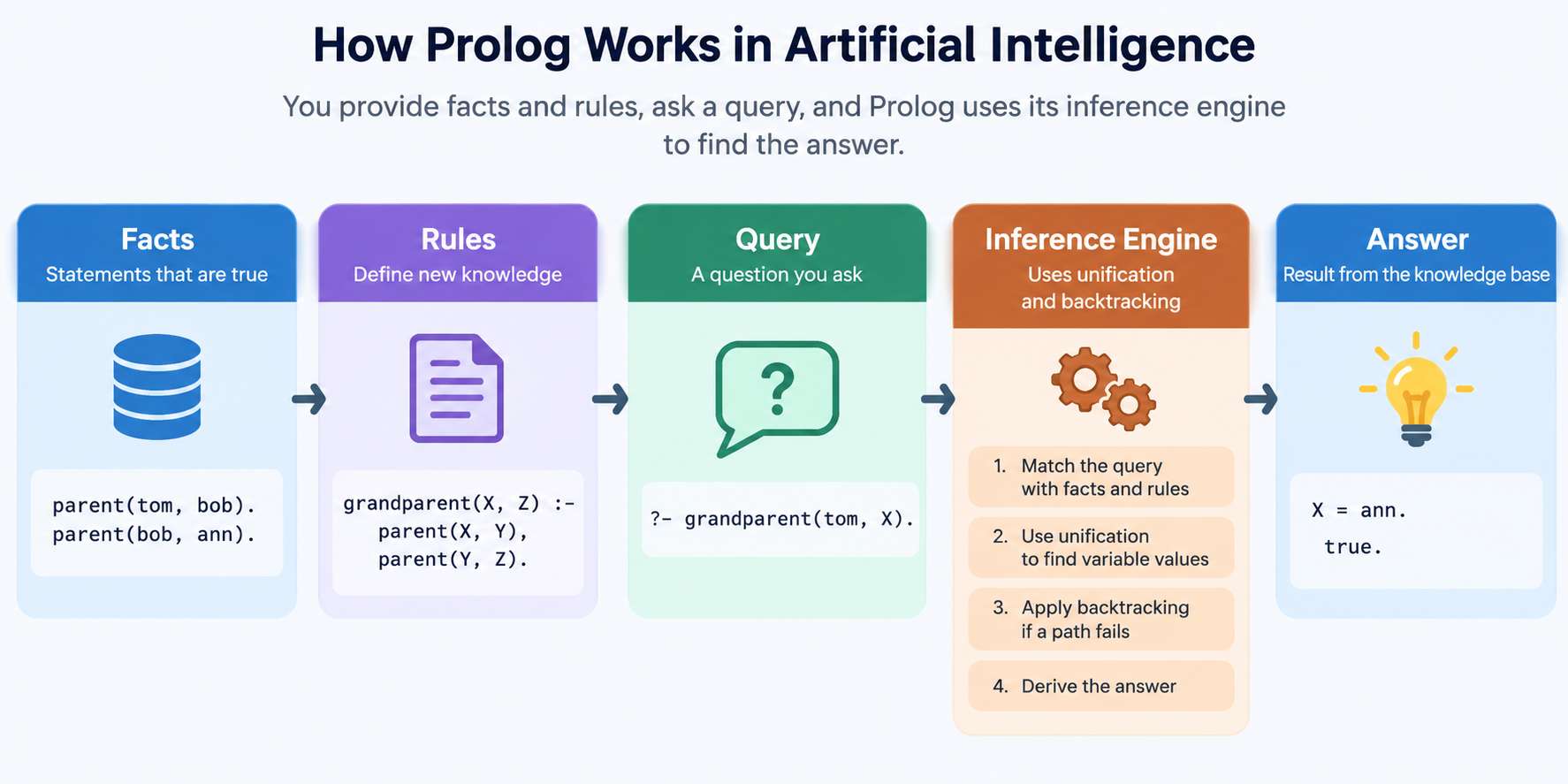
The knowledge base is the collection of facts and rules in a Prolog program. It is the only source of information Prolog uses.
Prolog does not know anything beyond what is written there. If something is missing, Prolog treats it as false. This is called the closed world assumption.
A well-built knowledge base is the most important part of any Prolog program. Clear and accurate entries lead to reliable answers.
Facts and rules are the two building blocks stored in the knowledge base.
A fact states something that is true, such as parent(tom, bob). A rule defines a conclusion that depends on conditions, such as grandparent(X, Z) :- parent(X, Y), parent(Y, Z).
The symbol :- means "if." The comma means "and." So the rule reads: X is a grandparent of Z if X is a parent of Y and Y is a parent of Z.
Prolog can build new knowledge from these rules. You do not need to store every grandparent relationship. Prolog derives them when needed.
A query is a question you ask Prolog. The inference engine then tries to prove it. The engine reads the knowledge base from top to bottom. It uses unification to match the query with facts and rule heads. It applies backtracking when a path fails. This method is called SLD resolution.
For a rule, Prolog must prove each condition in the body. Each condition becomes a new goal, and the engine works through them in order.
The result is one of two outcomes. If a proof is found, Prolog returns true along with any variable values. If every path fails, it returns false. Because the engine does the searching, you focus on describing the problem. This is a key reason Prolog is used in artificial intelligence for reasoning tasks.
Also read: Types of AI: From Narrow to Super Intelligence with Examples
Prolog syntax is small and consistent. A few rules cover almost every program you will write.
A predicate is a named relationship between items. In parent(tom, bob), the predicate is parent. Its arguments are tom and bob.
The number of arguments is called the arity. This predicate is written as parent/2. A predicate with a different arity is treated as a separate predicate.
A fact is a predicate stated to be true. A rule is a predicate defined by conditions. Both are called clauses, and each must end with a full stop. Forgetting it is a common beginner error.
Atoms are fixed names, such as tom or paris. They start with a lowercase letter.
Variables are placeholders, such as X or City. They start with an uppercase letter or an underscore. A variable gets a value when Prolog unifies it with a term.
The anonymous variable _ is used when the value does not matter. Case also matters. Writing Tom instead of tom turns a fixed name into a variable.
A query looks like a fact, but you enter it at the Prolog prompt. It also ends with a full stop.
A query without variables checks whether something is true. For example, parent(tom, bob). returns true if that fact exists.
A query with variables asks Prolog to find values. For example, parent(tom, X). returns each child of Tom. In SWI-Prolog, press ; to see the next answer.
You can join goals with a comma. The query parent(tom, X), parent(X, Y). finds Tom's children and their children. If no answer exists, Prolog returns false.
Also read: Top 20 Types of AI in 2026 Explained
A small expert system shows how Prolog turns facts and rules into decisions. This example diagnoses a pet's likely condition from its symptoms.
The program has two parts. The facts record symptoms for each pet. The rules define when a diagnosis applies.
prolog
% Facts: symptoms observed
symptom(rex, fever).
symptom(rex, cough).
symptom(rex, runny_nose).
symptom(tom, itching).
symptom(tom, hair_loss).
% Rules: diagnosis conditions
diagnosis(Pet, flu) :-
symptom(Pet, fever),
symptom(Pet, cough),
symptom(Pet, runny_nose).
diagnosis(Pet, skin_allergy) :-
symptom(Pet, itching),
symptom(Pet, hair_loss).
Each diagnosis rule reads as an if-then statement. Take the first rule. A pet has flu if it has a fever, a cough, and a runny nose.
The facts hold the data. The rules hold the expert knowledge. To add a new condition, you add a new rule. You do not change the existing code.
This example is a teaching model, not a medical tool. Real expert systems use far larger knowledge bases built with domain experts.
Save the program as pets.pl and load it in SWI-Prolog. Then ask questions at the prompt.
To check one diagnosis:
prolog
?- diagnosis(rex, flu).
true.
Prolog finds all three symptoms for Rex, so the goal is proven.
To find a diagnosis:
prolog
?- diagnosis(tom, D).
D = skin_allergy.
Prolog unifies D with skin_allergy. Tom has itching and hair loss, so only the second rule succeeds.
To find every pet with flu:
prolog
?- diagnosis(Pet, flu).
Pet = rex.
Here the variable is the pet. Prolog tests each pet in the knowledge base and returns the match.
A failed query looks like this:
prolog
?- diagnosis(tom, flu).
false.
Tom has no fever, cough, or runny nose. Every path fails, so Prolog returns false. It does not mean Tom is healthy. It means the knowledge base cannot prove flu for Tom. This is the closed world assumption at work.
Also read: Top 10 Artificial intelligence Models
Prolog offers several strengths for symbolic AI work. These are the main advantages.
You describe what is true, not how to compute it. Programs stay close to the way people state a problem. This makes the code easier to read and check. A domain expert can often follow the rules without deep programming knowledge.
Search, unification, and backtracking come with the language. You do not need to write a reasoning engine from scratch. This saves development time. It also lets you focus on the quality of the knowledge, not the mechanics of the search.
Rule-based problems often need far fewer lines in Prolog than in procedural languages. Recursion and list pattern matching keep the code compact. Shorter programs are easier to test and maintain.
4. Flexible Queries
The same rules can answer different questions. With parent(X, Y), you can ask who is a parent, who is a child, or whether a specific pair is related. You do not need to write a new function for each question.
Knowledge is stored as separate clauses. Adding a new fact or rule rarely means rewriting existing code. This suits systems where knowledge grows over time, such as expert systems.
Prolog handles lists, trees, graphs, and logical relationships well. This makes it a natural choice for parsing, planning, and knowledge representation.
Also read: 24 Interesting Artificial Intelligence FactsYou Should Know
Prolog is powerful for symbolic reasoning, but it has clear weaknesses. These are the main limitations.
Modern AI relies heavily on statistical methods and neural networks. Prolog has no native support for these. Python and its libraries dominate that space.
Prolog can be paired with learning systems. Inductive logic programming is one example. Still, it is not a general choice for data-driven AI.
Prolog is built for logic, not heavy calculation. Arithmetic is handled through the is operator and feels awkward compared with other languages.
Tasks such as large-scale matrix work or numerical simulation are better handled elsewhere.
Prolog searches rules in a fixed order. A badly ordered rule can send it into an infinite loop. Left-recursive rules are a common cause.
Backtracking can also become costly on large problems. Programmers often need to reorder clauses or use the cut operator to control the search. This takes care and experience.
Prolog treats anything it cannot prove as false. This works for complete knowledge bases. It is risky when information is missing or uncertain.
Standard Prolog also handles uncertainty poorly. It has no built-in way to express probabilities or degrees of belief.
Prolog's logic-based thinking is unfamiliar to most programmers. Concepts such as unification, backtracking, and recursion take time to learn.
Debugging can also be harder, because the flow of execution is not written out step by step.
Also read: The Future Scope of Artificial Intelligence in 2026 and Beyond
Yes, but in a narrower role than in the 1980s. Prolog is no longer the default language for AI. It remains a practical choice for specific kinds of problems.
Prolog is still used in rule-based systems, natural language tools, and logic-heavy applications. Examples include business rule engines, configuration checkers, and scheduling tools.
It is also widely taught in university AI and logic courses. For many students, it is the first introduction to symbolic reasoning.
Active implementations keep the language alive. SWI-Prolog is the most popular open-source choice. SICStus Prolog and other commercial systems are used in industry.
The AI field shifted toward machine learning and deep learning. Those methods learn patterns from large datasets. Prolog works with explicit rules written by people.
Python became the main language for AI because of its libraries and community. Prolog could not compete in that space, and it is not meant to.
Neural networks are strong at pattern recognition. They are weaker at logical reasoning and explaining their decisions. This has led to growing interest in neuro-symbolic AI, which combines learning with rule-based reasoning.
In this setting, logic programming still has value. It offers clear rules, traceable reasoning, and results that humans can inspect. Related approaches, such as Answer Set Programming and Datalog, are also used in modern reasoning and data systems.
Prolog is not a replacement for Python or machine learning tools. It is a specialist tool for problems built on rules and relationships.
If your task needs explainable logic, Prolog remains a strong option.
Also read: Top 5 Machine Learning Models Explained For Beginners
Conclusion
Prolog in artificial intelligence is built on one idea. You describe the problem, and the system finds the answer. Facts, rules, unification, and backtracking work together to make this possible.
This approach suits tasks where knowledge matters more than calculation. Expert systems, language parsing, planning, and theorem proving all fit well. The built-in inference engine handles the search, so you can focus on writing clear and accurate rules.
If you want to understand how machines reason with explicit knowledge, Prolog is a good place to start. Install SWI-Prolog, write a few facts and rules, and test your own queries.
Have any questions about artificial intelligence courses? Book a free consultation call with our experts and get personalized guidance on the right learning path for you.
SWI-Prolog is the usual choice. It is free, open source, and runs on Windows, macOS, and Linux. It also has good documentation and an active community. GNU Prolog is another free option, and it can compile programs into standalone executables.
Both were early AI languages, but they work differently. Lisp is a general-purpose language built around functions and lists. You write the logic of the search yourself. Prolog has search and matching built in, so you write rules and let the system do the rest.
Yes. Bridges such as PySwip let Python call Prolog. Recent versions of SWI-Prolog also include Janus, which connects the two languages directly. A common setup uses Python for data handling and Prolog for rule-based reasoning.
Prolog uses negation as failure. The goal \+ symptom(tom, fever) succeeds if Prolog cannot prove that Tom has a fever. It does not prove that Tom has no fever. Place negated goals after the goals that bind their variables. Otherwise, the result can be wrong.
Yes. The built-in predicates assertz and retract add and remove clauses at runtime. In SWI-Prolog, you should declare the predicate as dynamic first. This is useful for programs that learn new facts from user input or earlier results.
Use the trace. command, then run your query. Prolog shows each goal as it is called, succeeds, fails, or is retried. To watch one predicate only, use spy(predicate_name). Type notrace. to turn tracing off.
The = operator tries to unify two terms. It can bind variables to make them match. The == operator only checks whether two terms are already identical. So X = 5 succeeds and binds X, while X == 5 fails if X has no value.
Most modern systems do both. They compile the code into an internal bytecode and run it on a virtual machine. Many are based on the Warren Abstract Machine design. You still get the interactive prompt, which feels like an interpreter.
Yes. SWI-Prolog includes libraries for HTTP servers, JSON handling, and HTML generation. Developers use them to build APIs and tools around reasoning logic. It is a niche choice, but it works well when the core of the application is rule-based.
It was a Japanese government research project that began in 1982 and ran for about a decade. It aimed to build computers for knowledge processing based on logic programming. The hardware did not become a commercial success. The project did raise global interest in Prolog and logic-based AI research.
You do not need advanced math. Basic logic helps, especially the ideas of "and," "or," and "if-then." Some comfort with recursion also helps, since Prolog has no standard loops. If you have programmed before, expect to unlearn the habit of writing step-by-step instructions.
1010 articles published
We are an online education platform providing industry-relevant programs for professionals, designed and delivered in collaboration with world-class faculty and businesses. Merging the latest technolo...
Speak with AI & ML expert
By submitting, I accept the T&C and
Privacy Policy
Top Resources
Master's Degree
18 Months
Executive Diploma
12 Months
IIIT Bangalore
Executive Programme in Generative AI & Agentic AI for LeadersIndia’s #1 Tech University
Dual Certification
5 Months