SWOT Matrix: What It Is and How to Use It for Strategic Planning
By upGrad
Updated on May 13, 2026 | 10 min read | 2.52K+ views
Share:

All courses
Certifications
More
By upGrad
Updated on May 13, 2026 | 10 min read | 2.52K+ views
Share:
Table of Contents
A SWOT matrix is a powerful 2x2 strategic planning tool that helps organizations evaluate both internal and external factors affecting their growth. By identifying Strengths, Weaknesses, Opportunities, and Threats, businesses gain a clear picture of where they stand and where they need to focus.
Widely used across business, project management, and personal development, the SWOT matrix turns complex decisions into structured, actionable insights, making it one of the most effective frameworks for building competitive, informed strategies.
Mastering strategic planning starts with the right foundation. Exploring a Management Courses from upGrad can equip you with the frameworks to conduct effective SWOT analyses, make informed decisions, and build strategies that drive sustainable organizational growth.
Popular Management Programs
A SWOT matrix is a strategic framework used to assess the internal and external factors that can influence a business, project, or individual. It is commonly known as a 2x2 strategic planning tool. The SWOT matrix is popular because it presents important insights in a simple and organized format. Businesses often use it when launching new products, entering different markets, building strategies, hiring talent, or making long-term business decisions.
The four elements of the framework are: Strengths, Weaknesses, Opportunities and Threats
Also Read: SWOT Analysis: Meaning, Examples, and Complete Guide (2026)
The SWOT matrix is divided into four main areas: strengths, weaknesses, opportunities, and threats. Strengths refer to the internal factors or capabilities that give an advantage, while weaknesses highlight internal areas that need improvement. Opportunities are external factors that can support growth and expansion, whereas threats are external challenges or risks that may affect performance or stability. Together, these four elements provide a balanced view of both internal capabilities and external market conditions.
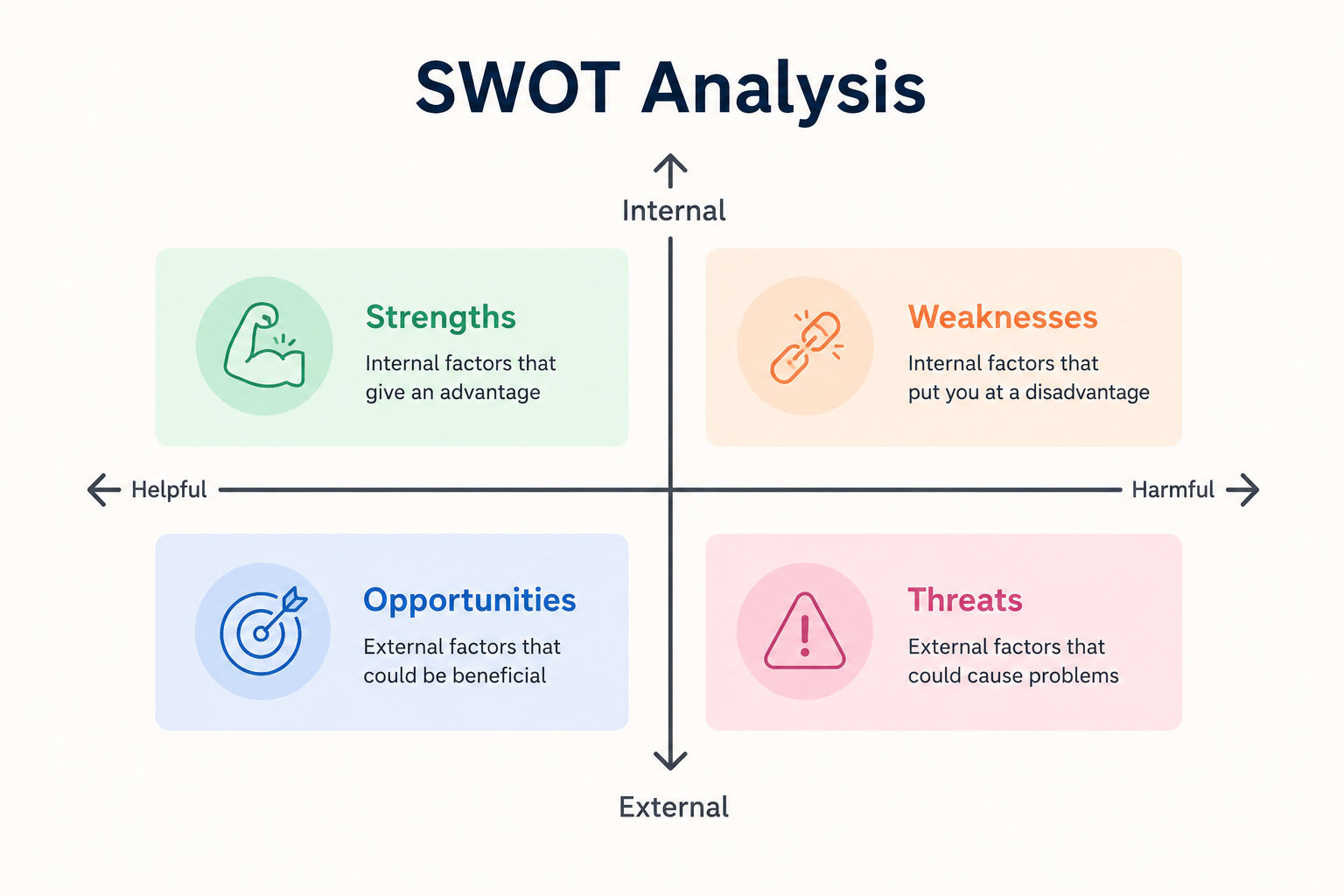
Strengths are internal advantages that help a business perform better than competitors. For example, a food delivery platform with quick service and high app ratings may list these as strengths in its SWOT matrix.
Examples include:
Weaknesses are internal areas that limit growth or performance. Recognizing weaknesses helps businesses improve and make better decisions.
Common weaknesses include:
Opportunities are external factors that can create growth potential. A company entering the online education sector may see increasing digital learning demand as an opportunity.
Examples include:
Threats are external challenges that may impact business performance. A well-planned SWOT matrix helps organizations prepare for these risks early.
Some common threats are:
The framework is useful because it is simple, flexible, and practical. It can be applied to:
Also Read: SWOT Analysis in Strategic Management: A Complete Guide
Free Courses
Creating a SWOT matrix is simple when you follow a structured process. It helps organize ideas and supports better decision-making.
Start with a clear goal. This could be launching a product, improving sales, planning a career move, or entering a new market. Your objective will decide what information to include in the SWOT matrix.
List the internal factors that give you an advantage. Keep the points realistic and specific.
Examples include:
Highlight internal areas that may limit growth or performance. Being honest at this stage improves the effectiveness of the analysis.
Consider factors such as:
Look for external trends or situations that can support growth. Businesses often use market research and customer feedback to identify opportunities.
Examples include:
Area |
Opportunity |
| Technology | AI and automation |
| Market trends | Rising customer demand |
| Customer behavior | Growth in online services |
| Partnerships | Strategic collaborations |
Identify external risks that could affect performance. A strong SWOT matrix helps businesses prepare for these challenges early.
Common threats include:
Use the findings to create practical strategies. Organizations can use strengths to capture opportunities, improve weaknesses, and reduce potential risks.
Management Courses to upskill
Explore Management Courses for Career Progression
IIIT-B & IIM, Udaipur
Chief Technology Officer & AI Leadership ProgrammeA SWOT matrix is widely used because it is simple, flexible, and useful for strategic planning. However, it also has certain limitations that organizations should understand before using it.
Also Read: SWOT Opportunities Examples: How to Identify and Use Them for Growth
The four-box structure makes the SWOT matrix simple to create and review. Even beginners can use it without advanced business knowledge.
Businesses use a SWOT matrix to evaluate different options before making strategic decisions related to marketing, hiring, investments, or expansion.
The framework helps organizations analyze both internal and external factors instead of focusing only on problems or short-term goals.
A SWOT matrix can be used by startups, large companies, students, nonprofits, and professionals. This flexibility makes it a widely accepted planning tool.
Teams from different departments can contribute ideas and insights, making discussions more structured and productive.
Some businesses include vague points that are difficult to measure or act upon. Specific insights make the analysis more effective.
The quality of the SWOT matrix depends on the knowledge and perspective of the people creating it. Bias or lack of research can reduce accuracy.
The framework identifies factors but does not rank them based on importance. As a result, critical issues may appear equal to less important ones.
Opportunities and threats can shift rapidly due to market trends, competition, or economic conditions. This means that the SWOT matrix should be updated regularly.
Also Read: Threats in SWOT Analysis: What They Mean and How to Identify Them
Best Practices that help organizations get more value from the framework. To make a SWOT matrix more effective:
A SWOT matrix is one of the most practical tools for planning and decision-making. It helps businesses and individuals identify strengths, improve weaknesses, discover opportunities, and prepare for threats.
The framework works because it is simple, flexible, and easy to apply across industries. Whether you are a student, entrepreneur, startup founder, or corporate manager, a well-structured SWOT matrix can help you make smarter strategic decisions.
Most importantly, remember that the framework is not just about filling four boxes. The real value comes from turning insights into action.
The main purpose of a SWOT matrix is to help individuals or organizations understand their current position before making decisions. It highlights internal strengths and weaknesses along with external opportunities and threats.
A SWOT matrix is the visual framework used in SWOT analysis. SWOT analysis refers to the overall strategic process of studying strengths, weaknesses, opportunities, and threats. The matrix is usually presented in a four-box format to organize findings clearly and simply.
A SWOT matrix can be used by businesses, startups, students, professionals, nonprofits, and even government organizations. The framework is flexible and works in many situations. People also use it for career planning, interview preparation, and academic projects because it simplifies strategic thinking.
The four elements are strengths, weaknesses, opportunities, and threats. Strengths and weaknesses are internal factors, while opportunities and threats are external factors. Together, they create a balanced view of the current situation and future possibilities.
Businesses use a SWOT matrix because it supports informed decision-making. It helps leaders identify competitive advantages and potential risks before taking action. The framework also improves communication between teams by organizing ideas into a clear structure.
Yes, students frequently use a SWOT matrix to evaluate their skills, learning gaps, career opportunities, and industry challenges. This helps them identify areas for improvement and prepare better career strategies for future growth.
A simple example could include strong branding as a strength, limited funding as a weakness, growing market demand as an opportunity, and increasing competition as a threat. This format helps businesses quickly understand their current position and future directions.
Organizations should update their SWOT matrix regularly because market conditions, customer behavior, and competition change over time. Many businesses review it quarterly or annually to keep strategies aligned with current trends.
One limitation is that the framework can become too broad or subjective if not supported by data. Different teams may also have different opinions about strengths or weaknesses. Another issue is that it does not automatically prioritize which problems need immediate attention.
Startups use a SWOT matrix to identify market opportunities, understand risks, and improve business planning. It helps founders make realistic decisions with limited resources. The framework is especially useful during early-stage growth and funding discussions.
The framework is called a 2x2 strategic planning tool used to evaluate an organization’s Strengths, Weaknesses, Opportunities, and Threats because it is divided into four sections arranged in a square layout.
1008 articles published
We are an online education platform providing industry-relevant programs for professionals, designed and delivered in collaboration with world-class faculty and businesses. Merging the latest technolo...
Get Free Consultation
By submitting, I accept the T&C and
Privacy Policy
Top Resources
Certification
3 Months
Certification
6 Months
O.P. Jindal Global University
Masters in International Accounting and Finance (Accredited by ACCA, UK)Master's Degree
12 Months