Top 30 Artificial Intelligence Projects with difficulty level in 2026
Updated on Jul 07, 2026 | 25 min read | 44.19K+ views
Share:

All courses
Certifications
More
Updated on Jul 07, 2026 | 25 min read | 44.19K+ views
Share:
Table of Contents
AI projects in 2026 span from beginner-friendly tasks like sentiment analysis and chatbot development to advanced applications such as real-time autonomous navigation, medical image diagnostics, and generative AI powered by large language models (LLMs).
Key areas of focus include object detection, natural language processing (NLP), reinforcement learning, and MLOps, typically developed using tools and frameworks like Python, TensorFlow, and Hugging Face.
Now let's explore the 30 best Artificial Intelligence projects for students and professionals.
For hands-on expertise in Gen AI and ML, check out the Executive Post Graduate Certificate in Generative AI & Agentic AI from IIT Kharagpur.
Popular AI Programs
These projects are the perfect starting point. They focus on fundamental concepts, data preprocessing, computer vision for python and using standard libraries like Scikit-learn and Keras.
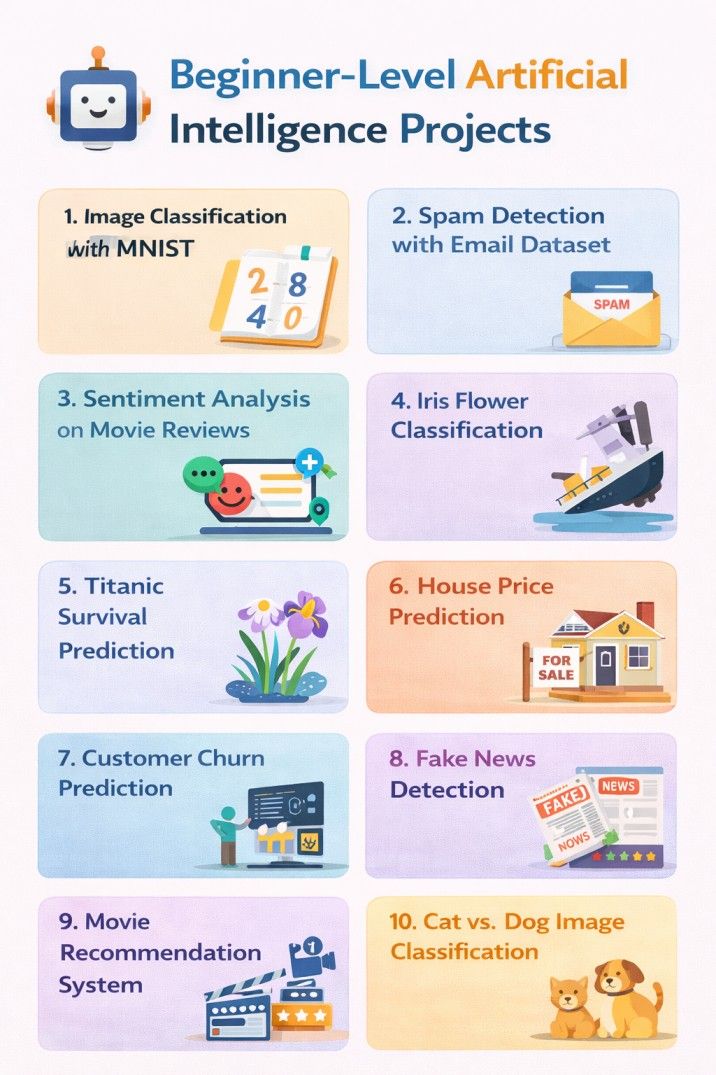
Also Read: Image Classification in CNN: Everything You Need to Know
Also Read: Email Classification Using Machine Learning and NLP Techniques
Also Read: Sentiment Analysis on IMDB Reviews Using Machine Learning
Also Read: Iris Dataset Classification Project Using Python
Also Read: Titanic Survival Prediction in R: Complete Guide with Code
Also Read: House Price Prediction Using Machine Learning in Python
Also Read: Customer Churn Prediction Project: From Data to Decisions
Also Read: Fake News Detection Project Using Python and ML
Also Read: Movie Recommendation System: How To Build it with Machine Learning?
Free Courses
These artificial intelligence projects introduce you to deep learning, time-series data, and more complex model architectures. They often require more data and computational power.
Also Read: How to create Chatbot in Python: A Detailed Guide
Also Read: Stock Market Prediction Using Machine Learning [Step-by-Step Implementation]
Also Read: Object Detection Using Deep Learning: Techniques, Applications, and More
Also Read: Face Recognition using Machine Learning: Complete Process, Advantages & Concerns in 2025
Also Read: How to Implement Speech Recognition in Python Program
Also Read: Anomaly Detection With Machine Learning: Techniques and Uses
AI Courses to upskill
Explore Artificial Intelligence Courses for Career Progression
These artificial intelligence projects are for those comfortable with deep learning. They involve cutting-edge architectures like GANs, Transformers, and Reinforcement Learning.
Also Read: Reinforcement Learning in Machine Learning: How It Works, Key Algorithms, and Challenges
Accessing a good list of artificial intelligence project topics like this is a great step.
Also Read: Basic CNN Architecture: A Detailed Explanation of the 5 Layers in Convolutional Neural Networks
Also Read: Medical Imaging Technology: Process, Applications, and Career Opportunities in 2025
Also Read:What Is Deepfake Technology? AI’s Role in Creating and Detecting Fakes
Artificial intelligence projects are widely used across industries to automate tasks, improve decision-making, and deliver personalized user experiences. Many of the AI applications used by global companies today are built on the same concepts students learn through hands-on AI projects.
1. Recommendation Systems in Streaming Platforms
Companies like Netflix use AI-powered recommendation systems to analyze viewing history, preferences, and user behavior to suggest movies and TV shows. These systems rely on machine learning algorithms and collaborative filtering techniques.
2. Self-Driving Technology in Automobiles
Tesla uses artificial intelligence for autonomous driving features such as lane detection, object recognition, traffic sign detection, and real-time decision-making using computer vision and deep learning models.
3. AI Fraud Detection in Banking
Banks and fintech companies use AI models to detect suspicious transactions and prevent fraud. Machine learning algorithms analyze transaction patterns, spending behavior, and anomalies in real time to identify potential risks.
4. Healthcare Diagnosis Systems
AI-powered healthcare systems help doctors detect diseases from medical images such as X-rays, MRIs, and CT scans. Deep learning models are increasingly used for cancer detection, medical diagnosis, and patient monitoring.
5. Product Recommendation Systems in E-Commerce
E-commerce platforms like Amazon use AI recommendation engines to suggest products based on customer searches, purchase history, and browsing behavior. These systems improve customer experience and increase sales conversions.
Also Read: Top 30 Final Year Project Ideas for CSE Students in 2026
Building strong AI projects is one of the most effective ways for freshers and students to stand out during placements. Recruiters don’t just look at marks, they evaluate how you apply concepts in real-world scenarios. A well-structured project portfolio shows problem-solving ability, coding skills, and practical AI understanding.
For beginners, the focus should be on simple but concept-clear projects that demonstrate core AI and machine learning fundamentals. These can include:
The goal here is not complexity, but clarity of concepts like data preprocessing, model training, and evaluation. Freshers should ensure every project has a clean README and explanation of the approach.
A strong GitHub portfolio acts as your digital resume. Recruiters often check it before interviews. Each AI project should include:
Consistently updating GitHub shows discipline and growth. Even small projects, when properly documented, create a strong impression.
Participating in hackathons is one of the fastest ways to build real-world AI experience. Platforms like Kaggle competitions or college hackathons expose you to:
Even if you don’t win, mentioning hackathon participation on your resume adds credibility and shows practical exposure.
These are slightly advanced projects designed specifically to help you answer interview questions confidently. They should clearly demonstrate:
Examples include fraud detection systems, chatbot assistants, or demand forecasting models. Interviewers often ask you to explain your project architecture, so clarity is more important than complexity.
Deployment is what transforms a project from “academic” to “industry-ready.” Instead of just building models, deploy them using tools like Flask, FastAPI, or Streamlit. You can:
Subscribe to upGrad's Newsletter
Join thousands of learners who receive useful tips
After diving into the projects, let's cover two crucial questions: Why is Python the language of choice for AI, and how do you pick the right project for your skill level?
Python is the undisputed king of artificial intelligence, and for good reason. Its simple, readable syntax means you can focus more on the AI logic and less on complex programming rules. This makes it ideal for rapidly prototyping and building sophisticated artificial intelligence projects.
But Python's real power comes from its massive ecosystem. An unparalleled collection of open-source libraries makes it the default choice for data science and AI:
This robust toolkit makes Python the most practical and powerful language for any artificial intelligence based projects.
Also Read: Python Libraries Explained: List of Important Libraries
Choosing the right project is crucial. A project that's too hard can be discouraging, while one that's too easy won't help you grow. Here are the key criteria to consider when selecting artificial intelligence projects for students:
Questions to Ask Before Starting
Project Level Comparison
| Feature | Beginner Projects | Intermediate Projects | Advanced Projects |
| Data Complexity | Small, clean, structured (CSV) | Medium, requires cleaning, time-series, or text | Large, unstructured (video, audio), real-time |
| Model Complexity | Scikit-learn models (e.g., Logistic Regression) | Simple neural networks (CNNs, RNNs) | Transformers, GANs, Reinforcement Learning |
| Outcome | A trained model with performance metrics | A simple web app or API | A deployed, scalable application or research |
If you’re serious about excelling in artificial intelligence with Python, upGrad offers everything you need to succeed. With over 10 million learners, 200+ courses, and partnerships with 1,400+ hiring companies, upGrad ensures you have access to top-tier education and career opportunities.
Below are the Python courses available for learners like you in India.
In addition to these courses, upGrad offers something even more personal and impactful. Through free one-on-one career counseling, you can gain clarity on your learning path and future career opportunities.
Similar Reads:
Good topics include image classification (MNIST or Cat vs. Dog), spam detection, and sentiment analysis on movie reviews. These artificial intelligence project topics are great because they have clean datasets and teach you fundamental classification and NLP skills.
It varies. A beginner project might take 10-20 hours. An intermediate project could be 40-60 hours. An advanced project can easily take 100+ hours. The key is consistency and focusing on what you are learning, not just the hours spent.
The "holy trinity" is NumPy (for numerical operations), Pandas (for data manipulation), and Scikit-learn (for classical machine learning). For deep learning, you'll need either TensorFlow (with Keras) or PyTorch. These are the foundation for most artificial intelligence based projects.
Yes! All beginner projects and many intermediate artificial intelligence projects (especially those using Scikit-learn) run perfectly fine on a regular CPU. For deep learning (CNNs, LSTMs), a GPU becomes necessary. You can use Google Colab for free GPU access.
Start with famous, clean datasets from sources like Kaggle, the UCI Machine Learning Repository, or built-in datasets from Keras. For artificial intelligence projects for students, a high-quality dataset is more important than a unique one, as it lets you focus on the model.
Your primary outcome should be a trained, evaluated model and a clear README.md file on GitHub explaining your process. A great secondary outcome for projects on artificial intelligence is a simple web app (using Streamlit or Flask) that provides a demo of your model.
It depends on the task. For classification, use accuracy, precision, recall, and a confusion matrix. For regression, use Mean Absolute Error (MAE) or Root Mean Square Error (RMSE). Always split your data into training and testing sets.
For beginners, 2-3 small, completed projects are better than one large, unfinished one. This shows you can deliver a full project from start to finish. Once you're intermediate, one large, impressive capstone project can be more valuable.
The simplest way is to wrap your model in a REST API using Flask or FastAPI. You can then deploy this API on services like Heroku, AWS, or Google Cloud Platform. For simpler demos, Streamlit is a fantastic tool.
Projects like Customer Churn Prediction, Time Series Forecasting (e.g., for sales or stock), and Recommendation Systems are extremely relevant. These projects solve direct business problems and are highly valued by employers.
The biggest pitfall is data leakage (your test data "leaking" into your training data). Avoid this with proper train/test splits. Other pitfalls include poor data cleaning, not trying a simple baseline model first, and focusing only on accuracy.
Use a combination of text, metrics, and visuals. In your README.md, state your final metric (e.g., "Achieved 95% accuracy"). Then, show it with a confusion matrix, a prediction-vs-actual chart, or screenshots of your model working.
Absolutely. It's expected. Using standard datasets (like MNIST, CIFAR-10, IMDb reviews, or data from Kaggle) is a great practice because it allows others to replicate your work and compare your results against established benchmarks.
Create a "pinned repositories" section on your GitHub profile. Pin your top 3-5 projects on artificial intelligence. Make sure each has a clear title, a one-line description, and a compelling README.md file with visuals.
Think of AI as the broad concept of creating intelligent machines. Machine Learning (ML) is a subset of AI that involves systems "learning" from data. Most artificial intelligence projects you see, like spam detection or image recognition, are technically ML projects.
For beginner artificial intelligence projects for students, you only need basic high school math. As you advance, understanding linear algebra, calculus, and statistics becomes very important for understanding why models work and for debugging them.
Projects involving Reinforcement Learning (RL), GANs, and Transformers (for NLP) are typically the most challenging. They require a deep understanding of the theory, significant computational power, and advanced debugging skills.
Create a dedicated "Projects" section. For each project, list the title, a 1-2 sentence description of the goal and outcome, and the technologies used (e.g., "Python, TensorFlow, Scikit-learn"). Link to the GitHub repository.
Both have value. Solo projects demonstrate your full-stack capability. Team projects (like in a hackathon or class) are crucial for your resume as they prove you have communication and collaboration skills, which are vital in any tech job.
Follow AI research on platforms like Twitter (following key researchers) and Reddit (r/MachineLearning). Read papers on "Papers with Code." Try to incorporate one new technique a year, like using a new Transformer model instead of an LSTM.
911 articles published
Pavan Vadapalli is the Director of Engineering , bringing over 18 years of experience in software engineering, technology leadership, and startup innovation. Holding a B.Tech and an MBA from the India...
Speak with AI & ML expert
By submitting, I accept the T&C and
Privacy Policy
Top Resources
Master's Degree
18 Months
Executive Diploma
12 Months
IIIT Bangalore
Executive Programme in Generative AI & Agentic AI for LeadersIndia’s #1 Tech University
Dual Certification
5 Months