SWOT Analysis Examples for Students
By upGrad
Updated on May 11, 2026 | 7 min read | 2.57K+ views
Share:

All courses
Certifications
More
By upGrad
Updated on May 11, 2026 | 7 min read | 2.57K+ views
Share:
Table of Contents
A student SWOT analysis identifies key internal factors like strengths and weaknesses, along with external opportunities and threats, to improve academic success and career readiness. It is especially useful for managing studies, extracurricular involvement, and long-term career planning.
This blog explains how SWOT analysis works for students. You’ll learn how to create one, where to use it, common mistakes to avoid, and detailed SWOT analysis examples for students across academics, career planning, and personal growth.
Explore upGrad’s Management and Marketing programs to understand how strategic analysis tools like SWOT work in real-world decision-making, build practical problem-solving and planning skills, and make smarter academic and career choices with confidence.
Popular upGrad Programs
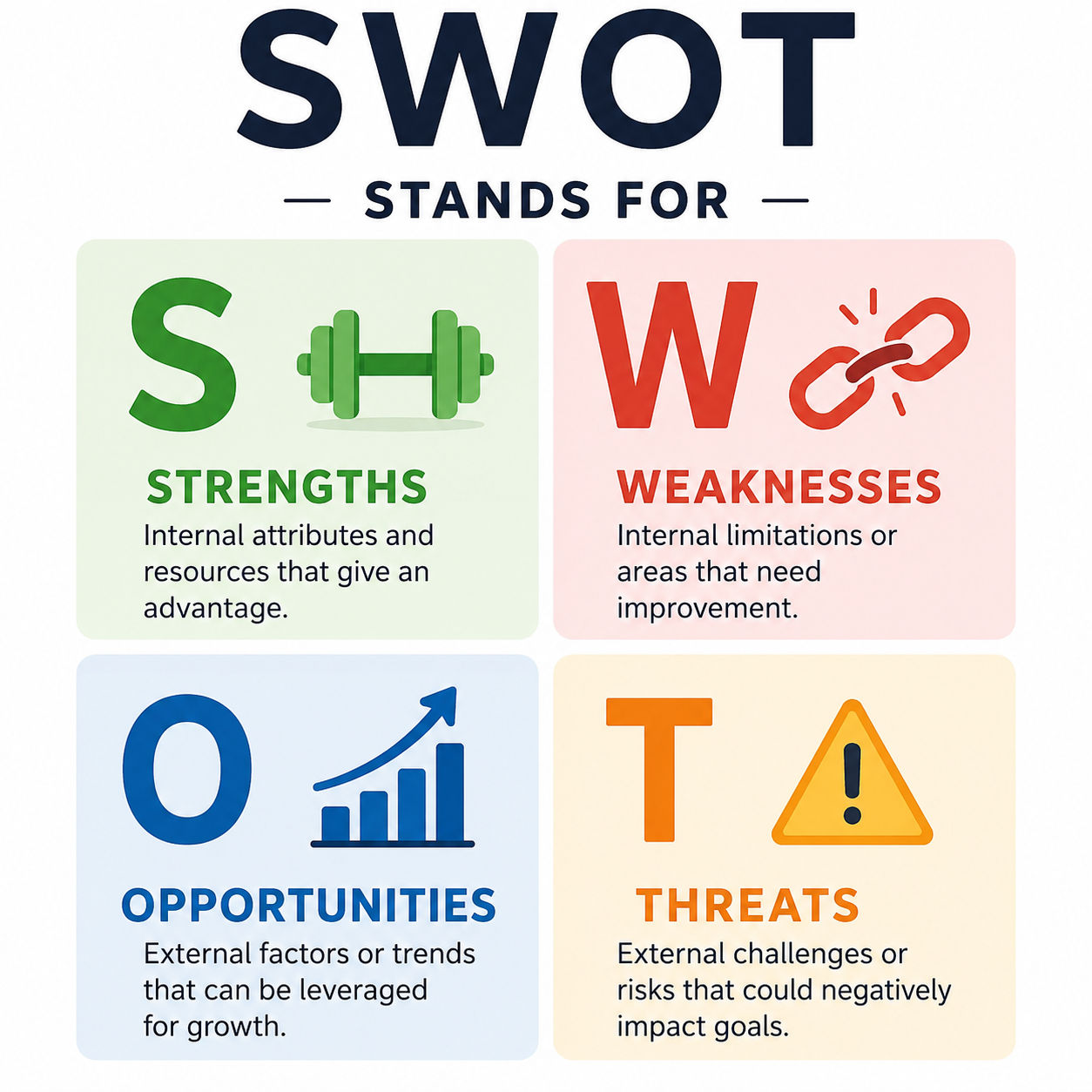
SWOT stands for Strengths, Weaknesses, Opportunities, and Threats. It's a structured way of looking at yourself or a situation from four angles.
Students often skip self-reflection because they feel uncomfortable. But that discomfort is exactly where growth starts.
The beauty of SWOT is its simplicity. You don't need a business background or special software. A sheet of paper divided into four boxes is enough. It's used by professionals across industries, but it's just as powerful for a student figuring out their next step.
Also read: SWOT Analysis: Meaning, Examples, and Complete Guide (2026)
SWOT analysis helps students understand where they currently stand and what they need to improve. It breaks down self-evaluation and makes decision-making easier during academics, career planning, internships, or skill development. Students don’t need special tools or technical knowledge to use it. It helps them:
Strengths |
Weaknesses |
| Good communication skills | Poor time management |
| Strong subject knowledge | Fear of public speaking |
| Consistent attendance | Difficulty with math |
Opportunities |
Threats |
| Online certification courses | High competition |
| Internship openings | Academic pressure |
| College networking events | Financial limitations |
Must Read: SWOT Analysis in Strategic Management: A Complete Guide
Free Courses
Academic performance is one of the most common areas where students use SWOT analysis. It helps identify study habits, subject-level challenges, and opportunities for improvement.
Let’s look at a practical example.
Strengths |
Weaknesses |
| Good memory retention | Poor revision planning |
| Strong notes preparation | Easily distracted |
| Consistent attendance | Weak numerical skills |
Opportunities |
Threats |
| Access to online mock tests | Exam stress |
| Study groups | Competitive classmates |
| Free learning platforms | Social media distractions |
This type of SWOT analysis helps students create a better study strategy. Instead of studying randomly, they can focus on fixing specific problems.
For example:
College students face different challenges compared to school students. Academics become more independent, competition increases, and career pressure starts building early.
Here’s a sample SWOT analysis.
Strengths |
Weaknesses |
| Strong presentation skills | Poor networking |
| Active in college clubs | Weak coding skills |
| Good teamwork ability | Inconsistent study routine |
Opportunities |
Threats |
| Campus placements | Economic slowdown |
| Internships | High competition |
| Industry workshops | Lack of practical experience |
The opportunities and threats are mostly external. Students can’t fully control them. What they can control is preparation.
That’s why SWOT analysis examples for students work so well. They separate controllable factors from uncontrollable ones, which reduces unnecessary anxiety and improves focus.
Must read: Threats in SWOT Analysis: What They Mean and How to Identify Them
Students who regularly review their SWOT analysis often improve in several important areas:
A student struggling in science subjects, for example, might realize the issue isn’t low ability. The real problem could be inconsistent revision, fewer practice tests, or ineffective study techniques. Once that becomes clear, improvement starts happening much faster.
Recommended Courses to upskill
Explore Our Popular Courses for Career Progression
IIIT Bangalore
Executive Diploma in Machine Learning and AI360° Career Support
O.P.Jindal Global University
MBA from O.P.Jindal Global UniversityLive Case Studies and Projects
With countless options and constant advice, career decisions can feel confusing for students. A SWOT analysis offers a clear approach, allowing them to evaluate choices realistically instead of relying on emotions.
Strengths |
Weaknesses |
| Strong writing ability | No internship experience |
| Creative thinking | Limited technical knowledge |
| Good communication | Fear of interviews |
Opportunities |
Threats |
| Growing digital marketing industry | Automation replacing jobs |
| Online skill courses | Intense job competition |
| LinkedIn networking | Lack of industry exposure |
This analysis immediately highlights areas requiring action.
For example:
Career planning becomes practical when students stop looking only at dream jobs and start evaluating actual readiness, market demand, competition levels, and existing strengths together.
That’s where SWOT analysis creates real value.
Do Read: SWOT Opportunities Examples: How to Identify and Use Them for Growth
Example 4. SWOT Analysis for MBA Aspirants
Let’s see how this SWOT analysis can be applied in real life for an MBA aspirant.
Strengths |
Weaknesses |
| Leadership experience | Weak quantitative aptitude |
| Good academic scores | Limited work experience |
| Strong communication | Poor interview preparation |
Opportunities |
Threats |
| Scholarship programs | Competitive entrance exams |
| Networking events | Rising education costs |
| International programs | Limited admission seats |
Students should prioritize weaknesses that directly affect their goals. If MBA entrance exams require quantitative aptitude, then improving quantitative skills becomes urgent. Other issues can wait.
Students commonly use SWOT analysis for:
Must Read: Techniques of Decision-Making: 15+ Tools & Methods for Success in 2026
Students often make SWOT analysis needlessly complex, focusing on sounding formal rather than truthful. This undermines its value. An effective SWOT should be specific, honest, and actionable, not overly polished or generic.
Question |
Example |
| What subjects do you perform well in? | English, Science |
| Which skills do teachers praise? | Communication, Leadership |
| What tasks feel easier for you? | Presentations, Writing |
| What achievements are you proud of? | Debate wins, Good grades |
| What are your strengths? | Fast learner, Creative thinking |
Students often avoid writing about their weaknesses because they feel uncomfortable. Ignoring weaknesses doesn't remove them. A weakness only becomes dangerous when it stays hidden for too long without action, because unnoticed habits slowly affect grades, confidence, interviews, productivity, and even career opportunities over time.
Examples:
Opportunities are external chances for growth. Examples include:
Students often miss opportunities simply because they aren't actively looking for them. A SWOT analysis forces awareness.
Threats are outside factors that may create problems.
Examples:
Not every threat can be controlled. Preparation still helps reduce impact.
Question |
Yes/No |
| Did you include real strengths? | |
| Did you identify actual weaknesses? | |
| Did you mention external opportunities? | |
| Did you include realistic threats? | |
| Did you create action steps? |
Also Read: 16 Top Time Management Techniques And Tools: Features And Benefits
Here are some practical steps to use it effectively
SWOT analysis isn't just a business tool. It's a thinking habit. Students who do this consistently get better at self-awareness, better at decision-making, and faster at identifying where to focus their energy.
A strong SWOT analysis won't solve every problem overnight. It will help students think clearly, plan better, and make smarter decisions with more confidence. That's what actually creates long-term growth.
Ready to start your journey? Book a free consultation with upGrad today to find the best path for your career.
The easiest way to start is by reflecting on daily academic habits, classroom performance, and personal skills instead of trying to sound professional. Students should think about what comes naturally to them, where they struggle consistently, what opportunities are available around them, and what external challenges may slow their progress.
Good strengths are skills or habits that genuinely help a student perform better in academics or activities. Common examples include communication skills, leadership, creativity, problem-solving ability, teamwork, discipline, and subject expertise. Students should focus on strengths supported by real achievements, teacher feedback, or practical experiences.
Students shouldn’t include fake weaknesses designed to sound positive, like “I work too hard.” That weakens the entire exercise. Instead, they should mention real improvement areas such as procrastination, weak time management, fear of public speaking, inconsistent revision habits, or lack of technical skills that affect performance directly.
Yes. SWOT analysis helps students connect their strengths and interests with realistic career opportunities. It also highlights skill gaps that may affect future goals. For example, a student interested in data analytics may discover strong logical thinking but weak programming knowledge that needs immediate improvement before applying for internships.
Placement preparation becomes easier when students understand their strengths, weaknesses, and market challenges clearly. A SWOT analysis helps identify missing skills, interview fears, resume gaps, and networking opportunities. It also helps students focus on practical improvements instead of applying randomly to jobs without preparation or direction.
Strengths are internal qualities students already possess, such as communication skills or subject knowledge. Opportunities are external situations that can support growth, like scholarships, internships, certification courses, or networking events. Students often confuse the two, which makes their SWOT analysis less accurate and harder to act upon later.
Students should review their SWOT analysis every three to six months or after major academic and career milestones. Skills, goals, and challenges change quickly during school and college. Updating the analysis regularly helps students track progress, identify new opportunities, and stay realistic about changing academic or professional priorities.
Yes. SWOT analysis helps students identify habits that affect productivity, focus, and academic consistency. A student may realize their biggest weakness isn’t understanding concepts but poor revision planning or excessive distractions. Once the real issue becomes visible, students can create practical study routines and improve academic performance much faster.
Absolutely. Scholarship applications often ask students to explain achievements, challenges, leadership experience, and future goals. A SWOT analysis helps organize these thoughts clearly. Students become better at presenting their strengths honestly while also showing self-awareness about areas they’re actively trying to improve through education and skill-building.
The biggest mistakes include writing generic points, hiding real weaknesses, copying examples from the internet without personalization, and failing to create action plans afterward. A SWOT analysis only works when students use honest observations connected to real academic situations, career goals, and everyday habits affecting their growth and performance.
Yes. SWOT analysis is extremely useful before selecting streams like science, commerce, or humanities. It helps students evaluate subject strengths, interests, learning styles, and long-term goals realistically. Instead of choosing based only on peer pressure or trends, students can make decisions that align better with their abilities and career interests.
972 articles published
We are an online education platform providing industry-relevant programs for professionals, designed and delivered in collaboration with world-class faculty and businesses. Merging the latest technolo...
Get Free Consultation
By submitting, I accept the T&C and
Privacy Policy
Top Resources
Certification
3 Months
Certification
6 Months
O.P. Jindal Global University
Masters in International Accounting and Finance (Accredited by ACCA, UK)Master's Degree
12 Months