Software Testing Life Cycle (STLC): A Complete Guide
By Sriram
Updated on Jul 14, 2026 | 14 min read | 3.59K+ views
Share:

All courses
Certifications
More
By Sriram
Updated on Jul 14, 2026 | 14 min read | 3.59K+ views
Share:
Table of Contents
Quick Overview
In this blog, we will learn what the software testing life cycle is, why it matters, and how it differs from the software development life cycle. We will walk through each phase in detail, compare the STLC with the bug life cycle, examine how it fits into agile and waterfall projects, and cover common challenges and best practices. By the end, you will have a practical, end-to-end understanding of STLC that you can apply to real projects.
If topics like structured testing processes, catching defects before they reach production, and building the QA skills to test software like a professional interest you, upGrad's Data Science courses can help you build the skills to run a testing life cycle with confidence, from requirement analysis to test closure.
Popular Data Science Programs
The software testing life cycle is a sequence of defined phases that a QA team follows to systematically test a software application. Instead of testing randomly or only at the end of development, the software testing life cycle breaks the process into stages, each with its own goals, activities, and deliverables.
The software testing life cycle, often shortened to STLC, is not the same as running test cases. It is the entire framework around testing, including planning, designing, executing, and reporting. Think of it as the roadmap that QA teams follow from the moment requirements are shared to the moment testing is signed off.
A few things define the software testing life cycle STLC approach:
Here is a quick snapshot of what the software testing life cycle looks like in practice:
Aspect |
Description |
| Purpose | Ensure systematic, complete testing coverage |
| Starts | Once requirements are available for analysis |
| Ends | After test closure and sign-off |
| Owner | QA team, with input from developers and business analysts |
| Output | Tested, quality-checked software ready for release |
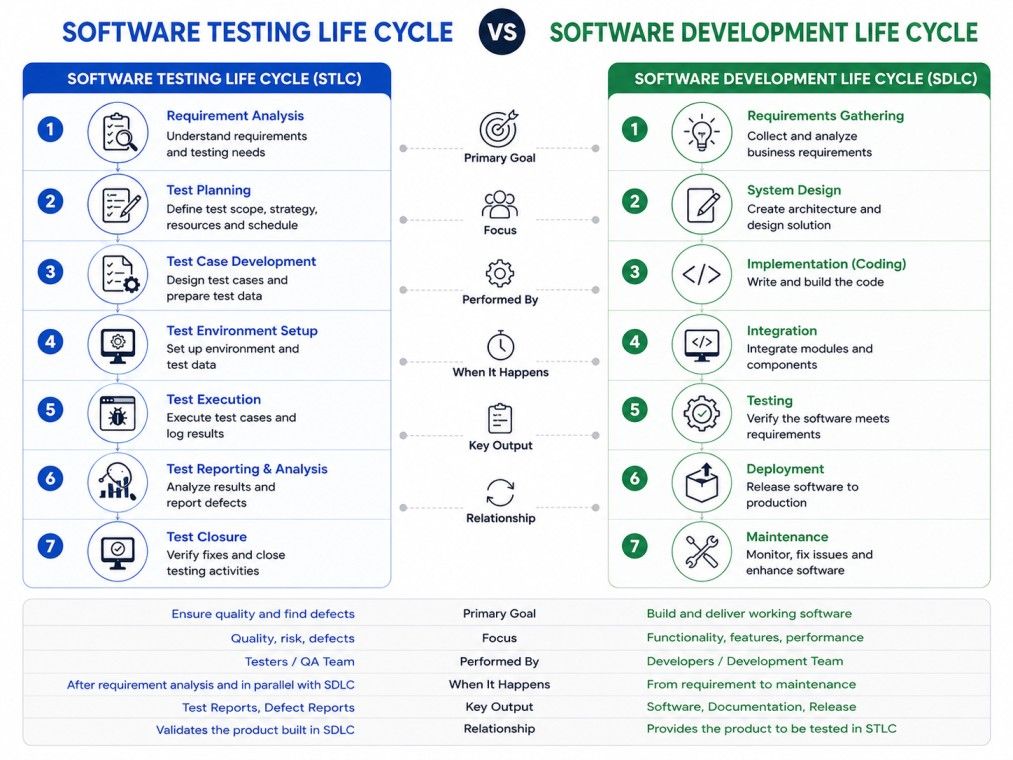
Software testing life cycle is sometimes confused with the software development life cycle. They are related to one another but not identical.
SDLC covers the entire process of building software, from requirement gathering to deployment and maintenance. STLC is a subset that focuses only on testing activities within that larger cycle.
Free Courses
Many people wonder why software testing needs a structured life cycle in the first place. After all, why not simply test the application as development progresses?
In small projects, informal testing might work. But as applications grow more complex, involve multiple teams, and need to meet strict quality standards, an unstructured approach leads to gaps. Features get missed, edge cases go untested, and bugs slip through to production.
The software testing life cycle addresses this by giving each phase a clear purpose.
This structure is why STLC is considered a core discipline in software quality assurance, taught in QA training programs and followed by teams across industries, from banking software to mobile apps.
Also Read: Types of Software Testing: Everything You Need to Know
Understanding the importance of the software testing life cycle helps explain why Quality Assurance teams insist on following it rather than testing on an ad hoc basis.
A structured cycle brings predictability to a process that can otherwise become chaotic, especially on larger projects with tight deadlines.
1. Catches Defects Earlier
When testing starts as soon as requirements are ready, rather than only after development finishes, defects get caught and fixed while they are still cheap to resolve.
A bug found during requirement analysis costs far less to fix than one discovered after release.
2. Improves Test Coverage
Structured planning and test case development make sure testers cover functional requirements, edge cases, and negative scenarios, not just the obvious happy paths.
Without a defined process, coverage tends to be inconsistent and dependent on individual testers.
3. Creates Accountability
Every phase has clear owners and deliverables. This makes it easy to track progress, identify bottlenecks, and know exactly where a project stands in its testing effort.
4. Supports Better Communication
Test plans, test cases, and closure reports give developers, project managers, and stakeholders a shared reference point.
Everyone knows what has been tested, what passed, and what still needs attention.
5. Reduces Last-minute Surprises
Teams that skip structured testing often discover major issues right before release, leaving no time to fix them properly.
A well-followed software testing life cycle spreads risk discovery across the project rather than bunching it at the end.
6. Supports Compliance And Audits
In regulated industries such as healthcare, finance, and aviation software, documented testing processes are often a legal or contractual requirement.
STLC deliverables, such as test plans and closure reports, serve as evidence that testing was conducted properly.
7. STLC Builds Trust
When a QA process is consistent and well-documented, business stakeholders trust the quality signals from testing. That trust matters when deciding whether a release is ready to ship.
Skipping structured testing might feel faster in the short term. But the cost usually shows up later, in the form of production bugs, customer complaints, or emergency hotfixes.
The software testing life cycle exists precisely to avoid that trade-off by front-loading quality checks instead of pushing them to the end.
Data Science Courses to upskill
Explore Data Science Courses for Career Progression
IIIT Bangalore
Executive Post Graduate Certificate in Data Science & AIPlacement Assistance
One of the most common sources of confusion is the difference between the STLC and the SDLC. Both are life cycles, both involve phases, and both aim to deliver working software. But they serve different purposes.
The software development life cycle, or SDLC, covers the entire journey of building software. It starts with gathering business requirements and ends with deployment and ongoing maintenance. Testing is one part of this larger process, not the whole thing.
The software testing life cycle, on the other hand, zooms in specifically on testing. It starts once requirements are available for analysis and ends when testing is formally closed. It runs parallel to, and often overlaps with, phases of the SDLC.
Here is a side-by-side comparison:
Factor |
SDLC |
STLC |
| Scope | Entire software development process | Testing activities only |
| Phases | Requirement gathering, design, coding, testing, deployment, maintenance | Requirement analysis, test planning, test case development, environment setup, execution, closure |
| Primary owner | Development and project teams | QA and testing teams |
| Goal | Build and deliver working software | Verify software meets requirements and is defect-free |
| Timing | Runs across the full project lifespan | Runs within the testing-related phases of SDLC |
A useful way to think about the SDLC life cycle in software testing context is that STLC is nested inside SDLC. SDLC is the container. STLC is one of the processes running inside that container, focused entirely on quality checks.
In practice, the two overlap a lot. In modern agile and DevOps projects, testing does not wait until development is done. Instead, STLC phases run alongside SDLC phases continuously, with testers involved from the requirement stage through to release. This is different from older waterfall approaches, where testing was often a separate phase that only began after coding was complete.
Also Read: SDLC Guide: The 7 Key Software Development Life Cycle Phases Explained
Modern QA is no longer just about running test cases. Teams increasingly rely on data to predict defect patterns, prioritize testing efforts, and catch quality issues before they surface in production. If you're looking to move beyond testing execution and into the data-driven side of software quality, the Master of Science in Data Science from Liverpool John Moores University, offered in collaboration with upGrad, gives you the credentials and skills to get there.
A well-run software testing life cycle STLC process does not start or stop arbitrarily, and a good software testing life cycle diagram usually marks these checkpoints between phases. Each phase has entry and exit criteria that define exactly when work can begin and when it is considered complete.
Entry criteria are the conditions that must be met before a phase starts. For example, test case development cannot begin until requirements have been analyzed and a test plan exists. Skipping entry criteria often leads to rework, since testers may end up designing test cases based on incomplete or unclear requirements.
Exit criteria are the conditions that must be met before a phase is considered finished. For instance, test execution might have an exit criterion that all high-priority test cases have been run and no critical defects remain open.
Here is a general view of entry and exit criteria across the software testing life cycle phases:
Phase |
Entry Criteria |
Exit Criteria |
| Requirement Analysis | Requirement documents available | Testable requirements identified and clarified |
| Test Planning | Requirements analyzed | Test plan approved and signed off |
| Test Case Development | Test plan approved | Test cases reviewed and finalized |
| Test Environment Setup | Test cases ready, environment requirements known | Environment configured and validated |
| Test Execution | Environment ready, test cases approved | All planned test cases executed, defects logged |
| Test Closure | Execution complete, defects resolved or tracked | Test summary report signed off |
These criteria act as checkpoints that prevent teams from rushing ahead before the groundwork is solid. Without clear entry criteria, testers might start writing test cases against requirements that are still changing. Without exit criteria, a phase can drag on indefinitely with no clear definition of "done."
STLC officially begins once requirements are stable enough for analysis, and it ends after test closure, when a summary report is signed off and lessons learned are documented. Everything in between follows this same pattern of defined entry and exit points, which is part of what makes the process repeatable across projects and teams.
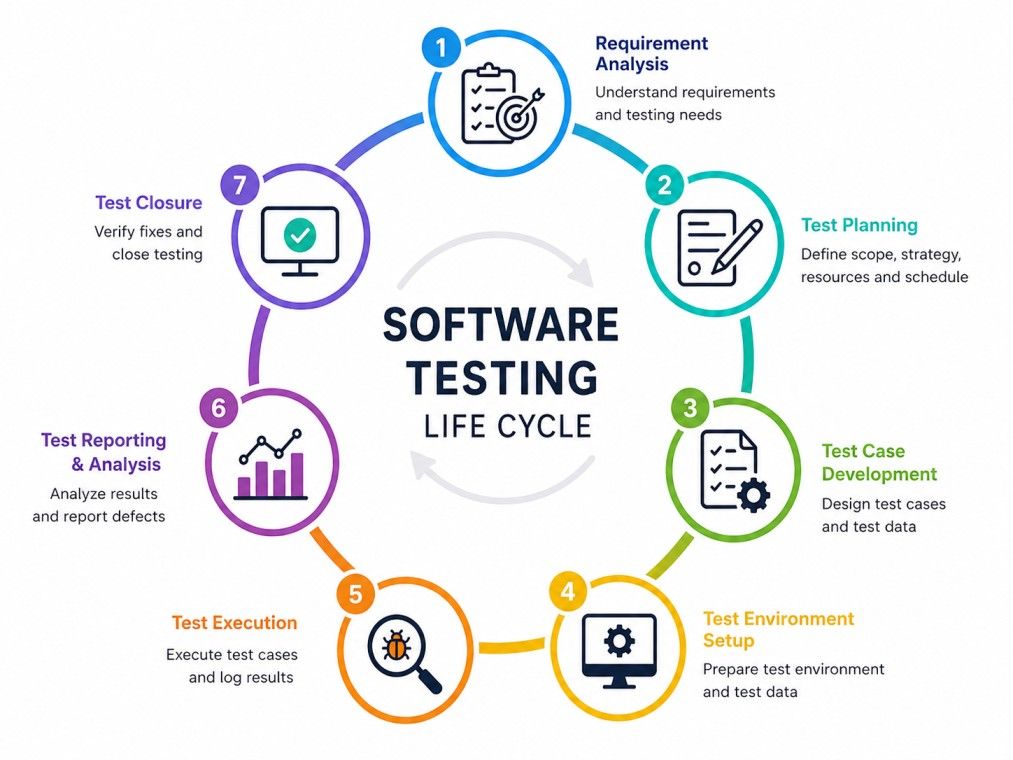
The software testing life cycle phases form the backbone of the entire testing process. Each software testing life cycle phase builds on the previous one, and skipping a phase might create problems later.
Below is a detailed look at each stage involved in the software testing life cycle, what happens at each stage, and who is typically involved.
A simple software testing life cycle diagram would show these six phases connected in sequence, often shown as a loop when the process feeds into future test cycles or regression testing rounds.
This is where testers study the requirement documents to understand what needs to be tested. The goal is to identify testable requirements and flag anything unclear or ambiguous before development moves too far ahead.
Key activities:
Deliverables: Requirement Traceability Matrix (RTM) and a list of clarified requirements.
Roles involved: QA lead, test analysts, business analysts.
Test planning defines the scope, approach, resources, and schedule for testing. It is usually led by a test manager or QA lead and results in a formal test plan document.
Key activities:
Deliverables: Test plan document, effort estimation report.
Roles involved: Test manager, QA lead.
In this software testing life cycle phase, testers convert requirements into detailed test cases and test scripts. This phase also includes preparing the test data needed to run those cases.
Key activities:
Deliverables: Test cases, test scripts, test data.
Roles involved: Test analysts, QA engineers.
This phase involves setting up the hardware, software, and network configuration needed to execute tests. A test environment that does not closely mirror production can lead to bugs being missed or false results appearing.
Key activities:
Deliverables: Ready test environment, smoke test results.
Roles involved: QA engineers, DevOps or infrastructure teams.
This is the software testing life cycle phase in which testers actually run test cases against the application. Any defects found are logged, tracked, and reported back to the developers.
Key activities:
Deliverables: Test execution reports, defect reports.
Roles involved: QA engineers, testers.
This is the final phase of the software testing life cycle, wrapping up the testing process. The team evaluates whether exit criteria were met, documents lessons learned, and prepares a summary report for stakeholders.
Key activities:
Deliverables: Test closure report, test metrics summary.
Roles involved: Test manager, QA lead.
Together, these software testing life cycle phases give teams a repeatable structure. Whether testing a small feature update or a full application release, following each phase in order reduces the chance of missed coverage and unclear ownership.
Also Read: 24 Essential Quality Assurance Engineer Skills You Must Master.
STLC and the bug life cycle in software testing or defect life cycle in software testing are closely related and often get used interchangeably even though they describe different things.
STLC is about the overall testing process. The defect life cycle in software testing, also called the bug life cycle, focuses on what happens to a single defect from the moment it is found to the moment it is closed.
During the test execution phase of STLC, testers find issues. Each of those issues then enters its own separate journey, the bug life cycle in software testing, which typically looks like this:
Stage |
What Happens |
| New | Defect is logged by the tester |
| Assigned | Defect is assigned to a developer |
| Open | Developer starts investigating and fixing |
| Fixed | Developer marks the defect as resolved |
| Retest | Tester verifies the fix |
| Closed | Defect is confirmed fixed and closed |
| Reopened | If the fix does not work, the defect goes back to Open |
So, while the STLC is the framework that covers all testing activities, the defect life cycle in software testing is a smaller, focused loop that happens repeatedly within the test execution phase.
A single test cycle might involve dozens or hundreds of individual defects, each going through the bug life cycle independently in software testing.
Understanding both processes is critical, as STLC tells you whether testing as a whole is on track, while the bug life cycle in software testing tells you the health of individual issues.
A project can have a well-run software testing life cycle and still struggle if defects are not moving smoothly through their own life cycle, sitting unassigned or unresolved for too long.
Teams often use bug tracking tools like Jira or Azure DevOps to manage the defect life cycle in software testing separately from the broader test plan, but both processes report back into the same testing life cycle in software testing, feeding into the metrics reviewed during test closure.
Thus, the bug life cycle in software testing occurs within test execution, while the defect life cycle is simply another name for the same journey a single issue takes from discovery to closure.
Subscribe to upGrad's Newsletter
Join thousands of learners who receive useful tips
The testing life cycle in software testing does not look identical across every project. How STLC phases are timed and repeated depends heavily on the development methodology a team follows.
In an agile software testing life cycle, testing happens continuously within each sprint rather than as a separate phase at the end. Requirement analysis, test planning, and test case development often happen in parallel with development, sometimes within the same one or two week sprint.
Key traits of the agile software testing life cycle:
Because sprints repeat every few weeks, the agile software testing life cycle essentially runs the full STLC in miniature, repeatedly, throughout the project.
In waterfall projects, STLC phases follow a stricter sequence. Development is usually completed before testing begins in full, meaning test execution happens later in the project timeline.
This approach works well for projects with stable, well-defined requirements but can delay defect discovery compared to agile.
The V-Model pairs each development phase with a corresponding testing phase. For example, requirement analysis on the development side pairs with acceptance test planning, and system design pairs with system test planning.
This model makes the connection between SDLC and STLC explicit, since every development stage has a matching test stage planned at the same time, even if execution happens later.
Regardless of methodology, the core phases of STLC stay the same. What changes is timing, frequency, and how much overlap there is between testing and development work.
Even with a clear structure, teams run into recurring problems while following the testing life cycle in software testing. Recognizing these challenges early helps avoid delays and quality gaps.
1. Unclear or Changing Requirements
When requirements are vague or keep shifting, requirement analysis becomes difficult, and test cases built on shaky assumptions often need rework later.
2. Tight Timelines
Testing is sometimes squeezed at the end of a project when other phases run late. This limits how thoroughly test execution can be carried out.
3. Environment Mismatches
A test environment that does not closely match production can cause bugs to go undetected, or lead to false failures that waste time investigating.
4. Poor Defect Tracking
Without disciplined logging and follow-up, defects can sit unresolved, get lost, or reappear after supposedly being fixed.
5. Limited Test Data
Test cases need realistic data to be meaningful. Missing or poorly prepared test data limits how well hidden issues can be caught.
6. Communication Gaps
When testers, developers, and business stakeholders are not aligned, defects get misunderstood, priorities get confused, and rework increases.
A few practical steps help address these challenges:
None of these fixes require a complete process overhaul. Most come down to discipline: following entry and exit criteria consistently, keeping documentation updated, and treating testing as a continuous activity rather than a final checkpoint.
Getting the most out of the software testing life cycle comes down to a handful of practices that experienced QA teams follow consistently.
1. Start Testing Early
Involve testers during requirement analysis, not after coding is done. Early involvement catches ambiguous requirements before they become expensive bugs.
2. Keep Documentation Lightweight But Consistent
Test plans and test cases do not need to be lengthy, but they should be clear, version controlled, and easy for anyone on the team to reference.
3. Prioritize Test Cases By Risk
Not every test case carries equal weight. Focus execution time on high-risk, high-impact areas first, especially when timelines are tight.
4. Automate Wisely
Automate stable, repetitive test cases like regression suites. Leave exploratory and usability testing to manual testers who can catch issues automation might miss.
5. Track Metrics That Matter
Metrics like defect density, test case pass rate, and defect leakage give a clearer picture of quality than raw test counts alone.
6. Review And Adapt After Every Cycle
Use test closure as a real feedback loop. Ask what worked, what did not, and adjust the next cycle's approach accordingly.
7. Align STLC With Your Methodology
Whether the project follows agile, waterfall, or a hybrid model, adapt phase timing to fit, without dropping the phases themselves.
If you are working out how to implement software testing life cycle in a project for the first time, start small. Pick one upcoming release, apply the full six-phase structure to it, and use that experience to refine your approach before scaling it across bigger projects.
Not every project needs the same version of the software testing life cycle STLC process. The right model depends on project size, requirement stability, and how much time is available for testing.
Which SLTC model to choose for a project:
On prioritizing test cases within any model, focus first on core functionality, then on high-traffic user paths, and finally on edge cases and rarely used features. This keeps testing efficient even when time is limited.
The software testing life cycle provides QA teams with a clear, repeatable way to test software effectively, from the initial review of requirements to the final closure report. Knowing the software testing life cycle phases, how STLC differs from SDLC, and how it connects to the defect life cycle helps teams catch issues earlier and ship with more confidence.
Whether your project follows agile, waterfall, or a hybrid approach, the core structure of STLC stays useful. Start with a clear requirement analysis, plan realistically, write thorough test cases, set up a reliable environment, execute carefully, and close every cycle with an honest review.
Want personalized guidance on Data Science and upskilling? Speak with an expert for a free 1:1 counselling session today.
The software testing life cycle is a structured process QA teams follow to test software, covering everything from requirement analysis to test closure. It ensures testing happens systematically rather than randomly, with each phase building on the one before it and producing clear deliverables along the way.
The main software testing life cycle phases are requirement analysis, test planning, test case development, test environment setup, test execution, and test closure. Each phase has its own entry and exit criteria, deliverables, and team members responsible for completing it before the next phase begins.
SDLC covers the entire software development process, from requirement gathering to deployment and maintenance. STLC is a smaller process focused only on testing activities, running within the testing-related stages of the larger SDLC. Testing teams follow STLC, while development and project teams typically own the broader SDLC.
STLC is the overall framework for testing an application. The defect life cycle, or bug life cycle, tracks a single issue from when it is logged to when it is closed. Many individual defect life cycles happen within the test execution phase of one STLC.
Yes. In an agile software testing life cycle, the same phases apply but happen continuously within each sprint instead of as one long sequence. Testers get involved early, test cases are written incrementally, and closure happens at the end of every sprint rather than only at project completion.
Most QA professionals point to requirement analysis as the most critical phase, since unclear requirements at this stage create problems throughout the rest of the cycle. That said, every phase matters, and skipping one usually causes gaps that surface later during execution or after release.
Beginners benefit from following STLC closely at first, since it teaches structured thinking about testing. Once the fundamentals are solid, experienced testers often adapt the process, combining or overlapping phases depending on project needs, without losing the core discipline the structure provides.
Duration varies widely based on project size and methodology. A small agile sprint might complete a mini STLC in one to two weeks, while a large waterfall project could spend several months across all phases. There is no fixed timeline; it depends on scope and complexity.
Yes, especially in agile and DevOps environments. Test planning for one feature might begin while test execution for another is still underway. Overlapping phases is common and often necessary to keep pace with fast release cycles, as long as entry and exit criteria are still respected.
A Requirement Traceability Matrix, or RTM, maps each requirement to its corresponding test cases. It is created during requirement analysis and updated through test case development, helping teams confirm that every requirement has been tested and nothing has been missed.
Responsibility varies by phase. Business analysts and testers handle requirement analysis, test managers lead planning, test analysts write test cases, QA and infrastructure teams manage environment setup, testers handle execution, and test managers oversee closure and final reporting.
724 articles published
Sriram K is a Senior SEO Executive with a B.Tech in Information Technology from Dr. M.G.R. Educational and Research Institute, Chennai. With over a decade of experience in digital marketing, he specia...
Speak with Data Science Expert
By submitting, I accept the T&C and
Privacy Policy
Start Your Career in Data Science Today
Top Resources
Executive Diploma
12 Months
Master's Degree
18 Months
Bootcamp
6 Months