Cloud Networking: A Complete Guide to Concepts, Architecture, and Best Practices
By Sriram
Updated on Jul 14, 2026 | 14 min read | 3.69K+ views
Share:

All courses
Certifications
More
By Sriram
Updated on Jul 14, 2026 | 14 min read | 3.69K+ views
Share:
Table of Contents
Key Takeaway
This blog covers everything you need to know about cloud networking, from the basics to advanced concepts. You will learn what cloud networking is, with real examples; how it differs from cloud computing; the types of cloud networking; its architecture; security practices; common problems and fixes. Whether you are a student, an IT consultant, or a business owner exploring cloud options, this guide is built to answer every question you might have.
If topics like cloud architecture, network security, and building infrastructure that keeps global businesses connected interest you, upGrad's Data Science courses can help you build the skills to design, secure, and manage the networks behind them.
Popular Data Science Programs
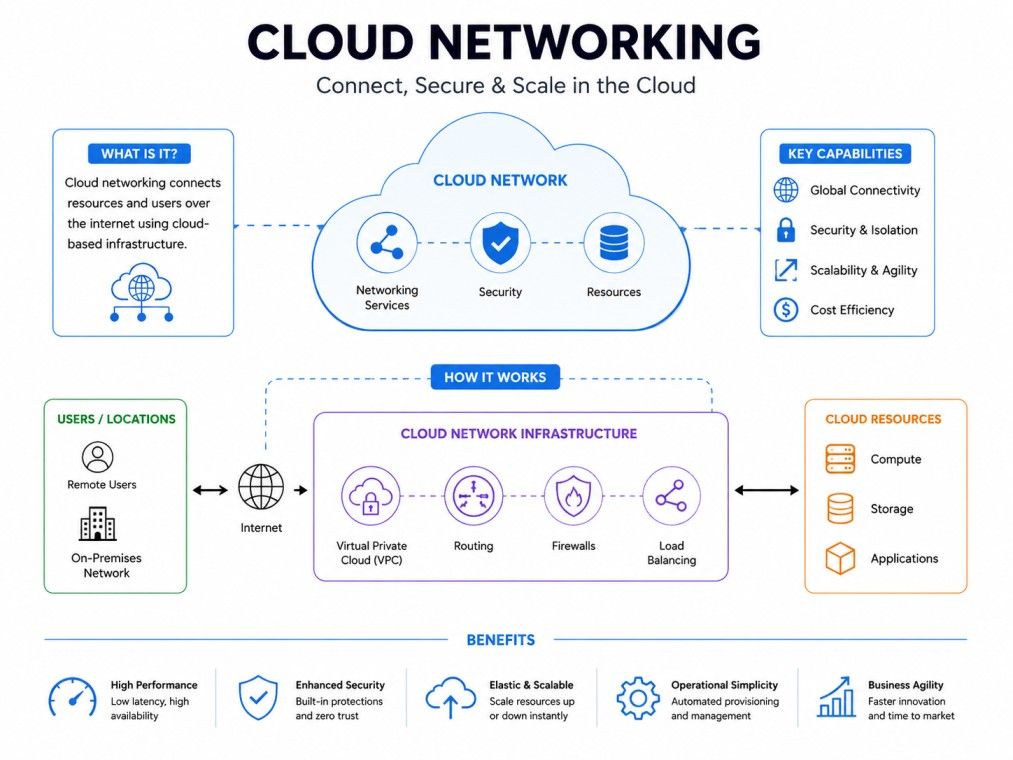
Cloud networking refers to the IT infrastructure and services used to build, manage, and secure networks in cloud environments or to connect on-premises systems with cloud platforms. Instead of relying on physical networking hardware installed in offices or data centers, it uses software-defined, cloud-based infrastructure to manage network resources.
In simple terms, cloud networking moves traditional networking functions such as routing, firewalls, and load balancing from dedicated physical devices to virtual, cloud-hosted platforms.
Instead of purchasing routers, switches, and cables, businesses can rent networking capabilities from cloud providers such as AWS, Microsoft Azure, and Google Cloud, then configure and manage them via software. This approach has transformed how organizations build, scale, and secure their IT infrastructure.
Unlike traditional networks, that depend on hardware installed at specific locations, cloud networking runs network functions as software on shared cloud infrastructure. As a result, businesses can quickly scale network capacity up or down without investing in additional physical equipment.
Cloud networking works by replacing physical network hardware with virtualized components hosted on a cloud provider's infrastructure.
When a business sets up cloud networking, it defines virtual networks, subnets, routing rules, and security policies through a control panel or code, and the cloud provider handles the physical execution behind the scenes.
Here is a simplified breakdown of How Cloud Networking Works:
To understand how cloud networking works, you need to know a few core cloud networking concepts:
These cloud networking concepts form the foundation of nearly every cloud architecture, whether it is a small startup app or a large enterprise system.
Cloud networking depends on standard networking protocols, adapted for virtual environments. Common ones include TCP/IP for data transmission, HTTPS for secure web traffic, BGP for routing between networks, and VPN protocols like IPsec for secure remote connections. These protocols ensure that data moves reliably and securely, regardless of whether it is traveling within a single cloud, between multiple clouds, or back to an on-premises data center.
Imagine an e-commerce company that runs its website on Amazon Web Services. Instead of setting up physical servers and routers, the company creates a Virtual Private Cloud, sets up subnets, configures security groups, and connects everything through virtual gateways.
All of this is cloud networking in action. Another common example is a company using Microsoft Azure Virtual WAN to connect its branch offices across different cities without laying any physical cables between them.
Free Courses
Networking and cloud computing are closely linked but not identical. Cloud computing is the broader concept of delivering computing services, including servers, storage, databases, and software, over the internet.
Networking and cloud computing come together when these services need to communicate with each other, with users, and with the outside world.
Without a strong network layer, cloud computing services simply cannot function. This is why cloud networking is often treated as a core pillar of cloud computing rather than a separate add-on.
Here is a quick breakdown of how networking and cloud computing relate:
Aspect |
Cloud Computing |
Cloud Networking |
| Focus | Delivering compute, storage, and software | Connecting and securing resources |
| Core function | Running applications and workloads | Enabling communication between resources |
| Example | Hosting a web app on a virtual server | Connecting that server to users and databases |
| Dependency | Needs a network to function | Supports and enables cloud computing |
People often use cloud networking and cloud computing interchangeably, but they are not the same thing. Cloud computing is the umbrella term. It covers compute power, storage, databases, and applications delivered over the internet. Cloud networking is one specific piece of that puzzle, focused purely on connectivity, traffic management, and security between resources.
Think of cloud computing as an entire office building, and cloud networking as the electrical wiring and internet cabling that keep everything connected. You cannot run the building without the wiring, but the wiring alone is not the building.
A cloud computing network is the underlying layer that enables virtual machines, storage systems, and applications hosted in the cloud to communicate with each other and with end users.
It includes virtual routers, load balancers, firewalls, and gateways, all delivered as software rather than physical boxes.
When people search for a cloud computing network, they usually want to understand how data moves between cloud-hosted resources. The short answer is that it moves through virtual network layers that mimic traditional networking hardware, but with far more flexibility and automation.
Key differences to remember:
Both work together, and neither is complete without the other. A well-designed cloud computing network directly impacts application speed, reliability, and security, which is why businesses invest heavily in getting this layer right before scaling their cloud computing usage.
Managing distributed systems like cloud networks takes more than just choosing the right provider, it takes people who understand connectivity, security, and architecture from the ground up. If you're looking to build that expertise, upGrad's Executive Post Graduate Certificate Programme in Data Science & AI from IIITB, gives you the skills to design, secure, and manage the cloud infrastructure that powers modern businesses.
Data Science Courses to upskill
Explore Data Science Courses for Career Progression
IIIT Bangalore
Executive Post Graduate Certificate in Data Science & AIPlacement Assistance
Cloud networking is not a single, fixed setup. Businesses choose different types of cloud networking based on their size, budget, and security needs.
The four common types of cloud networking are single-cloud, multi-cloud, Hybrid cloud, and Distributed cloud.
Each type suits a different kind of business. A small startup might be happy with single-cloud networking, while a large bank might need hybrid cloud networking to keep sensitive data on-premises and use the cloud for less sensitive workloads.
Also Read: Cloud Computing Architecture: A Comprehensive Guide For Beginners
Single cloud networking means a business relies on just one cloud provider, such as AWS or Google Cloud, for all its networking needs. This is the simplest setup to manage. It reduces complexity and cost but creates a dependency on a single provider, which can be risky if that provider experiences downtime or price changes.
Multi-cloud networking involves using services from multiple cloud providers simultaneously. A company might run its databases on Azure and its applications on AWS. This approach reduces the risk of vendor lock-in and lets businesses pick the best service from each provider, but it also adds complexity in managing consistent security and connectivity across platforms.
Hybrid cloud networking connects a company's own data center with one or more public cloud environments. This is popular among businesses with strict compliance needs, since sensitive data can stay on-premise while other workloads run in the cloud. It offers a balance between control and flexibility.
Distributed cloud networking spreads cloud resources across multiple physical locations, including public cloud data centers, edge locations, and regional hubs, while still managing them as a single, unified network.
Distributed cloud networking focuses on placing resources closer to where they are needed, whether near end users for lower latency or in specific regions to meet data residency and compliance requirements.
A cloud provider still owns and operates the underlying infrastructure, but the control plane remains centralized, so businesses get local performance benefits without losing centralized visibility and management. This model works well for applications that need fast response times across different geographies, such as real-time analytics, IoT platforms, or global content delivery, where even small delays can affect user experience.
Also Read: What is TCP/IP Model? Computer Networking Guide
Hybrid cloud networking and multi-cloud networking are often confusing, but they solve different problems. Hybrid cloud networking connects on-premises infrastructure with the cloud. Whereas, multi-cloud networking connects two or more public cloud providers, without necessarily involving on-premises systems at all.
Factor |
Hybrid Cloud Networking |
Multi-Cloud Networking |
| Involves on-premises systems | Yes | Not always |
| Number of cloud providers | Usually, one | Two or more |
| Main goal | Balance control and flexibility | Avoid vendor lock-in |
| Common users | Regulated industries | Businesses wanting best-of-breed services |
Choosing between them depends on compliance needs, existing infrastructure investments, and the level of complexity a business is ready to manage.
Alongside the types of cloud networking, it helps to know the four types of cloud services:
Cloud networking supports all four service types by providing the connectivity layer that enables them to communicate with users and with one another.
Also Read: Types of Cloud Service Models & Which One Should You Choose?
Before cloud networking existed, traditional IT relied on four basic types of networks:
Cloud networking essentially extends and virtualizes these traditional network types, letting businesses build WAN-like connectivity across the globe without laying physical cables.
Subscribe to upGrad's Newsletter
Join thousands of learners who receive useful tips
Cloud networking architecture refers to how all the pieces of a cloud network fit together to deliver secure, reliable connectivity. A well-designed cloud networking architecture reduces latency, improves security, and makes it easier to scale as a business grows.
A Virtual Private Cloud is the backbone of most cloud networking architecture. It is a private, isolated section of a public cloud where a business can launch resources in a controlled environment. Within a VPC, businesses define IP address ranges, create subnets, and set routing rules, giving them the same level of control they would have with a physical network, without the hardware.
Network virtualization in cloud computing is the technology that makes cloud networking possible. It separates network functions like routing, switching, and firewalling from physical hardware, and runs them as software instead. Network virtualization in cloud computing allows multiple virtual networks to run on the same physical infrastructure, each isolated and independently managed. This is what let's cloud providers offer flexible, on-demand networking to thousands of customers using shared hardware.
A storage area network in cloud computing is a high-speed network that connects servers to shared storage devices, making that storage appear as if it were locally attached.
A storage area network in cloud computing is commonly used for workloads that need fast, reliable access to large amounts of data, such as databases and enterprise applications.
Cloud providers offer virtualized versions of this setup, giving businesses SAN-like performance without requiring them to own physical storage arrays.
Cloud networking topology describes how resources are arranged and connected within a cloud network. Common topologies include hub-and-spoke, where a central hub manages traffic to multiple spoke networks, and mesh, where resources connect directly to each other.
The right topology depends on how much traffic flows between resources and how much control a business needs over routing.
Every major cloud provider offers its own set of cloud networking services. Here are some common examples:
Provider |
Service |
Purpose |
| AWS | Virtual Private Cloud (VPC) | Isolated network environment |
| AWS | Route 53 | DNS and traffic routing |
| Azure | Virtual Network (VNet) | Private network within Azure |
| Azure | Virtual WAN | Global network connectivity |
| Google Cloud | VPC Network | Global private network |
| Google Cloud | Cloud Load Balancing | Distributes traffic across resources |
These cloud networking services handle everything from connecting virtual machines to routing traffic across continents, giving businesses the tools to build networks that would have taken months to set up physically.
Cloud networking supports a wide range of real-world use cases across industries:
These use cases show why cloud networking has become essential, not optional, for most modern businesses.
Cloud networking offers real, measurable advantages over traditional networking setups.
For most businesses, these benefits translate directly into faster time-to-market and lower operating costs, which is why cloud networking adoption continues to grow across industries.
Cloud networking is not without its downsides, and it is worth understanding these before committing fully.
These challenges do not outweigh the benefits for most businesses, but they do mean cloud networking needs proper planning rather than a rushed rollout.
Cloud networking looks different when set side by side with the traditional and hybrid approaches it's often compared to.
Traditional networking relies on physical hardware installed on-site, managed manually by IT teams.
Cloud networking replaces most of that hardware with virtual, software-defined equivalents that can be managed remotely and scaled instantly.
On-premise networking gives businesses full physical control over their equipment and data, which some industries require for compliance.
Cloud networking trades some of that control for speed, flexibility, and lower maintenance overhead.
Public cloud networking uses shared infrastructure managed by a third-party provider, while private cloud networking uses dedicated infrastructure for a single organization, either on-premises or hosted by a provider.
Private setups offer more control and security, while public setups offer lower costs and faster scaling.
SD-WAN, or Software-Defined Wide Area Network, is a technology often used within cloud networking to manage and optimize traffic across multiple locations.
Cloud networking is the broader concept of running network infrastructure in the cloud, while SD-WAN is a specific tool that improves how traffic is routed across that network.
Security is one of the most searched and most important parts of cloud networking, and getting it right protects a business from costly breaches.
Cloud network security refers to the policies, tools, and practices used to protect data and resources as they move through a cloud network.
Since resources are no longer confined to a physical office, cloud network security depends heavily on identity management, encryption, and continuous monitoring rather than physical barriers.
Key practices for strong cloud network security include:
Common cloud networking security risks include misconfigured security groups, weak access controls, unencrypted data transfers, and lack of visibility across multi-cloud environments.
Most cloud security incidents stem from configuration errors rather than flaws in the cloud provider's infrastructure, which is why proper setup and regular audits matter so much.
A slow or poorly configured cloud network can quietly drag down application speed and inflate costs, so here's how to identify bottlenecks and keep performance running smoothly.
When cloud network performance drops, the usual suspects are misconfigured routing, insufficient bandwidth allocation, or resource bottlenecks.
Troubleshooting cloud network performance starts with checking latency between resources, reviewing load balancer configurations, and confirming that traffic is taking the most efficient route.
To reduce cloud networking latency, businesses can place resources closer to end users using edge locations, use content delivery networks for static content, and choose regions closer to their user base. Reducing the number of network hops between services also helps cut down delay.
Cloud networking cost optimization involves regularly reviewing usage, shutting down unused resources, choosing the right pricing tier, and monitoring data transfer costs, which can add up quickly across regions.
Many businesses save significantly just by auditing their cloud networking setup every few months.
Choosing the right cloud networking setup and rolling it out correctly can make or break how well your infrastructure scales, so here's a practical, step-by-step approach to getting it right.
When choosing a cloud networking provider, consider pricing, available regions, security features, support quality, and how well the provider integrates with tools you already use. It also helps to check the provider's track record for uptime and reliability.
A basic cloud networking implementation guide includes these steps:
Migrating to cloud networking involves mapping existing network dependencies, choosing a migration strategy such as lift-and-shift or gradual migration, and testing thoroughly before switching over completely. A phased approach reduces the risk of downtime during the transition.
Cloud networking has moved from being a niche IT concern to a core part of how modern businesses operate. It connects, secures, and scales the resources that power everything from small applications to global enterprises. Understanding the basics, from architecture and security to types and real-world use cases, gives you a strong foundation whether you are managing a business network or building a career in this field. As more companies shift away from physical infrastructure, the demand for solid cloud networking knowledge, and the professionals who understand it, will only keep growing.
Want personalized guidance on Data Science and upskilling? Speak with an expert for a free 1:1 counselling session today.
A VPN is a tool used within cloud networking to create secure, encrypted connections between users and cloud resources. Cloud networking is the broader infrastructure that includes VPNs along with routing, firewalls, and load balancing. A VPN solves one specific problem, secure remote access, while cloud networking covers the entire connectivity layer.
Not exactly. Software-Defined Networking, or SDN, is a technology that separates network control from hardware, and it is often used to build cloud networking systems. Cloud networking is the broader practice of running network infrastructure in the cloud, while SDN is one of the technologies that makes this possible.
Yes, small businesses often benefit the most, since cloud networking removes the need for expensive hardware and dedicated IT staff. They can start with basic setups and scale as they grow, paying only for what they actually use. This makes advanced networking capabilities accessible even on a limited budget.
Common tools include AWS VPC console, Azure Network Watcher, Google Cloud Network Intelligence Center, and infrastructure-as-code tools like Terraform. These tools help teams configure, monitor, and troubleshoot their cloud network setups without manually managing hardware.
Data privacy in cloud networking is handled through encryption, access controls, and compliance certifications maintained by the cloud provider. Businesses are still responsible for configuring their own security settings correctly, since misconfiguration is the most common cause of data exposure in the cloud.
DNS translates domain names into IP addresses, helping traffic reach the correct cloud resources. In cloud networking, DNS services like AWS Route 53 or Azure DNS also help route traffic intelligently based on location, load, or failover requirements, improving both speed and reliability.
Basic scripting knowledge helps, especially with tools like Terraform or Python for automation, but it is not always mandatory for entry-level roles. Many cloud networking jobs focus more on configuration, troubleshooting, and security than heavy coding, though automation skills become more valuable as you advance.
Edge networking brings computing and networking resources closer to end users, reducing latency for time-sensitive applications. It works alongside cloud networking by handling local processing needs while the broader cloud network manages storage, coordination, and less time-sensitive workloads.
Most experts recommend auditing a cloud network at least quarterly, along with automated continuous monitoring in between. Regular audits catch misconfigurations, unused resources, and outdated permissions before they turn into security incidents.
Industries like e-commerce, banking, healthcare, and media rely heavily on cloud networking for scalability and uptime. These sectors deal with high traffic volumes, strict compliance needs, or global user bases, all of which benefit from the flexibility cloud networking provides.
Cloud networking generally requires internet or dedicated private connections to function, since resources are hosted remotely. However, businesses can use dedicated links like AWS Direct Connect or Azure ExpressRoute to reduce reliance on the public internet while still maintaining a private, stable connection to their cloud network.
698 articles published
Sriram K is a Senior SEO Executive with a B.Tech in Information Technology from Dr. M.G.R. Educational and Research Institute, Chennai. With over a decade of experience in digital marketing, he specia...
Speak with Data Science Expert
By submitting, I accept the T&C and
Privacy Policy
Start Your Career in Data Science Today
Top Resources
Executive Diploma
12 Months
Master's Degree
18 Months
Bootcamp
6 Months