Product Lead Job Description: Roles, Responsibilities, Skills and Qualifications
By Sriram
Updated on Jul 14, 2026 | 9 min read | 4.57K+ views
Share:

All courses
Certifications
More
By Sriram
Updated on Jul 14, 2026 | 9 min read | 4.57K+ views
Share:
Table of Contents
Key Takeaways
This blog explains the key elements of a Product Lead job description, including responsibilities, skills, qualifications, reporting structure, KPIs, and sample job description. It is useful for employers, recruiters, and professionals exploring Product
Lead roles.
Advance your career with upGrad's MBA course and develop the strategic thinking, leadership, and business skills needed to succeed in Product Lead and other leadership roles. Learn from industry experts and gain practical experience through real-world projects.
Popular MBA Programs
A Product Lead is responsible for defining a product's strategy and ensuring cross-functional teams work toward shared business goals. They balance customer needs, business priorities, and technical feasibility while guiding products from planning to launch.
Instead of focusing only on day-to-day execution, Product Leads prioritize features, allocate resources, align stakeholders, and measure product success. While responsibilities vary by organization, the role typically combines strategic planning, leadership, and collaboration to deliver successful products.
Free Courses
Most organizations place the Product Lead between senior product leadership and product managers.
A common reporting structure looks like this:

Smaller companies don't always follow this structure. Sometimes the Product Lead reports directly to the founder or CEO. In product-first startups, the role often includes responsibilities that appear in both a product development lead job description and a traditional product management role because smaller teams require broader ownership.
Also read : What is Production Management? Definition, Functions, Importance, and Scope
A Product Lead isn't just responsible for product decisions. They're responsible for influencing people without always having direct authority over them.
On any given day, they might:
Leadership in this role comes from decision-making, communication, and alignment rather than managing large teams.
Also Read: Do you know different Types of Product Managers?
A Product Lead job description should clearly define the role, key responsibilities, required skills, and performance expectations. A well-written description helps attract qualified candidates and sets clear expectations from the start.
We are looking for an experienced Product Lead to define product strategy, manage the product roadmap, and lead cross-functional teams. The ideal candidate can balance customer needs with business goals to deliver successful products.
Skill |
Purpose |
| Product Strategy | Defines long-term product direction |
| Roadmap Planning | Prioritizes product initiatives |
| Customer Research | Identifies user needs |
| Data Analysis | Supports product decisions |
| Leadership | Leads cross-functional teams |
| Communication | Aligns stakeholders |
| Agile/Scrum | Improves product delivery |
A clear Product Lead job description focuses on business impact, helping organizations hire candidates with the right mix of strategy, leadership, and product management expertise.
Also Read: A Complete Guide to a Career In Product Management
MBA Courses to upskill
Explore MBA Courses for Career Progression
O.P.Jindal Global University
MBA (with Career Acceleration Program by upGrad)Become interview ready with Career Services
PSB MBA + IIML Certification
MBA from Paris School of Business with Certification from IIM LucknowThe core responsibility of a Product Lead is to guide a product from idea to launch while balancing customer needs, business goals, and technical feasibility. A typical product lead job description focuses on strategic planning, cross-functional collaboration, and continuous product improvement rather than managing individual tasks.
Although responsibilities vary across organizations, most Product Leads are expected to own the following areas.
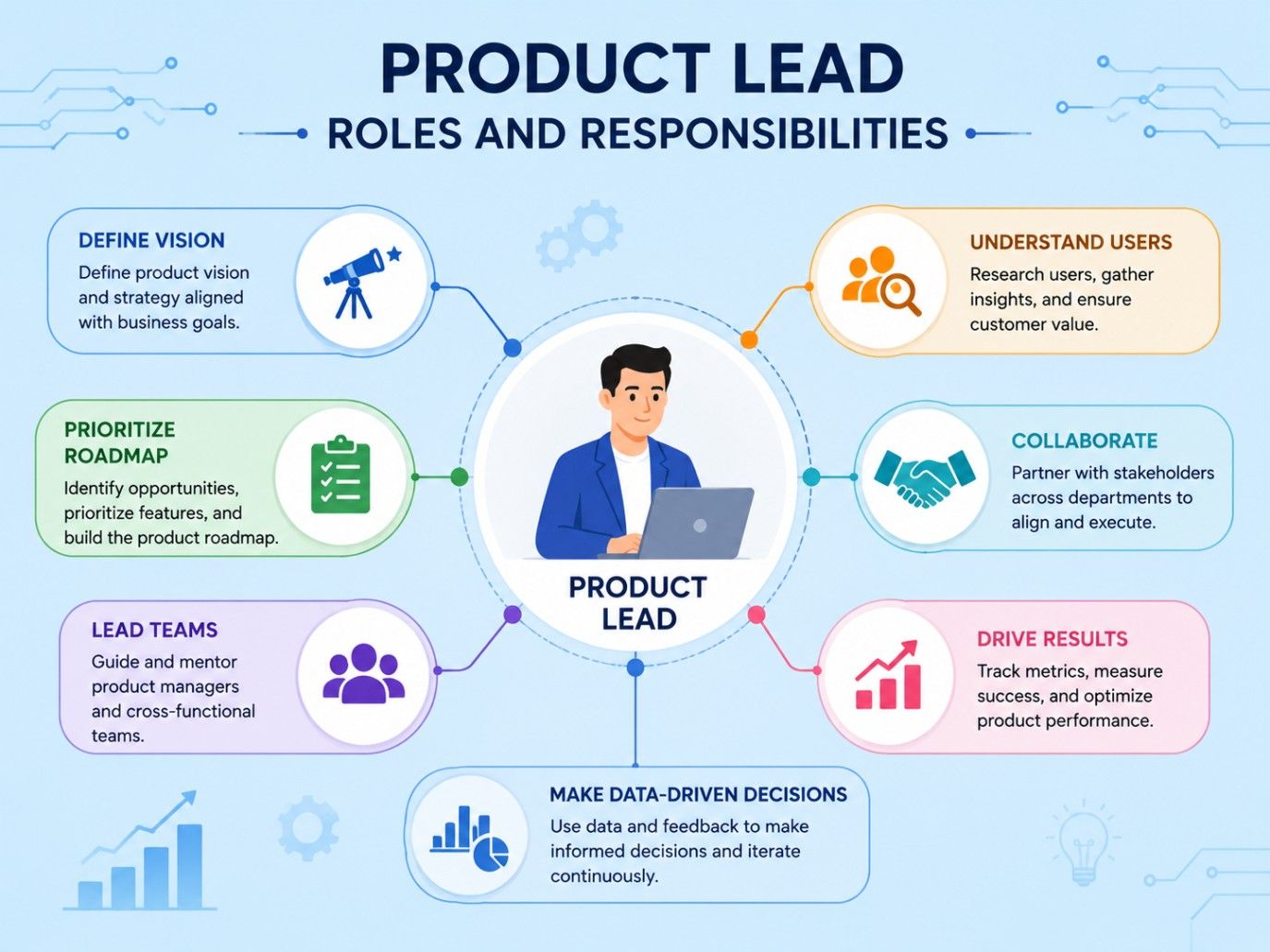
A successful Product Lead combines strategic thinking, leadership, and execution to deliver products that create value for both customers and the business.
A Product Lead follows a structured workflow to turn ideas into successful products. While the exact process varies between organizations, the goal remains the same. Build products that solve customer problems and support business objectives.
The workflow isn't linear. Product Leads continuously gather feedback, measure results, and improve the product after every release.
Stage |
Key Activity |
Outcome |
| Customer Research | Understand customer needs and market trends | Identify product opportunities |
| Product Strategy | Define product vision and business goals | Clear product direction |
| Roadmap Planning | Prioritize features and plan releases | Actionable product roadmap |
| Product Development | Work with engineering and design teams | Build and test features |
| Product Launch | Coordinate release with stakeholders | Successful product launch |
| Performance Review | Track KPIs and customer feedback | Measure product success |
| Continuous Improvement | Refine features and update the roadmap | Better customer experience |
This workflow highlights how a Product Lead connects strategy, execution, and customer feedback to keep the product moving in the right direction throughout its lifecycle.
Also Read: What is Project Management Process: Phases and Life Cycle
A Product Lead needs a balanced mix of technical knowledge, business understanding, leadership, and communication skills. While technical expertise is helpful, the ability to make informed decisions, align teams, and solve customer problems is what makes a Product Lead successful.
Skill Category |
Why It Matters |
Example |
| Technical Skills | Helps collaborate with engineering teams and understand product development. | Understanding Agile, Scrum, APIs, or product analytics tools. |
| Business Skills | Aligns product decisions with business goals and market opportunities. | Prioritizing features based on customer value and ROI. |
| Leadership Skills | Guides cross-functional teams and drives product initiatives. | Leading roadmap discussions and resolving team conflicts. |
| Communication Skills | Keeps stakeholders, developers, and business teams aligned. | Explaining product priorities during sprint planning. |
| Analytical Skills | Supports data-driven decision-making and performance evaluation. | Using customer feedback and KPIs to improve the product. |
| Customer-Focused Skills | Helps build products that solve real user problems. | Conducting user interviews and translating insights into features. |
In some organizations, a product development lead job description places greater emphasis on technical collaboration with engineering teams, while a product design lead job description focuses more on user experience and design thinking. Regardless of the title, these core skills help Product Leads deliver products that meet both customer needs and business objectives.
There isn't a single qualification that makes someone a successful Product Lead. Employers usually look for candidates who combine relevant education with hands-on experience in product management, business strategy, and cross-functional collaboration.
While the exact requirements vary by industry and company size, most product lead job description listings include the following qualifications.
Category |
Details |
| Educational Background | Bachelor's degree in Business, Computer Science, IT, Engineering, Marketing, Economics, or a related field. An MBA is preferred for senior roles. |
| Professional Experience | 5–10 years of experience in product management and cross-functional product delivery. |
| Relevant Experience | Experience as a Product Manager, Senior Product Manager, Product Owner, Business Analyst, or Technical Product Manager. |
| Preferred Certifications | CSPO, SAFe POPM, PMI-ACP, or other Product Management certifications. |
| Strategic Thinking | Ability to define product vision and align it with business goals. |
| Leadership Experience | Experience leading teams and managing cross-functional collaboration. |
| Customer-Centric Mindset | Focus on solving customer problems and improving user experience. |
| Analytical Skills | Ability to use data to make informed product decisions. |
| Communication Skills | Strong communication and stakeholder management skills. |
A Product Lead is responsible for delivering products that create value for both customers and the business. To measure success, organizations track a set of Key Performance Indicators (KPIs) that evaluate product growth, customer satisfaction, delivery efficiency, and business impact.
The exact KPIs vary by company and product type, but most product lead job description roles include the following performance metrics.
KPI |
What It Measures |
Why It Matters |
| Product Adoption Rate | Number of users adopting the product or feature | Indicates market acceptance |
| Customer Satisfaction (CSAT) | User satisfaction with the product | Reflects overall customer experience |
| Customer Retention | Percentage of customers who continue using the product | Measures long-term value |
| Feature Adoption | Usage of newly launched features | Shows whether new features meet user needs |
| Time-to-Market | Time taken to launch new features or products | Tracks delivery efficiency |
| Product Revenue | Revenue generated by the product | Measures business performance |
| Product Engagement | Frequency and depth of product usage | Indicates how valuable the product is to users |
| Roadmap Delivery | Percentage of planned initiatives delivered on time | Evaluates execution and planning |
Tracking KPIs isn't just about reporting numbers. Product Leads use these metrics to identify improvement opportunities, prioritize future enhancements, and make informed product decisions.
For example, if a feature has a high launch rate but low adoption, the Product Lead may investigate customer feedback, review usability issues, or reassess whether the feature addresses a real user need.
Regularly monitoring these performance metrics helps Product Leads balance customer expectations with business objectives and continuously improve product outcomes.
Take the next step in your career with upGrad's MBA Career Acceleration Program from O.P. Jindal Global University. Build the strategic thinking, leadership, and business management skills needed to lead products, drive innovation, and grow into senior product leadership roles.
Subscribe to upGrad's Newsletter
Join thousands of learners who receive useful tips
Although the titles are sometimes used interchangeably, a Product Lead and a Product Manager have different levels of ownership. A Product Manager focuses on planning and delivering a specific product, while a Product Lead oversees the broader product strategy and guides multiple teams toward common business goals.
A Product Lead spends more time making strategic decisions and aligning stakeholders. A Product Manager is more involved in product planning, feature prioritization, and execution.
Aspect |
Product Lead |
Product Manager |
| Primary Focus | Product strategy and leadership | Product planning and execution |
| Scope | Multiple products or strategic initiatives | A single product or product line |
| Key Responsibility | Defines product vision and business direction | Builds and manages the product roadmap |
| Decision-Making | Strategic decisions | Tactical product decisions |
| Works With | Leadership, product managers, engineering, and business teams | Engineering, design, marketing, and stakeholders |
| Success Metric | Business growth, product success, and customer value | Product delivery, adoption, and customer satisfaction |
A product lead job description usually includes leadership responsibilities such as defining product vision, mentoring product managers, and driving long-term business outcomes. In contrast, a Product Manager focuses on turning that strategy into an actionable roadmap and delivering valuable features to customers.
Also Read: Top 10 Books to Improve Communication Skills
A Product Lead and a Product Owner both contribute to product success, but their responsibilities are different. The Product Lead defines the overall direction of the product, while the Product Owner manages the product backlog and works closely with the development team to deliver features.
The Product Owner plays a key role in Agile development by translating business requirements into actionable tasks for engineers. The Product Lead looks beyond individual sprints and focuses on long-term product growth.
Aspect |
Product Lead |
Product Owner |
| Primary Focus | Product strategy and leadership | Sprint planning and backlog management |
| Scope | Overall product direction | Individual features and development priorities |
| Key Responsibility | Defines product vision and business goals | Prioritizes the product backlog |
| Works With | Leadership, engineering, design, marketing, and stakeholders | Developers, Scrum Master, and QA teams |
| Decision-Making | Strategic product decisions | Sprint-level execution decisions |
| Success Metric | Product growth and business impact | Successful delivery of planned features |
Many organisations include both roles in their product teams because they complement each other. While the Product Lead sets the destination, the Product Owner helps the development team take the right steps to reach it. A clear product lead job description defines these responsibilities early, reducing role overlap and improving collaboration across teams.
Also Read: Best Career Options in India 2026: Salary, Future Scope, Jobs
A clear product lead job description helps attract the right candidates and sets realistic expectations. However, many organizations make avoidable mistakes that can lead to confusion or poor hiring decisions.
Avoid generic statements like "manage products" or "lead teams." Instead, clearly describe responsibilities such as defining the product roadmap, prioritizing features, and collaborating with cross-functional teams.
A Product Lead has broader strategic responsibilities than a Product Manager. Mixing both roles in one job description can create unrealistic expectations and attract unsuitable candidates.
Including every possible skill or tool can discourage qualified applicants. Focus on the essential qualifications, leadership abilities, and product management skills needed for the role.
Candidates should understand how their performance will be measured. Mention key metrics such as product adoption, customer satisfaction, roadmap delivery, or business growth.
A good job description should state who the Product Lead reports to and which teams they will work with. This gives candidates a better understanding of the role within the organization.
Before publishing your product lead job description, make sure it:
A well-structured job description not only attracts qualified candidates but also helps set the foundation for long-term success in the role.
Also Read: How to Develop Analytical Thinking [A Complete Guide]
Follow these best practices to create a clear and effective Product Lead job description:
A well-crafted Product Lead job description helps attract candidates with the right blend of product expertise, strategic thinking, and leadership skills. By clearly outlining the role, responsibilities, required qualifications, and expectations, you can improve the quality of applicants and streamline your hiring process. Keep the description clear, concise, and updated to reflect your organization's evolving product goals and business needs.
Ready to start your journey? Book a free consultation with upGrad today to find the best path for your career.
Product Leads are employed across industries such as software, fintech, healthcare, e-commerce, SaaS, manufacturing, and telecommunications. Any organization that develops or manages products can benefit from a Product Lead who aligns customer needs with business goals and drives product success.
In many organizations, yes. A Product Lead typically has broader ownership than a Product Manager, overseeing product strategy, mentoring team members, and coordinating multiple initiatives. However, job titles vary by company, so reporting structures and responsibilities may differ between organizations.
The salary of a Product Leader varies based on experience, industry, company size, and location. In India, Product Leaders typically earn between ₹20 LPA and ₹45 LPA, while senior professionals at large technology companies may receive significantly higher compensation through performance bonuses, ESOPs, and other incentives.
While certifications are not mandatory, they can strengthen your profile. Programs in product management, Agile, Scrum, business strategy, UX, analytics, or leadership demonstrate practical knowledge and can improve career prospects, especially for professionals moving into leadership roles.
A Product Lead acts as the bridge between business, engineering, design, marketing, and customer success teams. They prioritize product requirements, clarify objectives, resolve dependencies, and ensure cross-functional teams work toward delivering valuable products on schedule.
Product Leads often balance competing stakeholder priorities, limited resources, changing customer expectations, and tight delivery timelines. They also need to make strategic decisions with incomplete information while keeping teams aligned with long-term product objectives.
Performance is usually measured using product adoption, customer retention, feature usage, revenue growth, customer satisfaction, roadmap delivery, and business impact. The exact KPIs depend on the organization's goals and the maturity of the product.
Yes. Many Product Leads progress into senior leadership positions such as Head of Product, Director of Product, VP of Product, or Chief Product Officer. Developing strong leadership, strategic planning, and business management skills supports this career progression.
Coding skills are generally not required, but a strong understanding of technology, software development processes, APIs, and product architecture helps Product Leads communicate effectively with engineering teams and make informed product decisions.
Yes. Many organizations now offer hybrid or fully remote Product Lead positions, particularly in the technology and SaaS sectors. Since the role relies heavily on collaboration and digital tools, remote work has become increasingly common across global product teams.
Exceptional Product Leads combine customer-focused thinking, strategic decision-making, leadership, communication, analytical problem-solving, and adaptability. They inspire cross-functional teams, make data-informed decisions, and consistently deliver products that create value for both customers and the business.
724 articles published
Sriram K is a Senior SEO Executive with a B.Tech in Information Technology from Dr. M.G.R. Educational and Research Institute, Chennai. With over a decade of experience in digital marketing, he specia...
Speak with MBA expert
By submitting, I accept the T&C and
Privacy Policy
From MBA to Dream Job - Explore Our Alumni Success Stories
Top Resources
Master's Degree
13 Months
Master's Degree
12 Months
O.P.Jindal Global University
MBA (with Career Acceleration Program by upGrad)Become interview ready with Career Services
Master's Degree
12 Months