KPMG Interview Questions: Everything You Need to Know
By Sriram
Updated on Jul 14, 2026 | 12 min read | 4.65K+ views
Share:

All courses
Certifications
More
By Sriram
Updated on Jul 14, 2026 | 12 min read | 4.65K+ views
Share:
Table of Contents
Quick Overview
This blog covers everything from the KPMG interview process and rounds to role-specific questions for technical, HR, finance, business analyst, audit associate, and automation testing positions. You'll also find preparation tips, common mistakes to avoid, and answers to the questions candidates ask most often before walking into a KPMG interview.
Preparing for a KPMG interview Questions is just the first step. Build in-demand business, technology, and leadership skills with upGrad's Management programs through flexible online learning.
Popular Management Programs
Regardless of the specific role, KPMG technical interview questions tend to test core reasoning ability alongside subject knowledge. This section covers general technical questions that apply across roles before we get into role-specific clusters later.
Here are some commonly asked KPMG technical interview questions:
1. Tell me about a technical project or task you handled recently.
Start with one sentence of context: what the project was about, who it was for, and why it mattered (e.g., "a client manual reconciliation process was taking three days each month, so I was asked to streamline it"). Then explain your specific role, including what you did, not what the team did.
Walk through the approach step by step: what data or systems you worked with, what tool or method you chose and why, and any obstacles you hit along the way. Close with the outcome, ideally quantified (time saved, error rate reduced, revenue impact, stakeholder satisfaction).
Finally, add a short reflection on what you'd do differently or what you learned, as this shows maturity rather than just execution. Imagine explaining your work to a manager outside your specific function and keep technical jargon to a minimum.
2. What tools or software are you comfortable using for your role?
Resist the urge to list every tool you've ever touched. Instead, pick 3-4 that are genuinely relevant to the role you're interviewing for, and for each one, briefly say how you used it, not just that you know it.
For example: "I use Excel extensively, particularly Power Query and pivot tables for cleaning and summarizing large datasets, and I've built a few macros to automate repetitive reporting tasks."
If the role involves auditing or data analytics, mention SQL, Power BI, Tableau, or Alteryx with a concrete use case. If it's an advisory or finance-related role, mention financial modeling tools or ERP systems (e.g., SAP or Oracle) you've worked on. If you are not very proficient in a tool the JD lists, it's fine to say you have working familiarity and are actively building depth in it.
3. Walk me through how you'd approach a problem you've never seen before.
Here you should present a clear, repeatable process rather than an ad hoc reaction, since this question tests structured thinking under uncertainty. Start by clarifying the problem, like what's being asked, what constraints exist, what a "good" outcome looks like, because jumping to solutions before understanding the problem is a common failure point interviewers watch for.
Next, break the problem into smaller, more familiar sub-problems; most "novel" problems are combinations of things you've seen before. Mention that you would research documentation, precedent cases, internal knowledge bases, or consult colleagues with relevant experience rather than guessing.
Then describe testing a hypothesis or a small-scale solution before committing fully and iterating based on what you learn. End by noting you'd validate the result against the original requirement and document the approach for future reference. This shows you have a method, not just instinct.
4. How do you stay updated with changes in your field?
Give specific, ongoing habits rather than a vague "I read a lot." For example: subscribing to industry newsletters or publications relevant to your field (accounting standards updates, tech/data trends, regulatory changes), pursuing certifications (like ACCA, CFA, CPA, or technical certs like Power BI or SQL credentials), attending webinars or internal training sessions, and being part of a professional community or LinkedIn group where practitioners discuss emerging issues.
It also helps to mention applying what you learn. For instance, "when a new accounting standard came out, I read the summary and discussed its implications with my team before it was formally rolled out." This shows that continuous learning is a habit integrated into your work, not just a resume line.
5. Describe a time you had to learn a new tool or system quickly.
Use a mini-STAR structure. Set the situation: what the tool was, why you suddenly needed it (e.g., for a new project, team change, client requirement), and the time pressure involved in implementation.
Explain your learning approach concretely. Did you use official documentation, YouTube tutorials, a colleague as an informal mentor, or trial-and-error in a sandbox environment?
Be specific about the sequence: e.g., "I spent the first evening going through the basic documentation, then spent day two replicating a sample report before applying it to the real dataset." Share the outcome: you delivered on time, or caught up within a defined timeframe, and, if possible, mention you've continued using that skill since, which reinforces that it wasn't a one-off scramble.
6. What technical skills do you think are most relevant to this role?
This answer should clearly connect to the job description, so before the interview, identify 2-3 skills the JD explicitly or implicitly emphasizes (e.g., data analysis, audit methodology, financial modeling, client communication of technical findings, etc.).
For each technical skill, briefly explain why it matters for day-to-day work in that role. For example, "data analysis skills matter because a lot of audit work now involves testing full populations rather than samples, which requires comfort with tools like SQL or IDEA."
Where possible, back each skill with a quick example of you applying it. This shows you've done your homework on the role rather than giving a generic answer that could apply to any job.
7. How do you handle a situation where your technical solution doesn't work as expected?
Interviewers are testing composure and problem-solving abilities under pressure, so keep the tone calm and methodical rather than anxious. Describe your process: first, diagnose and isolate what specifically went wrong rather than immediately scrapping the whole approach.
Second, seek input if needed. Check documentation, ask a colleague, or revisit assumptions you made early on.
Third, implement a fix or a reasonable workaround and communicate early with stakeholders if the failure affects a deadline. Close the learning loop, e.g., by adding a validation check or a test step so the same issue doesn't recur. If you have a real example, even a small one, use it; it's far more convincing than a hypothetical.
8. Explain a concept from your field to someone with no background in it.
Pick something simple and use an everyday analogy rather than technical language; remember, the goal is clarity, not showing off depth. For example, explaining "variance analysis" as comparing what you actually spent this month against your household budget and figuring out why the numbers differ.
Structure it into three parts: name the concept in plain terms, give the relatable analogy, then briefly connect it back to why it matters in a business context. Check for understanding by inviting a question at the end, or you can simply provide an example. This question evaluates communication as much as technical knowledge, so resist the urge to slip back into jargon halfway through.
9. What's the most challenging technical problem you've solved?
Use the full STAR framework tightly. 1. Situation: give a brief context, what made it challenging, e.g., tight deadline, incomplete data, and an unfamiliar system. 2. Task: what you specifically need to achieve. 3. Action: the concrete steps you took. and 4. Result: the measurable outcome, plus what you learned.
Pick one problem and stay focused on it rather than blending multiple stories, since a single, well-detailed example is far more memorable and credible than a vague composite. If possible, choose an example where the challenge wasn't just technical complexity but also involved constraints like time pressure, ambiguity, or stakeholder pushback — it shows more rounded problem-solving.
10. How do you prioritize tasks when working on multiple technical assignments?
Describe a clear method rather than. Start with how you assess priority. It should typically be a mix of deadline urgency and business impact (e.g., a client-facing deliverable due tomorrow outranks an internal report due next week).
Mention breaking larger tasks into smaller milestones, so progress is visible and nothing slips silently. Talk about the tools you use to stay organized such as a task tracker, shared calendar, or simple to-do list and how you communicate proactively when priorities conflict, rather than silently missing a deadline.
Finally, note that you stay flexible; priorities shift when new information arrives (such as a client escalation or a manager's request), and you reassess rather than rigidly sticking to a plan that's no longer optimal.
These general questions set the foundation. From here, KPMG tailors its technical rounds based on the specific role you're applying for, which is where role-specific preparation becomes important.
Also Read: Which of These Product Management Tools Are You Already Using?
Free Courses
Audit is one of KPMG's largest practice areas, and KPMG interview questions for audit associate roles are among the most searched, as many candidates enter the firm through this path, especially CA articleship candidates in India.
Interviewers typically start with foundational audit concepts before moving into scenario-based questions. Common areas include:
Since audit work is grounded in compliance, expect questions on accounting standards and regulations, such as:
1. Walk me through the audit cycle.
Structure this as four clear phases so the interviewer can follow your logic easily.
If you've been part of any stage during an internship, let's say, fieldwork on a specific client. Mention it briefly to ground the answer in real experience rather than just textbook recall.
2. How is materiality determined in an audit?
Explain that materiality isn't a fixed number; it's a judgment call based on both the size and nature of an item relative to the financial statements as a whole.
On the quantitative side, auditors often use a benchmark like a percentage of revenue, total assets, or profit before tax (common ranges are around 0.5%–1% of revenue or 5%–10% of profit before tax, though this varies by firm methodology and client circumstances).
On the qualitative side, even a small misstatement can be detrimental if it affects compliance with loan covenants, changes a profit into a loss, involves fraud, or relates to related-party transactions. Thus, nature matters as much as size.
It's also worth mentioning that materiality is set at the planning stage but reassessed throughout the audit as new information comes in, and that a lower "performance of materiality" is typically used for testing to build a margin of safety.
3. What is the difference between substantive testing and control testing?
In practice, the two testing methods are connected. If control testing shows controls are strong and reliable, auditors can often reduce the extent of substantive testing (and vice versa). This trade-off is part of designing an efficient, risk-based audit approach.
4. How do you verify inventory during an audit?
Break this into three components, since inventory verification typically covers existence, valuation, and cut-off.
Mentioning that you'd also reconcile physical count results back to the general ledger shows you understand the full loop, not just the count itself.
5. What are related party transactions, and why do they matter in audits?
Define them clearly first: related party transactions are dealings between the company and parties that have significant influence over it or are influenced by it, this includes subsidiaries, holding companies, key management personnel, directors, and their close family members.
They matter because they carry a higher inherent risk of manipulation, such as transactions priced above or below market value to shift profits, hide losses, or benefit specific individuals, since the "arm's length" assumption that normally applies to transactions may not hold.
Auditors typically address this by obtaining a complete list of related parties from management, cross-checking it against statutory filings and other sources, examining whether transactions are appropriately disclosed and priced, and applying heightened professional skepticism given the elevated risk of fraud associated with these transactions.
6. Explain the Going Concern assumption.
Explain that the going concern is a fundamental accounting assumption that a company will continue operating for the foreseeable future (typically at least 12 months from the reporting date) without any intention or necessity to liquidate or significantly curtail operations.
Financial statements are prepared on this basis by default, which affects how assets and liabilities are valued (e.g., at historical/amortized cost rather than forced-sale/liquidation values).
The auditor's role is to assess whether this assumption is appropriate, looking for indicators such as recurring losses, negative working capital, loan covenant breaches, loss of a major customer, or an inability to pay debts as they fall due.
If material uncertainty exists, the auditor must ensure it's properly disclosed in the financial statements and may need to include an "Emphasis of Matter" or modify the audit opinion depending on the severity and adequacy of disclosure.
7. What red flags do you look for during an audit?
Group your answer into a few categories so it sounds organized rather than like a random list.
Mentioning that these flags don't automatically indicate fraud, but rather raise your professional skepticism and often trigger additional procedures, shows a balanced understanding.
8. What is CARO 2020?
Explain that CARO stands for the Companies (Auditor's Report) Order, 2020, an order issued under the Companies Act (in India) that requires auditors of specified companies to report on a set of additional matters beyond the standard true-and-fair audit opinion.
These typically include matters such as fixed asset verification and title deeds, inventory verification, compliance with statutory dues, whether the company has defaulted on loan repayments, utilization of borrowed funds for stated purposes, and reporting on fraud noticed during the audit, among other clauses.
It's worth noting that CARO applies to most companies but includes specific exemptions (e.g., certain small companies, one-person companies, and certain categories are excluded), and it exists to provide stakeholders, lenders, regulators, and investors with a deeper layer of assurance than the standard opinion alone can provide.
If you're targeting KPMG interview questions for audit associate roles specifically, focus your preparation on Indian accounting standards, recent regulatory changes, and practical audit scenarios rather than just theory.
Also Read: How To Improve Your Career Skills for a Job and Employability
Management Courses to upskill
Explore Management Courses for Career Progression
IIIT-B & IIM, Udaipur
Chief Technology Officer & AI Leadership ProgrammeKPMG finance interview questions differ from audit questions in one key way: they lean more toward corporate finance, financial analysis, and valuation rather than compliance and reporting.
Candidates should be comfortable with:
1. Walk me through the three financial statements and how they connect.
Start by naming the three statements and what each one shows: the income statement reports revenue, expenses, and net income over a period; the balance sheet shows assets, liabilities, and equity at a single point in time; and the cash flow statement tracks actual cash movement across operating, investing, and financing activities. Then walk through the linkages explicitly, since that's really what's being tested.
Net income from the income statement flows into retained earnings on the balance sheet (adjusted for any dividends paid), which is part of shareholders' equity.
The cash flow statement starts with net income and adjusts for non-cash items (like depreciation) and changes in working capital to arrive at actual cash generated, and the ending cash balance ties directly to the cash line on the balance sheet.
Closing with a simple example, e.g., "if a company records a sale on credit, net income goes up on the income statement, but cash doesn't move until the receivable is collected, which is exactly why cash flow and net income can diverge", shows you understand the mechanics, not just the definitions.
2. What financial ratios would you use to assess a company's liquidity?
Lead with the current ratio (current assets ÷ current liabilities), which measures whether a company has sufficient current assets to cover its short-term obligations; generally, a ratio above 1 is considered healthy, though "healthy" varies by industry.
Follow with the quick ratio (or acid-test ratio), which is more conservative because it excludes inventory from current assets — useful because inventory can be slow to convert to cash, so this ratio better reflects immediate liquidity.
You can add a third layer for depth: the cash ratio (cash and equivalents ÷ current liabilities), the strictest measure, or the operating cash flow ratio, which looks at actual cash generated from operations rather than just balance sheet snapshots.
It's worth noting that no single ratio tells the full story — a very high current ratio might actually indicate inefficient use of assets rather than strong liquidity, so context (industry norms, trend over time) matters as much as the number itself.
3. How would you value a private company with limited public data?
Acknowledge upfront that a traditional DCF becomes harder here because reliable forecasts, discount rate inputs (like beta), and sometimes even historical financials are limited or unaudited — so practical alternatives are typically used instead.
Comparable company analysis involves identifying publicly traded companies in the same industry with similar size, growth, and margin profiles, then applying their valuation multiples (such as EV/EBITDA or P/E) to the private company's financials, usually with a discount applied for lack of marketability since private shares are harder to sell.
Precedent transactions involve looking at what similar private companies actually sold in past M&A deals, which can better reflect real-world pricing, including control premiums.
You can also mention that if some financial data exists, a simplified DCF can still be built with more conservative assumptions and sensitivity analysis to account for the added uncertainty, but comparables and precedents are usually the more defensible starting point when data is genuinely scarce.
4. What's the difference between EBITDA and net income?
Explain that net income is the bottom-line profit after every expense has been deducted, including interest on debt, taxes, depreciation, and amortization, so it reflects the company's actual accounting profit, including its capital structure and tax situation.
EBITDA (Earnings Before Interest, Tax, Depreciation, and Amortization) strips out those items, making it useful for comparing the core operating performance of companies with very different debt levels, tax jurisdictions, or capital intensity (and therefore very different depreciation schedules).
It's worth adding a note of caution here, since this often comes up as a follow-up: EBITDA is not a substitute for net income or cash flow; it ignores real cash costs such as interest payments and capital expenditures, so a company can have strong EBITDA but still be cash-strapped or overleveraged. Analysts use it as one lens among several, not a standalone measure of financial health.
5. How do you assess whether a company is over-leveraged?
Explain that leverage should never be judged from a single ratio in isolation, since debt level alone doesn't tell you whether a company can actually service that debt.
The debt-to-equity ratio shows how much of the company is financed by debt versus shareholder equity, a useful structural snapshot, but it doesn't account for earnings capacity.
Pair it with the interest coverage ratio (EBIT ÷ interest expense), which shows whether the company is actually generating enough operating earnings to comfortably cover its interest obligations; a low or declining ratio is often a more urgent red flag than a high debt-to-equity ratio on its own.
You can strengthen the answer by mentioning that context matters too: capital-intensive industries (utilities, telecom) typically run higher leverage than asset-light industries (services, tech), so comparing against industry peers and looking at the trend over time, rather than a single snapshot, gives a fuller picture of whether leverage is a genuine risk or just sector-normal.
6. Explain working capital and why it matters.
Working capital = current assets − current liabilities. It represents the short-term resources a company has left after covering its short-term obligations.
It matters because it measures operational liquidity: a company can be profitable on paper yet still struggle to pay suppliers, employees, or short-term debt if working capital is insufficient. Positive working capital signals comfortable near-term coverage; negative or shrinking working capital often warns of cash strain before it appears in profit figures.
The main drivers are receivables, payables, and inventory. Managing these well, collecting faster, negotiating better payment terms, avoiding excess inventory — lets companies free up cash without external financing.
7. What would you check first if a company's profits are rising but cash flow is falling?
Frame this as a classic sign that reported profit isn't translating into actual cash, and walk through the most likely culprits.
First, check receivables: if revenue is being recognized but customers aren't paying on time, profit rises while cash lags; a rising Days Sales Outstanding (DSO) alongside profit growth is a strong signal.
Second, consider revenue recognition practices: the company may be recognizing revenue aggressively (e.g., booking sales before cash is received or even before goods/services are fully delivered), which inflates reported profit without a corresponding cash inflow.
Third, look at inventory buildup or payables management: inventory tying up cash or the company delaying payments to suppliers can also distort the profit-cash relationship.
Mentioning that you'd pull the cash flow statement and specifically examine changes in working capital line items is a good way to show you'd investigate systematically rather than just name possibilities.
8. How do you approach a client who disagrees with your financial analysis?
You can answer it in the following manner
I would handle it in four steps:
The balance interviewers look for: confidence in the work, paired with genuine openness — not caving under pressure, but not being rigid either.
KPMG finance interview questions often blend technical accuracy with client-facing scenarios, since many finance roles at KPMG involve direct client interaction.
If audit and finance roles at firms like KPMG interest you, the right qualification can make a real difference to how you're evaluated. The MSc in International Accounting & Finance from JGU (Accredited by ACCA, UK) , is built to prepare you for exactly these roles, with a curriculum covering global accounting standards, financial reporting, and audit practices that top firms look for.
KPMG business analyst interview questions sit at the intersection of technical skill and business thinking. Candidates are expected to understand data, processes, and stakeholder needs simultaneously.
Typical areas covered include:
Business analyst interviews at KPMG often include short case scenarios where you're asked to break down a business problem and suggest an approach. This isn't about having a perfect answer; it's about showing structured thinking.
1. How do you gather requirements from stakeholders with conflicting priorities?
Begin by having individual conversations to understand each stakeholder's underlying goal, not just their stated request; the "why" behind a requirement often reveals more flexibility than the requirement itself. Look for common ground or overlapping needs that can satisfy multiple parties at once.
If conflicts remain unresolved, document the trade-offs clearly and escalate to a decision-maker with objective criteria (cost, timeline, business impact) rather than opinion.
2. Write a simple SQL query to find duplicate records in a table.
A common approach is SELECT column_name, COUNT(*) FROM table_name GROUP BY column_name HAVING COUNT(*) > 1; — this groups rows by the column(s) that define a "duplicate" and filters to only those appearing more than once.
Be ready to explain that GROUP BY collapses matching rows and HAVING filters on the aggregated count (unlike WHERE, which can't filter on aggregates). If asked to return full duplicate rows rather than just counts, mention using a self-join or a window function like ROW_NUMBER() OVER (PARTITION BY...).
3. How would you approach a client asking to improve process efficiency?
Start by mapping the current process end-to-end, ideally through direct observation or interviews with people who actually perform it, since documented processes often differ from reality.
Identify bottlenecks/steps that cause delays, rework, or resource strain, using data where available (e.g., cycle times, error rates). Propose targeted changes to the highest-impact bottlenecks first, rather than a full redesign, and validate them with a small pilot before rolling them out broadly.
4. What's the difference between a functional and a non-functional requirement?
Functional requirements describe what the system should do, specific features, behaviors, or outputs, like "the system should allow users to reset their password."
Non-functional requirements describe how well it should do it, qualities like performance, security, scalability, or usability, such as "password reset should complete within 2 seconds." Both are essential: functional requirements without non-functional ones can produce a system that works but performs poorly or is unsafe.
5. How do you handle a situation where data doesn't match what a client expects?
Before assuming either the client or the data is wrong, verify the data source and methodology first: check for differences in date ranges, filters, definitions, or system versions that could explain the discrepancy.
Walk the client through your methodology transparently so they can see exactly how the number was derived. If the discrepancy turns out to be a genuine error, correct it and communicate clearly; if it's a difference in definitions, align on a shared definition going forward.
6. Describe a time you translated a technical issue into simple terms for a non-technical stakeholder.
Use a brief example: describe the technical issue, who the audience was, and how you adapted your language, using an analogy, avoiding jargon, or focusing on business impact rather than mechanics (e.g., "the system was slow because of a data bottleneck" instead of naming the specific technical cause).
Mention checking for understanding by inviting questions. This shows you can bridge technical depth and clear communication, a core BA skill.
7. What tools have you used for data visualization or analysis?
Name specific tools you've genuinely worked with and briefly say how, for example, "Power BI for building interactive dashboards for stakeholder reporting" or "Excel with Power Query for cleaning and transforming raw data before analysis."
If you've used SQL, Tableau, or Python (pandas), mention the specific use case rather than just listing the tool name. Specificity signals hands-on experience rather than surface familiarity.
8. How would you estimate the market size for a new product?
Choose between a top-down approach: starting from a broad market figure (like total industry revenue) and narrowing down using relevant filters (target segment, geography, adoption rate), or a bottom-up approach, building up from unit-level assumptions (number of potential customers × price × purchase frequency).
Explain your assumptions clearly and transparently, since interviewers care more about your logical structure than about arriving at an exact number. Mention sanity-checking your estimate against any available benchmarks or comparable products.
KPMG business analyst interview questions reward candidates who can move fluidly between data, process, and communication rather than those who are strong in only one area.
Automation testing roles at KPMG sit under the technology and advisory functions, and KPMG interview questions for automation testing focus heavily on tools, frameworks, and testing logic rather than finance or audit concepts.
Common areas tested include:
1. What is the difference between SDLC and STLC?
SDLC (Software Development Life Cycle) covers the entire process of building software: requirements, design, development, testing, deployment, and maintenance.
STLC (Software Testing Life Cycle) is a subset focused specifically on the testing phases, test planning, test case design, environment setup, execution, and closure. STLC typically runs in parallel with SDLC rather than only after development is complete, especially in agile environments.
Understanding both shows you see testing as integrated into delivery, not a separate afterthought.
2. How do you decide what to automate versus what to test manually?
Prioritize test cases that are repetitive, stable (not subject to frequent UI/logic changes), and high-priority from a business-risk standpoint — regression suites and core workflows are classic automation candidates. Conversely, keep exploratory, usability-focused, or frequently-changing features in manual testing, since automation scripts for volatile features require constant rework and can become a maintenance burden. Also factor in ROI — if a test case runs only once or twice, automating it often isn't worth the setup time.
3. What is a framework in automation testing, and why is it used?
A framework is a structured set of guidelines, tools, and reusable components (such as utility functions, locators, and reporting mechanisms) that organizes the way automated tests are built and executed.
It's used because it makes scripts more maintainable, readable, and scalable; instead of duplicating code across tests, common actions are written once and reused. Common types include data-driven, keyword-driven, and hybrid frameworks, each suited to different testing needs and team skill levels.
4. Explain the difference between Selenium WebDriver and Selenium Grid.
Selenium WebDriver is the core tool that directly automates browser actions such as clicking, typing, and navigating by communicating with the browser via its native automation APIs.
Selenium Grid extends this by allowing tests to run in parallel across multiple machines, browsers, and operating systems, significantly speeding up execution for large test suites. In short, WebDriver handles what the test does, while Grid handles where and how many environments it runs on at once.
5. How do you handle dynamic elements in a web page during automation?
Use explicit waits (e.g., WebDriverWait) to pause execution until a specific condition is met, like an element becoming visible or clickable, rather than relying on fixed sleep times, which are unreliable and slow.
For elements whose IDs or attributes change dynamically, use more robust locator strategies such as relative XPath, CSS selectors targeting stable attributes, or partial text matching. It also helps to work with developers to add stable, unique identifiers (such as data-testid attributes) specifically for automation.
6. What is a test case, and what should it include?
A test case is a documented set of steps designed to verify that a specific feature or functionality behaves as expected. It should include a clear objective (what's being tested), preconditions (setup required before execution), step-by-step actions, expected results (what should happen), and actual results (what did happen, filled in during execution).
Well-written test cases are detailed enough that someone unfamiliar with the feature could execute them and get consistent results.
7. How do you prioritize test cases when time is limited?
Focus first on high-risk, high-impact areas of the application, features that are used most frequently, are tied to core business functionality, or have historically been prone to defects.
Use a risk-based approach: consider both the likelihood of failure and the severity of impact if that area breaks. Deprioritize low-risk, rarely-used, or cosmetic features when time is genuinely constrained, and communicate clearly to stakeholders what's being deferred and why.
8. Describe a bug you found that was hard to reproduce and how you handled it.
Briefly describe the bug, like what made it inconsistent (e.g., only occurring under specific data conditions, timing, or environment configurations). Explain your methodical approach: checking logs, narrowing down the exact conditions through repeated testing, isolating variables one at a time, and collaborating with developers to add additional logging if needed.
Close with the outcome, whether you successfully reproduced and reported it with clear steps, or documented the pattern even without full reproduction, showing patience and structured thinking under uncertainty.
Since KPMG's technology consulting work spans multiple industries, candidates for automation testing roles should also be ready to discuss how testing fits into broader project delivery, not just the technical mechanics.
Once the technical rounds are done, KPMG HR interview questions focus on personality, motivation, and fit. These questions might seem simple, but a lot of candidates stumble here because they don't prepare structured answers.
1. What are your greatest strengths?
Choose 1-2 strengths that are directly relevant to the role rather than generic traits like "hardworking."
For each, back it up with a quick, concrete example, like, "I'm detail-oriented; while working on a group project, I caught a data inconsistency others had missed, which prevented an incorrect conclusion in our final report." This makes the strength credible rather than just a claim.
2. What is your biggest weakness?
Pick something genuine rather than a disguised strength (like "I work too hard"), since interviewers can usually tell when an answer is rehearsed to sound safe.
State the weakness clearly, briefly explain how it's shown up in real situations, and then focus most of your answer on the concrete steps you're taking to improve it, e.g., "I used to struggle with public speaking, so I started volunteering to present in team meetings to build confidence." The improvement effort matters more than the weakness itself.
3. Where do you see yourself in five years?
Keep the answer realistic and grounded in growth within the firm or industry rather than an unrelated career pivot, e.g., progressing from an associate role into a specialist or senior position, deepening expertise in a specific practice area, or taking on more client-facing responsibility.
Avoid overly specific job titles or timelines that could sound rigid; instead, focus on the trajectory (skill growth, increasing responsibility) and tie it back to how the firm supports that path.
4. Why are you leaving your current job?
Stay professional and forward-looking. Frame the answer around what you're moving toward (new challenges, growth opportunities, better alignment with your skills or interests) rather than what you're moving away from.
Avoid criticizing your current or previous employer, manager, or colleagues, even if the real reasons involve frustration, since it can raise concerns about how you'll speak about KPMG in the future. If asked directly about a negative reason, acknowledge it briefly and neutrally, then pivot back to the positive opportunity ahead.
5. How do you handle pressure at work?
Share a specific example rather than a general statement like "I stay calm." Briefly describe a high-pressure situation like a tight deadline, competing priorities, or an unexpected problem, and walk through what you actually did: prioritizing tasks, breaking work into manageable steps, communicating proactively if timelines were at risk, and staying focused rather than reactive.
Close with the outcome, showing that your approach led to a successful result despite the pressure.
The KPMG aptitude test is usually the first hurdle, and it's designed to filter candidates before the interview stage even begins.
Expect questions on percentages, ratios, time and work, and basic data interpretation. Speed matters here as much as accuracy.
This section tests pattern recognition, coding and decoding, and sequence-based problems. Practicing under a timer helps more than reading theory.
Behavioral questions ask you to reflect on past experiences, usually to predict how you'd behave in similar future situations.
1. Tell me about a time you solved a difficult problem.
Use the STAR structure tightly: briefly set the Situation (what made the problem difficult, like its complexity, ambiguity, or constraints). State the Task (what you specifically needed to achieve). Then walk through the Action (the concrete steps you took, which should be the most detailed part), and close with the Result (a measurable or clear outcome).
Pick one focused example rather than blending multiple stories, and if possible, mention what you learned; it shows reflection, not just execution.
2. Describe a time you worked under a tight deadline.
Rather than just stating you met the deadline, focus on how you organized your time, e.g., breaking the work into prioritized chunks, identifying which tasks were truly critical versus nice-to-have, and cutting out anything non-essential.
Mention any proactive communication, such as flagging risks to a manager early rather than staying silent until the last minute. Close with the outcome, but keep the emphasis on your planning process, since that's what the question is really testing.
3. Tell me about a time you managed a conflict within your team.
Briefly describe the source of the conflict without dwelling on blame or naming individuals negatively; keep the tone neutral and professional. Explain how you approached it: listening to both perspectives, finding common ground, and facilitating a solution rather than escalating or avoiding the issue.
Close with the outcome: the conflict was resolved, the team moved forward productively, and, ideally, mention any lasting improvements, such as a clearer process to prevent similar friction.
4. Describe a time you took initiative beyond your job responsibilities.
Choose an example where you identified a gap or opportunity nobody explicitly asked you to address, e.g., noticing an inefficient process and proposing a fix, or volunteering for an unassigned task that needed doing.
Explain what motivated you to act rather than wait to be asked, and what you actually did. Close with the outcome and, if possible, how your team or manager received it. This reinforces the ownership mindset KPMG values.
5. Share an example of a mistake you made and what you learned from it.
Choose a genuine mistake, not a disguised strength, and briefly own it without over-explaining or making excuses, since honesty and accountability matter more here than appearing flawless.
Explain what caused it, how you addressed or corrected it at the time, and most importantly, what concrete change you made afterward to prevent it from happening again (a new habit, a process check, asking for feedback earlier). Ending on the learning, rather than dwelling on the mistake itself, leaves a stronger final impression.
Case studies are more common for consulting and advisory roles. They test structured problem-solving in a business context.
1. How would you improve profitability for a retail client?
Break profitability into two broad levers: revenue growth and cost reduction, since profit is fundamentally revenue minus costs. On the revenue side, consider increasing sales volume, selectively raising prices, improving the product mix toward higher-margin items, or boosting customer retention.
On the cost side, consider reducing operating expenses, optimizing inventory and supply chain, or renegotiating supplier contracts; then prioritize whichever lever offers the fastest, highest-impact win given the client's specific situation.
2. A client's sales have declined by 20 percent. How would you approach the problem?
Start by narrowing the cause into three broad buckets: a demand issue (market shrinking or changing customer preferences), a competition issue (rivals gaining share through pricing, product, or marketing), or an internal issue (stockouts, poor service, pricing missteps, or execution problems).
Ask clarifying questions to isolate which segment, region, or product line is driving the decline, since a uniform drop points to macro factors while a localized drop points to something specific and fixable. Once narrowed down, dig into data such as sales trends, customer feedback, and competitor moves before proposing a solution.
3. How would you recommend a company reduce operating costs?
Separate costs into fixed (rent, salaries, long-term contracts) and variable (materials, utilities, commissions), since each requires a different approach; fixed costs often need structural or contractual renegotiation, while variable costs can be trimmed more flexibly with volume or efficiency changes.
Identify quick wins first: renegotiating supplier terms, cutting non-essential spend, improving process efficiency. Since these build momentum and show fast impact. Then address longer-term structural changes, such as automating manual processes or consolidating facilities, which take more time but often deliver greater sustained savings.
4. How would you estimate the market size for a new product?
Choose between a top-down approach, starting with a broad industry figure and narrowing it down using relevant filters such as target segment, geography, and expected adoption rate, or a bottom-up approach, building up from unit-level assumptions such as the number of potential customers, price point, and purchase frequency.
Clearly state your assumptions as you go, since interviewers care more about the logic and structure than an exact final number. Sanity-check your estimate against any available benchmarks or comparable products to show you're validating, not just calculating in isolation.
5. A client wants to expand into a new market. What factors would you analyze?
Start with market demand: is there a genuine customer need and sufficient market size to justify entry? Then assess the competitive landscape, identify the existing players, their market shares, and how differentiated the client's offering would be.
Factor in the regulatory environment, including licensing requirements, trade restrictions, or compliance obstacles specific to that market, and entry barriers more broadly, such as capital requirements, distribution challenges, or cultural/language differences that could affect execution.
KPMG is one of the world's largest professional services firms, and its hiring process is designed to test both technical knowledge and cultural fit. If you are preparing for a KPMG interview, it helps to understand what the firm is looking for before you start exploring various interview questions.
KPMG hires across multiple functions, including audit, tax, advisory, technology, and business consulting. Because the roles vary so much, the interview process isn't identical for every candidate. A business analyst applicant will face a very different set of questions compared to someone applying for an audit associate position, even though both go through the same broad framework.
That said, a few things stay consistent across almost every KPMG interview:
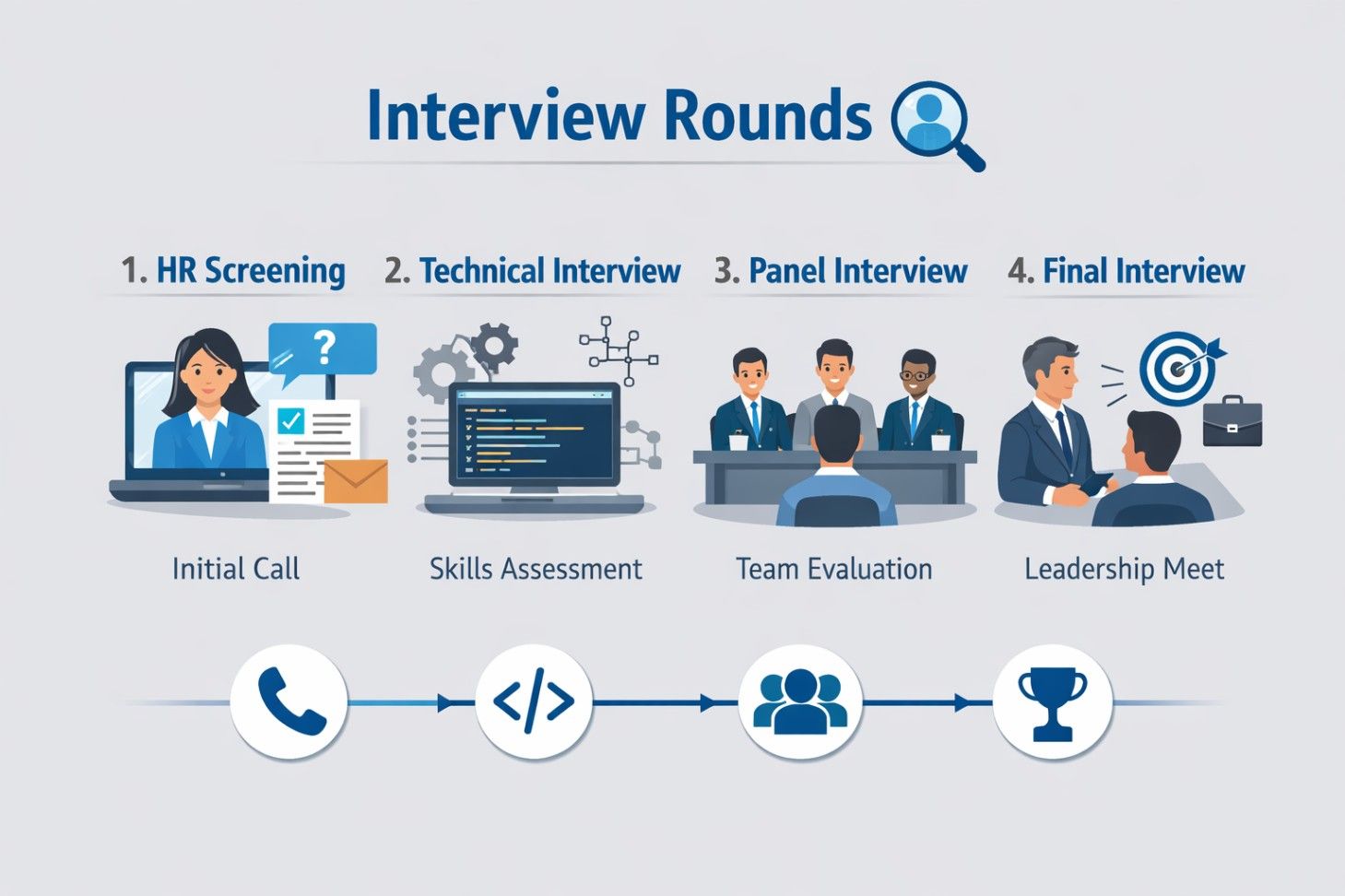
Most candidates go through some combination of an online assessment, a technical round, and an HR or behavioral round. Senior or specialized roles may include an additional case study or partner-level discussion. Knowing this structure ahead of time takes away much of the guesswork, and it's the first step in preparing well for KPMG interview questions.
Also Read: KPMG Salary in India 2026: Roles, Pay Structure & Career Growth
The number and order of rounds can vary slightly depending on the role and location, but most KPMG interviews follow a similar pattern. Here's a quick breakdown:
This is usually the first filter. It includes quantitative aptitude, logical reasoning, and sometimes a short verbal ability section. The goal isn't to trip you up with tricky math, it's to see how quickly and accurately you can process information under time pressure.
This round digs into your subject knowledge. For audit or finance roles, expect accounting and audit concepts. For business analyst or automation testing roles, expect questions about tools, processes, and problem-solving scenarios specific to those functions.
Here, KPMG wants to understand who you are beyond your resume. Expect questions about your strengths, weaknesses, career goals, and how you handle pressure or conflict.
Not every candidate goes through this stage, but for senior or specialized positions, a final round with a partner or senior manager is common. This round often covers judgment, leadership potential, and long-term fit within the firm.
Also Read: Best Career Options in India 2026: Salary, Future Scope, Jobs
Preparing well for KPMG interview questions isn't about memorizing answers, it's about building genuine familiarity with the firm and your own experience.
Freshers are usually evaluated on fundamentals, learning ability, and communication skills, since they don't have much work experience to draw on. Experienced professionals, on the other hand, face deeper technical probing and are expected to discuss real project outcomes, client interactions, and decision-making under pressure.
If you're a fresher, focus on strong fundamentals and clear communication. If you're experienced, be ready to walk through specific projects with measurable outcomes.
Many candidates prefer a downloadable reference to revise on the go. Keep a simple document with the questions listed in this guide, organized by round and role, so you can review it quickly before your interview without scrolling through pages of content.
Cracking KPMG interview questions comes down to preparation that's specific to your role, not generic memorization. Whether you're preparing for audit associate, finance, business analyst, or automation testing positions, understanding the structure of each round and practicing real scenarios will put you in a much stronger position. Focus on clear communication, genuine examples from your own experience, and a solid grasp of the fundamentals relevant to your role, and the rest of the preparation becomes much more manageable.
Ready to start your journey? Book a free consultation with upGrad today to find the best path for your career.
The KPMG interview is competitive, but it's manageable with the right preparation. Recruiters evaluate your technical knowledge, communication skills, problem-solving ability, and cultural fit rather than expecting perfect answers. Practicing common interview questions and researching the company can significantly improve your performance.
The number of interview rounds depends on the role and location. Most candidates go through an aptitude assessment (for some roles), a technical interview, an HR interview, and occasionally a managerial or case study round. Experienced professionals may also have leadership or client-facing interviews.
Yes, coding questions are common for software development, data, and technology roles. Interviewers may assess programming fundamentals, data structures, algorithms, SQL, databases, object-oriented programming, and problem-solving through coding exercises or technical discussions based on your experience.
Communication skills play a significant role in KPMG interviews because employees regularly collaborate with teams and interact with clients. Interviewers assess how clearly you explain your ideas, structure your answers, and communicate technical concepts in a professional and confident manner.
The hiring timeline varies depending on the position and hiring requirements. Many candidates complete the interview process within two to four weeks, although campus recruitment and experienced hiring may follow different schedules based on business needs.
No. Case study interviews are primarily used for consulting, advisory, business transformation, and strategy-related positions. Technical, audit, tax, and support roles generally focus more on domain knowledge, problem-solving, and behavioral interview questions.
KPMG values candidates who demonstrate analytical thinking, integrity, teamwork, adaptability, client focus, and strong communication skills. Recruiters also look for individuals who can solve business problems, learn quickly, and work effectively in collaborative environments.
Yes. Freshers are evaluated on their academic knowledge, internships, projects, certifications, communication skills, and willingness to learn. Explaining your projects confidently and demonstrating problem-solving abilities can help compensate for limited professional experience.
Research KPMG's services, culture, and career development opportunities before your interview. Explain how the company's work aligns with your skills, interests, and long-term career goals, while highlighting the value you can bring to the organization.
Common reasons include weak technical preparation, poor communication, generic answers, limited knowledge about KPMG, and an inability to explain projects clearly. Practicing structured responses and preparing real-world examples can help you avoid these mistakes.
Absolutely. Mock interviews improve confidence, communication, and answer structure while helping you identify knowledge gaps. They also simulate real interview conditions, making it easier to manage pressure and respond confidently during the actual KPMG interview.
727 articles published
Sriram K is a Senior SEO Executive with a B.Tech in Information Technology from Dr. M.G.R. Educational and Research Institute, Chennai. With over a decade of experience in digital marketing, he specia...
Get Free Consultation
By submitting, I accept the T&C and
Privacy Policy
Top Resources
Certification
3 Months
Certification
6 Months
O.P. Jindal Global University
Masters in International Accounting and Finance (Accredited by ACCA, UK)Master's Degree
12 Months