Data Ingestion: Complete Guide to Architecture, Pipelines, Types & Best Practices
By Sriram
Updated on Jul 03, 2026 | 6 min read | 2.26K+ views
Share:

All courses
Certifications
More
By Sriram
Updated on Jul 03, 2026 | 6 min read | 2.26K+ views
Share:
Table of Contents
Data ingestion is basically how raw data makes its way into your system. Think of it as the process of pulling in data from all sorts of places like apps, sensors, files, APIs, etc., and funneling it into one central spot, like a data warehouse, lake, or database, where it can actually be put to use.
It's the very first step of any data pipeline, without it, nothing can happen, be it analytics, dashboards, machine learning models, business insights. Everything downstream depends on data being ingested properly first.
This guide will explain the data ingestion meaning, data ingestion pipelines, different ingestion types, common techniques, monitoring practices, architecture, challenges, and practical strategies for choosing the right approach.
Understanding AI concepts is only the first step toward building a successful career in this field. Explore our Artificial Intelligence Courses and compare programs designed to help you develop practical, industry-ready skills.
Popular AI Programs
Data ingestion is when we bring data into one main system, where it validates, changes if needed, and gets it ready to use for analysis or day-to-day operations. It is not only about collecting data; it also makes sure the data gets to where it needs to go in a way that can be used.
According to research from Gartner and IBM, companies keep investing in modern data architectures because high quality and timely data directly affect analytics, AI, and business decisions. Reliable data ingestion is the basis of these systems.
Related Article: Data Modeling for Data Integration: Best Practices and Tools
Data Ingestion Meaning: It is the process of collecting data from one or more sources and moving it to a place where it can be stored processed or analyzed. The place could be a data warehouse, data lake, cloud storage, or another analytics system.
The process involve:
Free Courses
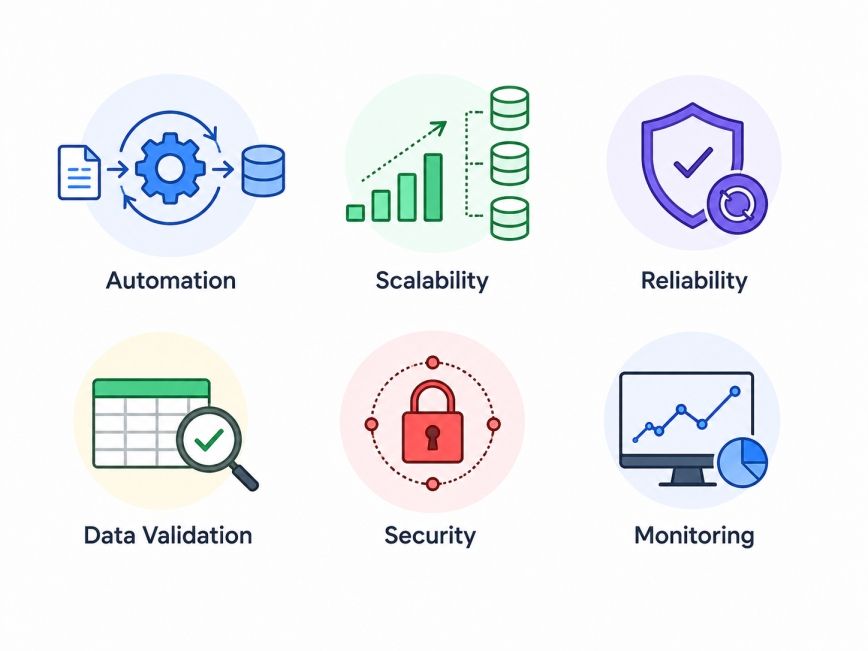
Although how it's done differs from organization to organization, most data ingestion systems have some traits.
These traits help organizations create data pipelines that back up their daily operations and data analysis on a large scale, which in turn helps with business operations and analytics.
Characteristic |
Description |
| Automation | Moves data with minimal manual effort |
| Scalability | Handles increasing data volumes efficiently |
| Reliability | Prevents data loss during transfer |
| Data Validation | Checks data accuracy before loading |
| Security | Protects sensitive data during transmission |
| Monitoring | Tracks performance, failures, and processing status |
Read for Better Insight: 5 Must-Know Steps in Data Preprocessing for Beginners!
AI Courses to upskill
Explore Artificial Intelligence Courses for Career Progression
Modern organizations are generating a lot of data these days. IDC states that the global datasphere is expected to continue growing. This means capability of efficient data movement is critical for an organization.
As the amount of data grows, it becomes really hard for manual processes. So, organizations need automated ingestion pipelines for their data. New data ingestion tools can connect to sources automatically, making it easier to grow without having to change the whole way data is set up.
An effective data ingestion process offers several benefits:
Business data usually comes from different applications.
Instead of working with separate sets of data, organizations can put them all together in one place, making reports more accurate and consistent.
When businesses have the data, they can act quickly. If businesses do not have a way to get data, they have to make decisions based on old or incomplete information.
For example, efficient data ingestion:
Ingestion systems checked Data before loading it. Fixing problems with data early on makes the analysis of data more accurate and reduces mistakes later on.
Common validation checks include:
Artificial Intelligence and machine learning need a lot of data. A good data ingestion process makes sure that fresh and accurate data is always available to train models to make predictions and power dashboards.
Businesses usually do not just use one source of data. As organizations start using applications, cloud platforms and Internet of Things devices, the number of sets of data coming in grows very quickly.
Read: Introduction to Cloud Computing: Concepts, Models, Characteristics & Benefits
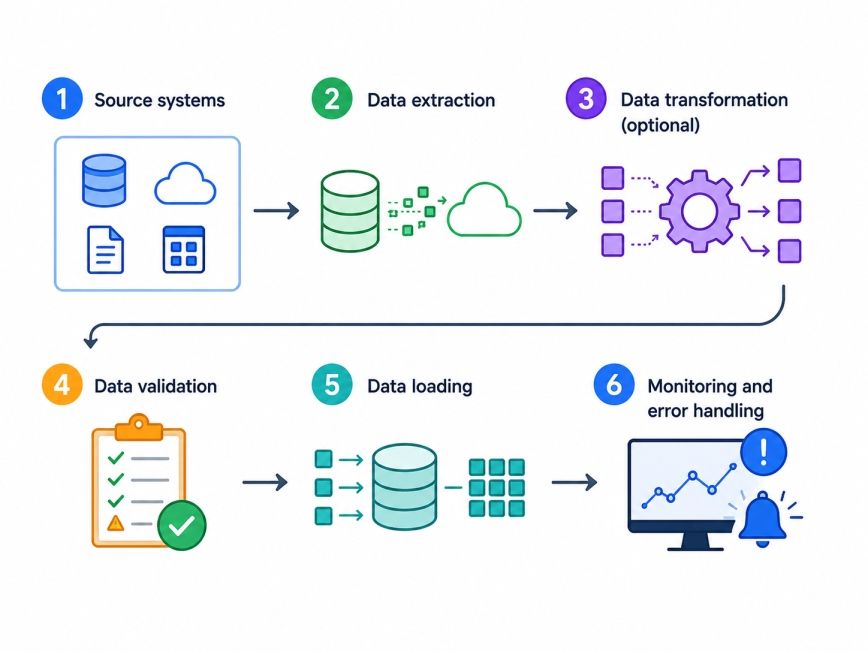
Understanding the question ‘what is data ingestion’ becomes much easier when you look at the complete workflow. Data does not usually go from where it comes from, to where it needs to go. It goes through steps to make sure it is gathered, verified, and sent in a way that can be used.
The steps it takes depend on what the organization needs and what tools they use to get the data. Some data pipelines move data in groups at a time a day. Others handle events as they happen. No matter the method, most data ingestion processes have the basic steps.
The table below provides a quick overview of the process:
Stage |
Purpose |
| Source systems | Identify where data originates |
| Data extraction | Collect data from source systems |
| Data transformation (optional) | Convert data into the required format |
| Data validation | Verify data quality and consistency |
| Data loading | Transfer data to the destination system |
| Monitoring and error handling | Track pipeline health and resolve failures |
Read: Explore the Top 10 Big Data Tools for Businesses
Every data ingestion process begins with one or more source systems. These are the places where raw data is generated or stored before it is moved elsewhere. Depending on the business, data can come from a wide range of sources.
Common source systems include:
Data extraction involves reading information from each source and preparing it for transfer. Depending on business needs, extraction can happen at scheduled intervals or continuously.
There are several ways to extract data:
At this stage, organizations also decide whether to extract:
Extraction Type |
Description |
| Full extraction | Copies the complete dataset every time |
| Incremental extraction | Transfers only new or modified records |
Incremental extraction is more efficient because it saves time and uses networks, especially for large datasets.
Related: Data Modeling for Real-Time Data in 2025: A Complete Guide
This step is not always needed because not every data ingestion workflow requires transformation. Many modern cloud setups load data first, then transform it later. When different systems use different formats, transformation is necessary.
For example, think of a company that operates in countries.
Standardizing the format during transformation helps make reports and dashboards consistent. The aim is not to change what the data means but to make it easier to work with and analyze later.
Common transformation tasks are:
Validation is one of the most important steps in the data ingestion process. Just because we got the data, it doesn't mean it's good to use. We need to check its quality
When we validate data, we find mistakes early. This way, these errors don't mess up our analysis or the choices we make for the business.
Typical validation checks include:
For example, imagine a banking application receiving transaction records. If an account number is missing or a payment amount contains letters instead of numbers, the validation process flags the record before it enters the analytics platform.
Many data ingestion tools automatically generate validation reports, so data engineers can quickly identify and resolve issues. Good validation practices reduce data quality problems and improve confidence in downstream reporting.
After validation, the processed data is loaded into its destination. The destination depends on the organization's analytics and storage requirements.
Common destinations include:
Loading can occur in different ways.
Loading Method |
Best For |
| Batch loading | Periodic reporting and historical analysis |
| Real-time loading | Live dashboards and instant decision-making |
| Micro-batch loading | Frequent updates without full streaming complexity |
Read: Data Lake vs Data Warehouse: Difference Between Data Lake & Data Warehouse
The data ingestion process does not end after loading the data. We need to keep an eye on it all the time. This helps to make sure that our data pipelines keep working, giving us correct data and doing so in a fast manner.
Monitoring helps teams to find issues before they cause trouble with our business operations.
Key monitoring activities include:
Take your AI project experience beyond coding with IIM Kozhikode Strategic AI for Business Professionals - Leadership for an AI-First World program and learn how organizations leverage AI to drive business growth and innovation.
A data ingestion pipeline is important for any company that works with a lot of data. The pipeline is like a system that makes sure data ingestion processes are done consistently and reliably.
Without data ingestion, pipeline companies would have to move data from one system to another manually. This would be slow, error-prone, and difficult to scale. A well-designed data ingestion pipeline automates every step of the process and makes sure it is ready to be used.
It is a series of steps that are done automatically and can run all the time, at times, depending on what the company needs. It saves people from repetitive manual tasks and makes sure that data reaches quickly.
A typical pipeline performs several functions such as:
Also Read: Building a Data Pipeline for Big Data Analytics: 7 Key Steps, Tools and More
Although data pipelines vary across organizations, most include the core parts. Each part plays an important role in ensuring that data moves smoothly from source to destination. They work together to create a workflow that can handle data without needing constant manual oversight.
Component |
Purpose |
| Data sources | Generate or store raw data |
| Connectors | Establish communication with source systems |
| Extraction engine | Collects data from each source |
| Transformation layer | Cleans or standardizes data when required |
| Validation engine | Checks data quality before loading |
| Loading mechanism | Transfers data to the target system |
| Monitoring system | Tracks performance, failures, and alerts |
Read: Top 7 Data Extraction Tools in the Market [Hand-picked]
Subscribe to upGrad's Newsletter
Join thousands of learners who receive useful tips
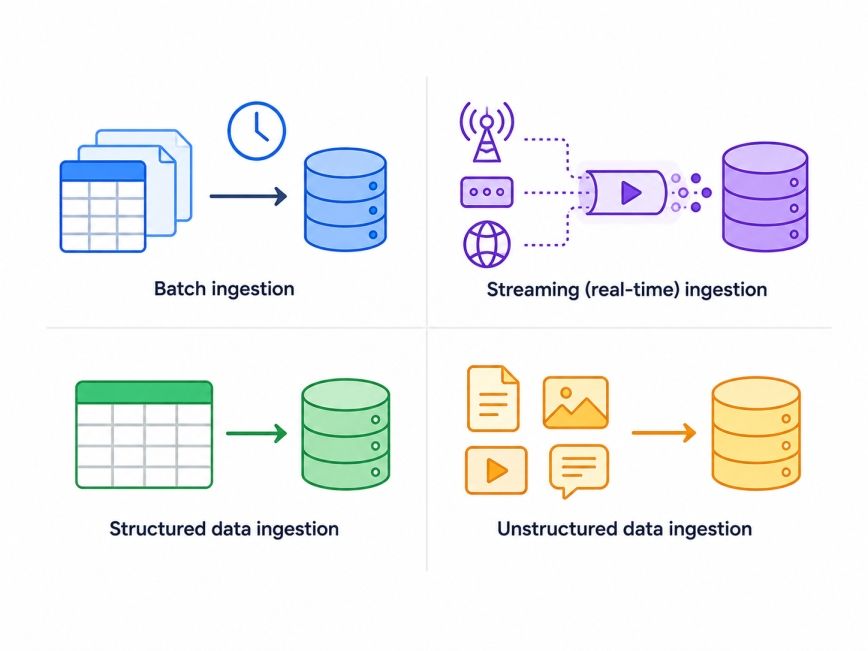
Not every business handles data in the same way. This is why there are types of data ingestion, and each type of data ingestion is designed to handle different workloads, data volumes, and how long it takes to get the data.
When you are choosing the right approach, it depends on factors like how fast you need the data, how much data is coming in, and what systems are involved in the data ingestion. Understanding the types of data ingestion helps you select a strategy that balances performance, cost, and reliability.
The table, below summarizes the common types of data ingestion:
Type |
Best For |
Data Availability |
| Batch ingestion | Reporting, backups, historical analysis | Scheduled intervals |
| Streaming (real-time) ingestion | Live analytics, fraud detection, IoT | Continuous |
| Structured data ingestion | Databases, spreadsheets | Organized data |
| Unstructured data ingestion | Images, videos, logs, documents | Multiple formats |
Read for Better Insight: How to Leverage Big Data for Fraud Detection in Banking in 2025?
Batch data ingestion is an old method, and a lot of people use it because it is easy to understand it works well and it does not cost a lot of money.
It collects and transfers data at a predefined time instead of processing it as soon as it is generated. This can be done every hour every night or once a week depending on what the business needs.
Batch ingestion is commonly used for:
Streaming, or real-time data ingestion is the process of getting information as soon as it is generated. It means that the information is processed without waiting.
Although real-time systems require more planning, they provide significant value for organizations where speed is critical.
This approach is ideal for businesses that rely on immediate insights.
Examples include:
Related Article: Difference Between Batch Processing and Stream Processing
Structured data is organized in a way with rows, columns, and clear fields. This makes it easy to check and handle. Structured data follows rules, which helps many data ingestion tools process it quickly, without much setup.
Common examples include:
Also Read: What is Structured Data in Big Data Environment?
Unstructured data is not in a format. It often includes things like text, images, videos, audio files, emails, or application logs.
Processing data needs extra tools, like natural language processing, computer vision, or metadata extraction. These tools help make sense of the data before we can analyze it properly.
Examples include:
One of the most common questions beginners ask is which method is better. The answer really depends on what the business needs. It's not about what tech you like.
The comparison below highlights the key differences.
Feature |
Batch Ingestion |
Real-Time Ingestion |
| Processing | Scheduled | Continuous |
| Data latency | Minutes to hours | Seconds or milliseconds |
| Infrastructure cost | Lower | Higher |
| Complexity | Relatively simple | More advanced |
| Best suited for | Reporting and analytics | Operational systems and live insights |
| Scalability | High | High, but requires more planning |
As companies gather more videos, images, and data from machines, they need tools to handle both organized and disorganized information. Modern data ingestion tools must be able to manage both types of information.
The table below compares the two approaches.
Aspect |
Structured Data |
Unstructured Data |
| Format | Fixed and organized | Flexible and varied |
| Storage | Relational databases | Data lakes and object storage |
| Processing complexity | Lower | Higher |
| Validation | Easier | More challenging |
| Examples | Customer tables, invoices | Videos, emails, images |
Read: Data Modeling for Data Lakes: Structuring Unstructured Data
A technique is a method to move data from one system to another. The right technique to use depends on factors like source of data, update frequency, data volume, and business requirements.
Modern data ingestion tools can support multiple techniques; they let companies combine these techniques, for different jobs.
For instance, a company might use APIs to get customer details of database ingestion to get transaction records and event-driven ingestion to get notifications in time.
The table below shows the common techniques used:
Technique |
Best Used For |
Update Frequency |
| File-based ingestion | CSV, Excel, XML, JSON files | Scheduled |
| API-based ingestion | SaaS platforms and web applications | On demand or continuous |
| Database ingestion | Relational and NoSQL databases | Batch or incremental |
| Change Data Capture (CDC) | Tracking database changes | Near real time |
| Event-driven ingestion | Applications and IoT systems | Real time |
File-based ingestion is one of the simplest and most widely used methods of data ingestion. It involves transferring data through files rather than connecting directly to databases or applications.
Businesses often exchange information using common file formats such as:
Although newer integration methods are gaining popularity, file-based ingestion remains common because many legacy systems still rely on scheduled file transfers.
Many modern applications expose their data through Application Programming Interfaces (APIs). Instead of exchanging files, systems communicate directly by sending and receiving requests over the internet.
API-based data ingestion is commonly used when organizations need frequent access to cloud applications or third-party platforms.
Common examples include:
Database ingestion involves moving data directly from one database to another. This technique is widely used in enterprise environments where operational systems continuously generate structured data.
Source databases may include:
Organizations can perform database ingestion in several ways:
Processing an entire database every time new data arrives is inefficient, especially when only a small percentage of records have changed. Change Data Capture (CDC) solves this problem.
CDC identifies only the records that have been inserted, updated, or deleted since the previous ingestion cycle. Instead of transferring everything, it processes only those changes.
Event-driven ingestion processes data immediately after a specific event occurs. Instead of waiting for scheduled jobs, the system reacts automatically whenever an event is generated.
Examples of events include:
There is no single data ingestion strategy that works for every organization. A startup with a few thousand users has different data requirements than a global enterprise processing millions of transactions every hour.
Before selecting a strategy, evaluate your business goals, technical infrastructure, and long-term scalability requirements.
Several technical and business factors determine which data ingestion strategy is most appropriate. Evaluating these factors early helps avoid unnecessary redesigns as your data ecosystem grows.
The amount of incoming data has a direct impact on pipeline design.
Organizations handling a few thousand records per day can often use simple ingestion workflows. Businesses processing terabytes or petabytes of information require distributed architecture capable of handling much larger workloads.
Questions to consider:
Velocity refers to how quickly data is created and how frequently it must be processed. Higher data velocity generally requires streaming or event-driven ingestion rather than traditional batch processing.
For example:
Latency measures the delay between data generation and data availability. Some businesses can tolerate hours of delay, while others require updates within seconds.
Understanding latency requirements helps determine whether batch or streaming ingestion is the better choice.
The table below illustrates common latency expectations.
Business Scenario |
Typical Latency Requirement |
| Financial reporting | Hours |
| Sales dashboards | Minutes |
| Fraud detection | Seconds |
| IoT monitoring | Near real time |
| Emergency response systems | Real time |
Budget plays an important role when selecting a data ingestion strategy. Batch systems generally cost less because they process data periodically and require fewer computing resources.
Real-time architectures often involve:
Reliable pipelines ensure data arrive accurately and consistently, even when unexpected issues occur.
A reliable ingestion strategy should include:
Data requirements rarely remain constant. As businesses grow, they introduce new applications, expand into new markets, and collect larger volumes of information.
Cloud-native architectures have become popular because they can scale resources based on demand, making them suitable for organizations with rapidly growing data needs.
A scalable data ingestion strategy should:
While modern data ingestion tools automate much of the process, building and maintaining reliable pipelines is not without challenges. As organizations integrate more applications, cloud services, and data sources, the complexity of managing data movement also increases.
Understanding these challenges helps teams design more resilient systems and avoid common issues that affect data quality and business performance.
Poor data quality is one of the most frequent challenges in data ingestion. If inaccurate or incomplete data enters the pipeline, it can lead to incorrect reports, unreliable AI models, and poor business decisions.
Common data quality problems include:
As data volumes increase, ingestion pipelines may struggle to process information efficiently. These issues increase processing time and delay data availability.
Organizations can improve performance by using incremental loading, parallel processing, workload balancing, and optimized storage solutions.
Performance bottlenecks can result from:
New columns may be added; existing fields may change, or data types may be modified. These structural changes are known as schema evolution.
Without proper planning, schema changes can interrupt ingestion pipelines or cause validation failures.
Good practices include:
Duplicate data affects reporting accuracy and increases storage costs. Modern data ingestion tools often include deduplication features that compare records using unique identifiers before loading them into storage.
Duplicates may occur because of:
Hardware failures, software bugs, and network outages are unavoidable in distributed systems. A fault-tolerant pipeline continues operating even when individual components fail.
Important fault-tolerance features include:
Many organizations process sensitive information such as customer records, financial transactions, and healthcare data. Protecting this information is an essential part of every data ingestion strategy.
Key security practices include:
Addressing challenges early leads to more dependable data platforms, better analytics, and improved decision-making. With the core concepts, strategies, and challenges covered, the final section will summarize the key takeaways and answer the most common questions people search for about data ingestion.
The following practices help organizations build more reliable ingestion pipelines:
Data ingestion is the foundation of every modern data platform. It ensures data moves securely and efficiently from multiple sources to systems where it can be analyzed and used for decision-making. By understanding the ingestion process, pipeline components, techniques, strategies, and common challenges, organizations can build scalable data architectures that support business intelligence, analytics, and AI-driven applications with reliable, high-quality data.
Data ingestion is the process of collecting data from one or more sources and moving it into a destination such as a data warehouse, data lake, or cloud platform. The goal is to make data available for reporting, analytics, machine learning, or operational use. Depending on business requirements, data can be ingested in batches or in real time using different data ingestion tools.
A data ingestion pipeline is an automated workflow that transfers data from source systems to a target destination. It typically includes data extraction, optional transformation, validation, loading, monitoring, and error handling. Pipelines reduce manual effort and ensure that data is delivered consistently, accurately, and on time.
The main types of data ingestion are batch ingestion and streaming (real-time) ingestion. Batch ingestion processes data at scheduled intervals, while streaming ingestion handles data continuously as it is generated. Organizations may also work with structured and unstructured data depending on the format of their source systems.
Batch ingestion collects and processes data at predefined intervals, making it suitable for reports and historical analysis. Real-time ingestion processes data immediately after it is generated, enabling live dashboards, fraud detection, and instant decision-making. The right approach depends on latency requirements and business objectives.
ETL (Extract, Transform, Load) includes transforming data before it is loaded into the destination system. Data ingestion, however, focuses on collecting and moving data, with transformation being optional. In many modern cloud architectures, ingestion happens first, followed by transformation through ELT workflows.
Some of the most common challenges include poor data quality, duplicate records, schema changes, performance bottlenecks, security risks, and pipeline failures. Organizations can reduce these issues through data validation, monitoring, automated recovery mechanisms, and scalable pipeline design.
A scalable architecture starts with understanding current and future data volumes. It should support distributed processing, automated monitoring, fault tolerance, incremental data loading, and cloud-native infrastructure where appropriate. Flexibility is equally important so new data sources can be added without major architectural changes.
Improving performance involves reducing unnecessary data movement, using incremental loading instead of full extraction, optimizing database queries, and processing data in parallel where possible. Continuous monitoring also helps identify bottlenecks before they impact reporting or business operations.
Several platforms support modern data ingestion, including Apache Kafka, Apache NiFi, AWS Glue, Azure Data Factory, Google Cloud Dataflow, Talend, Fivetran, Airbyte, and Informatica. The right tool depends on factors such as scalability, integration requirements, budget, and the complexity of your data ecosystem.
Yes. Most organizations now perform data ingestion directly into cloud services such as data lakes, cloud storage, and data warehouses. Cloud platforms provide better scalability, automated infrastructure management, and easier integration with analytics, business intelligence, and AI services compared to many traditional on-premises systems.
AI and machine learning models rely on accurate, timely, and high-quality data. Data ingestion ensures information from multiple sources is collected, validated, and delivered to training and analytics environments efficiently. Without a reliable ingestion process, AI models may produce inaccurate predictions because they are trained on incomplete or outdated data.
730 articles published
Sriram K is a Senior SEO Executive with a B.Tech in Information Technology from Dr. M.G.R. Educational and Research Institute, Chennai. With over a decade of experience in digital marketing, he specia...
Speak with AI & ML expert
By submitting, I accept the T&C and
Privacy Policy
Top Resources
Master's Degree
18 Months
Executive Diploma
12 Months
IIIT Bangalore
Executive Programme in Generative AI & Agentic AI for LeadersIndia’s #1 Tech University
Dual Certification
5 Months