Marketing Automation Tools That Simplify Modern Marketing
By upGrad
Updated on May 07, 2026 | 8 min read | 2.17K+ views
Share:

All courses
Certifications
More
By upGrad
Updated on May 07, 2026 | 8 min read | 2.17K+ views
Share:
Table of Contents
Leading marketing automation tools in 2026 include HubSpot for all-in-one marketing management, ActiveCampaign for AI-powered automation, Klaviyo for eCommerce-focused campaigns, and Salesforce Marketing Cloud for advanced customer journey orchestration. Other notable platforms such as Omnisend, Brevo, and Customer.io help businesses automate email marketing, lead nurturing, social media scheduling, and CRM workflows to improve efficiency and increase ROI.
This blog breaks down the best marketing automation tools, how they work, who should use them, and what features matter most before you invest. You’ll also learn about email marketing automation tools, pricing models, workflow examples, and mistakes businesses make while choosing a platform.
Explore upGrad’s Marketing programs to build hands-on skills in campaign automation so you can use marketing automation tools to create smarter campaigns and make data-driven decisions with confidence.
Marketing automation tools are software platforms designed to automate repetitive marketing tasks like email campaigns, social media posting, and lead tracking. These systems help you manage complex campaigns across email, social media, and CRM platforms without needing a massive team to handle every manual click or send button. By using these tools, you'll reduce human error and make sure no potential customer falls through the cracks during their buying journey.
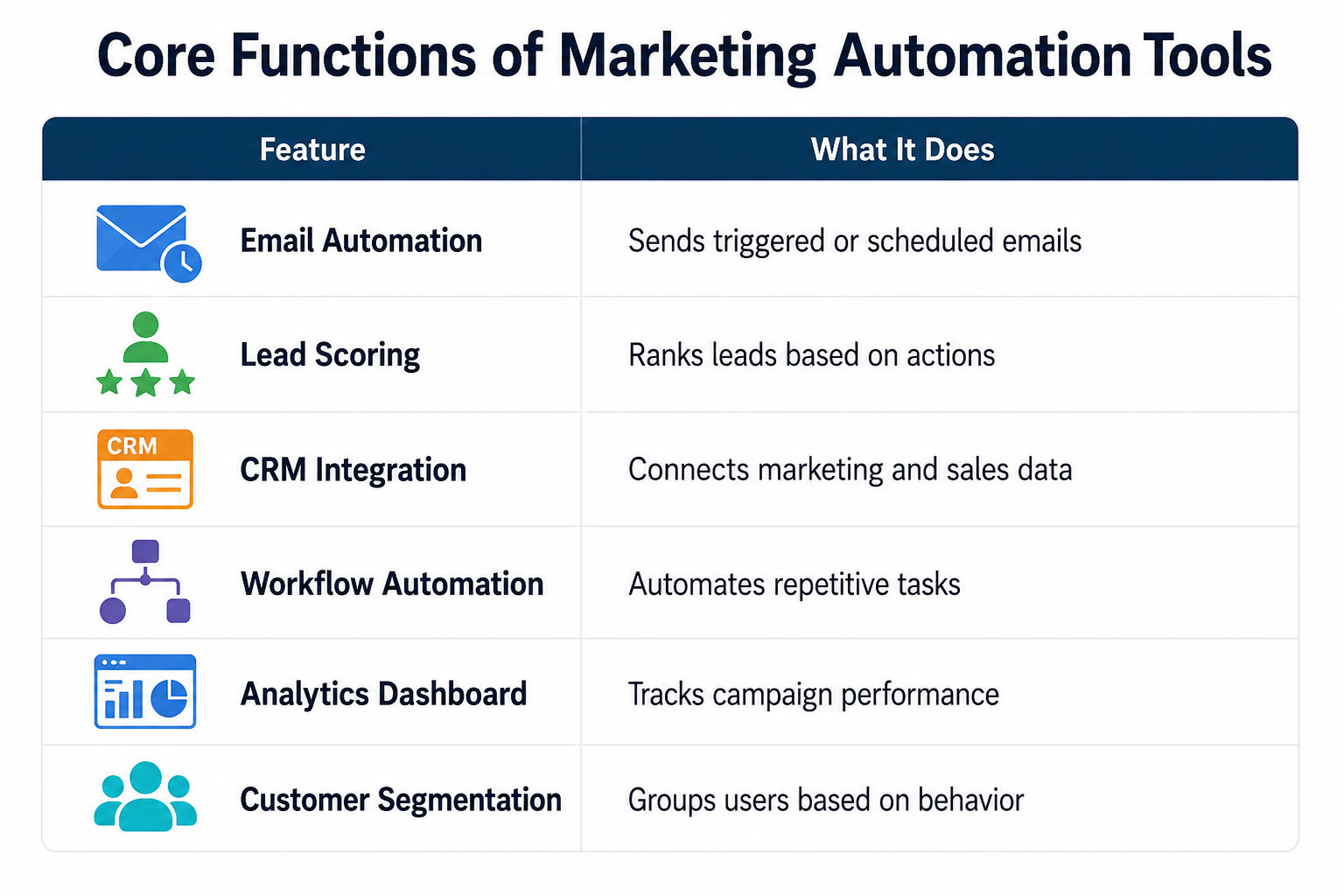
Most digital marketing automation tools combine several functions into one platform. That includes email campaigns, lead nurturing, analytics, customer segmentation, and workflow management.
Must Read: Top 32 Tools Every Successful Digital Marketer Uses
Free Courses
Digital marketing automation tools fix this by removing the human work from tasks that don't need one.
Without Automation |
With Automation |
| Manually sending an email | Triggered email sequences |
| Guessing the right time to post | Scheduled content delivery |
| Chasing leads manually | Automatic lead scoring and routing |
| Disconnected data across tools | Unified reporting dashboard |
| High cost per action | Lower cost per action at scale |
Also Read: Top 21 AI Tools for Digital Marketing
Digital Marketing Courses to upskill
Explore Digital Marketing Courses for Career Progression
MICA Executive Alumni Status
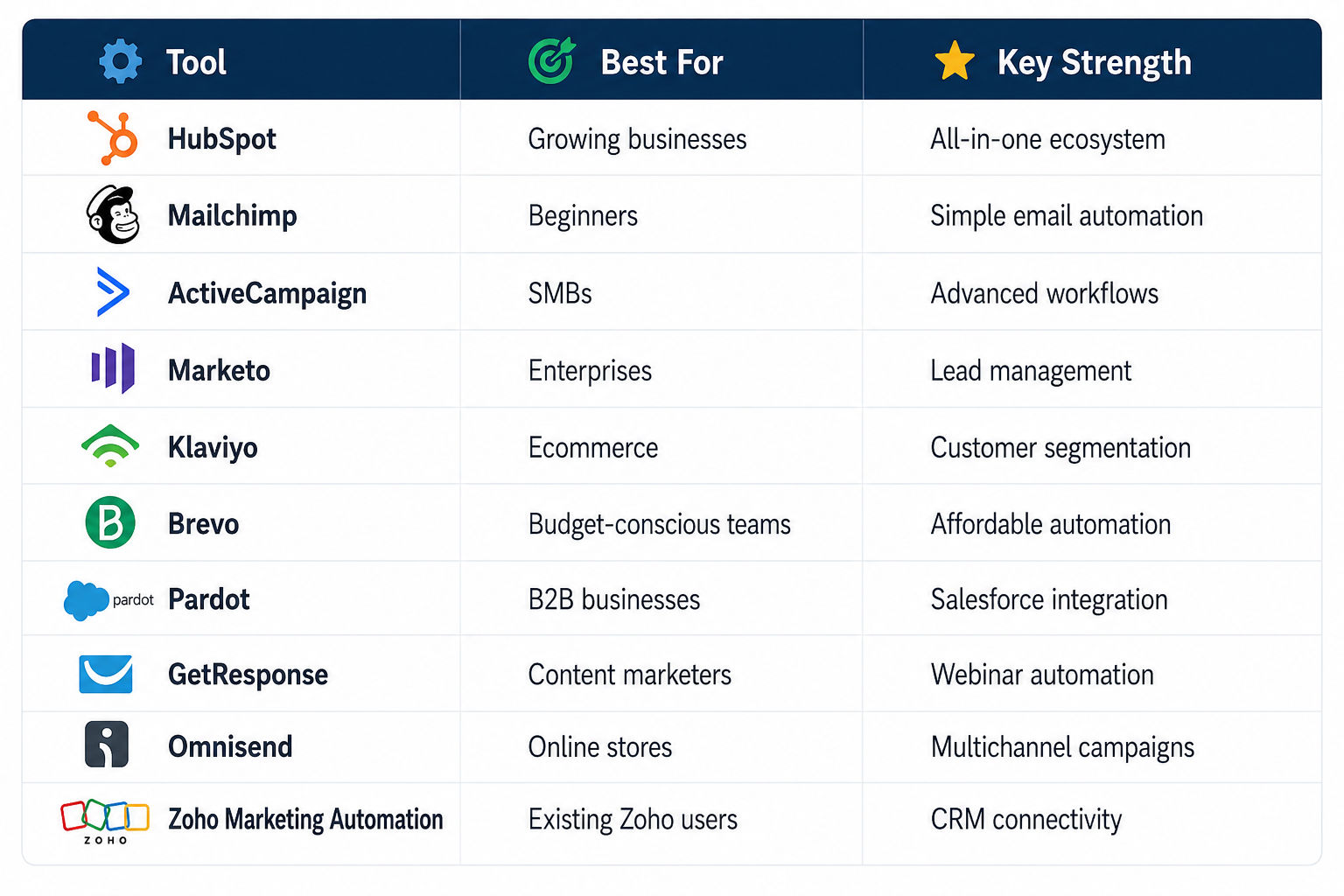
Here are the top 10 marketing automation tools businesses commonly use today.
HubSpot is one of the most popular all-in-one platforms. It combines CRM, email, social media, and lead management in a single system. It's well-suited for businesses that want everything under one roof.
Best for: Mid-size to large teams wanting an integrated stack.
Mailchimp started as an email marketing tool and has grown into a broader automation platform. It's beginner-friendly and handles email sequences, audience segmentation, and basic campaign automation well.
Best for: Small businesses and startups.
ActiveCampaign is strong on email marketing automation tools specifically. Its visual workflow builder is easy to use, and its CRM integration keeps sales and marketing aligned.
Best for: Teams that want powerful email automation with a CRM layer.
Marketo is built for enterprise teams. It handles complex multi-channel campaigns and connects deeply with Salesforce.
Best for: Large enterprises with dedicated marketing ops teams.
Klaviyo is built for e-commerce. It connects with Shopify and WooCommerce natively and specializes in behavior-based email and SMS automation.
Best for: E-commerce brands.
Brevo is an affordable platform covering email, SMS, and WhatsApp marketing. It's a solid option for teams on a tighter budget who still want multi-channel automation.
Best for: SMBs looking for value.
Pardot fits companies already invested in Salesforce.
Sales and marketing alignment becomes smoother because customer data syncs directly across systems. B2B organizations with longer sales cycles benefit the most.
GetResponse combines marketing automation with content creation tools. Along with email workflows, it offers webinar hosting, landing pages, and conversion funnels in one platform. This makes it especially useful for businesses that rely heavily on audience engagement and lead generation through content.
Best for: Educators, coaches, creators, and content-driven businesses.
Omnisend is designed specifically for ecommerce brands. It brings together email marketing, SMS automation, push notifications, and personalized product recommendations within a single workflow. Its ready-made ecommerce templates and store integrations make campaign execution faster during seasonal sales and promotional events.
Best for: Ecommerce stores running multichannel campaigns.
Part of the Zoho suite, this tool handles lead capture, nurturing workflows, and analytics. If your business already uses Zoho CRM, it's a logical choice.
Best for: Zoho ecosystem users.
Must Read: Digital Marketing Placements: Start Your Career the Right Way
Do read: Digital Marketing Resume: Complete Guide
Here's a breakdown of the best automation tools in the market, matched to specific scenarios.
Email marketing automation tools are the most widely adopted category. The core function is sending the right email to the right person at the right time, based on behavior or schedule.
Top picks: ActiveCampaign, Klaviyo, Mailchimp
What to look for:
B2B teams need tools that connect marketing activity to sales outcomes. Lead scoring, CRM sync, and multi-touch attribution are non-negotiable here.
Top picks: HubSpot, Pardot, Marketo
What to look for:
E-commerce automation is all about using purchase behavior to trigger the right messages. Abandoned cart, post-purchase follow-up, and product recommendation sequences drive real revenue.
Top picks: Klaviyo, Drip, Brevo
What to look for:
Scheduling and automating content distribution saves hours every week. Some digital marketing automation tools cover this alongside email and CRM.
Top picks: HubSpot, Buffer, Sprout Social
What to look for:
Also Read: Digital Marketing Types: Top 12 Digital Marketing Types You Should Know
Most businesses compare five or six platforms before deciding. Picking the wrong one costs you time, money, and momentum. So how do you actually decide? Ask yourself these questions first:
Are you trying to automate email sequences, manage leads, post on social, or do all of the above? Don't buy a platform built for enterprise B2B if you're running a small e-commerce store.
For most Indian startups and SMBs, tools like Zoho, Brevo, and ActiveCampaign usually offer the best balance between pricing and functionality. Enterprise platforms such as Marketo and Pardot are more common among large companies with dedicated sales and marketing teams.
Monthly Budget (Approx.) |
Good Options |
| Under ₹5,000/month | Brevo, Mailchimp (Free Plan) |
| ₹5,000 to ₹20,000/month | ActiveCampaign, Zoho Marketing Automation |
| ₹20,000 to ₹75,000/month | HubSpot Starter/Professional, Klaviyo |
| ₹75,000+/month | Marketo, Pardot, HubSpot Enterprise |
Tools that don't connect to your CRM or website are a headache. Always check the integration list before committing.
The best marketing automation tool is the one your team will actually use consistently.
Do Read: What is MBA in Digital Marketing? Scope, Career option and Salary
Benefits of Marketing Automation |
Challenges of Marketing Automation |
| Better Lead Nurturing:Keeps potential customers engaged with email sequences, reminders, retargeting, and personalized offers | Poor Setup: Incorrect workflows and targeting can reduce campaign effectiveness |
| Stronger Customer Segmentation: Delivers more relevant messaging based on customer behavior and interests | Over-Automation: Excessive automated messages can feel robotic and frustrate users |
| Time Savings: Automates repetitive tasks so teams can focus more on strategy and creativity | Weak Data Quality: Inaccurate customer data leads to poor personalization and targeting |
| Improved Reporting: Provides insights through dashboards, conversion tracking, and customer journey analysis | Steep Learning Curves: Advanced platforms often require time and training to use effectively |
| Higher Conversion Opportunities: Timely and personalized campaigns improve engagement and sales potential | High Costs: Enterprise-level automation tools can become expensive over time |
| Scalable Campaign Management: Helps businesses manage large audiences efficiently | Loss of Human Touch: Too much automation can weaken |
Marketing automation tools aren't a shortcut to skip the hard work of marketing. They're a system that makes your effort go further. The right tool handles the repetitive tasks, keeps your leads engaged, and shows the data you need to make better decisions.
The right platform depends on your goals, budget, team size, and workflow complexity. Some businesses need lightweight email marketing automation tools. Others require advanced lead scoring, CRM integration, and multichannel orchestration.
Ready to start your journey? Book a free consultation with upGrad today to find the best path for your career.
Marketing automation tools help businesses automate repetitive marketing activities like email campaigns, lead nurturing, customer segmentation, and workflow management. These platforms save time while improving campaign consistency and customer engagement. Most businesses also use them to track analytics and improve conversion rates through behavior-based communication.
Mailchimp, Brevo, and GetResponse work well for beginners because they offer simple dashboards, ready-made templates, and easy automation workflows. These tools help small businesses create automated emails without needing technical expertise. Many also provide free plans for businesses just starting with email automation.
Not always. Many marketing automation tools offer affordable starter plans designed for small teams and startups. Pricing usually depends on contact count, features, and email volume. Businesses should compare long-term costs carefully because expenses often rise as subscriber lists grow larger.
Digital marketing automation tools track customer behavior and trigger relevant communication automatically. For example, when a user downloads a guide or visits pricing pages repeatedly, the system can send follow-up emails or notify sales teams. This improves lead response speed and increases conversion opportunities.
Important features include workflow automation, CRM integration, analytics dashboards, segmentation, personalization, and multichannel communication support. Businesses should also evaluate ease of use and integration compatibility. A feature-rich platform loses value quickly if teams struggle to use it efficiently during daily operations.
No. These tools automate repetitive tasks but still rely on human strategy, creativity, and decision-making. Businesses still need marketers to create campaigns, understand customer psychology, and optimize messaging. Automation supports marketing teams rather than replacing them completely.
Ecommerce, SaaS, education, healthcare, finance, and agencies commonly benefit from automation because they manage large customer interactions regularly. Ecommerce businesses use automation heavily for cart recovery and product recommendations, while B2B companies focus more on lead nurturing and CRM workflows.
Implementation timelines vary based on platform complexity and business size. Small businesses may complete setup within days, while enterprises sometimes need several months for integrations, workflow creation, and employee training. Proper planning reduces implementation delays and prevents operational confusion later.
CRM software mainly focuses on customer relationship management and sales tracking, while marketing automation tools focus on campaign automation and audience engagement. Many modern platforms combine both capabilities, allowing sales and marketing teams to share customer data more effectively.
Yes. Automation helps businesses maintain regular communication through onboarding emails, loyalty campaigns, personalized recommendations, and re-engagement sequences. Customers stay connected with brands more consistently, which improves retention and increases repeat purchase opportunities over time.
Start by identifying your business goals, team size, workflow complexity, and budget. Compare platforms based on usability, integrations, reporting, and automation capabilities. Testing free trials helps businesses understand whether a platform fits daily operational needs before committing financially.
1011 articles published
We are an online education platform providing industry-relevant programs for professionals, designed and delivered in collaboration with world-class faculty and businesses. Merging the latest technolo...
Get Free Consultation
By submitting, I accept the T&C and
Privacy Policy
Level Up Your Digital Marketing Career Today!
Top Resources
MICA
Advanced Certificate in AI-Powered Digital Marketing & Communication from MICAMICA Executive Alumni Status
Certification
5 Specialisation
Classroom
4 Months
Certification
2 Months