Innovative Digital Marketing: Ideas, Strategies, and Solutions for Businesses
By upGrad
Updated on Sep 24, 2026 | 9 min read | 2.36K+ views
Share:

All courses
Certifications
More
By upGrad
Updated on Sep 24, 2026 | 9 min read | 2.36K+ views
Share:
Table of Contents
Key Highlights
Ready to turn digital marketing ideas into real skills? Explore our digital marketing courses, learn at your own pace. Get hands on with real tools and real campaigns. Build a skill set that keeps you ahead as the industry keeps changing.
Innovative digital marketing means using new tools, fresh creative ideas, and real data to reach people in ways that actually get noticed. It's not about jumping on every new app or trend. It's about picking the right ones and using them well.
Take Instagram ads. Everyone runs them. That's not innovative on its own. But say a customer adds something to their cart and leaves. You send a dynamic ad the moment they drop off, built around that exact product. That's innovation. Same platform but different approach.
Organic reach keeps shrinking. People have gotten good at tuning out anything that feels templated. The ones getting ahead treat marketing like a product. They test often. They drop what doesn't work and push harder on innovative digital marketing strategies that work.
These are some points that make digital marketing innovative:
Also read: Stages of Digital Marketing: A Complete Practical Guide
Free Courses
Anyone can list ten digital marketing ideas. The real value is knowing which ones fit your business, what they cost, and how to actually start. Below is a quick comparison, followed by the details.
Idea |
Best For |
Cost to Start |
Difficulty |
| 1. AI powered personalization | Ecommerce, SaaS | Medium to High | Medium |
| 2. Interactive content | D2C brands, beauty, wellness | Low | Low |
| 3. Short form video first | B2C, lifestyle, food | Low | Medium |
| 4. Zero party data campaigns | Subscription, retail | Low | Low |
| 5. Community led marketing | Niche brands, B2B, SaaS | Low to Medium | High |
| 6. Micro influencer partnerships | D2C, fashion, fitness | Low to Medium | Low |
| 7. Conversational search content | Any B2B or service business | Low | Medium |
| 8. Shoppable content | Ecommerce | Medium | Medium |
| 9. Gamification | Apps, loyalty programs | Medium | High |
| 10. Real time trigger marketing | Ecommerce, SaaS | Medium | Medium |
Now let's break each innovative digital marketing idea.
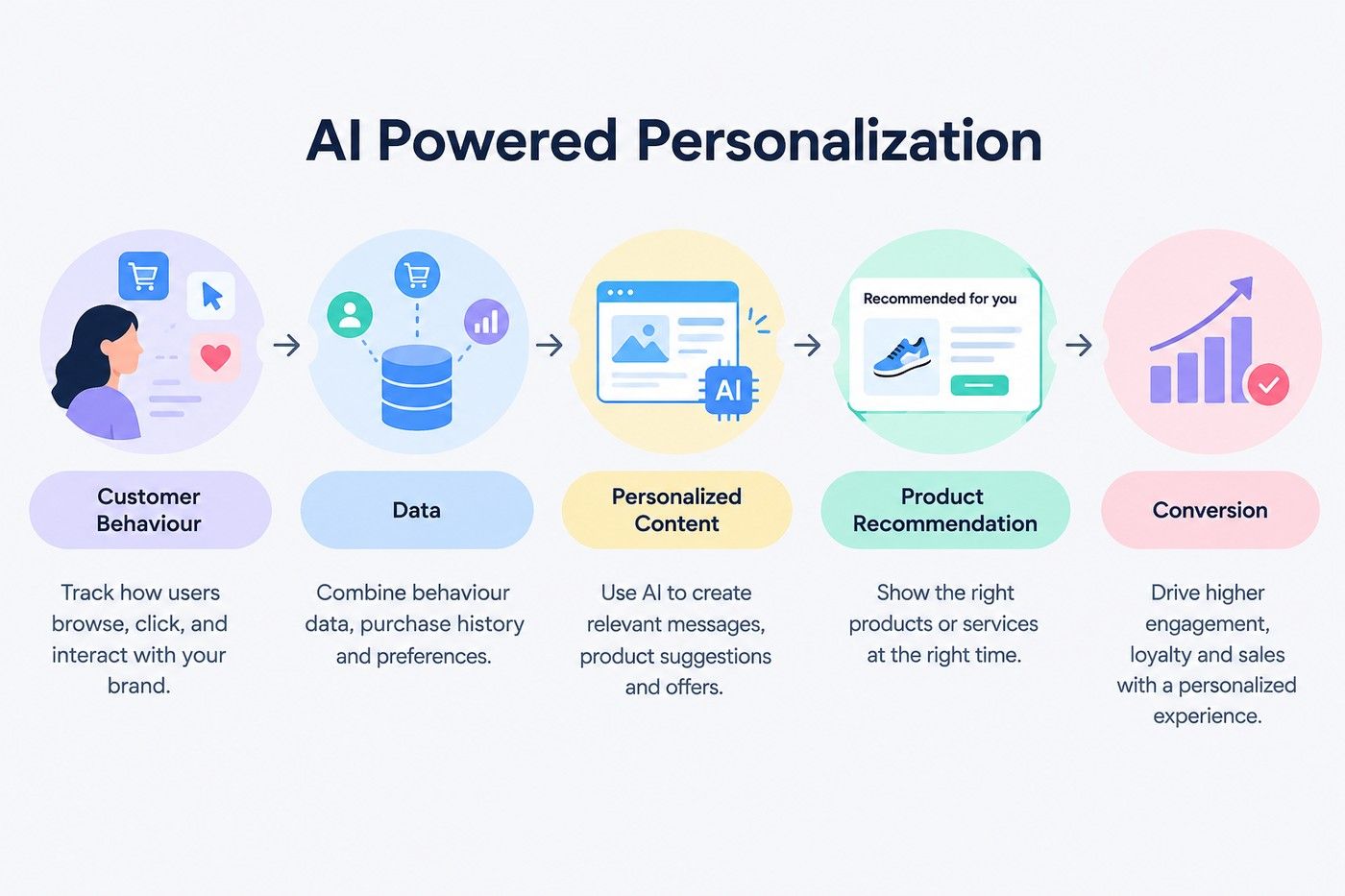
Use browsing and purchase data to show different content to different people. Not just a first name in an email. Real personalization changes what someone actually sees.
Why it works:
How to start:
Quizzes, calculators, polls, and AR filters. People engage more when they can do something, not just scroll past it. A skincare brand asking "what's your skin type?" before showing products will almost always beat a generic product grid.
Formats worth testing:
Reels, YouTube Shorts. Build the campaign around this format first, then adapt it elsewhere. Shrinking a long ad into 15 seconds rarely works. Starting short and building up does.
A few things that tend to perform well, behind the scenes content, before and after transformations, quick tips under 30 seconds, and trend based content with a brand twist.
Ask customers directly what they want. Preference quizzes. Surveys. Sign up forms that ask real questions instead of just an email address.
This works better than inferred data because it is more accurate, customers trust brands more when asked directly, also it builds a data asset that doesn't rely on third party cookies.
Create a space where customers can interact with each other. Like private groups, forums, or even a strong comment section. Word of mouth inside a community converts better than most paid ads, but it takes longer to build.
Where to start:
Small creators with 10k to 50k followers usually have more trusting audiences. Engagement rates are often higher, and the cost is much lower than working with big influencers and celebrities.
Why working with micro influencers often wins:
People search differently when they talk instead of type. If you write content that answers complete questions will rank better on search engines. Like instead of targeting "best running shoes," write content that answers "what are the best running shoes for flat feet." Means just narrow down the questions, and write for a targeted audience.
Let people buy directly from a video, post, or livestream. Every extra click between interest and purchase loses customers. Shoppable formats remove that friction. Here you can consider platforms like Instagram, shoppable livestreams and videos on YouTube.
Points, streaks, unlockable rewards. Duolingo didn't get famous for teaching languages well. It got famous for making people come back daily.
Simple ways to gamify:
Abandoned cart emails are old news now. The next step is triggers based on behavior in the moment. Someone views a product three times in a week. Send them something then, not in a weekly newsletter three days later.
Common triggers worth setting up are cart abandonment, repeated product views, browsing without purchase after multiple sessions, price drop on a viewed item, and more.
Also read: What is Content Marketing? How does it help businesses?
Digital Marketing Courses to upskill
Explore Digital Marketing Courses for Career Progression
MICA Executive Alumni Status
Ideas are tactics. Strategies are the thinking behind them. A strategy tells you why you're doing something, not just what to do. Here are some of the best strategies.
Third party cookies are going away. Ad platforms are getting more expensive and less predictable. Brands that rely only on paid ads are building their brand on rented land.
Here is the solution:
Most brands still work in a "plan big, launch big, hope it works" cycle. That's slow, and expensive when it fails.
A better approach is to run small tests before big budgets, kill underperforming campaigns fast, don't wait a full month, and scale only what's already proven on a small scale.
By the time a channel feels "safe," the best returns are usually gone. Early movers on a platform almost always get cheaper reach and less competition.
Stage |
What It Looks Like |
Risk |
Reward |
| Early | Few brands present, unclear ROI | High | High |
| Growing | Some competition, format still evolving | Medium | Medium to High |
| Mature | Everyone's there, ad costs climbing | Low | Low to Medium |
This doesn't mean chasing every new app. It means test early on channels that fit your audience, before they get crowded.
A lot of brands think personalization means changing the subject line or adding a first name. That's just the surface level. Real personalization changes:
Every piece of content should work across formats, not get created once and forgotten.
Example: one long form blog post can become, a short video script, five social posts, an email newsletter section, a slide deck for LinkedIn, and more.
Cold traffic converts worse every year. People want proof before they buy, not just a good ad.
Ways to build this in:
If you're serious about staying ahead in digital marketing, this is where to start. Master end-to-end digital marketing with MICA x upGrad. Build real skills, work on real projects, and earn a certificate that actually means something.
Ideas and strategies only mean something when you see them working. Here are a few campaigns that actually pulled off what this article has been talking about, and what to take from each one.
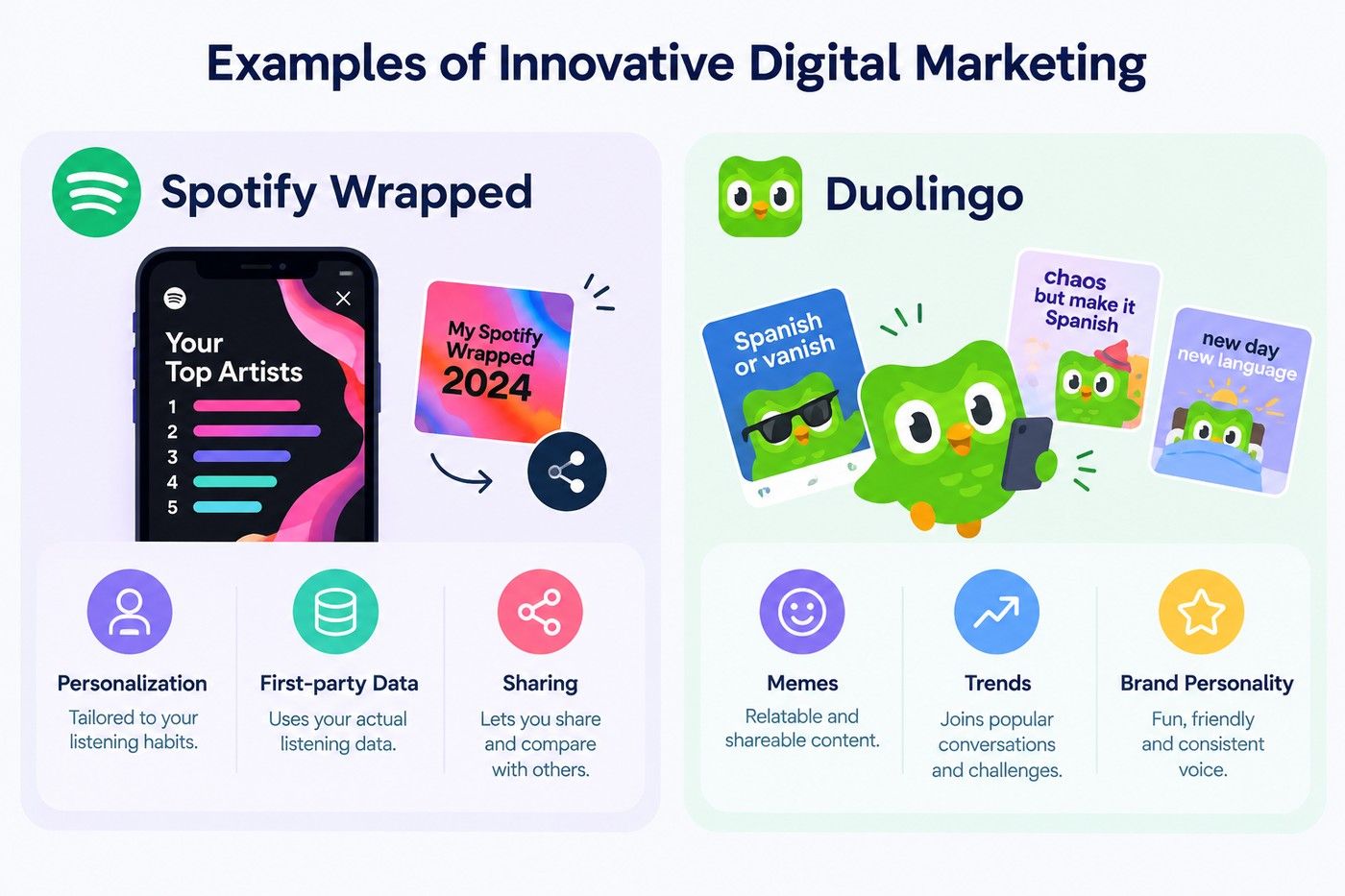
Spotify turned listening data, something users already generate every day, into a personalized, shareable year end recap. No two Wrapped results look the same.
Why it worked:
Duolingo turned its mascot into an unhinged, meme heavy social media personality instead of running typical education marketing.
Why it worked:
Also read: What is Social Media Marketing? Overview, Key Features, and How It Works
Subscribe to upGrad's Newsletter
Join thousands of learners who receive useful tips
Knowing the ideas and innovative digital marketing strategies is one thing. Actually building this into how your team works is different. Here's a practical way to start, step by step.
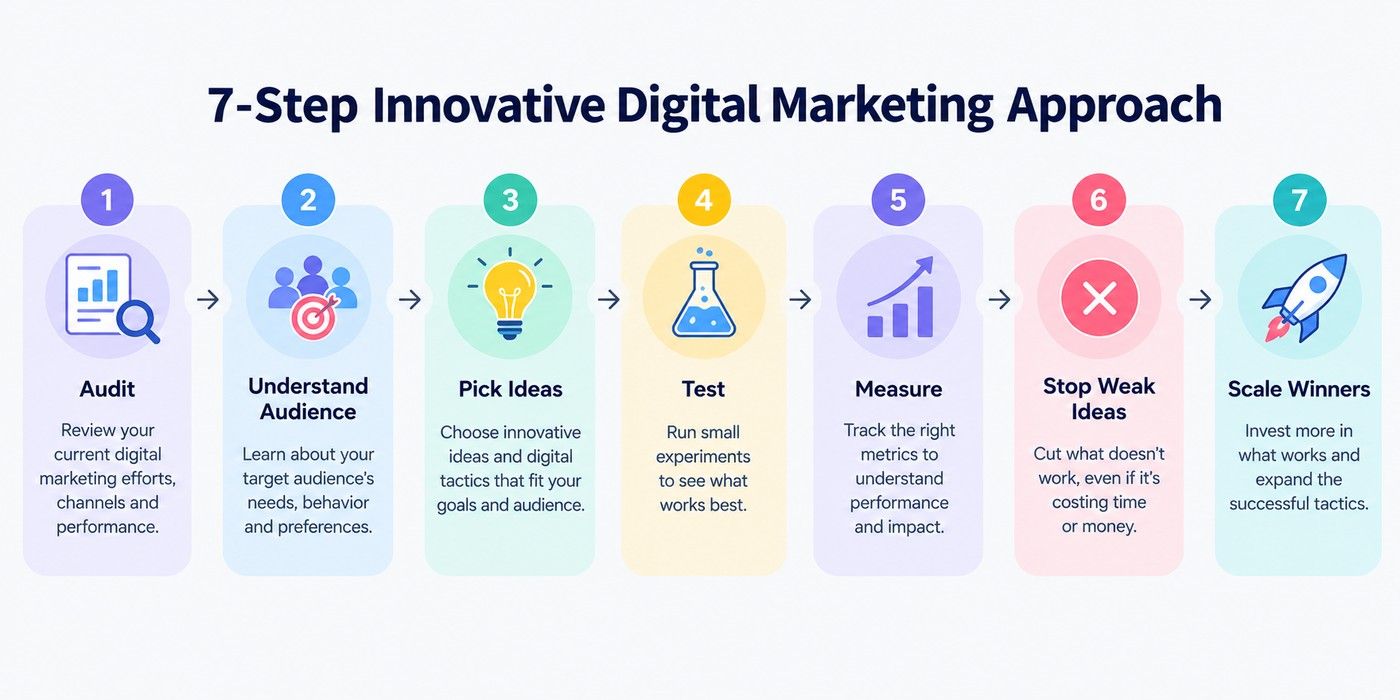
Before adding anything new, know what's already there. Most teams skip this and end up duplicating effort.
Look at:
Age and location aren't enough anymore. You need to know behavior.
Ask:
Step 3: Pick Two or Three Ideas to Test
Go back to the ideas list earlier in this article. Don't try everything at once. Pick what fits your audience and budget.
A simple way to choose:
Question |
If Yes |
If No |
| Does it fit where your audience already spends time? | Good candidate | Skip for now |
| Can you test it with a small budget first? | Good candidate | Reconsider |
| Do you have the data or tools to support it? | Good candidate | Build this first |
Don't launch a full digital marketing campaign on day one. Test small. Learn fast.
Vanity metrics feel good but don't pay bills. Focus on numbers tied to real outcomes. Metrics worth tracking are conversion rate, customer acquisition cost, repeat purchase rate, and time to conversion.
This is the step most teams struggle with. Sunk cost makes people keep a bad campaign alive too long. Here set a clear cutoff before you launch, and don't wait for a "maybe it'll pick up" moment that usually doesn't come.
Once something works on a small scale, then increase budget and reach. So, double budget gradually, watch if performance holds as spend increases, and keep testing new ideas alongside scaling old ones.
Also read: Digital Marketing for Startups
Innovation sounds great in theory. In practice, it comes with real problems that most articles skip over. Knowing these upfront saves time and budget.
Also read: 20+ Best Digital Marketing Blogs for Trends, Tips, and Tactics
Conclusion
Innovative digital marketing isn't about chasing every new tool or trend. It's about knowing your audience well enough to try the right things, at the right time, in the right place. The brands that get this right don't have unlimited budgets or the newest technology. They test often. They drop what doesn't work. They stick with what does and keep testing alongside it.
Start small. Pick one or two ideas from this article that fit your audience. Measure what actually matters. Build from there. Marketing keeps changing. The businesses that stay ahead aren't the ones with the perfect plan. They're the ones willing to keep adjusting.
Have any questions about this topic? Book a free consultation call with our experts and get personalized guidance on the right learning path for you.
Creative digital marketing uses original, attention grabbing ideas, like storytelling, humor, or unexpected visuals, to make a brand stand out. It focuses on imagination and message, not just new technology.
Digital innovation is using new technology to solve problems or create new value, in marketing, this means adopting tools like AI, automation, or data platforms to reach and understand customers in ways that weren't possible before.
Most tests need two to four weeks to show early signal. Bigger shifts, like building a community or a loyalty program, can take a few months to show real impact.
Digital marketing covers standard practices like ads, email, and SEO. Innovative digital marketing adds new technology, creative formats, or fresh approaches on top of those basics.
No. AI is one tool among many. Community building, interactive content, and zero party data strategies can be just as innovative without any AI involved.
Check if it fits where your audience already spends time and if you can test it on a small budget first. If both are true, it's worth a trial.
Any industry can benefit, but ecommerce, SaaS, and consumer facing brands tend to see faster results because their audiences engage more directly online.
Yes. Tactics like conversational search content, community building, and personalized outreach work well in B2B, though the format usually looks different than B2C.
Trying too many new tactics at once without measuring results properly. It's better to test one or two ideas well than to spread thin across many.
Start with a small, low cost test and show real numbers from it. Data from a small trial is far more convincing than a pitch alone.
No. It works alongside traditional methods. Most successful brands blend proven channels with new tactics rather than dropping one for the other.
987 articles published
We are an online education platform providing industry-relevant programs for professionals, designed and delivered in collaboration with world-class faculty and businesses. Merging the latest technolo...
Get Free Consultation
By submitting, I accept the T&C and
Privacy Policy
Level Up Your Digital Marketing Career Today!
Top Resources
MICA
Advanced Certificate in AI-Powered Digital Marketing & Communication from MICAMICA Executive Alumni Status
Certification
5 Specialisation
Classroom
4 Months
Certification
2 Months