Cost and Management Accounting: Meaning, Process, Techniques, Types, and Importance
By upGrad
Updated on Aug 04, 2026 | 10 min read | 2.14K+ views
Share:

All courses
Certifications
More
By upGrad
Updated on Aug 04, 2026 | 10 min read | 2.14K+ views
Share:
Table of Contents
Take charge of your career growth today. Enroll in upGrad's Management Courses and build the leadership skills employers actively seek.
Popular Management Programs
Cost accounting is the process of gathering, sorting, looking at and managing the costs that are connected to making products or providing services.
Management accounting is about creating reports looking at how well things are working and giving useful information that helps managers make choices about how to run the business and plan for the future.
When cost and management accounting work together they help companies:
Read: What Is Management Accounting? Meaning, Functions, Types, and Importance
Free Courses
The cost and management accountants of India (ICMAI) is the professional group that takes care of the Cost and Management Accountancy field in India. It was created under the Cost and Management Accountants Act, 1959 (which was once called the Cost and Works Accountants Act, 1959). The Institute sets rules holds tests gives the CMA certificate and helps companies with how to manage money and make financial choices.
ICMAI has a role in making sure money matters are clear, making sure costs are low, and encouraging the best ways to handle cost accounting, management accounting and how companies are running.
The main goals of ICMAI are:
Cost and management accountant CMA help companies work better and make money by looking at money matters and controlling costs. Their main tasks are:
Read: Top 10 Functions of Management Accounting
Cost and management accountant CMA plays important role in making businesses successful by giving correct cost details and helpful financial ideas. They help companies:
As more companies focus on saving money and using data to make choices, Cost and Management Accountant CMA are becoming more important because of their skills, in making things work better, managing money and helping businesses grow in a way.
CMAs can find jobs in many different industries, such as manufacturing, banking, healthcare, information technology, retail, consulting, infrastructure, and the public sector. Common jobs include:
Management Courses to upskill
Explore Management Courses for Career Progression
IIIT-B & IIM, Udaipur
Chief Technology Officer & AI Leadership Programme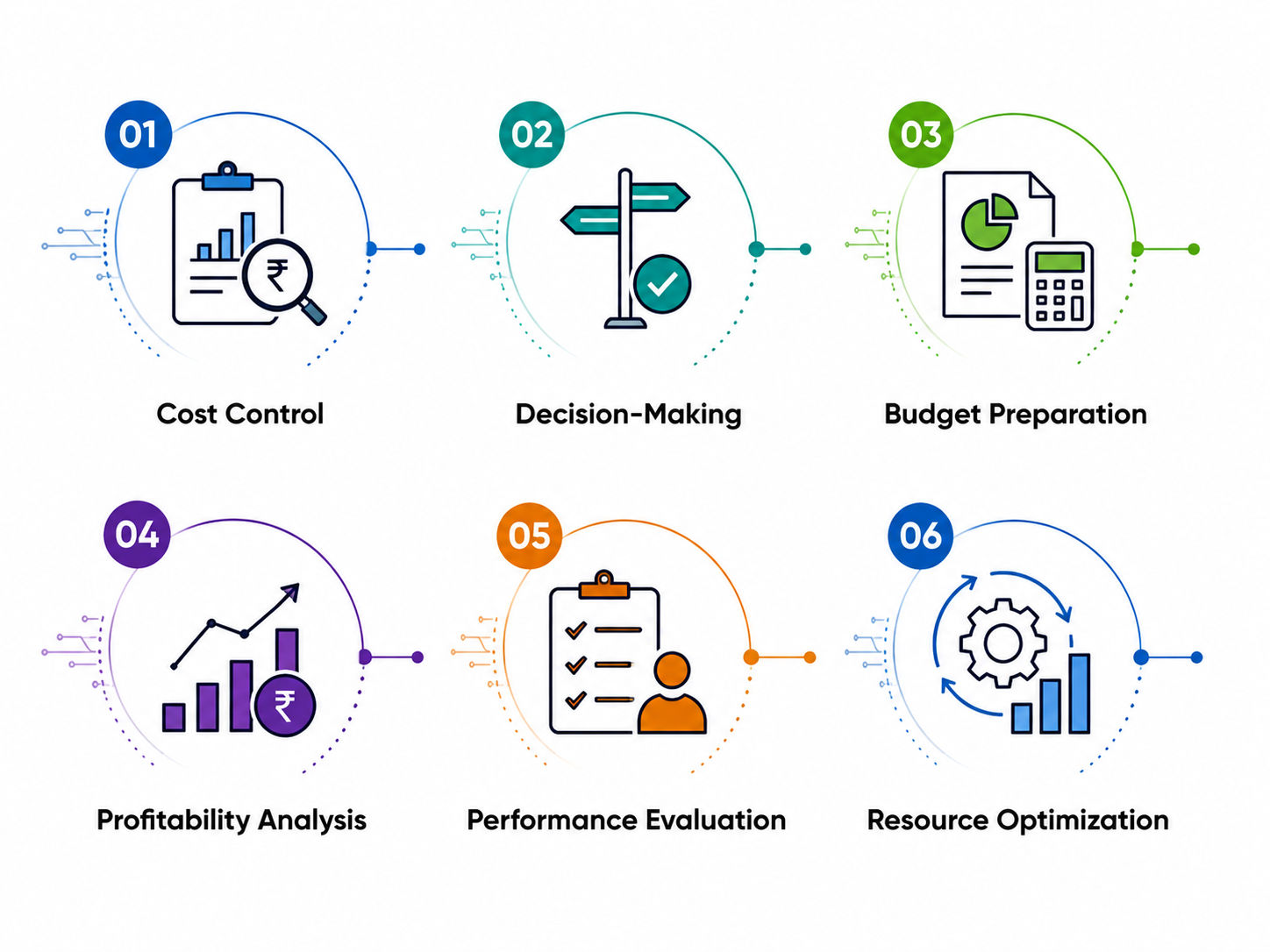
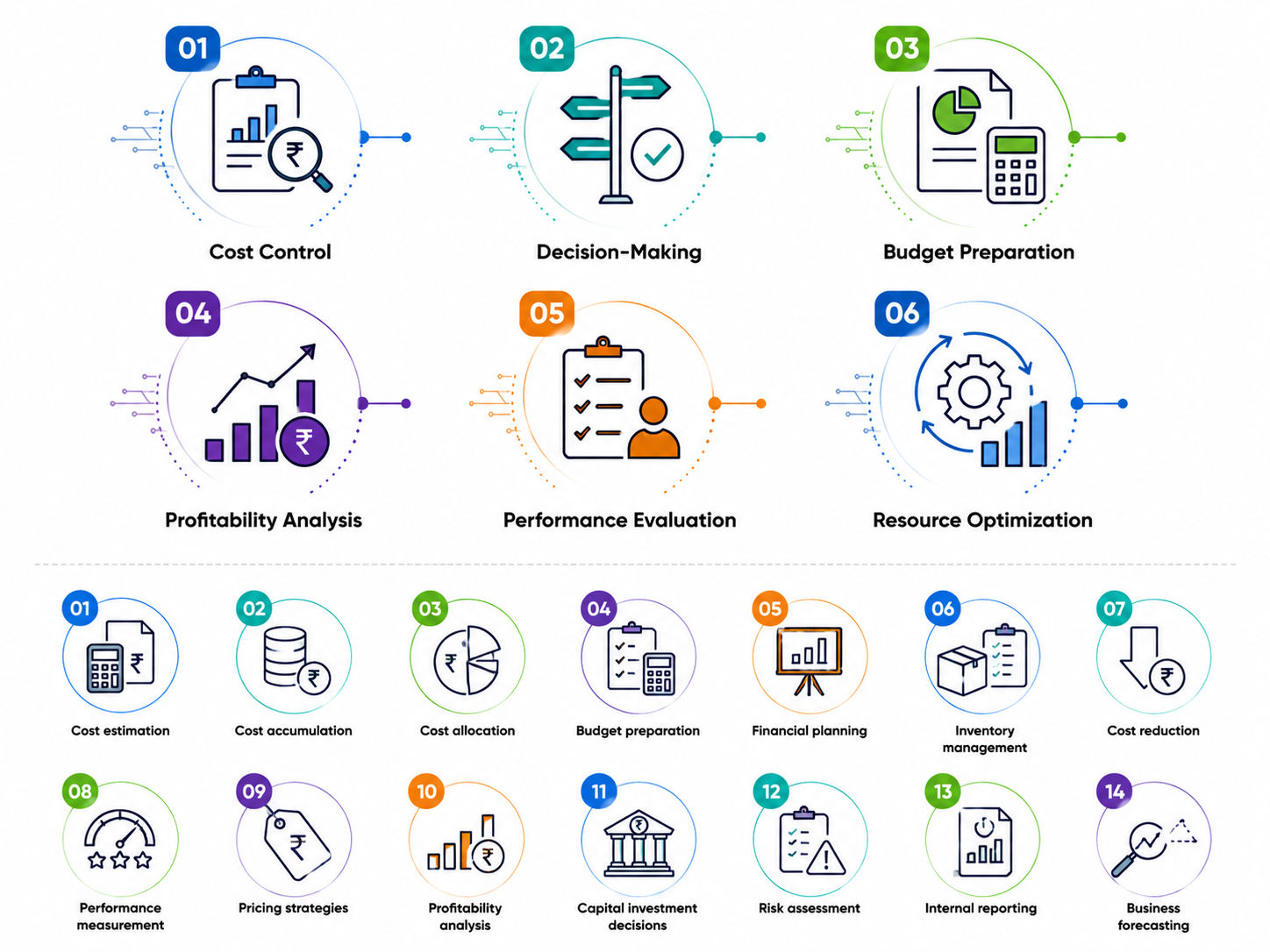
The main goals of cost and management accounting are:
1. Cost Control: Find costs and cut down on expenses without making quality worse.
2. Decision-Making: Give managers the financial details so they can make the best choices.
3. Budget Preparation: Help make budgets that are possible to reach and check how well the company is doing compared to what was planned.
4. Profitability Analysis: Look at how money each product, department, customer or project makes.
5. Performance Evaluation: Check how well departments, workers and parts of the business are doing by looking at money and other information.
6. Resource Optimization: Make sure workers, materials, machines and other parts of the business are used in the way possible.
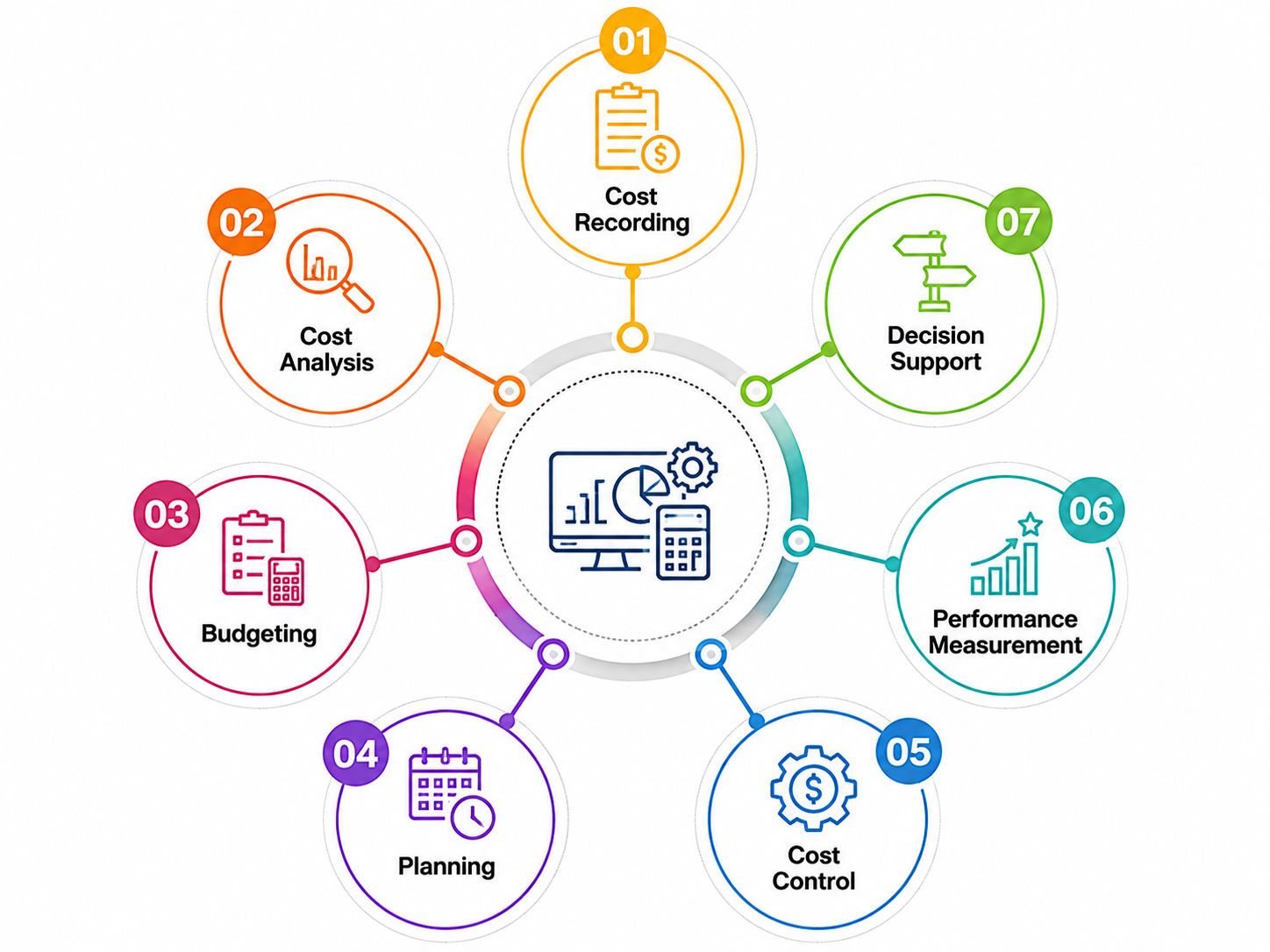
Major functions include:
1. Cost Recording: Capture all costs related to production, operations and administration.
2. Cost Analysis: Analyze different cost components to identify opportunities for improvement.
3. Budgeting: Prepare organizational budgets.
4. Planning: Support long-term business planning using data.
5. Cost Control: Monitor actual costs and compare them with budgeted costs.
6. Performance Measurement: Evaluate efficiency using key financial indicators.
7. Decision Support: Provide reports that assist managers in pricing, outsourcing, expansion and investment decisions.
Step into AI leadership now. Enrol in the IIIT-B and IIMU Chief Data and AI Officer Programme and lead data-driven transformation.
Some commonly followed principles include:
1. Cost-Benefit Principle: The value of accounting information should exceed the cost of collecting it.
2. Consistency Principle: Use consistent accounting methods for meaningful comparisons over time.
3. Relevance Principle: Provide information that is useful for managerial decision-making.
4. Accuracy Principle: Ensure financial and cost information is reliable and free from material errors.
5. Timeliness Principle: Deliver reports quickly enough to support effective decision-making.
6. Materiality Principle: Focus on information that significantly affects business decisions.
Cost and management accounting follows a process that turns operational data into useful information for managers.
The process starts with gathering cost details and ends with checking performance and making choices that help the business.
A typical process includes:
This step is about getting information from different parts of the business. Good sorting makes reporting and helps with checking the numbers.
Costs are split into groups based on things like:
After sorting, the costs are studied to see why they happen and how they change.
Cost allocation gives costs to products, departments, or projects using the best ways to spread the costs. Correct allocation helps with pricing. Knowing how much profit is made.
Common ways to spread the costs are:
Management accountants make reports that help leaders see how the business is doing. Managers use these reports to make choices about how to run the business.
These reports include:
The last part is about checking what really happened against what was planned. Changes are made when things are not going as expected.
Businesses monitor:
Knowing types of costs is important for budgeting setting prices and seeing if the business is making money.
Fixed costs stay the same no matter how much is made long as it is within a certain range. These costs do not change in the term.
Examples include:
Variable costs change depending on how much's made or sold. More production means variable costs.
Examples include:
Semi- -variable costs have both fixed and variable parts. These costs go up when more is done. There is a base amount that stays the same.
Examples include:
Direct costs can be linked to a product, service or project. These costs are easier to assign to items.
Examples include:
Indirect costs help the business run but are not tied to a single product. These costs are spread out using the ways.
Examples include:
Opportunity cost is the value of the option that is not chosen when making a decision.
Example:
Using factory space for Product A means giving up the opportunity to manufacture Product B.
A sunk cost is a cost that has already happened and cannot be changed. Sunk costs should not influence future business decisions.
Example:
Companies use ways to track costs and manage the business depending on what they need.
Job costing is used when the product or service is made for a customer.
Each job has its own cost sheet that records:
Suitable for:
Advantages
Process costing is used in industries where products are manufactured continuously and are identical. Costs are accumulated for each production process or department and averaged across units produced.
Suitable for:
Advantages
Activity-Based Costing (ABC) allocates indirect costs based on the activities that drive those costs rather than using broad averages.
Examples of cost drivers include:
Advantages
Limitations
Standard costing establishes predetermined costs for materials, labor, and overhead before production begins. Actual costs are later compared with these standards to identify differences.
Benefits
Example
If the standard material cost for a product is ₹500 but the actual cost is ₹550, the ₹50 difference is analyzed to determine the cause and take corrective action.
Marginal costing considers only variable costs when determining the cost of producing one additional unit. Fixed costs are treated as period costs and are not allocated to individual units.
Applications
Advantages
Budgetary control involves preparing budgets for different business functions and comparing actual results with planned figures to manage performance.
Steps in Budgetary Control
Benefits
Variance analysis compares actual costs and revenues with budgeted or standard amounts to identify differences and understand their causes.
Common Types of Variances
Benefits
Although cost accounting and management accounting are closely related, they serve different purposes within an organization. Cost accounting focuses on determining and controlling the cost of products or services, while management accounting uses financial and operational information to support planning, decision-making, and business strategy.
The table below highlights the key distinguish between cost accounting and management accounting:
Basis |
Cost Accounting |
Management Accounting |
| Purpose | Determine, record, and control production or operational costs | Provide information for planning, decision-making, and performance management |
| Users | Cost accountants, production managers, department heads | Senior management, executives, business owners, and managers |
| Focus | Cost measurement, cost allocation, and cost control | Overall business performance, planning, forecasting, and strategy |
| Reports | Cost sheets, cost statements, inventory cost reports, production cost reports | Budgets, performance reports, profitability reports, forecasts, dashboards |
| Time Orientation | Primarily historical and current costs | Historical, current, and future-oriented information |
| Compliance | May follow internal costing standards; not legally mandatory in most businesses | No statutory reporting requirement; designed for internal use |
| Decision Support | Supports pricing, inventory valuation, and cost control | Supports strategic planning, investment, budgeting, expansion, and operational decisions |
Cost and management accounting provides managers with reliable financial information that improves operational efficiency and strategic decision-making. It helps organizations optimize costs, allocate resources effectively, and improve long-term profitability.
Accurate cost information enables businesses to determine selling prices that cover production costs while generating desired profit margins.
Benefits include:
Management accounting supports the preparation of realistic budgets based on historical performance and future expectations.
Benefits include:
Businesses use cost data to determine which products, customers, services, or departments generate the highest profits.
This helps management:
Cost analysis helps businesses allocate labor, capital, machinery, and raw materials efficiently.
Benefits include:
Cost accounting supports effective inventory valuation and inventory control by tracking material costs and production expenses.
Benefits include
Managers compare actual performance against budgets and standards to evaluate departmental efficiency.
Performance evaluation helps:
Organizations use several analytical techniques to improve planning, control, and decision-making.
Budgeting involves estimating future revenues, expenses, and resource requirements for a specified period.
Benefit
Standard costing establishes predetermined costs for production and compares them with actual costs.
Benefits
Marginal costing considers only variable costs when evaluating production and pricing decisions.
Applications
Break-even analysis determines the level of sales required to cover all fixed and variable costs.
Formula
Break-Even Point (Units) = Fixed Costs ÷ Contribution per Unit
Benefits
CVP analysis examines how changes in costs, selling prices, and sales volume affect business profits.
It helps management answer questions such as:
Benefits
Variance analysis compares actual performance with budgeted or standard performance to identify deviations.
Common Variances
Benefits
A Cost and Management Accounting course provides students and professionals with the knowledge and skills needed to analyze costs, prepare budgets, evaluate business performance, and support strategic decision-making. The course combines accounting principles with cost analysis and management techniques to help organizations improve efficiency, control expenses, and maximize profitability.
It is suitable for commerce students, finance professionals, business owners, and individuals pursuing careers in accounting, auditing, finance, and management.
A typical course covers both theoretical concepts and practical applications, including:
Eligibility requirements vary depending on the course provider, but generally include:
Enrolling in a cost and management accounting course offers several advantages:
By learning cost and management accounting, individuals gain the expertise to improve cost efficiency, support strategic decision-making, and contribute to the financial success of organizations across various industries.
A cost and management accounting course is ideal for:
Understanding real-world examples makes accounting concepts easier to apply.
A furniture manufacturer calculates the cost of producing each table by including direct materials, labor, and factory overhead. Management compares actual production costs with standard costs to identify inefficiencies and improve production planning.
A consulting firm tracks employee hours, travel expenses, software subscriptions, and administrative costs for each client's project. This information helps determine project profitability, set billing rates, and manage resource utilization.
A supermarket analyzes inventory carrying costs, supplier discounts, storage expenses, and sales margins. Using management accounting reports, the retailer identifies slow-moving products, optimizes stock levels, and improves profitability through better purchasing decisions.
Even well-established businesses can make accounting errors that affect profitability and decision-making.
1. Incorrect Cost Classification
Misclassifying fixed, variable, direct, or indirect costs can distort product costing and lead to poor pricing decisions.
Solution: Establish clear cost classification guidelines and review them regularly.
2. Ignoring Indirect Costs
Many businesses underestimate overhead costs such as rent, utilities, depreciation, and administrative expenses.
Ignoring these costs may result in underpricing products and reduced profitability.
3. Using Outdated Cost Data
Changes in material prices, labor rates, and production processes make historical cost information less reliable over time.
Businesses should regularly update costing data to reflect current market conditions.
4. Overlooking Variance Analysis
Failing to investigate differences between actual and budgeted costs can allow inefficiencies to continue unnoticed.
Regular variance analysis helps identify problems early and supports timely corrective action.
5. Poor Budget Monitoring
Preparing budgets without monitoring actual performance reduces their effectiveness.
Organizations should compare budgeted and actual figures periodically to maintain financial discipline and improve accountability.
Despite its many advantages, cost and management accounting has certain limitations that organizations should consider.
1. Historical Cost Limitations
Many accounting reports rely on historical data, which may not reflect current market conditions or future business risks.
As a result, historical costs alone may not support effective strategic decisions.
2. Subjective Cost Allocation
Allocating indirect costs often involves management judgment and estimation.
Different allocation methods can produce different product costs, affecting pricing and profitability analysis.
3. Data Collection Challenges
Accurate cost accounting depends on collecting large volumes of financial and operational data.
Poor data quality, incomplete records, or manual processes can reduce the reliability of accounting reports.
4. Limited Use Without Accurate Data
Cost and management of accounting is only as effective as the quality of the underlying information.
Inaccurate or outdated data can lead to:
To maximize the benefits of cost and management accounting, businesses should invest in reliable accounting systems, maintain accurate records, and regularly review costing methods and assumptions.
Cost and management accounting helps businesses understand costs, improve efficiency, and make informed financial decisions. By combining accurate cost measurement with strategic analysis, it supports budgeting, pricing, profitability, and performance evaluation. Using appropriate costing methods and management techniques enables organizations to control expenses, allocate resources effectively, and achieve sustainable growth while maintaining a competitive advantage.
Cost and management accounting is the process of collecting, analyzing, and interpreting financial and cost information for internal decision-making. It helps businesses control costs, prepare budgets, evaluate performance, determine product costs, and support strategic planning to improve operational efficiency and profitability.
The main objectives are to control costs, improve profitability, support pricing decisions, prepare budgets, evaluate business performance, optimize resource utilization, assist in planning, and provide accurate financial information that helps managers make informed operational and strategic decisions.
Cost accounting focuses on measuring, recording, and controlling production or service costs. Management accounting uses financial and operational information, including cost data, to support planning, budgeting, forecasting, performance evaluation, and strategic decision-making across the organization.
Cost and management accounting improves decision-making by providing accurate financial insights. It helps businesses control expenses, set competitive prices, prepare budgets, evaluate profitability, allocate resources efficiently, monitor performance, and identify opportunities to increase operational efficiency and long-term growth.
The primary cost accounting methods include job costing, process costing, activity-based costing (ABC), standard costing, and marginal costing. Each method is suitable for different industries and helps businesses accurately determine costs, improve pricing, and manage operational efficiency.
Key management accounting techniques include budgeting, standard costing, marginal costing, variance analysis, break-even analysis, and cost-volume-profit (CVP) analysis. These techniques support planning, cost control, profitability analysis, forecasting, and informed business decision-making.
Cost and management accounting depends on accurate data and appropriate cost allocation methods. Limitations include reliance on historical information, subjective allocation of indirect costs, complex data collection, implementation costs, and reduced effectiveness when financial information is incomplete or outdated.
Cost and management accounting provides managers with reliable financial information for pricing, budgeting, investment planning, profitability analysis, inventory management, and resource allocation. It helps evaluate alternatives, reduce unnecessary costs, improve efficiency, and make strategic decisions that support business growth.
A Cost and Management Accounting PDF is a downloadable study resource containing concepts, costing methods, management accounting techniques, formulas, examples, and practice questions. It helps students, professionals, and exam aspirants learn key topics conveniently for academic studies, certifications, and workplace references.
973 articles published
We are an online education platform providing industry-relevant programs for professionals, designed and delivered in collaboration with world-class faculty and businesses. Merging the latest technolo...
Get Free Consultation
By submitting, I accept the T&C and
Privacy Policy
Top Resources
Certification
3 Months
Certification
6 Months
O.P. Jindal Global University
Masters in International Accounting and Finance (Accredited by ACCA, UK)Master's Degree
12 Months