Leverage in Financial Management: Types, Formulas, and Examples
Updated on Sep 13, 2026 | 11 min read | 6.91K+ views
Share:

All courses
Certifications
More
Updated on Sep 13, 2026 | 11 min read | 6.91K+ views
Share:
Table of Contents
Want to strengthen your management and leadership skills? Explore MBA Certification Courses Online from upGrad and gain practical skills in managing projects, teams, and business goals.
Popular MBA Programs
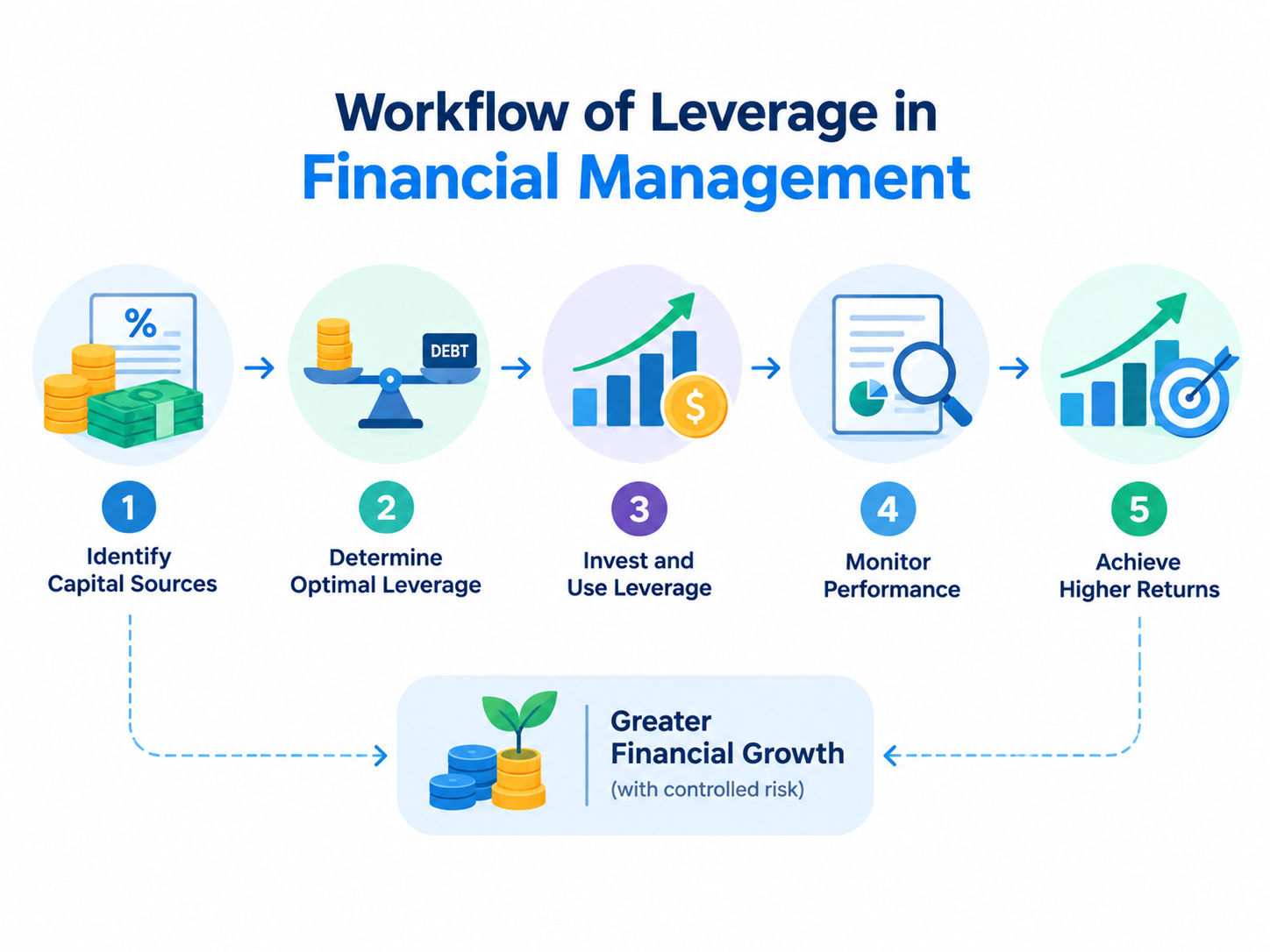
Leverage means using fixed costs or borrowed funds to increase potential returns. In simple terms, it shows how changes in sales can affect a company’s profits.
So, what is leverage in financial management? It is a way to understand how fixed operating costs and financial obligations influence earnings. For example, if a company’s sales increase while its fixed costs stay the same, its profit can rise faster. However, debt also brings interest payments, which can increase financial pressure when earnings fall.
Thus, leverage in financial management can improve returns but also increases risk. The right level depends on the company’s costs, cash flow, debt capacity, and business stability.
Free Courses
The effect of leverage becomes easier to understand by looking at fixed costs.
A business generally has two broad categories of costs:
Suppose a company produces and sells 10,000 units. Its rent, administrative salaries, and equipment costs may remain the same even if it sells a few hundred additional units.
When sales increase, the fixed costs are spread across more units. This can cause operating profit to rise faster than sales. This is the basic idea behind operating leverage.
Financial leverage works differently. It comes from fixed financial commitments such as interest on loans or other debt obligations. When a company earns enough operating profit to cover these costs, the remaining earnings available to shareholders can increase.
For example:
If sales increase while fixed operating costs remain unchanged, EBIT can rise. If the company also has debt, the increase in EBIT can lead to a larger increase in earnings before tax after interest is accounted for.
However, the reverse is also true. A decline in sales can reduce operating profit quickly while fixed costs and interest payments continue. This is why leverage can increase both potential returns and financial risk.
Also Read: Scope of Financial Management: Future Prospects and Career Opportunities
MBA Courses to upskill
Explore MBA Courses for Career Progression
O.P.Jindal Global University
MBA (with Career Acceleration Program by upGrad)Become interview ready with Career Services
PSB MBA + IIML Certification
MBA from Paris School of Business with Certification from IIM LucknowThe types of leverage in financial management are generally divided into three categories:
Each type focuses on a different part of the business.
Operating leverage examines the effect of fixed operating costs on operating profit. Financial leverage focuses on debt and other fixed financial costs. Combined leverage considers both effects together.
Understanding these types of leverage in financial management helps managers identify where business risk comes from and how changes in sales can affect earnings.
Operating leverage is a result of a company’s fixed operating costs. These costs may consist of rent, salaries, depreciation, insurance, and other costs that do not depend on the company’s sales volumes directly.
Therefore, if the company has high operating leverage, a small change in sales will lead to a significant change in the company’s operating profit. The degree of operating leverage can be calculated as follows:
Degree of Operating Leverage (DOL) = Contribution ÷ EBIT
Where:
For example, assume:
Contribution = ₹10 lakh − ₹6 lakh = ₹4 lakh
EBIT = ₹4 lakh − ₹2 lakh = ₹2 lakh
Therefore
DOL = ₹4 lakh ÷ ₹2 lakh = 2
It means if there is a 1% change in sales, it will lead to about 2% change in EBIT, keeping other things constant. High operating leverage is very good when sales are rising steadily because profit increases substantially but becomes very risky when sales are fluctuating because costs have to be met irrespective of sales.
Financial leverage arises because of financial expenses which are incurred due to use of debt or other fixed charges financing by the firm.
The borrowed funds may be used for repayment of loans taken for purchase of assets, expansion schemes, diversification projects or for meeting working capital requirements. The firm has to bear interest burden irrespective of sales.
The degree of financial leverage can be calculated as:
Degree of Financial Leverage (DFL) = EBIT ÷ EBT
Where:
For example, assume a company has:
Therefore:
DFL = ₹4 lakh ÷ ₹3 lakh = 1.33
This implies that a 1% change in EBIT will lead to a 1.33% change in EBT, all other things remaining the same.
If the return on borrowed funds exceeds the rate at which the funds are borrowed, it may be beneficial for the shareholders. But if the earnings of the firm decline, interest payments have to be met. This can increase financial pressure and the possibility of losses.
Combined leverage considers the effects of both operating and financial leverage. It shows how a change in sales can influence earnings before tax.
The degree of combined leverage can be calculated as:
Degree of Combined Leverage (DCL) = DOL × DFL
It can also be expressed as:
DCL = Contribution ÷ EBT
For example, if:
Then:
DCL = 2 × 1.5 = 3
This means a 1% change in sales may result in approximately a 3% change in EBT, assuming other factors remain constant.
Combined leverage is useful when a company wants to understand the overall effect of its operating cost structure and financing decisions.
Take your management knowledge further with MBA from LBS with IIMU Certification - upGrad and develop practical skills for better business decisions, process improvement, and leadership.
The following formulas are commonly used to measure the three major forms of leverage:
Type |
Formula |
What It Measures |
| Operating Leverage | Contribution ÷ EBIT | Effect of sales changes on EBIT |
| Financial Leverage | EBIT ÷ EBT | Effect of EBIT changes on EBT |
| Combined Leverage | DOL × DFL | Overall effect of sales changes on EBT |
These formulas help managers examine how sensitive profits are to changes in sales and operating income.
It is important to remember that the results are based on assumptions such as a stable cost structure and unchanged interest expenses. Actual business performance can be affected by taxes, changing prices, production levels, interest rates, and market conditions.
Consider a company that manufactures electronic accessories.
The company has the following figures:
Contribution is calculated by subtracting variable costs from sales.
Contribution = Sales − Variable Costs
= ₹20 lakh − ₹12 lakh
= ₹8 lakh
EBIT is the profit remaining after deducting operating costs but before interest and tax.
EBIT = Contribution − Fixed Operating Costs
= ₹8 lakh − ₹4 lakh
= ₹4 lakh
The company has an interest expense of ₹1 lakh.
EBT = EBIT − Interest
= ₹4 lakh − ₹1 lakh
= ₹3 lakh
DOL = Contribution ÷ EBIT
= ₹8 lakh ÷ ₹4 lakh
= 2
This means a 1% change in sales could lead to an approximately 2% change in EBIT.
DFL = EBIT ÷ EBT
= ₹4 lakh ÷ ₹3 lakh
= 1.33
This indicates that a 1% change in EBIT could result in an approximately 1.33% change in EBT.
DCL = DOL × DFL
= 2 × 1.33
= 2.66
Therefore, a 1% change in sales could result in an approximately 2.66% change in EBT, assuming other factors remain constant.
This example shows why understanding leverage in financial management is important. The company does not need sales to change by the same percentage for its earnings to change. Fixed operating costs and interest expenses can magnify the effect of changes in sales.
Also read: What is Project Management Process: Phases and Life Cycle
Leverage can offer several benefits when used carefully.
Debt can help a company finance projects without raising all the required capital from shareholders. If the project generates a return higher than the cost of borrowing, shareholder returns may improve.
Companies can use loans to purchase equipment, expand operations, or enter new markets. This allows them to access resources that may otherwise take longer to acquire.
A company may use debt financing to increase production capacity or open new locations. This can support growth without requiring an immediate large contribution from owners.
Leverage measures help managers understand how fixed costs and debt affect earnings. This information can support better budgeting, financing, and investment decisions.
Also Read: Top 10 Risk Management Strategies You Need to Follow for Success!
Leverage can also create problems if it is used without considering the company's ability to handle fixed commitments.
A company with substantial debt must continue making interest and principal payments even when sales are weak. This can increase the risk of financial difficulties.
Interest payments do not normally decrease simply because sales have fallen. A company therefore needs sufficient cash flow to meet its obligations.
Operating leverage can magnify the effect of falling sales on operating profit. If a company has high fixed operating costs, even a moderate decline in sales can have a significant impact on earnings.
Economic slowdowns, changing customer demand, higher interest rates, or unexpected expenses can make highly leveraged businesses more vulnerable.
Also Read: Financial Analyst Salary in India
The three main forms of leverage differ in what they measure and where the fixed costs arise.
Basis |
Operating Leverage |
Financial Leverage |
Combined Leverage |
| Main focus | Operating costs | Financing costs | Operating and financing costs |
| Main fixed cost | Fixed operating costs | Interest and other financial obligations | Both |
| Measures | Effect of sales on EBIT | Effect of EBIT on EBT | Effect of sales on EBT |
| Main risk | Business or operating risk | Financial risk | Overall risk |
| Common formula | Contribution ÷ EBIT | EBIT ÷ EBT | DOL × DFL |
For example, a manufacturing company with expensive machinery may have high operating leverage because of depreciation and other fixed costs. If the same company also relies heavily on loans, it may have high financial leverage as well.
When both are high, the company can experience a much larger change in earnings when sales move up or down.
Also Read: Scope of Financial Management: Future Prospects and Career Opportunities
There is no single leverage level that is suitable for every company. Managers need to consider the company's operating conditions and financial capacity before taking on additional fixed commitments.
Companies with predictable sales and stable cash flows may be better positioned to handle fixed costs and debt. Businesses with highly unpredictable demand may need to be more cautious.
A company should examine how much of its cost structure is fixed. High fixed costs can increase operating leverage and make profits more sensitive to changes in sales.
Before borrowing, a company should consider whether it can comfortably meet interest and principal payments from its expected cash flows.
Borrowing may make sense when the expected return from an investment is sufficiently attractive compared with the cost and risk of the debt.
Interest rates, consumer demand, inflation, competition, and broader economic conditions can affect a company's ability to generate profits. These factors should be considered before increasing leverage.
Leverage in financial management allows understanding what impact fixed operating costs, expenses, and financial obligations have on the company’s profits. Operating leverage is the state of fixed operating expenses, while financial leverage is the state of debt, and combined leverage is the combination of these two aspects.
The types of leverage in financial management allow estimating the possible benefits, associated risks, and selecting optimal strategies. High degree of operating or financial leverage may be beneficial for companies with high sales volume, but a significant decrease in revenues or expenses may cause serious losses. Therefore, it is essential to choose the optimal risk level based on the potential benefits.
Ready to start your journey? Book a free consultation with upGrad today to find the best path for your career.
Leverage in financial management refers to using fixed operating costs or fixed financial obligations to influence a company's earnings. It can increase potential returns when sales and profits rise, but it can also increase business and financial risk when performance declines.
The main types of leverage in financial management are operating leverage, financial leverage, and combined leverage. Operating leverage relates to fixed operating costs, financial leverage relates to debt and financial obligations, while combined leverage considers the effects of both.
Suppose a company borrows ₹10 lakh at an agreed interest rate to expand production. If the additional production generates returns greater than the borrowing cost, the debt may increase shareholder returns. However, the company must still meet its interest obligations if sales fall.
Operating leverage increases the sensitivity of operating profit to changes in sales. A company with high fixed operating costs may experience a significant rise in EBIT when sales grow. However, a fall in sales can also cause operating profit to decline quickly.
Operating leverage comes from fixed operating costs such as rent, salaries, and depreciation. Financial leverage comes from fixed financial commitments such as interest on debt. Operating leverage mainly affects business risk, while financial leverage affects financial risk.
High leverage is not automatically good or bad. It can improve returns when a company has stable earnings and uses funds effectively. However, excessive leverage increases fixed commitments and can make the company more vulnerable to falling sales, rising costs, or cash flow problems.
Financial leverage is commonly measured using the degree of financial leverage formula: EBIT divided by EBT. EBIT represents earnings before interest and tax, while EBT represents earnings before tax. The result indicates how sensitive earnings before tax are to changes in operating profit.
Combined leverage shows the overall effect of changes in sales on earnings before tax. It brings operating and financial leverage together. A higher combined leverage means a relatively small change in sales can create a larger change in earnings, increasing both potential gains and risk.
Leverage helps managers understand how fixed costs and financing choices can affect profitability and risk. It can support decisions related to borrowing, expansion, pricing, cost structures, and investment. Managers can use leverage measures to evaluate whether a proposed financing or operating strategy is sustainable.
Debt increases financial leverage because it usually creates fixed interest obligations. When operating earnings increase, these fixed costs can allow a larger portion of the additional earnings to reach shareholders. When earnings decline, however, the same interest obligations can increase financial pressure.
Leverage and risk are closely connected because fixed costs and financial obligations remain even when sales or profits decline. Higher operating leverage can increase business risk, while higher financial leverage can increase financial risk. Using both together can magnify the overall effect on earnings.
Speak with MBA expert
By submitting, I accept the T&C and
Privacy Policy
From MBA to Dream Job - Explore Our Alumni Success Stories
Top Resources
Master's Degree
13 Months
Master's Degree
12 Months
Master's Degree
15 Months