Capital Budgeting in Financial Management: Process, Techniques, and Examples
By upGrad
Updated on Oct 17, 2026 | 8 min read | 3.63K+ views
Share:

All courses
Certifications
More
By upGrad
Updated on Oct 17, 2026 | 8 min read | 3.63K+ views
Share:
Table of Contents
Key Highlights
Explore upGrad’s management courses to strengthen your financial decision-making, strategic planning, and leadership skills. Learn to evaluate investment opportunities, allocate resources effectively, and make informed business decisions that support long-term organisational growth.
Popular Management Programs
Capital budgeting in financial management is the process of evaluating long-term investments that require significant funds. It helps businesses decide whether an investment, such as machinery, a factory, or a new project, is worth pursuing.
Managers consider the initial investment, expected future cash flows, project life, risk, financing costs, and potential returns. They also consider the time value of money, since money received today is generally worth more than the same amount received in the future.
In simple terms, capital budgeting helps a company answer: Should we invest in this project or use the money elsewhere?
Free Courses
Consider a company planning to expand its manufacturing capacity. It has two options:
The company cannot choose based only on the initial cost. It must compare the expected cash flows and returns from both investments.
Suppose the machine generates ₹12 lakh in annual cash inflows for five years. The company can use methods of capital budgeting in financial management, such as Payback Period, NPV, and IRR, to determine whether the expected benefits justify the investment.
The same approach can be used for decisions such as opening a new store, developing a new product, or purchasing equipment. The key question is: Will the future benefits justify the money invested today?
Imagine that a company invests ₹10 lakh in a project. The project is expected to generate ₹3 lakh in cash inflows each year for five years.
At first glance, the project may appear attractive because the total expected cash inflow is ₹15 lakh. But this alone does not prove that the project is financially beneficial.
The company must also consider:
This is why capital budgeting involves more than simply comparing investment cost with expected revenue.
Also read: Financial Planning in 2026: 10 Crucial Salary Budgeting Tips
The main purpose of capital budgeting is to help a company make better long-term investment decisions. However, it serves several specific objectives.
A major objective is to select projects that can increase the value of the business.
When a project generates returns greater than the cost of the funds invested, it can contribute to the company's financial growth. Managers therefore look for investments that have the potential to create value rather than simply increase sales.
Companies usually have limited financial resources. They cannot invest in every project that appears promising. Capital budgeting helps managers compare different investment opportunities and identify those that are financially attractive.
For example, if a company has ₹1 crore available but receives proposals for five projects, it needs a logical method to decide which projects deserve funding.
Future results are never completely certain. Sales may be lower than expected. Costs may increase. A new technology may become outdated. Customer preferences may change.
Capital budgeting encourages managers to assess these uncertainties before committing money. Risk analysis can help the company understand how changes in assumptions may affect the project's expected return.
Large projects often require substantial funding. A company may need to use retained earnings, debt, equity, or a combination of financing sources.
By evaluating projects in advance, management can estimate how much capital may be required and plan its financing accordingly.
Money invested in one project cannot normally be used for another project at the same time. Capital budgeting helps businesses direct their limited funds toward projects that are expected to provide better financial and strategic benefits.
This becomes especially important when several projects compete for the same pool of capital.
The objectives of capital budgeting are closely connected. A project may appear profitable but still be unsuitable if it involves excessive risk or requires more capital than the company can comfortably provide.
For this reason, managers look at profitability, risk, timing of cash flows, financing requirements, and strategic value together.
A well-planned investment decision can support business growth for years. A poor one can tie up capital in an unsuccessful project and create financial pressure.
Also read: Budget Management: Strategies to Control Your Finances
A capital budgeting decision does not happen in a single step. Businesses usually follow a sequence that starts with identifying an investment opportunity and ends with reviewing the project's actual performance.
The capital budgeting process in financial management can be explained through the following eight steps.
The process begins when a company identifies a possible investment opportunity.
The opportunity could come from different business needs. A company may want to replace old equipment, increase production, enter a new market, reduce operating costs, or introduce a new product.
At this stage, the company may have several possible projects. The goal is to identify investments that support its business objectives.
Next, the company calculates how much money will be required to start the project.
The initial investment may include:
For example, if a machine costs ₹20 lakh but requires ₹2 lakh for installation and ₹1 lakh in additional working capital, the initial investment is not simply ₹20 lakh.
A realistic estimate is important because the project's financial results depend partly on the amount invested at the beginning.
The next step is to estimate how much cash the project may generate during its useful life.
This is one of the most important parts of the process. Managers may consider expected sales, operating expenses, taxes, maintenance costs, working capital requirements, and other relevant cash movements.
Suppose a company expects a new machine to generate ₹8 lakh in additional annual cash flow for five years. These expected cash flows become the basis for evaluating the investment.
Every investment carries some level of uncertainty.
The company therefore evaluates factors that could affect the project's results. These may include changes in demand, competition, inflation, technology, input prices, interest rates, and government regulations.
Managers may also perform sensitivity analysis. For example, they can examine what happens to the project's returns if sales fall by 10% or operating costs increase by 15%.
Once the investment and cash-flow estimates are available, managers evaluate the project using appropriate capital budgeting techniques.
Common methods include:
Each method looks at the investment from a slightly different perspective. Some focus on how quickly the investment is recovered. Others consider profitability or the time value of money.
After evaluating the available projects, management compares their results.
A company may accept a project if it meets its financial requirements. If two or more projects compete for limited funds, management may rank them and select the most suitable option.
The final decision should not depend only on one numerical result. Strategic importance, risk, available funding, and the company's long-term plans may also influence the decision.
Once a project is approved, the company moves from planning to execution.
This could involve purchasing equipment, hiring employees, building facilities, launching a product, or developing new technology.
The implementation stage should follow the approved budget and timeline as closely as possible. Unexpected costs or delays can affect the project's expected returns.
Capital budgeting does not end when the project starts. The company should compare actual performance with the original estimates.
For example, suppose management expected annual cash flows of ₹10 lakh but the project is generating only ₹7 lakh. The company needs to understand why.
The difference may be caused by lower sales, higher costs, delays, or incorrect assumptions. This review helps managers identify problems early and also improves the accuracy of future investment decisions.
Also read: 10 Key Importance of Financial Planning Leads to Success in 2026!
A Simple Flow of the Process
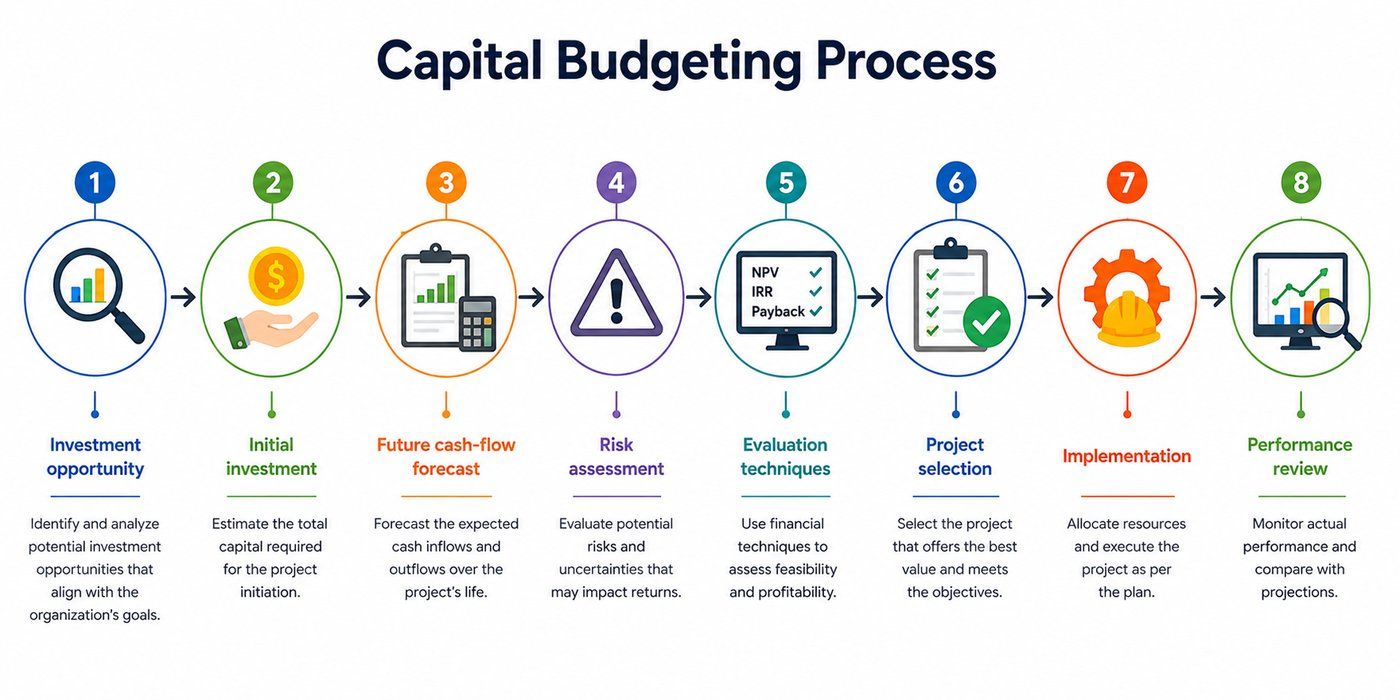
The major capital budgeting techniques in financial management help businesses evaluate long-term investment opportunities. Each method looks at a project from a different angle.
The Payback Period shows how long a company takes to recover its initial investment from cash inflows.
Formula:
Payback Period = Initial Investment ÷ Annual Cash Inflow
Example:
If a company invests ₹10 lakh and receives ₹2.5 lakh annually:
₹10 lakh ÷ ₹2.5 lakh = 4 years
The investment will be recovered in four years.
A shorter payback period is generally preferred. However, this method does not consider the time value of money or cash flows received after the payback period.
ARR measures the expected return from a project based on accounting profit.
Formula:
ARR = Average Annual Accounting Profit ÷ Average Investment × 100
Example:
If the average investment is ₹20 lakh and average annual profit is ₹4 lakh:
ARR = ₹4 lakh ÷ ₹20 lakh × 100 = 20%
A higher ARR may indicate a more attractive project. However, ARR uses accounting profit rather than cash flows and does not consider the time value of money.
NPV measures the value a project is expected to create after considering the time value of money.
Formula:
NPV = Present Value of Future Cash Flows − Initial Investment
Example:
If the present value of future cash flows is ₹12 lakh and the initial investment is ₹10 lakh:
NPV = ₹12 lakh − ₹10 lakh = ₹2 lakh
Decision rule:
NPV considers both the amount and timing of future cash flows.
IRR is the discount rate at which a project's NPV becomes zero. It represents the project's expected rate of return.
Decision rule:
Example:
If the required return is 12% and the project's IRR is 16%, the project may be considered financially attractive.
IRR is useful for comparing investment opportunities but can be difficult to interpret when cash flows change direction multiple times.
PI compares the present value of future cash inflows with the initial investment.
Formula:
PI = Present Value of Future Cash Flows ÷ Initial Investment
Example:
If future cash flows have a present value of ₹15 lakh and the initial investment is ₹10 lakh:
PI = ₹15 lakh ÷ ₹10 lakh = 1.5
Decision rule:
PI is useful when a company has limited capital and needs to compare the value generated by different projects.
Comparison of Capital Budgeting Techniques
| Technique | Main Focus | Time Value of Money |
| Payback Period | Investment recovery | No |
| ARR | Accounting profit | No |
| NPV | Value created | Yes |
| IRR | Rate of return | Yes |
| PI | Value per unit of investment | Yes |
Businesses may use more than one technique because each provides a different perspective. Simple methods offer a quick assessment, while NPV, IRR, and PI provide a more detailed evaluation of future cash flows.
Understand how employee behaviour and organisational dynamics influence business performance with the MA in Organizational Psychology from Golden Gate University. Develop expertise in workplace behaviour, employee motivation, and organisational development to support effective leadership and build productive work environments.
Capital budgeting has several characteristics that make it different from routine financial decisions. These characteristics highlight its long-term nature, financial impact, and the uncertainty involved.
Also read: 20+ Must-Have Finance Skills For Success in 2026
There is no single capital budgeting in financial management formula that can be used for every investment. The calculation depends on the technique selected.
The most commonly used calculations include Payback Period, ARR, NPV, IRR, and PI.
For example, if a company wants to calculate the Payback Period for an investment with equal annual cash inflows, it can use:
Payback Period = Initial Investment ÷ Annual Cash Inflow
For NPV, the calculation is based on the present value of future cash flows:
NPV = Σ [CFₜ ÷ (1 + r)ᵗ] − Initial Investment
Where:
Consider a simplified example.
A company invests ₹5 lakh in a project. It expects to receive ₹2 lakh at the end of each year for three years. Assume the required discount rate is 10%.
The company would first calculate the present value of each year's cash flow:
Year 1: ₹2 lakh ÷ 1.10
Year 2: ₹2 lakh ÷ (1.10)²
Year 3: ₹2 lakh ÷ (1.10)³
The present values are then added together and compared with the ₹5 lakh initial investment.
If the total present value of the future cash flows is higher than ₹5 lakh, the project has a positive NPV.
This illustrates an important point: capital budgeting calculations are based on cash flows and timing, not simply on total expected revenue.
Before applying a formula, managers usually need several inputs:
The estimates should be reviewed carefully because a small change in an important assumption can sometimes change the investment decision.
Also read: Explore the Core Functions of Financial Management in 2026
Capital budgeting offers several benefits that help businesses evaluate investments and make better long-term financial decisions.
Despite its benefits, capital budgeting has some limitations because investment decisions depend heavily on future estimates and changing business conditions.
Also read: Corporate Finance in India 2026: Top Tips You Can't Miss!
Before approving a project, management should examine more than just its expected return.
The company should calculate the total amount required to start the project. This may include purchase costs, installation, transportation, working capital, training, and other initial expenses.
Underestimating the initial requirement can create funding problems later.
Expected cash inflows and outflows should be estimated for the entire project life.
Managers should avoid treating revenue as equivalent to cash flow. Operating expenses, taxes, maintenance costs, and working capital changes can affect the actual cash generated by the investment.
The expected useful life of the investment affects its total cash-flow potential. A machine that remains productive for ten years may generate benefits for much longer than one that becomes outdated after three years.
The company should also consider whether the project's useful life matches its expected technological and market relevance.
The company needs a benchmark against which the project's expected return can be assessed.
The cost of capital represents the return that investors or financing providers require for providing funds.
For example, if a project's expected return is below the company's required return, management may question whether committing capital to that project makes financial sense.
Inflation can affect both project costs and future cash flows. Raw materials, wages, energy, transportation, and maintenance expenses may become more expensive over time. Cash-flow forecasts should therefore use realistic assumptions about inflation.
Taxes can have a significant effect on project cash flows. Depreciation, tax rates, tax deductions, and gains or losses from selling an asset may all affect the project's final financial outcome.
Tax effects should therefore be incorporated into the investment analysis where relevant.
Managers should identify the major uncertainties associated with the project.
A project with high expected returns may also involve high risk. Another project may offer lower returns but more predictable cash flows.
The better choice depends on the company's objectives, risk tolerance, and financial position.
Some assets can be sold at the end of their useful life. The expected amount received from selling the asset is called its salvage or residual value.
For example, if machinery costs ₹30 lakh and is expected to be sold for ₹5 lakh after eight years, the ₹5 lakh expected recovery should be considered when estimating the project's cash flows.
The broader market environment can influence the success of a project. Managers may need to examine customer demand, competitors, economic trends, technological changes, supply conditions, and regulatory developments.
A financially attractive project on paper may still be unsuitable if market conditions are moving against it.
Also read: Top Finance Project Topics for MBA & Research Projects
Capital budgeting helps businesses evaluate long-term investments before committing significant funds. The capital budgeting process in financial management involves identifying an investment opportunity, estimating cash flows, assessing risk, evaluating the project, and selecting the most suitable option.
Techniques such as Payback Period, ARR, NPV, IRR, and Profitability Index help businesses compare investment opportunities and make better decisions.
Overall, capital budgeting helps companies use their limited funds effectively and select investments that support long-term growth.
Capital budgeting helps businesses evaluate major long-term investments before committing their funds. It allows managers to compare expected cash flows, investment costs, risks, and returns. This can reduce the chances of putting substantial capital into projects that may not provide sufficient financial or strategic benefits.
There is no single method that is best for every situation. NPV is widely preferred because it considers the time value of money and measures the value a project may add. However, businesses often use NPV alongside IRR, Payback Period, or other measures.
Regular budgeting often deals with short-term income and expenses, such as salaries, utilities, and operating costs. Capital budgeting focuses on major investments that are expected to provide benefits over several years, such as equipment, buildings, technology, or expansion projects.
A negative NPV generally indicates that the project's expected returns are below the required rate of return. Under normal circumstances, the project would be rejected. However, management may still consider it if it provides important strategic, regulatory, or non-financial benefits.
Yes. In fact, using multiple techniques can provide a broader view of a project. For example, a company may use Payback Period to understand how quickly funds are recovered and NPV to assess whether the project is expected to create value.
Future cash flows show how much money an investment may actually generate or consume over time. They are more useful for investment analysis than revenue or accounting profit alone because they help managers understand the project's ability to recover its investment and generate financial returns.
Risk reflects the possibility that actual project results may differ from expectations. Changes in sales, costs, competition, technology, or economic conditions can affect cash flows. Managers therefore assess risk before approving a project and may use different scenarios to test the investment.
No. Businesses of different sizes can use capital budgeting. A small business deciding whether to purchase expensive equipment or open another location also needs to evaluate the expected costs and benefits. The scale of the investment may differ, but the underlying decision-making process is similar.
NPV measures the amount of value a project is expected to add after considering the required return. IRR represents the discount rate at which the project's NPV becomes zero. Both consider the time value of money, but they express project performance differently.
A rupee received today can potentially be invested and earn a return, so it generally has greater value than a rupee received several years later. Capital budgeting methods such as NPV and IRR account for this difference when evaluating future cash flows.
No. Capital budgeting improves the decision-making process, but it cannot eliminate uncertainty. Future cash flows, market conditions, costs, and customer demand can differ from forecasts. The quality of the decision therefore depends on realistic assumptions, careful analysis, and continuous monitoring.
1141 articles published
We are an online education platform providing industry-relevant programs for professionals, designed and delivered in collaboration with world-class faculty and businesses. Merging the latest technolo...
Get Free Consultation
By submitting, I accept the T&C and
Privacy Policy
Top Resources
Certification
3 Months
Certification
6 Months
O.P. Jindal Global University
Masters in International Accounting and Finance (Accredited by ACCA, UK)Master's Degree
12 Months