Introduction on Generative AI in Healthcare
By Sriram
Updated on Jun 12, 2026 | 6 min read | 2.48K+ views
Share:

All courses
Certifications
More
By Sriram
Updated on Jun 12, 2026 | 6 min read | 2.48K+ views
Share:
Table of Contents
Generative AI in healthcare is changing how doctors diagnose diseases, manage records, conduct research, and deliver care. Generative AI can create new content; it can make notes, medical summaries, messages to patients, research insights, and even possible new medicines.
Generative AI can help doctors with diagnoses, research, and help them take better care of patients. It is a tool that makes their jobs easier and helps them make decisions.
Here you will learn what generative AI in healthcare means, how it works. its usage today, future, real-life examples, challenges.
Ready to shape the future of healthcare? Explore upGrad's Artificial Intelligence Courses to dive deep into Generative AI in Healthcare and build expertise that puts you ahead in one of the fastest-growing fields today.
Generative AI Courses to upskill
Explore Generative AI Courses for Career Progression
IIIT Bangalore
Executive Diploma in Machine Learning and AI360° Career Support
Generative AI in healthcare is a technology that delivers output based on what they learn from data on medical information. These systems use language models and other technologies to do this.
Generative AI in healthcare is different from the kind of healthcare AI. The traditional kind just observes data and tries to guess what they are or what might happen. Whereas Generative AI in healthcare can actually create new ideas, and the output looks like a human.
Also Read: How AI in Healthcare is Changing Diagnostics and Treatment
Generative AI models are trained using large datasets that may include:
After training, the models can generate useful outputs such as:
Feature |
Traditional AI |
Generative AI |
| Main Purpose | Prediction and analysis | Content creation and generation |
| Output | Scores, classifications | Text, reports, summaries, recommendations |
| Healthcare Use | Disease detection | Documentation, research, patient communication |
| Data Processing | Structured data | Structured and unstructured data |
Also Read: The Role and Application of Machine Learning in Healthcare
Healthcare systems generate massive amounts of data every day. Doctors spend a lot of time on paperwork taking care of patients. A 2025 healthcare survey found that about 85% of healthcare organizations are looking into or already using AI. This shows how fast healthcare organizations are adopting AI.
Healthcare organizations are using AI, and generative AI is being adopted quickly by healthcare organizations.
Generative AI helps address this challenge by:
The greatest benefit of generative AI in healthcare comes from practical uses that save time and improve decision-making. Generative AI helps doctors and nurses to make better choices by giving them time to focus on patients.
Doctors often spend hours updating records. While clinical documentation and medical scribing by AI reduces the amount of administrative workload of doctors and allows them to focus more on taking care of patients.
A lot of hospitals are now using AI-powered documentation platforms to help doctors work more efficiently and reduce the stress of overwhelming workload.
Generative AI can:
Patients get answers quickly while healthcare staff can also handle larger questions at once.
Healthcare organizations use generative AI to:
Developing new medicines is expensive and time-consuming.
Generative AI helps researchers:
Also Read: What Is the Role of Generative AI in Drug Discovery?
Generative AI assists healthcare professionals by:
Generative AI can support radiologists and specialists by:
Healthcare is becoming increasingly patient-centric.
Generative AI supports personalized medicine through:
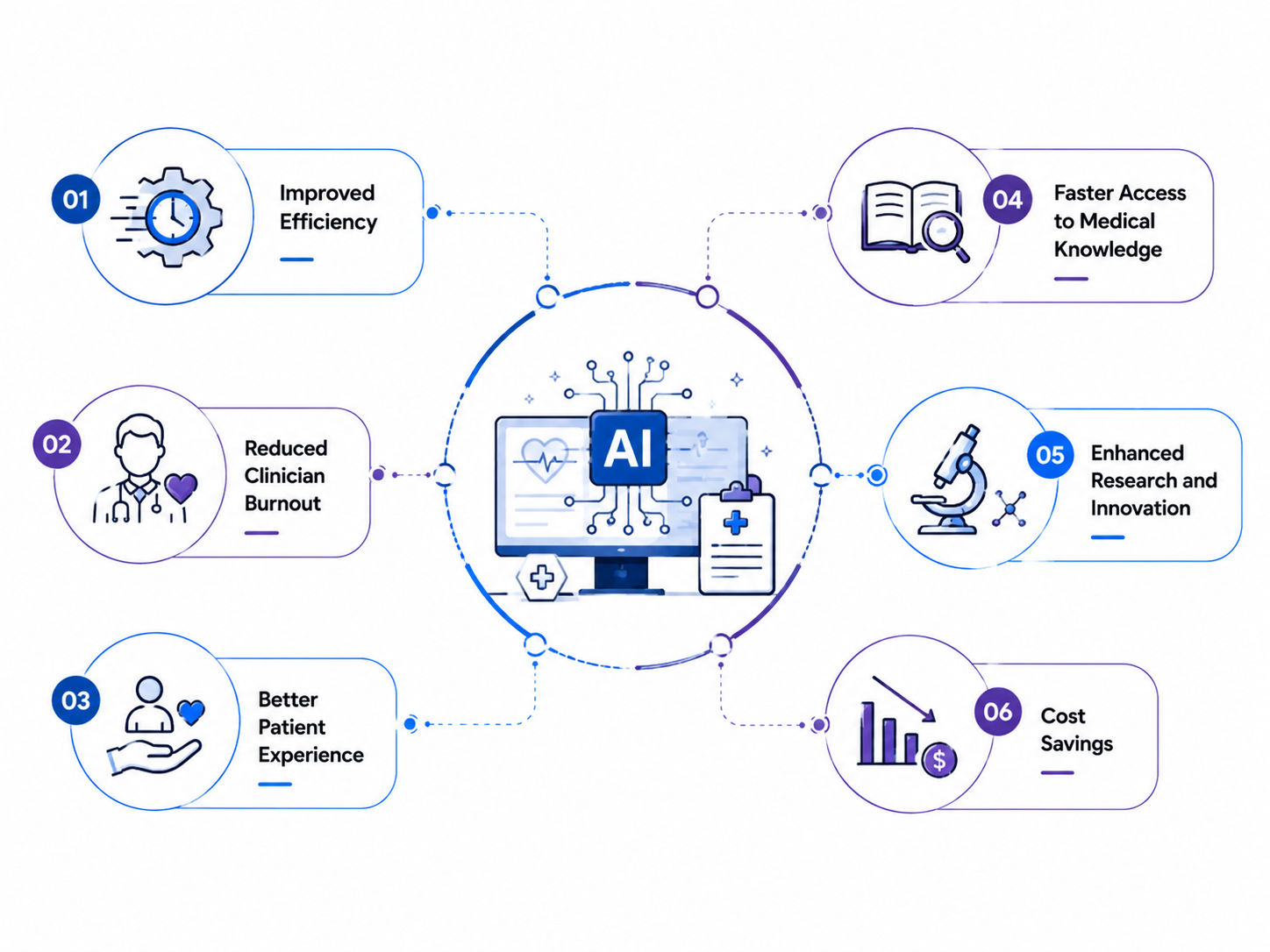
The rapid growth of generative AI in healthcare is driven by measurable benefits across clinical, operational, and research functions.
Administrative tasks consume a large portion of healthcare professionals' time.
Generative AI helps automate:
This improves productivity without requiring additional staff.
Physician burnout remains a major challenge worldwide.
By reducing repetitive documentation work, generative AI allows clinicians to spend more time interacting with patients and less time completing paperwork.
Patients increasingly expect faster and more personalized healthcare services.
Generative AI can improve experiences through:
Medical knowledge expands rapidly.
Generative AI can:
Researchers can analyze large datasets more efficiently and uncover patterns that may otherwise remain hidden.
This supports:
While implementation requires investment, organizations can reduce operational costs by automating repetitive processes.
Healthcare leaders increasingly consider generative AI as a tool for improving workflow efficiency and reducing operational loopholes.
Benefit |
Impact |
| Workflow Automation | Higher efficiency |
| Documentation Support | Less administrative burden |
| Research Acceleration | Faster discoveries |
| Patient Engagement | Improved satisfaction |
| Decision Support | Better clinical outcomes |
Also Read: How to Become a Healthcare Data Analyst: A Complete Career Guide
Despite its potential, generative AI in healthcare comes with important limitations that organizations must address carefully.
Healthcare data is highly sensitive.
Organizations must ensure:
Protecting patient information remains a top priority.
Generative AI systems can occasionally generate incorrect or misleading information.
In healthcare, even small errors can have serious consequences.
Therefore:
Healthcare operates under strict regulations.
Organizations must comply with:
Regulators worldwide are actively developing frameworks for AI governance. Recent FDA initiatives also demonstrate growing institutional adoption of AI-assisted workflows while maintaining oversight requirements.
AI models learn from historical data.
If training data contains bias, outputs may also become biased.
This can affect:
Healthcare organizations must continuously monitor model performance.
Many healthcare systems still rely on legacy technology.
Common implementation challenges include:
Healthcare decisions affect human lives. Questions around accountability, transparency, and trust remain important. Organizations should establish clear governance frameworks before large-scale deployment.
Also Read: Role of Data Science in Healthcare: Applications & Future Impact
The future of generative AI in healthcare extends far beyond documentation and administrative support.
Healthcare organizations are increasingly moving from pilot projects to enterprise-wide implementation. Industry surveys show adoption continuing to accelerate as organizations focus on measurable returns on investment and integration into daily workflows.
Several developments are expected to shape the next phase of adoption.
Future systems will combine:
This can provide more comprehensive clinical insights.
Researchers are increasingly using generative AI to identify drug candidates faster than traditional approaches.
This could reduce development costs and accelerate innovation.
Future healthcare may rely heavily on AI-generated treatment recommendations tailored to individual patients.
Generative AI will increasingly support:
While making clinicians the final decision maker.
Leading healthcare institutions continue expanding AI initiatives. For example, Mayo Clinic has invested in infrastructure and AI-powered documentation systems to support clinical workflows and research innovation.
The most successful healthcare organizations will likely combine AI capabilities with strong governance, clinical expertise, and patient-centered care.
What the Future May Look Like
Future Trend |
Potential Impact |
| Multimodal AI | More accurate insights |
| Drug Discovery | Faster innovation |
| Personalized Medicine | Better outcomes |
| Clinical Automation | Increased efficiency |
| Research Acceleration | Faster breakthroughs |
Generative AI in healthcare is rapidly moving from experimentation to real-world implementation. It helps healthcare providers in various ways even though at the same time, challenges related to privacy, accuracy, regulation, and ethics require careful management.
The technology is not a replacement for healthcare professionals. Instead, it serves as a powerful tool that can enhance human expertise and improve healthcare delivery. As adoption continues to grow, organizations that implement generative AI responsibly will be better positioned to deliver efficient, personalized, and high-quality care.
Want personalized guidance on Generative AI in healthcare? Speak with an expert for a free 1:1 counselling session today.
Generative AI in healthcare refers to AI systems that create new content such as medical notes, patient summaries, treatment suggestions, and research insights. Unlike traditional AI, it generates information rather than simply analyzing existing data. Healthcare providers use it to improve efficiency and support decision-making.
Traditional healthcare AI mainly focuses on predictions, classifications, and pattern recognition. Generative AI can create text, reports, recommendations, and other outputs based on learned medical knowledge. This allows it to support a wider range of healthcare workflows.
Generative AI can assist clinicians by analyzing information and generating recommendations. However, it should not be considered a standalone diagnostic tool. Medical professionals must review and validate AI-generated outputs before making clinical decisions.
Doctors use generative AI to automate clinical documentation, summarize patient records, review research, and generate reports. These capabilities reduce administrative workloads and allow physicians to spend more time focusing on patient care.
Generative AI can be safe when implemented with proper safeguards, validation processes, and regulatory compliance measures. Human oversight remains essential because AI systems can occasionally generate inaccurate or incomplete information.
The main risks include privacy concerns, inaccurate outputs, data bias, cybersecurity threats, and regulatory challenges. Healthcare organizations must establish governance frameworks and continuously monitor AI performance to minimize these risks.
Yes. Generative AI can provide faster responses, personalized communication, appointment reminders, and educational content. These capabilities help patients access information more easily and improve overall engagement with healthcare services.
Researchers use generative AI to identify potential drug compounds, analyze scientific literature, and generate research hypotheses. This can shorten early-stage research timelines and help pharmaceutical companies accelerate innovation.
Generative AI is unlikely to replace healthcare professionals. Instead, it functions as a support tool that enhances productivity, reduces repetitive tasks, and provides insights. Human expertise remains critical for diagnosis, treatment, and patient care.
Professionals should understand healthcare workflows, data privacy regulations, AI fundamentals, and digital health technologies. Knowledge of machine learning concepts and healthcare data management can also be valuable for future roles.
The future of generative AI in healthcare includes multimodal AI systems, personalized medicine, advanced clinical decision support, and faster drug discovery. As technology matures, adoption is expected to expand across hospitals, research institutions, and healthcare organizations worldwide.
727 articles published
Sriram K is a Senior SEO Executive with a B.Tech in Information Technology from Dr. M.G.R. Educational and Research Institute, Chennai. With over a decade of experience in digital marketing, he specia...
Speak with AI & ML expert
By submitting, I accept the T&C and
Privacy Policy