Artificial Intelligence Creativity: How AI Enhances, Challenges, and Transforms Human Creativity
By upGrad
Updated on Jul 28, 2026 | 5 min read | 1.58K+ views
Share:

All courses
Certifications
More
By upGrad
Updated on Jul 28, 2026 | 5 min read | 1.58K+ views
Share:
Table of Contents
Key Takeaway
Explore upGrad's generative AI courses in India to learn prompt engineering, foundation models, agentic AI workflows, Retrieval-Augmented Generation (RAG), and real-world AI applications through industry-focused projects and expert-led learning. Start building job-ready AI expertise today.
Popular AI Programs
Artificial intelligence creativity is the ability of AI to produce content that feels creative, whether it's writing a poem, designing a logo, composing music, or generating ad copy. It doesn't rely on imagination like people do. Instead, it predicts patterns from the data it has learned.
Unlike humans, AI doesn't create from personal experiences, emotions, or imagination. Instead, it identifies relationships across billions of examples and predicts what should come next. The result can feel surprisingly original, even though the process is based on learned patterns rather than conscious thought.
Think about everyday AI tools. They can write stories, design logos, compose melodies, suggest marketing campaigns, or generate realistic images within seconds. These outputs often look creative because the AI combines existing concepts in unexpected ways.
Can artificial intelligence be creative? Large language models and diffusion models learn by analyzing huge amounts of text, images, and other data. When you enter a prompt into tools like ChatGPT or Midjourney, they don't "think" the way people do. They generate a response by predicting the words, images, or patterns that best match your request based on what they've learned.
People create differently.
A writer stares at a blank page and thinks about a memory before typing a word. An AI model doesn't do that. It calculates probabilities. Even so, the combinations it produces can be fresh and unexpected, giving people new ideas they might not have considered on their own.
Must read: How to Build Your Own AI System: Step-by-Step Guide
This is where opinions start to differ. Some researchers believe creativity is simply the ability to produce something new and valuable.
By that definition, AI can be considered creative because it generates original-looking content that people find useful. Others argue that true creativity goes beyond the final result. They believe it requires intention, emotions, personal experiences, and an understanding of why something matters, qualities that AI doesn't possess.
Both perspectives have merit. AI can combine ideas in ways that feel fresh and unexpected, often suggesting possibilities that humans might overlook.
A recent example is the surge in Studio Ghibli-style AI artwork, where people transformed everyday photos into illustrations inspired by the iconic animation style. While the images looked imaginative and captured the visual charm of Ghibli films, the AI wasn't creating from its own inspiration or storytelling vision.
It generated those images by recognizing patterns from its training data and following user prompts. Humans, on the other hand, create with purpose, emotions, memories, and an understanding of why a particular creative choice matters.
Must read: What is Generative AI? Understanding Key Applications and Its Role in the Future of Work
Free Courses
This is where artificial intelligence creativity adds real value. It doesn't replace creative thinking. Instead, it takes care of repetitive tasks, sparks fresh ideas, and gives you more time to focus on the parts that need human insight.
Where AI Adds Value
Creative Task |
How AI Helps |
| Brainstorming | Generates multiple ideas in seconds to overcome creative blocks. |
| Idea Expansion | Explores different perspectives from a single concept. |
| Rapid Prototyping | Creates quick drafts or visual concepts before full production. |
| Editing and Refinement | Improves clarity, structure, and readability. |
| Personalization | Adapts content to different audiences, platforms, or tones. |
Speed is the biggest advantage, but it's not the only one. AI can also push you beyond your usual way of thinking. An unexpected suggestion or an unusual combination of ideas can spark a direction you might never have explored on your own. When a tool throws back an odd suggestion, it can jolt you out of your usual thinking pattern.
Creative Task |
Traditional Process |
AI-Assisted Process |
| Writing | Draft manually over hours | AI drafts in minutes, human refines |
| Design | Sketch, iterate by hand | AI generates variants for review |
| Music | Compose note by note | AI suggests melodies or chord progressions |
| Video | Manual editing and effects | AI auto-generates cuts or scenes |
| Marketing | Brainstorm in meetings | AI produces bulk ad copy variations |
AI can speed up creative work, but it shouldn't make the final decisions. The strongest results come when people review the output, add their own insights, and correct anything that feels inaccurate, repetitive, or out of place.
Do read: How Does Generative AI Work? Key Insights, Practical Uses, and More
AI Courses to upskill
Explore Artificial Intelligence Courses for Career Progression
Artificial intelligence creativity has changed how people write, design, compose music, and solve problems. But even as AI tools become more capable, human creativity remains at the center.
AI can generate ideas in seconds, but it can't understand emotions, personal experiences, or the deeper meaning behind creative choices. That's why the best results usually come from people and AI working together.
AI learns from patterns in existing data, while people create from lived experiences, emotions, curiosity, and imagination. Those qualities shape work in ways that technology simply can't replicate.
Imagine a filmmaker creating a documentary about losing a loved one. AI might help organize interview transcripts or suggest a soundtrack, but it can't draw from personal grief or understand which moments deserve silence instead of music. Likewise, a marketing campaign that resonates in one country may fall flat or even offend in another because cultural context and social awareness require human judgment.
Creative decisions aren't just about producing something new. They're about knowing what feels authentic, what connects with an audience, and why a particular idea matters.
Do read: Types of AI: From Narrow to Super Intelligence with Examples
The most effective way to use artificial intelligence creativity is to treat AI as a creative partner rather than a replacement. It can quickly generate ideas, draft content, suggest visual concepts, or create multiple variations, allowing creators to spend more time refining and improving the final result.
For example, a writer might ask AI for ten headline ideas before selecting one and rewriting it in their own style.
A graphic designer could generate several layout concepts before adding original illustrations and branding. In both cases, AI speeds up the process, while the human makes the important creative decisions.
A balanced workflow helps you get the most from AI without losing your own creative voice.
Step |
Role of the Human |
Role of AI |
| Define the goal | Set the objective, audience, and creative direction. | Understand the prompt and generate ideas. |
| Generate options | Evaluate which ideas have potential. | Create multiple drafts, concepts, or variations. |
| Refine the work | Add personal insights, storytelling, and originality. | Suggest edits, improve structure, or polish language. |
| Review and finalize | Fact-check, ensure accuracy, and make the final decision. | Support revisions based on feedback. |
When AI handles repetitive work and humans focus on strategy, emotion, and originality, the outcome is often stronger than what either could produce alone.
Human creativity + AI capabilities = Better ideas, faster execution, and more meaningful creative outcomes.
This balance is what makes artificial intelligence creativity so powerful. AI brings speed, scale, and experimentation, while humans contribute imagination, empathy, ethics, and purpose. Together, they create work that is not only efficient but also genuinely impactful.
Advance your career with upGrad's Executive Post Graduate in AI-Native Software Engineering from IIT Kharagpur to learn full-stack AI engineering, agentic workflows, retrieval systems, and production-ready deployment while building end-to-end AI applications through hands-on projects and live online learning.
Creativity isn't that simple. Artificial intelligence creativity and human creativity work in different ways, which makes direct comparisons difficult.
AI predicts and generates content, whereas humans can imagine and create.
Human Creativity |
Artificial Intelligence Creativity |
| Driven by emotion | Driven by pattern learning |
| Built from lived experience | Built from training data |
| Has genuine intent | Responds to prompts |
| Original insight | Statistical prediction |
| Applies ethical judgment | Follows rules it was given |
| Adapts to unfamiliar context | Struggles outside familiar patterns |
Can AI Replace Human Creativity? The short answer is no. Artificial intelligence creativity can automate repetitive creative tasks, but it can't replace the qualities that make human creativity unique.
Rather than replacing human creativity, AI is changing how creative work gets done. It takes care of repetitive tasks, speeds up idea generation, and helps creators experiment more freely. Humans remain responsible for setting the vision, making ethical decisions, and creating work that genuinely connects with an audience.
In the foreseeable future, the strongest creative work will continue to come from a partnership between people and AI, where technology enhances human creativity instead of replacing it.
Also read: 5 Significant Benefits of Artificial Intelligence
The biggest advantage isn't replacing creativity. It's making creativity easier to explore.
Some of the most practical benefits include:
The impact becomes even clearer when comparing traditional workflows with AI-assisted ones.
Creative Task |
Traditional Process |
AI-Assisted Process |
| Writing | Brainstorm, draft, revise manually | AI generates ideas and first drafts before human editing |
| Graphic Design | Multiple manual concept sketches | AI creates visual concepts for refinement |
| Music | Compose every variation manually | AI suggests melodies and arrangements |
| Video Production | Script, storyboard, edit individually | AI speeds up scripting, captions, and rough edits |
| Marketing | Develop campaigns from scratch | AI proposes campaign ideas and content variations |
Still, AI isn't perfect.
Generated content can sound repetitive, overlook context, or include factual mistakes. That's why successful creators don't rely on AI alone. They treat it as a collaborator that speeds up exploration while they make the final creative decisions.
Also read: AI vs. Human Intelligence in 2025: What's Changing?
Here are some examples of artificial intelligence creativity in different sectors:
A small ecommerce brand once used AI to generate 50 product description variants overnight. The team picked three, edited them, and cut a week of copywriting down to a single afternoon. That's artificial intelligence creativity doing what it does best, handling volume so humans can focus on judgment.
Must read: AI vs. Human Intelligence in 2025: hat's Changing?
Artificial intelligence creativity opens new possibilities, but it also brings important ethical issues in artificial intelligence creativity that creators, businesses, and policymakers need to address. As AI-generated content becomes more common, creators, businesses, educators, and policymakers are trying to balance innovation with responsibility and AI ethics. The technology raises real questions that don't have tidy answers yet.
There's no perfect solution. The challenge isn't simply whether AI can create something impressive. It's about ownership, authenticity, fairness, and accountability.
This question doesn't have a universal answer.
AI creates content by learning patterns from existing data. It doesn't invent ideas from personal experience or imagination. Instead, it predicts combinations that fit a user's prompt. That means an AI-generated image, article, or song can look original while still reflecting patterns learned during training.
For many creative projects, originality comes from human involvement.
If a designer uses AI to generate ten logo concepts and then combines, edits, and improves them into a final design, the creative contribution comes from both the AI and the designer.
The more meaningful the human contribution, the stronger the argument for originality.
Must read: Generative AI Chatbot: How Intelligent Conversational Systems Work
Ownership remains one of the biggest legal questions surrounding artificial intelligence creativity.
Different countries apply different rules. Some copyright laws only recognize works created by humans, while others are still adapting to AI-assisted content. As a result, ownership depends on factors such as local regulations, the level of human involvement, and the AI tool being used.
Creators should always review the licensing terms of the AI platform before publishing commercial work.
Here are a few practical considerations.
Good documentation can prevent future disputes.
Do read: Image Recognition Machine Learning: Brief Introduction
AI learns from existing information. If that information contains bias, the output can reflect it.
For example, an AI image generator asked to create a "CEO" might repeatedly produce similar demographics if its training data isn't diverse. Likewise, a writing tool could reinforce stereotypes without recognizing them.
That's why human review matters.
Before publishing AI-generated content, ask yourself:
Must read: Ultimate Guide to Generative AI Tools in 2025
People value authenticity.
Readers usually don't mind if AI helped produce content. What matters is whether the final work is accurate, useful, and honest about its purpose.
Imagine reading a travel article that describes places the writer never visited because the entire piece came from AI without fact-checking. Trust disappears quickly.
Authenticity comes from human oversight.
Creators can strengthen credibility by:
Authentic content earns long-term trust.
Do read: How to Become a Prompt Engineer: Essential Guide, Career Growth, and Opportunities
Overreliance on AI is a real risk, especially for teams under deadline pressure.
Quick checklist before publishing AI-assisted work:
Verify facts. Add personal insight. Edit the output line by line. Respect copyright. Avoid anything close to plagiarism.
Also read: Career Options in GenerativeAI
Using artificial intelligence creativity effectively isn't about generating more content. It's about generating better ideas and refining them with human expertise.
Successful creators don't hand over the entire process to AI. They guide it.
Best Practice |
Why It Matters |
| Start with a clear objective | A well-defined goal helps AI generate more relevant and focused outputs. |
| Use AI for ideation, not final decisions | AI can generate ideas quickly, but humans should make strategic, creative, and ethical decisions. |
| Combine multiple AI techniques | Different tools excel at different tasks, so using them together often produces better results. |
| Include a human review at every stage | Reviewing AI-generated content helps catch factual errors, bias, awkward wording, and inconsistencies. |
| Develop strong prompt engineering skills | Clear, detailed prompts improve output quality and reduce the need for extensive revisions. |
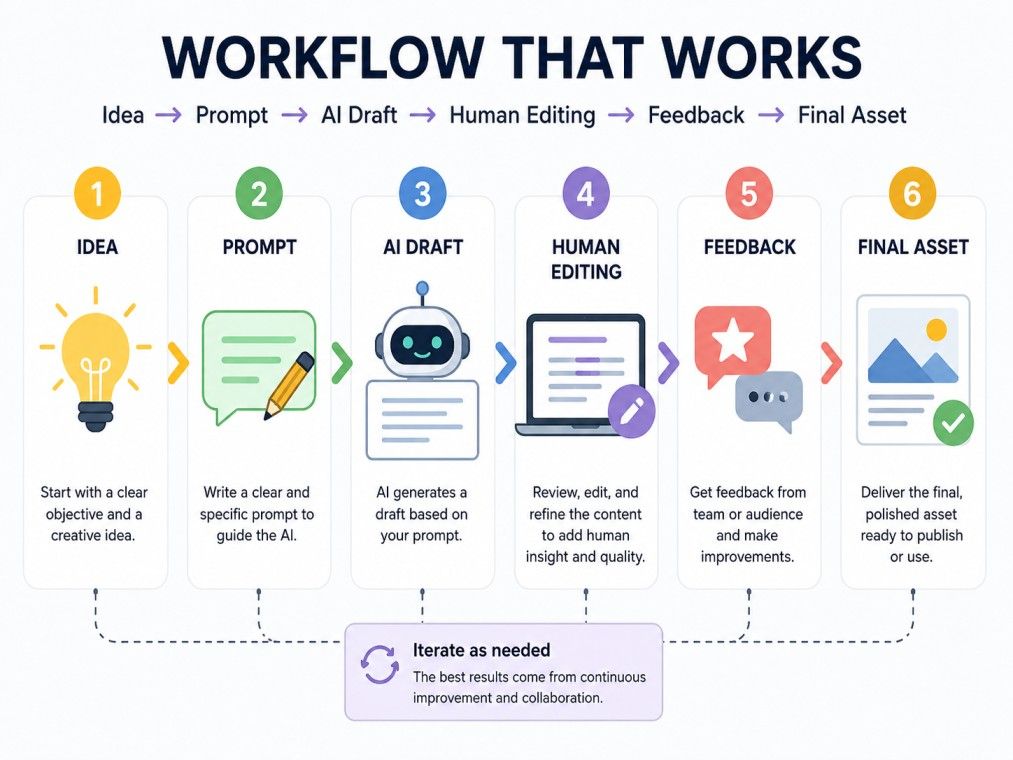
Artificial intelligence creativity has already changed how ideas are generated, refined, and shared. It helps creators overcome blank pages, explore more possibilities, and complete repetitive work faster. Yet creativity is still deeply human.
AI doesn't understand emotion, intention, or lived experience. It recognizes patterns and generates possibilities. Humans give those possibilities meaning, purpose, and context.
The future of creative work won't belong to AI alone. It will belong to people who know how to combine artificial intelligence creativity with their own expertise, curiosity, and imagination.
Ready to start your journey? Book a free consultation with upGrad today to find the best path for your career.
Prompt engineering helps AI produce more accurate, relevant, and creative outputs by providing clear instructions and context. Well-written prompts reduce generic responses, encourage better idea generation, and minimize editing time. As AI models evolve, prompt writing is becoming an essential skill for creators across industries.
Yes. Artificial intelligence creativity allows small businesses to create marketing content, product descriptions, social media posts, and design concepts without large creative teams.
Creative professionals use different AI tools depending on the task. ChatGPT and Claude assist with writing, Midjourney and Adobe Firefly generate images, while Runway supports AI-powered video editing. Choosing the right tool depends on your project, workflow, and creative goals rather than using one solution for everything.
Yes. AI is particularly effective during brainstorming because it quickly generates multiple ideas, alternative headlines, campaign concepts, and content angles. Instead of replacing human thinking, it expands the range of possibilities, helping teams overcome creative blocks and discover ideas they may not have considered initially.
Absolutely. Students can use AI to organize ideas, summarize research, draft presentations, and practice creative writing. Educators can generate quizzes, lesson plans, and teaching resources more efficiently. However, AI should support learning rather than replace critical thinking, research skills, or original work.
Yes, but only when it provides genuine value and includes meaningful human input. Search engines prioritize helpful, original, and trustworthy content over how it was created. AI-generated drafts should always be reviewed, fact-checked, and improved with unique insights before publication.
Businesses typically evaluate AI-assisted creative work using metrics such as engagement, conversion rates, click-through rates, customer feedback, and production time. While AI can improve efficiency, success ultimately depends on whether the content achieves business goals and connects with the intended audience.
No. AI is changing creative roles rather than eliminating them. Professionals are increasingly responsible for strategy, storytelling, brand direction, editing, and quality control, while AI handles repetitive production tasks. Many organizations now view AI as a collaborative tool instead of a replacement for creative talent.
Start with detailed prompts, then rewrite the output using your own voice and expertise. Adding personal experiences, industry knowledge, examples, and fact-checking improves authenticity. Human editing remains essential because AI-generated content often lacks context, emotional depth, and natural conversational flow.
Future challenges include evolving copyright laws, transparency requirements, responsible AI regulations, and concerns about overreliance on machine-generated ideas. Researchers also caution that excessive dependence on AI could encourage more similar outputs unless creators actively contribute original thinking.
Artificial intelligence creativity is expected to become more personalized, multimodal, and collaborative, supporting text, images, audio, video, and interactive content from a single workflow. Rather than replacing human imagination, future AI will likely act as an intelligent creative partner that enhances productivity while leaving strategic and emotional decisions to people.
980 articles published
We are an online education platform providing industry-relevant programs for professionals, designed and delivered in collaboration with world-class faculty and businesses. Merging the latest technolo...
Speak with AI & ML expert
By submitting, I accept the T&C and
Privacy Policy
Top Resources
Master's Degree
18 Months
Executive Diploma
12 Months
IIIT Bangalore
Executive Programme in Generative AI & Agentic AI for LeadersIndia’s #1 Tech University
Dual Certification
5 Months