Agentic Automation: How AI Agents Are Transforming Work
By Sriram
Updated on Aug 14, 2026 | 6 min read | 2.23K+ views
Share:

All courses
Certifications
More
By Sriram
Updated on Aug 14, 2026 | 6 min read | 2.23K+ views
Share:
Table of Contents
Agentic automation is changing the way companies do things. It is different from the way of automating work which just follows rules. Agentic automation uses intelligence to understand what needs to be done to make choices adjust to new things and finish tasks without people having to do much. It uses intelligence and machine learning and workflow automation to do things that people used to think about.
In this guide, you'll learn what agentic automation is, how it works, how it differs from conventional automation, and where organizations are using it today. You'll also see real life examples, understand its benefits and limitations, and learn why a lot of experts think agentic automation is the next big thing in automation, for big companies.
Agentic automation is redefining job roles. Get ahead of the shift with upGrad's industry aligned Agentic AI Courses Online.
Agentic AI Courses to upskill
Explore Agentic AI Courses for Career Progression
IIIT Bangalore
Executive Diploma in Machine Learning and AI360° Career Support
Agentic automation is about using artificial intelligence to make things happen on its own. This kind of automation uses AI agents that can think ahead to make choices and do things to reach a specific goal.
The old way of doing automation is great for jobs that're the same every time. It has trouble when things change or something unexpected happens. Agentic automation helps with this problem by giving AI systems freedom to make decisions.
Think about asking a computer helper to do something like this:
"Look at all the complaints we got from customers today figure out which ones are really important send them to the people write back, to the customers and give me a quick summary."
AI does not just do one thing; it breaks the request into multiple steps to help with customer complaints. The AI is using automation to make the whole process easier.
Feature |
Traditional Automation |
Agentic Automation |
| Decision making | Rule-based | AI-driven reasoning |
| Adaptability | Low | High |
| Learns from data | Limited | Yes |
| Handles uncertainty | Poorly | Much better |
| Multi-step execution | Limited | Excellent |
Also Read: Agentic Workflows: A Guide to AI-Powered Autonomous Execution
AI capabilities work together to help the automation system figure out what the automation system needs to do and how the automation system should do it.
Agentic systems usually have a lot of artificial intelligence capabilities.
Let us say an online store gets an email from a customer who wants their money back.
Of sending this email to a person who handles customer support a computer system that uses artificial intelligence can do some things with this email, such, as:
Every action happens with minimal human involvement while following company policies.
The difference is why companies are investing money into Artificial Intelligence agents instead of just using the old way of robotic process automation.
Many people confuse these approaches, but they solve different problems.
Rule-Based Automation |
Agentic Automation |
| Follows predefined steps | Chooses the best path |
| Works best for repetitive tasks | Handles dynamic workflows |
| Needs frequent manual updates | Adapts using AI |
| Limited flexibility | High flexibility |
| Low reasoning capability | Advanced reasoning |
Also Read: Agentic AI Learning Path: A Complete Guide for Developers and AI Professionals
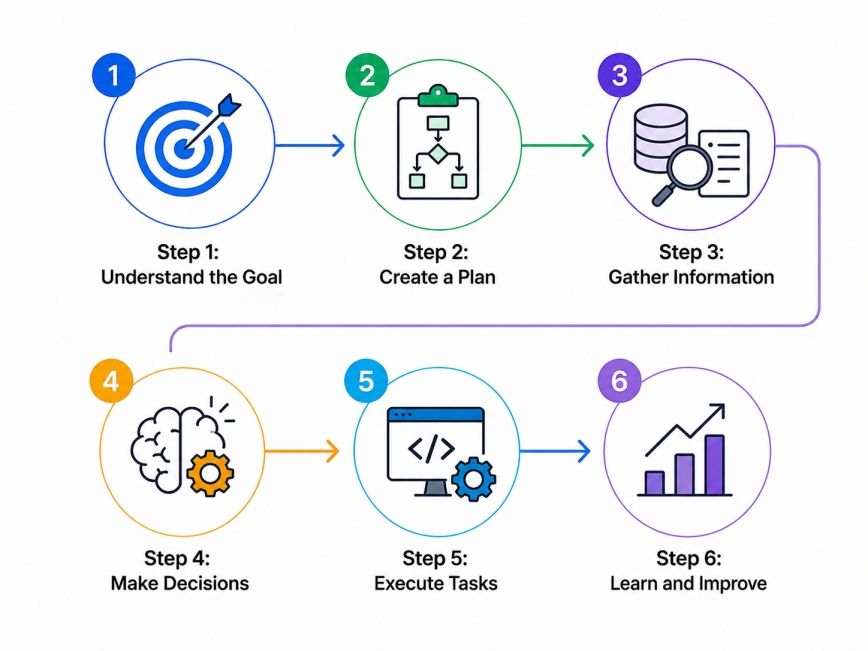
Understanding how things work with this technology helps explain why it feels different from the automation tools.
It does not just do one thing and then another thing. Agentic automation follows a process that is focused on achieving a goal.
Things begin with someone making a request. The artificial intelligence system figures out what the person wants to achieve. We do not need to create a lot of rules for it to follow.
Examples include:
This planning stage is what separates agentic systems from basic automation. The AI divides the objective into smaller tasks.
For example, preparing a sales report might involve:
The artificial intelligence system gets all the information from the systems it is connected to before it does anything.
This means the artificial intelligence system can make decisions based on what's happening now using the latest information instead of following old rules that may not be relevant anymore.
These may include:
This is where intelligence becomes valuable. The AI evaluates available information before choosing the next action. These choices happen dynamically rather than through rigid if-then logic.
For example:
Once decisions are made, the AI performs actions automatically.
Examples include:
Many modern systems keep track of results, and they use the feedback to do next time. This helps them perform better in the future.
While not every implementation continuously retrains itself, organizations can refine prompts, workflows, and decision policies over time to improve accuracy and efficiency.
An automic agent (often intended as autonomic or autonomous agent) is an AI system that performs tasks with limited human intervention. In an agentic automation environment, multiple agents may collaborate to complete complex workflows.
This collaborative model helps organizations to automate that once needed many employees or different departments.
For example:
AI Agent |
Responsibility |
| Research Agent | Collects information |
| Analysis Agent | Evaluates data |
| Planning Agent | Creates workflows |
| Communication Agent | Sends updates |
| Monitoring Agent | Tracks performance |
Also Read: Open Source AI Agents: A Complete Guide to Autonomous AI Systems
People often ask, can testing be done by machines? The truth is that we still need human experts to figure out how to test things to make sure the tests are what the business needs and look at the testing results to see if they make sense. Testing that is automated by agents works well when it helps skilled professionals do their job rather than trying to do the whole job for them. Agents can do the testing. We still need humans to make sure the testing is done correctly and that the results of the testing are good.
Increasingly, the answer is yes.
AI agents can:
Also Read: Artificial Intelligence in Software Testing: Transforming Quality Assurance
When companies handle a lot of data and complicated workflows, they need something than just simple automation rules. Agentic automation is a way because it lets artificial intelligence agents understand what needs to be done to make choices and adjust to new situations. This type of automation does not just do one task; it can handle a process and respond to new information as it happens.
The best thing about automation is that it saves employees time by doing repetitive work so they can focus on things that need creative thinking, planning, or decision making. Agentic automation does not replace people; it helps them by taking care of tasks so employees can use their skills and expertise for more important things.
Also Read: AI Automation Explained: Tools, Benefits, and How It Differs From Automation
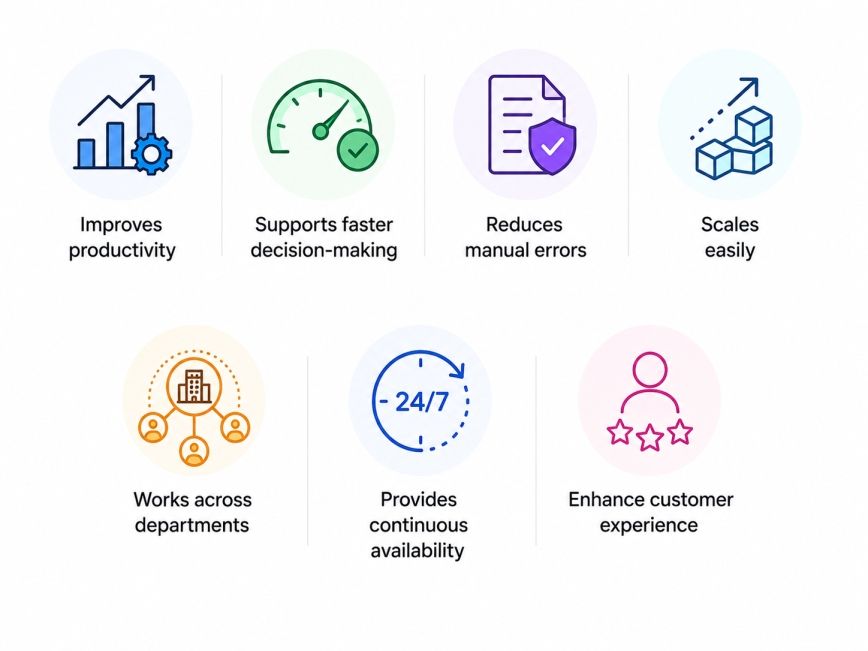
Here are some of the biggest advantages businesses gain from adopting agentic automation:
When companies start using Artificial Intelligence, it is usually an idea to begin with one simple process that they want to improve. This works a lot better than trying to automate everything in the company at once from the very beginning.
Organizations usually see the greatest return when processes:
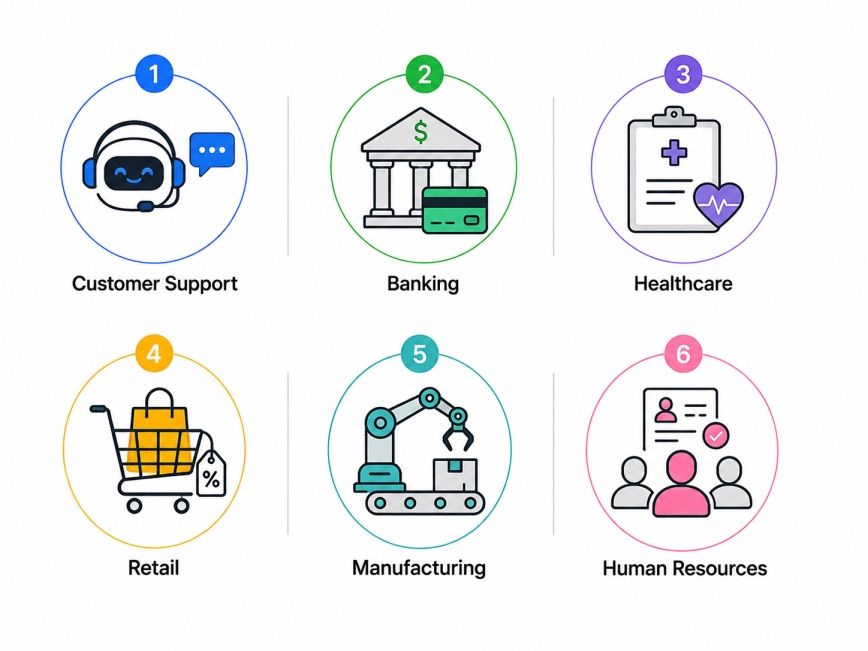
The value of automation is clear when used for real business problems. Across industries organizations use AI agents to make operations smoother, improve customer experiences and cut down on work.
These common uses show that agentic automation isn't just for one department.
Industry |
Example Use Case |
| Customer Support | Resolve common support tickets and escalate complex issues. |
| Banking | Detect fraud, verify documents, and process loan applications. |
| Healthcare | Schedule appointments, summarize medical records, and assist administrative staff. |
| Retail | Manage inventory, forecast demand, and personalize recommendations. |
| Manufacturing | Monitor equipment, predict maintenance needs, and optimize production schedules. |
| Human Resources | Screen resumes, coordinate interviews, and onboard new employees. |
Also Read: Agentic AI Use Cases: Real Applications
Artificial Intelligence technology is good. It needs to be planned carefully to work well.
Organizations should use Artificial Intelligence agents as tools that help people not as machines that make all the decisions on their own in areas, like finance and healthcare where there are a lot of rules to follow.
Some common challenges include:
Also Read: Agentic AI Solutions: How Autonomous AI Systems Are Transforming Business Operations
Businesses continue asking, can testing be automated by agents as software systems become more complex. Indeed, businesses can improve results by following a structured approach.
Industry experts think AI agents will get independent, aware of their surroundings and able to work well with others in the coming years. These AI systems will not replace workers but become digital helpers that do boring tasks so people can think about big plans, new ideas and building strong relationships with others.
Agentic automation represents a significant step beyond traditional automation. By combining AI reasoning, planning, and execution, it enables systems to complete complex workflows with minimal human intervention while adapting to changing conditions. As AI technology evolves, organizations that learn how to work alongside intelligent agents rather than simply automate individual tasks will gain the greatest long-term advantage.
Companies that focus on making rules using AI in a responsible way and helping their workers learn new skills now will be, in a better place to take advantage of this change.
Want to explore more about management accounting? Book your free 1:1 personal consultation with our expert today.
Agentic automation refers to AI-powered automation in which intelligent software agents can understand goals, make decisions, plan actions, and complete tasks with minimal human intervention. Unlike traditional automation, it adapts to changing situations and manages complex workflows instead of following only predefined rules.
Traditional automation performs tasks according to fixed rules and predefined workflows. Agentic automation adds AI reasoning, allowing software agents to interpret objectives, adjust their actions, and respond to new information. This makes it suitable for dynamic business processes where flexibility is important.
An automic agent generally refers to an autonomous AI agent capable of completing assigned tasks independently. These agents gather information, analyze data, make decisions, and interact with software systems to achieve specific business goals while requiring only limited human supervision.
Yes. Many modern software teams use AI agents to generate test cases, execute regression tests, detect anomalies, analyze logs, and prioritize failures. While AI improves speed and efficiency, experienced testers remain responsible for validating business requirements and reviewing critical scenarios.
Industries such as healthcare, banking, retail, manufacturing, customer service, logistics, and human resources are already adopting agentic automation. Any organization with repetitive, data-driven, or multi-step workflows can improve efficiency by using intelligent AI agents alongside human employees.
In most cases, no. Agentic automation is designed to support employees by handling repetitive and time-consuming tasks. Human professionals continue to provide judgment, creativity, ethical oversight, and strategic decision-making where AI should not operate independently.
Agentic automation combines several technologies, including large language models (LLMs), machine learning, workflow orchestration platforms, APIs, knowledge bases, and business software integrations. Together, these technologies enable AI agents to understand requests, plan actions, and execute workflows effectively.
Yes. Small businesses can begin with a single workflow, such as customer support, invoice processing, or appointment scheduling. Starting with a focused implementation allows organizations to measure business value before expanding agentic automation across multiple departments.
Organizations commonly face challenges related to data privacy, system integration, AI governance, model accuracy, and change management. Successful implementation requires clear business objectives, continuous monitoring, human oversight, and regular updates to AI workflows and policies.
Businesses should identify repetitive workflows, improve data quality, train employees on AI tools, establish governance policies, and begin with small pilot projects. Measuring outcomes and continuously refining processes helps organizations scale agentic automation successfully over time.
The future of agentic automation lies in increasingly collaborative AI agents that can coordinate tasks across multiple business systems. As AI becomes more context-aware and reliable, organizations are expected to use intelligent agents as digital teammates that enhance productivity while keeping humans involved in critical decisions.
Learning Agentic AI can help you move beyond basic automation by building skills in AI agents, autonomous workflows, task orchestration, and intelligent decision-making. With upGrad’s Agentic AI programs, you can apply these skills to real-world use cases and prepare for emerging AI and automation roles.
730 articles published
Sriram K is a Senior SEO Executive with a B.Tech in Information Technology from Dr. M.G.R. Educational and Research Institute, Chennai. With over a decade of experience in digital marketing, he specia...
Speak with AI & ML expert
By submitting, I accept the T&C and
Privacy Policy