Generative AI Assistants: How Are They Transforming Today
By Sriram
Updated on Jun 19, 2026 | 9 min read | 2.53K+ views
Share:

All courses
Certifications
More
By Sriram
Updated on Jun 19, 2026 | 9 min read | 2.53K+ views
Share:
Table of Contents
Generative AI assistants are changing the way people do their work, learning things, creating, and solving problems. They can do multitasks like writing emails, coding, answering questions, and analyzing documents. These AI tools are becoming a part of daily life for students, professionals, and businesses.
As generative AI gets better, their assistance is more than chatting. They can understand, remember, then create, can also perform tasks automatically and help in faster decision making. This technological shift is making them one of the most important applications of AI today.
In this blog, you will learn about AI assistants, how it works, benefits, risks, examples, and the best tools you can use today.
Master the tech behind today's smartest tools. Explore Agentic AI Courses Online from upGrad and learn how AI assistants actually think and act.
Generative AI Courses to upskill
Explore Generative AI Courses for Career Progression
IIIT Bangalore
Executive Diploma in Machine Learning and AI360° Career Support
Generative AI assistants are a type of software tool that is powered by large language models (LLMs) and other AI computers that can understand human instructions and provide human-like responses.
Generative AI assistants are different from the traditional chatbots that just follow instructions. Generative AI assistants can create content from scratch, summarize data, and answer hard questions, write computer code, analyze data, and help in making choices.
Some well-known examples include:
Read: Generative AI for Beginners: A Practical Guide to Understanding Modern AI
Feature |
Traditional Chatbots |
Generative AI Assistants |
| Responses | Predefined | Dynamically generated |
| Flexibility | Limited | High |
| Learning Context | Minimal | Strong contextual understanding |
| Content Creation | No | Yes |
| Complex Problem Solving | Limited | Advanced |
Also Read: Difference between AI Assistant and ChatBot
Recent studies have found that companies started adopting AI more. According to McKinsey research in 2024, 65% of companies are now using generative AI daily, for at least one business function. This is a double jump from the year before.
Generative AI assistants typically offer:
Imagine you are getting ready to give a presentation.
Instead of spending a lot of time finding information, writing slides and creating summaries, a generative AI assistant can:
Also Read: Generative AI Fundamentals: A Practical Guide to Understanding How Modern AI Works
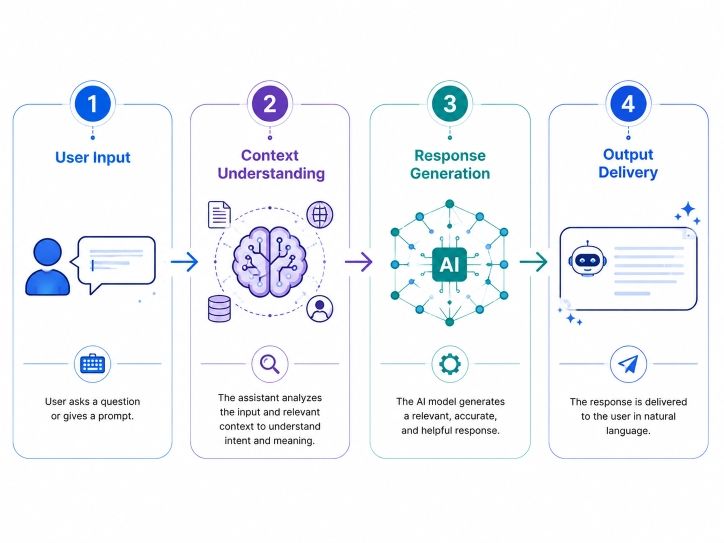
At the heart of every AI assistant is a large language model which is trained on large amounts of data. This data includes books, articles, websites, code, and other kinds of information.
These models figure out patterns in language and use those patterns to generate responses, and it gets better at this over time.
Step 1: User Input
A user enters a prompt such as: "Write a project proposal for a software development company."
Step 2: Context Understanding
The assistant analyzes:
Step 3: Response Generation
The model predicts the most relevant response based on its training and context.
Step 4: Output Delivery
The assistant provides:
Technology |
Purpose |
| Large Language Models | Language understanding and generation |
| Natural Language Processing | Understanding user input |
| Machine Learning | Pattern recognition |
| Retrieval Systems | Accessing external knowledge |
| Multimodal AI | Processing text, images, audio, and video |
The modern generative AI assistants can remember past chats thus their pattern of responds is adjusted according to the context in interactions. This means the assistant understands the ongoing discussion.
For example:
A user can ask:
The AI system does not think like humans; they predict what people are likely to say based on the information they learned and that is how they are trained.
Nevertheless, Generative AI assistants have achieved a milestone that they can almost simulate human-like conversation, because they:
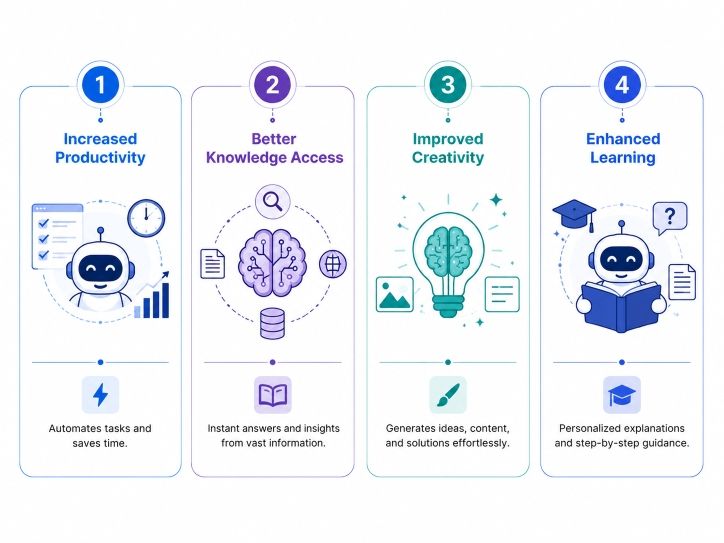
The rapid usage of generative AI assistants is influenced by one simple factor: productivity.
A generative AI Assistant is a tool that helps people complete their tasks faster and at the same time it reduces the boring task of work.
Generative AI assistants can automate time-consuming tasks such as:
Instead of searching through multiple documents, users can ask direct questions and receive summarized answers.
AI can generate:
Students use generative AI assistants to:
Industry |
Use Case |
| Education | Tutoring and study assistance |
| Marketing | Content creation |
| Customer Support | Automated responses |
| Software Development | Code generation |
| Healthcare | Documentation support |
| HR | Resume screening and communication |
| Finance | Report summarization |
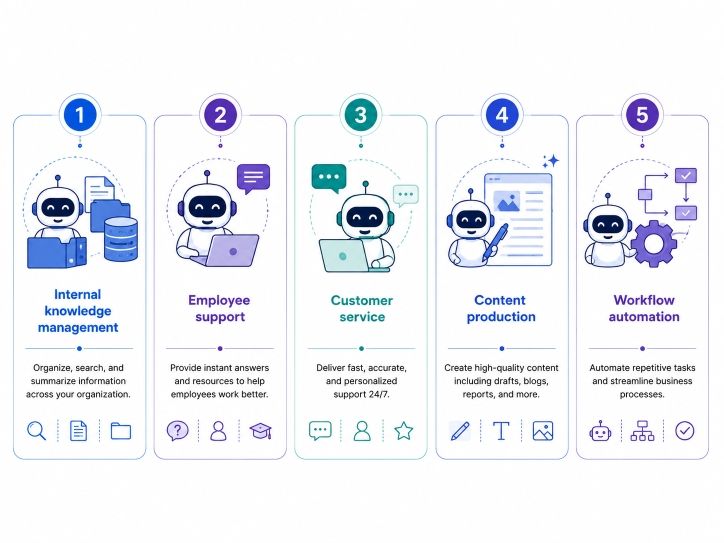
Organizations increasingly use generative AI assistants for:
Also Read: Generative AI for Business: Benefits, Use Cases, Challenges, and Future Trends
Utilizing AI assistant gives you ample time to focus on what really matters, like relationship building and revenue generation.
A sales team can use a generative AI assistant to:
Also Read: Generative AI Examples: Real-World Applications Explained
Generative AI assistants offer significant benefits, but they are not perfect and understanding their weakness only benefits the users in implementing them effectively.
AI models may occasionally generate inaccurate or fabricated information.
This is one of the most discussed risks associated with generative AI assistants.
Users should always verify:
Organizations must carefully manage:
Since models learn from existing data biases in the training, datasets can affect the responses.
Generative AI assistants work well when people are also involved in the decision. These AI assistants should help people make decisions rather than make decisions for us.
Generative AI assistants have quickly evolved from experimental tools into practical solutions used across education, business, healthcare, marketing, software development, and customer service. Yet, successful adoption requires responsible use.
Human oversight, fact checking, privacy protection, and critical thinking remain essential. As technology continues to advance, generative AI assistants will play an increasingly important role in how people work, learn, and create. Understanding how they function today is the first step toward using them effectively tomorrow.
Want to explore more about Generative AI assistants? Book your free 1:1 personal consultation with our expert today.
Generative AI assistants are AI-powered tools that understand natural language and generate responses, content, summaries, recommendations, or solutions. Unlike traditional chatbots, they can create original outputs and handle a wide range of tasks across different domains.
Some of the most widely used AI assistants today include ChatGPT, Microsoft Copilot, Claude, Google Gemini, and Perplexity. Each tool offers different strengths, ranging from content creation and coding support to research assistance and workplace productivity.
Generative AI assistants use large language models trained on vast amounts of data. They analyze user prompts, understand context, predict relevant responses, and generate outputs that resemble human-written content while adapting to different tasks.
Many generative AI assistants offer free versions with limited capabilities. Premium plans usually provide access to more advanced models, faster performance, higher usage limits, and additional features such as file analysis and workflow automation.
Generative AI assistants are designed to support people rather than completely replace them. They excel at repetitive and information-heavy tasks, while humans remain essential for creativity, strategic thinking, judgment, and relationship management.
Industries such as education, healthcare, software development, marketing, finance, customer service, and human resources are already seeing benefits. These tools help improve efficiency, reduce manual work, and accelerate knowledge sharing.
They can be safe when organizations establish clear governance policies. Businesses should review privacy controls, protect sensitive data, monitor outputs, and ensure employees follow responsible AI usage practices.
Yes. Many modern assistants can generate code snippets, explain programming concepts, identify bugs, and help developers build applications. However, human review remains important to ensure code quality, security, and correctness.
AI assistants mainly respond to user requests and provide support. AI agents go a step further by taking actions independently, executing workflows, and completing tasks with minimal human intervention based on defined goals.
Accuracy varies depending on the model, data sources, and task complexity. They often provide useful responses but can occasionally generate incorrect information. Factchecking remains necessary for important decisions and professional work.
Yes. Future generative AI assistants are expected to offer stronger reasoning, improved personalization, better memory, deeper workflow integration, and more reliable outputs. These advancements will expand their role across personal and professional environments.
730 articles published
Sriram K is a Senior SEO Executive with a B.Tech in Information Technology from Dr. M.G.R. Educational and Research Institute, Chennai. With over a decade of experience in digital marketing, he specia...
Speak with AI & ML expert
By submitting, I accept the T&C and
Privacy Policy